Commercial Real Estate CRM Platforms Compared
Pick Salesforce if your brokerage already uses it and can afford months of customization.
The right CRM for a commercial real estate team is not the most powerful one available. It is the one whose data model matches how your team actually tracks deals. That distinction sounds obvious until you watch a brokerage spend six months and five figures customizing Salesforce, only to have brokers revert to a shared spreadsheet because the system still doesn't understand what a stacking plan is.
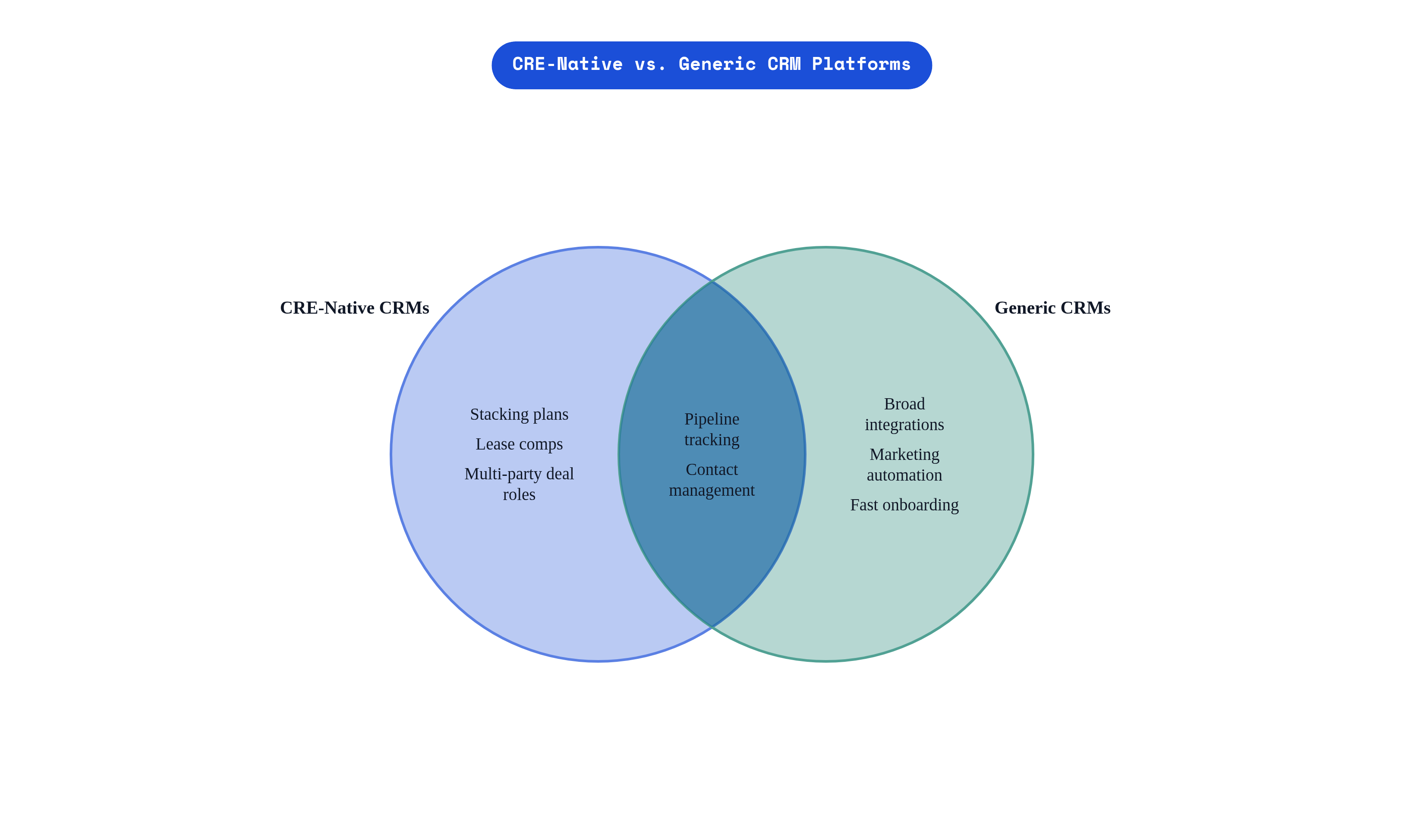
Generic CRMs are built around a simple architecture: contact, company, deal, close. That model works reasonably well for a residential transaction, which typically involves a buyer, a seller, and a closing date. A commercial deal is a different animal entirely. A single transaction can involve investors, tenants, landlords, brokers on both sides, lenders, attorneys, and property managers, all operating on different timelines and with different information needs. The data model required to track that deal simultaneously, at the property level, across multiple parties, with lease comps and CA status and LOI history attached, doesn't exist natively in most platforms. You either buy a system that was built for it, or you spend considerable time and money retrofitting one that wasn't.
That gap, a missing data model rather than a missing feature, is the lens through which every platform in this comparison should be evaluated.
How Different CRE Team Types Actually Use a CRM
Before comparing platforms, it is worth asking which team type you are, because the answer changes the evaluation criteria substantially.
Four archetypes show up repeatedly across the CRE landscape. Landlord rep teams care most about prospect tracking at the property level: who viewed a listing, who submitted an inquiry, which prospects are warming. They are less concerned with a generic pipeline and more concerned with visibility into activity around specific assets. Investment sales teams have entirely different priorities: they need rigorous deal tracking, confidentiality agreement management, buyer relationship history, and transaction reporting that holds up under scrutiny from principals.
National brokerages sit in a different category altogether. They need deep customization, strict permissions by market and practice group, reporting governance, and integration with enterprise systems that already exist. A platform that can't support role-based data access at scale is not a serious candidate. And then there are small teams, who need something clean and fast: contacts, notes, follow-up tasks, and active deals, without requiring a dedicated CRM administrator to keep it functional.
The evaluation criteria that follow logically from this segmentation are:
Deal-tracking depth. How granular can the pipeline get? Can it track CA status, LOIs, and multi-party roles simultaneously?
Relationship intelligence. Does the system surface who knows whom, relationship strength, and communication history without requiring brokers to log everything manually?
Pipeline visibility. Can leadership view deal flow by property, by broker, by stage, or only by contact?
Property data model. Do properties, leases, comps, and stacking plans live natively in the system, or are they shoehorned into generic objects?
Time-to-value. How long before the team is actually using it, not just paying for it?
These five criteria are the framework. Each platform below is worth evaluating against whichever two or three criteria matter most to your team type.
The Market These Platforms Are Competing In
The CRE CRM market is not a niche. Estimated at $2.5 billion in 2025 and projected to reach $7 billion by 2033 at a roughly 12% compound annual growth rate, it is among the faster-growing segments of the broader PropTech space. Over 60% of real estate companies have integrated CRM software, and adoption of cloud-based solutions has accelerated meaningfully as firms seek centralized data and workflow automation.
That said, adoption isn't uniform. Limited IT infrastructure in a significant portion of small enterprises restricts full-feature utilization, which is relevant context for why platform complexity is not a neutral variable. A system a team can't actually operate is worse than a simpler one they use consistently.
North America accounts for the largest share of the global real estate CRM market, with regional revenues of $1.44 billion reported for 2025. This is where the competitive dynamics among the platforms below play out most intensely, and where vendor investment in new features and pricing adjustments is most active. The practical implication: confirm pricing and features directly with vendors before purchasing. The figures in this article reflect publicly available information as of early 2026, but this category is moving.
Salesforce: Maximum Flexibility, Maximum Commitment
Salesforce has been ranked the number one CRM provider by IDC for twelve consecutive years, and roughly 90% of Fortune 500 companies use it. Those numbers are real, and they matter for CRE firms that need enterprise-grade integration with existing systems, compliance infrastructure, and the confidence that the platform will exist in five years.
What Salesforce does well in a CRE context is considerable. It handles automatic call and meeting summaries, generative AI for drafting emails and contracts, and integrated customer profiles across systems. Its Agentforce offering, rebranded as part of a broader AI push in 2024, deploys autonomous agents that can qualify leads around the clock, schedule showings, and hand off warm prospects to brokers with full context attached. A February 2024 partnership with CoStar Group added property-level market data accessible directly inside Salesforce, which meaningfully shortens deal research cycles for teams that run CoStar data as part of their workflow.
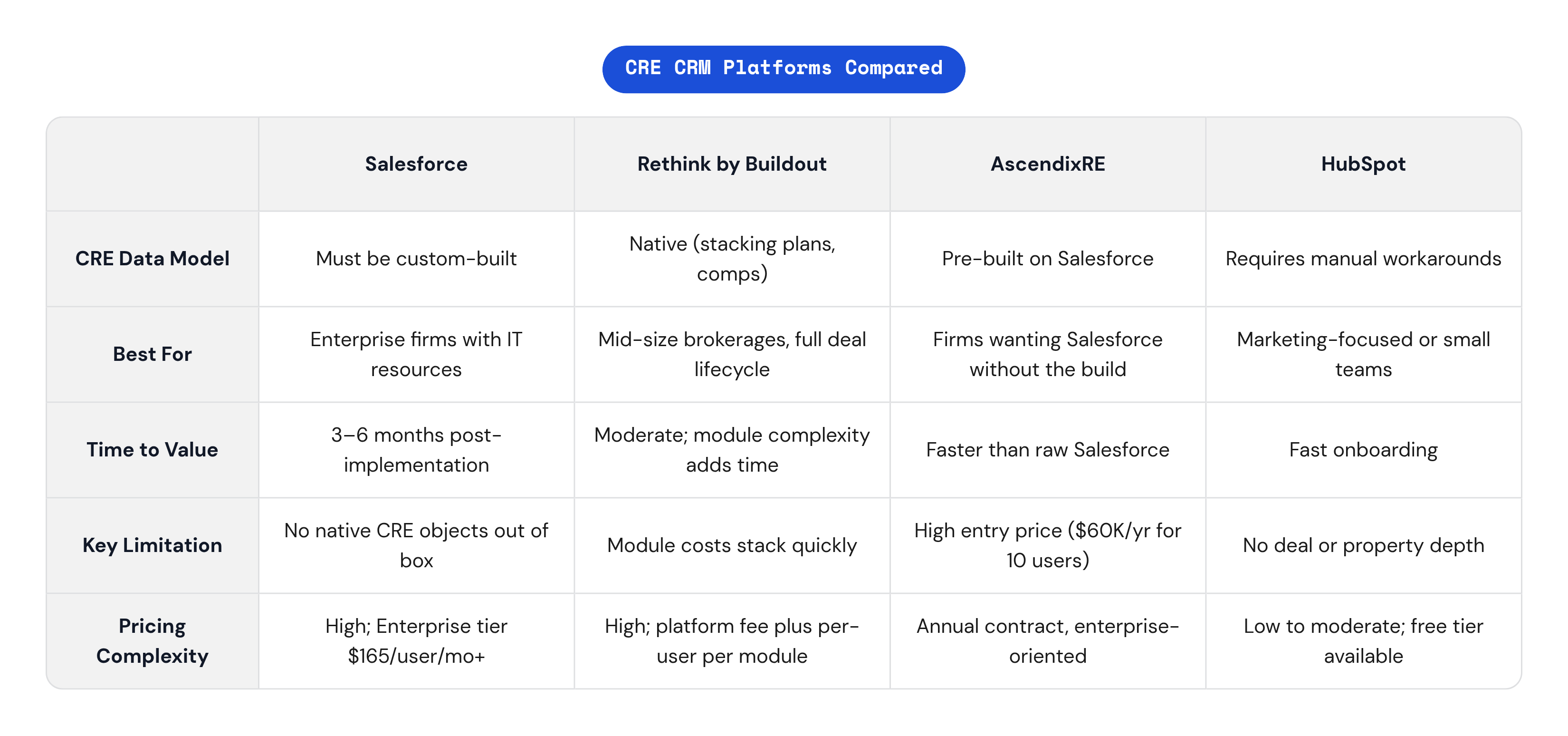
What it does not do, out of the box, is understand commercial real estate. No native stacking plans. No lease comps. No CRE-specific data model. You build those yourself, or you hire a consulting partner to build them for you. Enterprise implementations with heavy customization typically run three to six months before a team is fully operational.
Pricing reflects the enterprise orientation. Most CRE firms will need the Enterprise tier at $165 per user per month or the Unlimited tier at $330, since custom objects and workflow automation aren't available in lower tiers. That cost, multiplied by a mid-size brokerage's headcount, adds up before implementation fees are even considered.
The plain summary: Salesforce can do everything a CRE firm needs it to do. But "can do" requires resources to configure. The platform is raw material, not a finished product. For firms with internal CRM admin capacity and complex integration requirements, that tradeoff is worthwhile. For teams that need to be operational in weeks, it is not.
Buildout / Rethink by Buildout: Built by Brokers, Complicated to Price
Buildout is trusted by tens of thousands of CRE brokers nationwide, and that credibility is earned. Founded in 2010, the company has built its product around how brokers actually work rather than adapting a generic sales tool to fit CRE workflows. The platform history is worth knowing before evaluating it: Buildout acquired both Apto and Rethink CRM. Apto is no longer available to new customers and is maintained only for its existing base. Rethink by Buildout is the core CRM product going forward.
What Rethink offers is clearly differentiated. Property-level data, deal-specific pipelines, stacking plans, comp tracking: these live natively in the system. A broker doesn't need to explain to the platform what a lease comp is. Rethink+, the upgraded tier, embeds industry data and AI directly into the workflow, automating owner research and providing high-confidence contact information without leaving the CRM.
The broader Buildout ecosystem includes Showcase for marketing and listings, ProspectNow for property intelligence, and Manage & Close for commissions and deal workflows. The caveat worth stating plainly is that these modules were built by different companies at different times. Integration exists, but this is not seamless native architecture. Teams should evaluate each module's fit independently rather than assuming a unified experience.
Pricing, as of early 2026, is where complexity enters. Rethink CRM runs $129 per user per month; Rethink+ is $299. Manage & Close adds $85 per broker per month plus a $275 monthly platform fee. Showcase is $199 per broker per month with the same platform fee; Showcase+ adds $50 to that. The $275 monthly platform fee applies across most plans and stacks on top of per-user costs. For a mid-size team running multiple modules, total cost can rival enterprise alternatives that initially appeared far more expensive.
Noted criticisms include limited design flexibility due to template-based layouts and slower workflows for listing creation and updates. These are real friction points for teams that publish listings at volume.
Best fit: brokerages that want comps, commissions, and invoicing in a single source of truth without needing in-house Salesforce expertise. But model total cost across all modules before committing. The headline per-user price is rarely the actual number.
AscendixRE: Salesforce's Power With CRE Built In From the Start
AscendixRE occupies an interesting position in this market. It is a Salesforce-based product, meaning it inherits Salesforce's flexibility, reporting infrastructure, and enterprise integration capabilities. But the CRE-specific features, property and lease management, comp tracking, deal pipelines, stacking plans, are already built in rather than assembled through a custom implementation. The value proposition is essentially: skip the six-month build.
That proposition has become more defensible as AscendixRE has deepened its AI capabilities. The platform's AscendixDA framework handles AI lease abstraction. An AI Data Entry tool extracts and populates property information from emails, documents, and listing platforms. An AI Agent creates contact records and generates meeting notes without requiring the broker to leave the CRM. The AscendixRE AI Suite, launched in 2026, integrates Claude and ChatGPT to generate property emails, summarize deal notes, and surface CRM data insights in conversational form. The vendor claims automation saves brokers ten to fifteen hours per week on administrative tasks. That figure is worth interrogating against your team's actual workflow before treating it as a baseline assumption, but the direction of the impact is credible given the scope of what the tools automate.
Pricing is enterprise-oriented: the platform starts at $60,000 per year for ten users. A free version is available for smaller teams to evaluate the interface before committing. The cost structure makes most sense for teams where broker time is expensive and where administrative overhead is a documented, recurring cost.
The counterargument — that paying for Salesforce's infrastructure plus AscendixRE's CRE layer is redundant complexity — assumes the alternative is a clean, cost-efficient custom Salesforce build. In practice, the alternative is usually a multi-month engagement with an implementation partner and ongoing admin costs that are less visible but equally real.
Best fit: mid-to-large CRE firms that want Salesforce's flexibility without building the CRE data model from scratch, and where cost per user is offset by time savings at scale.
HubSpot: Strong Marketing Automation, Limited CRE Depth
HubSpot combines CRM, marketing automation, sales tools, content management, and reporting in one platform, and it does several of those things very well. For CRE teams whose primary need is running property campaigns, nurturing prospect lists, and managing lead capture across multiple listings, HubSpot's email sequencing, automation workflows, and intuitive UI are attractive. The free tier lowers the barrier to entry for small teams evaluating a first CRM, and onboarding is fast relative to Salesforce or even Buildout.
That is about where the CRE-specific case for HubSpot ends. There is no native CRE data model. Properties, leases, stacking plans, and comp tracking all require workarounds using custom objects, which is exactly the kind of manual configuration that diminishes time-to-value. The deal pipeline is architected around a generic B2B sales process and doesn't natively support multi-party CRE deal structures. Relationship intelligence is basic: there is no network-mapping or relationship-strength scoring of the kind investment sales teams rely on to prioritize outreach.
That raises an important question: is that a disqualifier, or simply a scoping issue? The answer depends on what problem you are actually trying to solve. HubSpot works well as a marketing layer. It works less well as the only system. Teams evaluating it should be clear about whether their primary need is contact and marketing workflow or deal and property tracking. Those are meaningfully different problems, and conflating them in a platform selection leads to a system that handles neither particularly well.
Best fit: CRE marketing functions, property campaigns, lead nurturing, prospect communications, often alongside a CRE-native system handling deal and property data.
What the Platforms Above Don't Address: Content and Outreach at Scale
Every platform reviewed in this article handles contact records, pipelines, and property data in some form. None of them is built to produce the outreach, property narratives, or market commentary that actually moves deals forward. That gap is worth naming explicitly because it tends to get absorbed into vague complaints about CRM adoption rather than recognized as a distinct operational problem.
CRE brokers spend significant time producing content that CRMs don't generate: property offering memorandums, broker opinion of value summaries, prospect emails, market update newsletters. A CRM tells you who to contact and when. It does not help you say something worth reading when you reach them.
For marketing leaders at brokerages running campaigns across multiple listings or markets, the bottleneck often isn't data. It is on-brand content produced fast enough to be timely. A system that knows a prospect toured a building two weeks ago is only as useful as the email you send them afterward.
Strategy-first content platforms that pair AI generation with editorial quality fill this gap: producing property emails, market updates, and campaign content in days rather than weeks, without sacrificing brand voice. The practical workflow separates cleanly. The CRM handles relationship and deal data. A dedicated content platform handles the output those relationships require. The two systems complement each other rather than one replacing the other, and teams that try to solve the content problem inside their CRM typically end up with neither function working particularly well.
Matching Platform to Team Type: A Decision Framework
The selection logic, when the criteria above are applied consistently, produces reasonably clear recommendations.
Large enterprise brokerages and owner/operators with internal IT resources should evaluate Salesforce directly or through AscendixRE. Salesforce offers maximum flexibility and enterprise integration; AscendixRE shortens time-to-value by delivering the CRE data model pre-built, which is worth the premium if the alternative is a multi-month custom implementation.
Mid-size brokerages that want CRE-native capability without Salesforce complexity should take a serious look at Rethink by Buildout. Stacking plans, comps, commissions, and deal tracking are native. But model the full cost across all modules before signing. Platform fees plus per-user costs across Rethink, Showcase, and Manage & Close can rival enterprise alternatives that initially appeared out of reach.
Small teams and landlord rep groups prioritizing marketing workflow over deal depth should consider HubSpot for its fast onboarding and strong lead nurturing, with clear-eyed acceptance of the tradeoff: CRE-specific data structures will need to be built manually, or HubSpot will need to sit alongside a purpose-built tool.
Before committing to any platform, every team should work through a short set of diagnostic questions. How many people will actively use the system, and what is the realistic total cost per user across all required modules? What does your team's deal data actually look like: how many parties, how many properties, what document types need to live in the system? Who owns the CRM internally, and do they have the capacity to configure and maintain a complex platform? And critically: what is the cost of the administrative time the platform is supposed to save, and does the pricing justify it at your team's scale?
The answers to those questions narrow the field faster than any feature checklist. The best CRM for a CRE team is not the one with the most capabilities. It is the one whose capabilities align with the problems your team actually has, implemented well enough that brokers use it without being asked.