Agent Productivity Tools Built Into Brokerage CRMs
Most brokerages CRMs now bundle productivity tools agents used to buy separately.

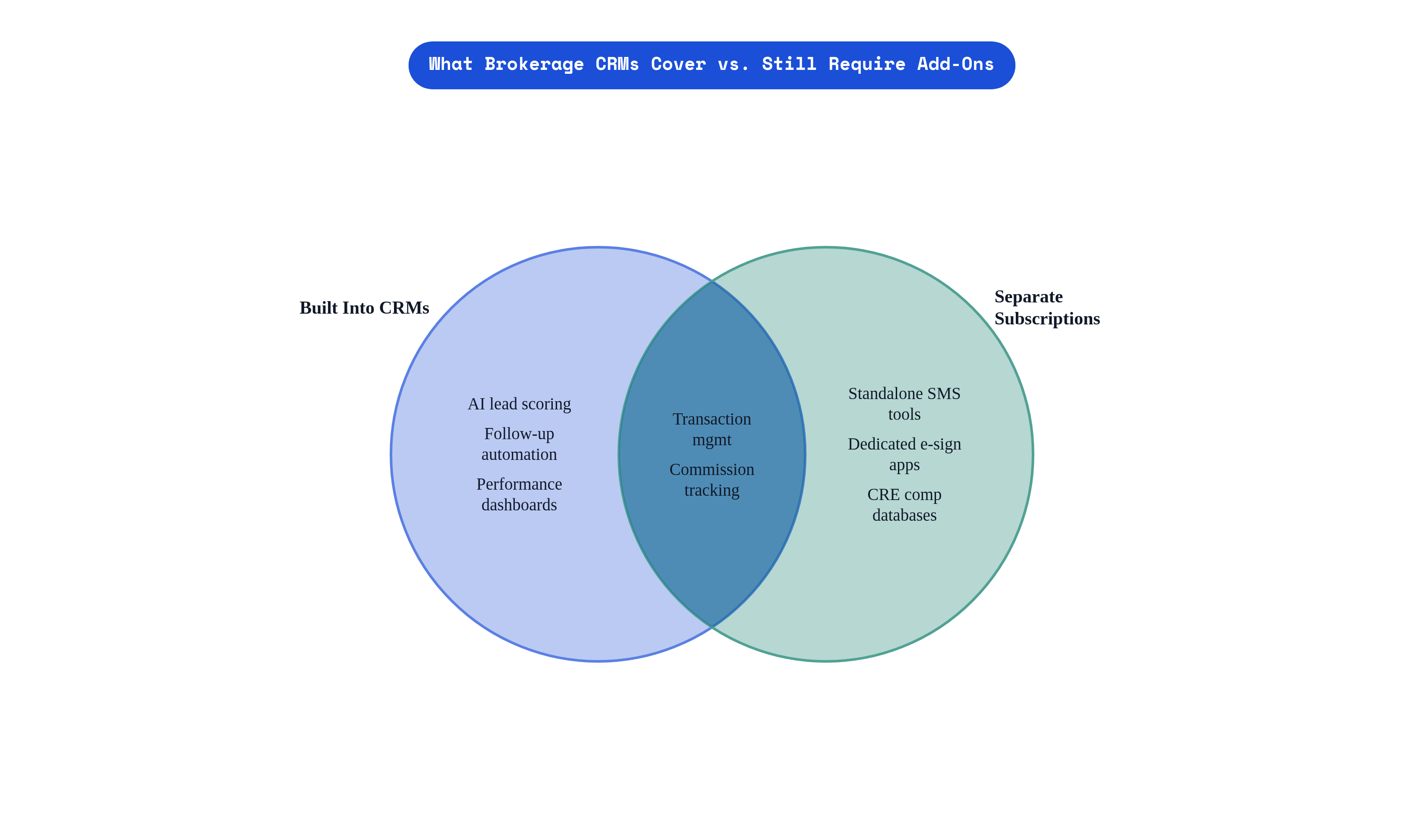
Brokerage CRMs have quietly turned into full productivity suites, absorbing the follow-up tools, transaction platforms, and commission trackers agents used to buy on their own. This piece walks through which categories the CRM has actually swallowed, which ones still need a second subscription, and how agents should think about the difference.
The numbers make the gap obvious before you even open a spreadsheet. NAR's 2025 Technology Survey, which polled a large sample of active Realtors, found CRM adoption spans the large majority of agents, yet the biggest chunk of them still spend tens to hundreds of dollars a month out of pocket on other tech tools. That's real money leaking out of an agent's pocket every month, and agents are paying twice: once through the brokerage for a CRM, and again on their own card for the stuff the CRM doesn't do.
Rechat put a number on the mess: agents at larger brokerages often juggle four separate vendor relationships, four logins, and four billing cycles for tools that never fully talk to each other. Four logins to do one job is a little like a game of Jenga, everybody quietly waiting to see whose piece falls out first and takes the tower with it. The question this piece keeps coming back to is simple: which brokerage CRMs have actually pulled those pieces out safely, and which ones still leave you holding the tower yourself?
What agents actually need productivity tools to do
Ask an agent why they adopted new tech and the answer, per NAR's 2025 survey, comes down to saving time, ahead of client experience, closing more deals, or keeping up with the competition. That ordering matters more than it looks. A tool that shaves twenty minutes off a daily task sells itself; a tool promising some fuzzy, unmeasurable gain in "efficiency" struggles to make the same case. Agents want their evenings back more than they want a slide in a pitch deck about efficiency.
Strip away the marketing language and the actual list of things agents need covered is short and specific: lead capture and routing, automated follow-up and nurture sequences, transaction and document management, commission and back-office tracking, performance visibility for both agent and broker, and team coordination with mobile access. That's five separate jobs, and each one represents a subscription an agent is currently paying for on the side if their CRM doesn't handle it.
Instead of chasing the single best app in each category, the more useful question is narrower: what's actually built into the CRM platforms agents already have, and what still means opening a new tab and typing in a new credit card number?
How automated follow-up became the centerpiece of built-in productivity
Start with the failure mode, because it explains why this category got so much investment. Most lost deals aren't lost to bad pricing strategy or a competitor's slicker listing photos. They're lost because nobody followed up on day four, or day twelve, or after the open house when the lead went quiet. Follow-up is unglamorous and repetitive, exactly the kind of task software does better than a tired human at 9pm.
Follow Up Boss built Action Plans around this: sequenced campaigns mixing emails, texts, and tasks, so an agent doesn't have to remember to do all three. Its consolidated inbox collapses texts, calls, and emails into a single thread per contact, and team plans come with a built-in dialer that logs calls and generates AI transcripts on its own.
BoldTrail takes a different angle with behavioral trigger logic. A lead who views several listings gets a targeted text without anyone lifting a finger, and saving a property triggers an email with similar homes automatically. That's a real jump from the old model, rule-based drip: send an email on day three, another on day seven, whether or not the lead has done anything at all. Behavior-triggered nurturing responds to what the lead actually does; calendar-based drip just assumes it knows. Real Geeks sits closer to that calendar-based end, covering automated drip, SMS autoresponders, and video integration for teams that want sequencing without building custom logic from scratch.
What all of this replaces, in practical terms, is the standalone email platform, the separate SMS tool, and the sticky note reminding an agent to follow up. Three fewer logins, right there.
AI-assisted lead scoring and what it changes about how agents prioritize their day
Here's a problem that's easy to state and hard to solve: an agent with 400 leads in their pipeline can't manually figure out which twenty are actually warm. So they default to recency, working whoever emailed most recently, or gut feel, working whoever seemed nice on the phone. Both miss conversions regularly, because neither one is measuring intent.
Follow Up Boss's AI assistant summarizes long conversation threads, drafts reply language, and flags which leads to contact next, cutting into the decision fatigue of scrolling through a pipeline wondering where to start. It narrows the field before judgment kicks in; it doesn't replace the judgment. BoldTrail's machine learning layer does something similar at a platform level, segmenting contacts and surfacing the ones with the highest odds of converting based on behavior patterns across the whole system, not just one conversation thread.
Lofty has something worth watching closely: a product called Homeowner Agent, launched in April 2026, that mines an agent's existing CRM contacts for likely-seller signals, pre-foreclosure flags, absentee ownership records, and life-event triggers. The pitch is that new pipeline comes from data agents already own instead of from buying more leads. Whether it delivers at scale remains to be seen, but the logic holds up: plenty of databases probably have more sellers hiding in them than agents realize.
Then there's the Zillow Pro integration with Follow Up Boss, which launched in 2025 and lets agents see what their contacts are viewing, saving, and searching on Zillow, right inside the CRM. That's consumer-side behavioral data flowing straight into the agent's workflow, and it's a real structural edge, because AI scoring is only as good as the data feeding it. Platforms that also own the lead source (Zillow and Follow Up Boss on one side, BoldTrail's IDX pages on the other) have a head start here that's hard to copy without owning that same pipe.
What changes day to day is subtle but real. Instead of working down a list in whatever order it happens to sit in, agents work a ranked queue that updates itself as new signals come in.
Transaction management and compliance built into the same platform agents use to sell
The handoff moment is where things usually break. An agent closes a deal inside the CRM, then has to move into a separate transaction platform to handle the paperwork. That's exactly where the data trail gets cut, and it happens at the worst possible time: right when compliance actually matters.
SkySlope is the dedicated transaction platform many brokerages plug in for this reason. It keeps digital audit logs, gives access to MLS and association forms through SkySlope Forms, and handles e-signatures through DigiSign, built to be a single source of truth for compliance. Dotloop covers contract-to-close inside one platform too, with eSignature, compliance workflows, and document sharing that updates in real time, which appeals to teams that want the CRM and the transaction layer sharing one contact record instead of two databases quietly drifting apart. Lone Wolf, formerly known as Propertybase, folds email campaigns, pipeline tracking, contract management, and e-signatures into one environment, and it's Forbes Advisor's pick for large brokerages specifically because of that range.
The compliance angle matters beyond agent convenience, too, and for brokers, audit trails and document completeness checks before closing carry real liability weight. A missing signature or an incomplete disclosure isn't a productivity hiccup, it's a legal exposure. Worth flagging, too: some of these integrations run through an API rather than living natively inside one shared data model. That's a different kind of "integrated," and it pays to know which one you're actually buying.
Commission tracking and back-office reporting as agent-retention tools
Manual commission tracking, according to research on the topic, lands somewhere in the mid-to-high eighties for accuracy, as a percentage, while switching to a CRM system built for the job pushes that number dramatically higher. That gap is real money going to the wrong place, and it's exactly the kind of error that shows up on an agent's statement and gets them browsing other brokerages.
Brokermint handles commission disbursements, compliance, and reporting at scale, and its mobile app and API let it plug into whatever lead-gen tools an agent already uses elsewhere. Buildout's Manage & Close functions less like a CRM feature and more like a dedicated transaction and comp database: it generates invoices, logs commission payments, produces comp reports, and leans toward commercial real estate teams where deal structures get more complicated. Wise Agent bundles commission tracking in with contact management, drip campaigns, transaction checklists, and landing pages in a flat-fee package, which is unusual, since not many platforms at that price point cover this much ground.
The retention math is worth saying out loud instead of leaving it implied. An agent who trusts their commission numbers and can watch their own earnings trend over time spends less time browsing other brokerages' recruiting pages. Clarity keeps agents in their seats.
Performance dashboards and coaching tools brokers actually use
BoldTrail cites a number worth sitting with for a second: agents using CRM-based systems report 41% higher revenue and close 27% more deals a year. That headline deserves a little unpacking instead of just repeating, because it's not purely a software effect. Some of the gain comes from the tool itself, sure, but a lot comes from the accountability structure the tool makes possible. A broker who can actually see response times and pipeline stages has a much easier time running a real coaching conversation than one working off memory and guesswork.
Sierra Interactive builds directly for that broker use case, with side-by-side agent comparison, response speed tracking, per-agent goal setting, and coaching insights baked in. Lofty lets brokers set and track goals by volume, closings, GCI, or revenue, and its performance reports are built to be coachable, showing patterns instead of just spitting out totals at month's end. HubSpot, which some brokerages run alongside their real estate-specific tools, brings dashboard views on lead source quality, agent productivity, response times, and conversion metrics, and fits well for brokerages running more structured marketing programs on top of their sales operation.
Most coverage of CRM dashboards centers on what agents see when they log in, but the more useful lens is what brokers can act on. A dashboard that just confirms an agent closed three deals this month is trivia. One that shows an agent's response time creeping from four minutes to forty over six weeks is a coaching conversation waiting to happen.
BoldTrail also cites 45% faster onboarding for new agents on CRM-based teams, along with a 30% bump in overall team productivity. That onboarding number has less to do with the software being intuitive and more to do with new agents inheriting clear workflows and dashboards from day one, instead of learning the job through trial and error and old email chains.
How to read the platform landscape: what the major options actually cover
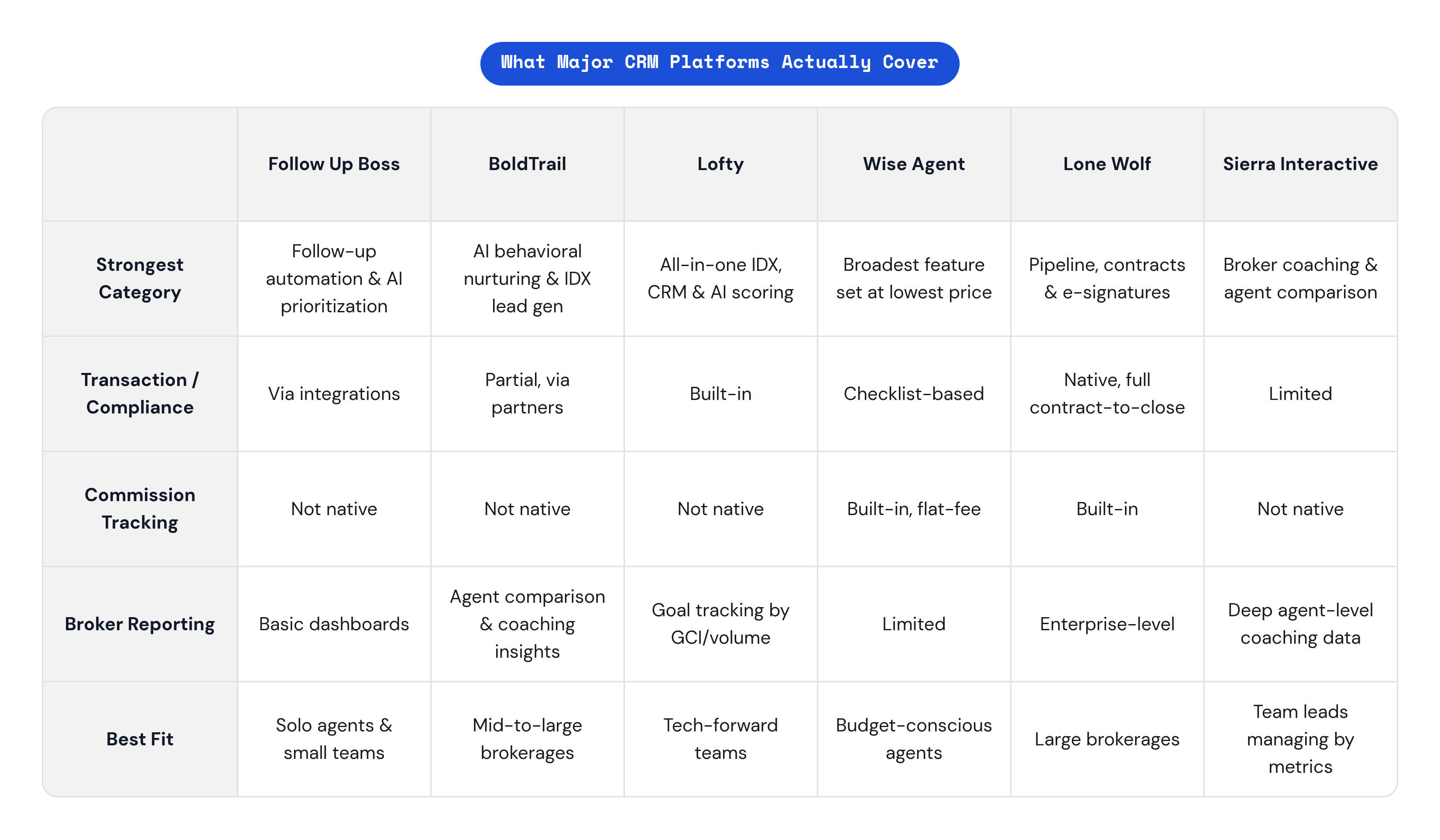
This isn't a ranked list, and treating it as one misses the point. Some platforms run deep in one category and thin everywhere else; others spread across five categories at a merely decent level. Knowing which is which matters more than knowing who's "best."
Follow Up Boss is strongest on follow-up automation and AI-assisted prioritization, and the Zillow Pro integration gives it a consumer-data layer that's genuinely hard for competitors to match. Pricing starts at $69 a month for Grow, climbs to $416 for Pro, and tops out at $833 for Platform. BoldTrail, formerly kvCORE, bundles AI behavioral nurturing, lead routing, and IDX lead generation into one system, with setup typically running $999 to $1,800 and monthly costs from $499 for two users up to $1,800 for a hundred, sized clearly for mid-to-large brokerages rather than solo agents.
Lofty positions itself as all-in-one, with IDX, CRM, Social Studio, and AI scoring built together rather than stitched on afterward, and its April 2026 Homeowner Agent product adds seller-pipeline mining on top. Pricing isn't public, but it's reported to sit in the mid-to-high tier. Wise Agent covers the broadest range of features at the lowest published price point (commission tracking, drip campaigns, transaction checklists, collaboration tools, landing pages) and it's been Forbes Advisor's Best Real Estate CRM pick for three years running.
Rechat calls itself an operating system built around four integrated modules. It won Inman's Company of the Year in 2025, and reports meaningfully higher revenue per agent compared to brokerages still running a fragmented tool setup. Top Producer stands out for MLS integration depth, connecting directly to MLS data rather than relying on limited IDX data alone, which gives agents richer property intelligence than the IDX-only approach offers. Lone Wolf remains Forbes Advisor's pick for large brokerages, covering pipeline, contracts, campaigns, and e-signatures, priced for enterprise use. Sierra Interactive holds its ground as a leading option for broker-level coaching and agent comparison, built for team leads who manage by the numbers rather than by feel.
One thing worth separating out: commercial real estate has its own requirements entirely. Tracking properties, leases, comp data, commission splits, and multi-party deal relationships isn't what residential platforms are built for. The CRE CRM market has been growing fast, and it's a different shopping list from what a residential team needs.
There's a version of this fragmentation problem sitting one layer up, too. Marketing leaders running brokerage content and campaign production deal with the same scattered-tools headache: strategy in one place, production in another, publishing somewhere else entirely. Platforms that fold strategy, production, and publishing into one workflow are solving the identical consolidation problem, just for the marketing team instead of the sales floor.
What to evaluate before consolidating onto a single platform
Consolidation sounds like an obviously good idea until you consolidate onto the wrong platform and end up with new problems dressed in the old ones' clothes. Before signing anything, there's a short list of questions worth putting directly to a vendor rather than taking their sales deck's word for it.
Which features are actually native to the platform, and which are API-connected? Native means one shared data model; API-connected means two separate systems with a sync layer holding them together, and that connection has a way of failing right when you need it most. Where does the CRM actually sit in an agent's day: do they live inside it, or does it sit off to the side while the real work happens somewhere else? Does the AI layer have real behavioral data to chew on, or is it just scoring leads off which form fields they filled out? What does the compliance and transaction workflow look like against your specific state's requirements, since those vary more than people expect? And does broker-level reporting give you something to coach against, or just a pile of totals at month's end?
There's a human wrinkle here, too, and it's worth naming plainly: agents who've made a fragmented setup work for them, however messily, might resist getting moved off it, and no feature comparison chart fixes that on its own. Onboarding and actual adoption matter just as much as the feature list, maybe more.
That 45% faster onboarding figure BoldTrail cites points to where consolidated platforms show their clearest advantage: how fast a brand-new agent gets productive when the workflows are already built and waiting, more than in shaving a few minutes off an experienced agent's day. The real goal is making sure agents stop reaching for their own credit card to cover the gaps the brokerage CRM was supposed to close in the first place.