Virtual Brokerage Models versus Traditional Brick-and-Mortar Brokerages
Agents choose based on deal volume and career stage, not lifestyle preference.

Roughly 4.06 million existing homes changed hands in 2025, hovering near the lowest volume in three decades. Mortgage rates stayed high, prices kept climbing anyway, and millions of owners sat locked into sub-4% loans they had no reason to give up. Against that backdrop, whether an agent hangs their license at a traditional brokerage or a virtual one stopped being a lifestyle question and started being a math question. This piece walks through both models, the actual numbers behind them, and what's driving the biggest agent migration the industry has seen in years.
What each model actually is (and what people commonly get wrong about virtual brokerages)
Traditional brick-and-mortar brokerages run on physical offices: a managing broker down the hall, admin staff at the front desk, a branch culture that develops the way any workplace culture does, through proximity and repetition. Virtual, or cloud-based, brokerages skip the office. Broker oversight, compliance checks, training, and transaction management all happen through video calls, cloud software, and digital paperwork instead.
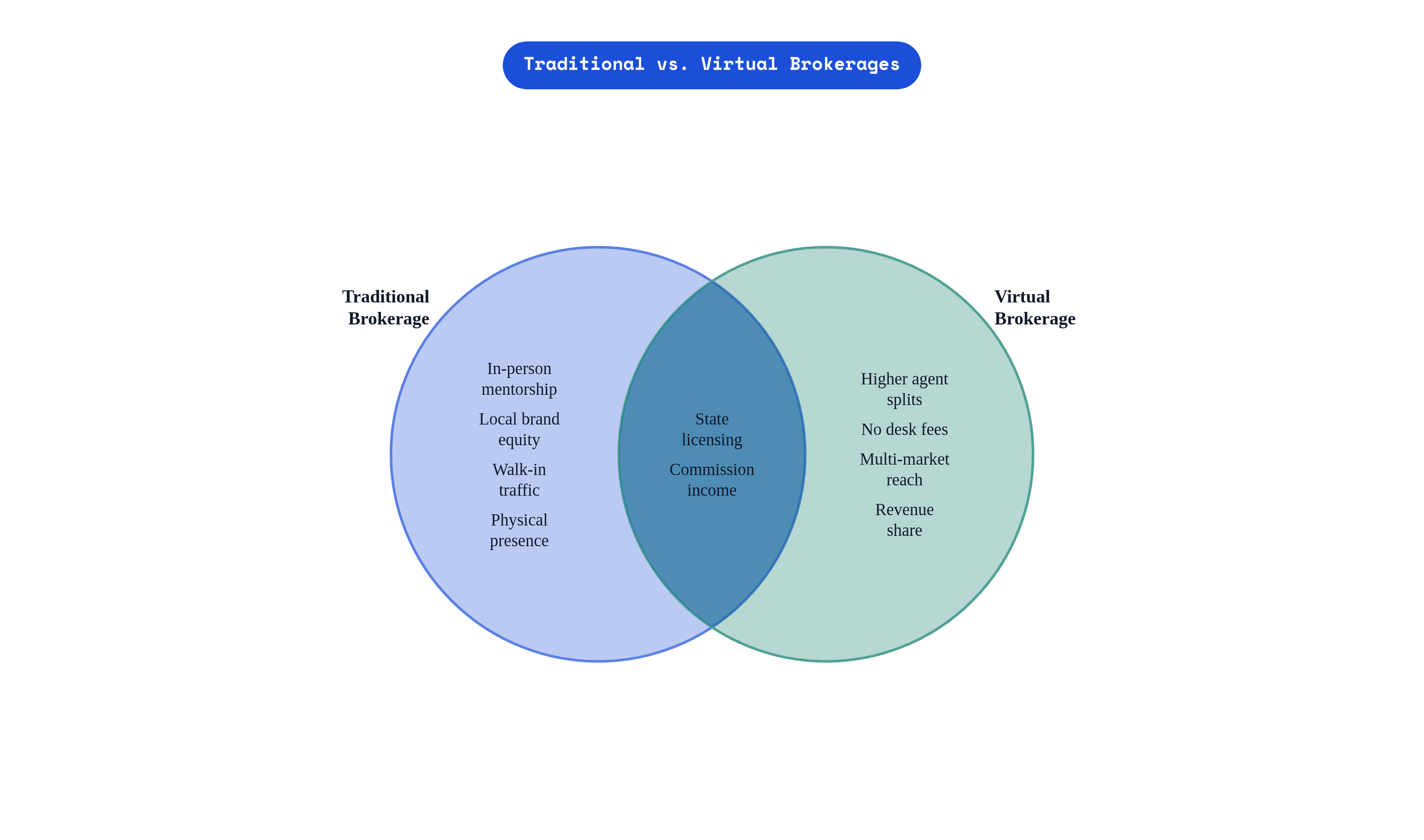
Here's the part that trips people up: virtual brokerages carry the same state licenses and the same regulatory obligations as any traditional firm. Agents get paid when a deal closes, not for signing up other agents, though the revenue-share programs some of these companies run (more on that later) get mistaken for multi-level marketing more often than they should. That comparison doesn't hold up once you look at how the money actually flows.
None of this is new so much as accelerated. Agents were already drifting toward remote work before 2020; the pandemic just proved the tools worked. Cloud CRMs, e-signature platforms, video conferencing, and now AI-assisted follow-up tools matured fast enough that a brokerage with zero square footage could run exactly as legitimately as one with a corner office on Main Street. The split between virtual and traditional is a structural difference in how the business operates, not a stand-in for how professional or competent the agent behind the license happens to be.
How commission splits and monthly costs actually compare between the two models
Traditional brokerage costs stack. There's the split itself, commonly somewhere between 50/50 and 90/10 in the agent's favor, then desk fees on top of that, then franchise royalties if the brokerage is part of a national brand, then technology fees, then transaction coordination charges. Each one looks small in isolation. Together, they add up to something that pulls a lot of agents' effective take well under their expected share, once you account for the office lease, the receptionist, and the utilities that all get paid for somehow.
Run the numbers on a single mid-range commission. At a traditional brokerage with a 70/30 split plus a desk fee, a transaction fee, and a franchise royalty, an agent might walk away with roughly half of that. At a flat-fee cloud brokerage charging a modest monthly fee plus a small per-transaction charge, the same $10,000 commission could net the vast majority of the commission. That gap is not rounding error. That's thousands of dollars on one deal.
Virtual brokerages generally use one of two structures: a flat monthly fee, usually somewhere of roughly one to two hundred dollars a month with no commission split at all, or a high-split-with-a-cap model. eXp Realty runs the second version: a modest monthly brokerage fee, an 80/20 split until the agent hits an annual cap, and then full commission with a flat per-transaction fee after that, no desk fees, no franchise royalties, no office rent baked into the math anywhere. Real Brokerage runs a similar high-split-with-a-cap structure, with a small per-deal fee once the annual cap is cleared.
So who wins? Depends entirely on how many deals you close. Agents doing high volume hit their cap fast and spend the rest of the year keeping nearly everything. Agents closing three or four deals a year are still paying that monthly fee every single month whether they close anything or not, and the break-even point matters a lot more to them than it does to the agent who closed 40 deals last year. Before deciding one model is cheaper, it's worth actually running your own transaction count against both structures rather than taking anyone's word for it.
What agents give up on support, mentorship, and culture when they leave a physical office
The traditional brokerage's real pitch has never really been about desk fees. It's about having a managing broker down the hall when a contract goes sideways, and having senior agents around who'll answer a question in the hallway without making you feel like you're wasting their time.
For a brand-new agent, that informal education (shadowing a seasoned colleague on a listing appointment, overhearing how a tough negotiation actually gets talked about in the break room, getting corrected on a mistake in real time) is genuinely hard to reproduce over a screen. It's not that virtual training doesn't exist. eXp runs a virtual campus platform where agents attend training sessions and connect with colleagues; other virtual brokerages lean on video calls, chat channels, and recorded course libraries. All of that works fine for someone who already knows what questions to ask. It works a lot less well for someone who doesn't yet know what they don't know.
Culture in a virtual brokerage has to be chosen on purpose. Nobody bumps into it in the hallway. Agents who do well in that setup tend to already be experienced, already self-motivated, already comfortable setting their own schedule without someone checking in. The mentorship gap here isn't a matter of anyone trying harder; spontaneous, unplanned conversation just doesn't have a dependable digital substitute yet, and broker-owners running distributed teams face a mirror version of the same problem: building real culture across time zones and screens takes deliberate effort that a shared office gets for free.
Neither setup is better in some absolute sense. The honest question is what a given agent actually needs right now, at this point in their career, and that answer changes as the agent grows.
The flexibility and geographic advantages virtual brokerages offer agents with non-traditional practices
Virtual brokerages let agents work across wide geography without being pinned to one branch's territory, which matters a lot if your business is resort real estate, military relocation, or clients spread across three different metro areas. No commute also means more hours available for clients, or more room to run a team, or manage a second business on the side.
Cloud tools tend to be more consistent in virtual models too, mostly because they have to be. A traditional brokerage's tech stack can vary wildly by franchise or even by branch; a virtual brokerage builds its CRM, transaction management, e-signature, and AI marketing tools into the platform from day one because there's no office fallback if the tech doesn't work.
Scale-wise, eXp Realty operates in 26 countries, and Real Brokerage closed north of 49,000 deals in the second quarter of 2025 alone, all without a single physical office anywhere. That answers the obvious skeptic's question up front: can a fully remote brokerage actually produce volume? Yes, clearly.
Where this gets less obviously appealing is for agents who lean on walk-in traffic, storefront visibility, or the brokerage's local name recognition to generate leads in the first place. Take that away and there's nothing filling the gap. An agent with an established referral network and personal brand loses very little going virtual; an agent who was quietly depending on the office's foot traffic loses more than they probably realized they were getting.
How broker-owners evaluate the model choice differently from individual agents
Individual agents think about take-home pay. Broker-owners think about capital allocation, and that's a fundamentally different math problem. A traditional brokerage carries real fixed costs (lease terms, staff payroll, office equipment), but it also owns something tangible: a local brand, a storefront people recognize, a sense of community identity that can help pull in and keep agents who actually care about that.
A virtual brokerage strips most of that overhead out. Growth happens by adding agents, not square footage, and there's no ten-year lease sitting on the balance sheet as a liability if the market turns. Adding the hundredth agent costs a virtual brokerage mostly technology and compliance overhead; adding the hundredth agent to a traditional office eventually means either a second location or agents tripping over each other at the coffee machine.
Compass posted significant losses in recent years while pouring money into its proprietary technology platform and market expansion, a useful reminder that building tech in-house at a traditional brokerage is expensive even when it works. Virtual brokerages generally sidestep that cost by licensing established platforms instead of building their own.
Recruiting splits along similar lines. High-split virtual models pull in experienced agents who don't need much hand-holding; traditional brokerages tend to pull in newer agents who want the training wheels. Broker-owners need to be honest with themselves about which type of agent their actual support system is built to serve, because building for one type while recruiting the other is how attrition happens quietly.
The consolidation wave underway right now (Compass acquiring Anywhere's brands, cloud brokerages expanding aggressively) all points to a specific squeeze on the middle. Mid-size regional brokerages are too small for enterprise-scale efficiency and too big to sell boutique intimacy. Some of those broker-owners may find that going virtual, or affiliating with a cloud network, beats trying to hold that middle ground in a market this consolidated.
What the rapid growth of eXp Realty and Real Brokerage reveals about agent preferences under competitive pressure
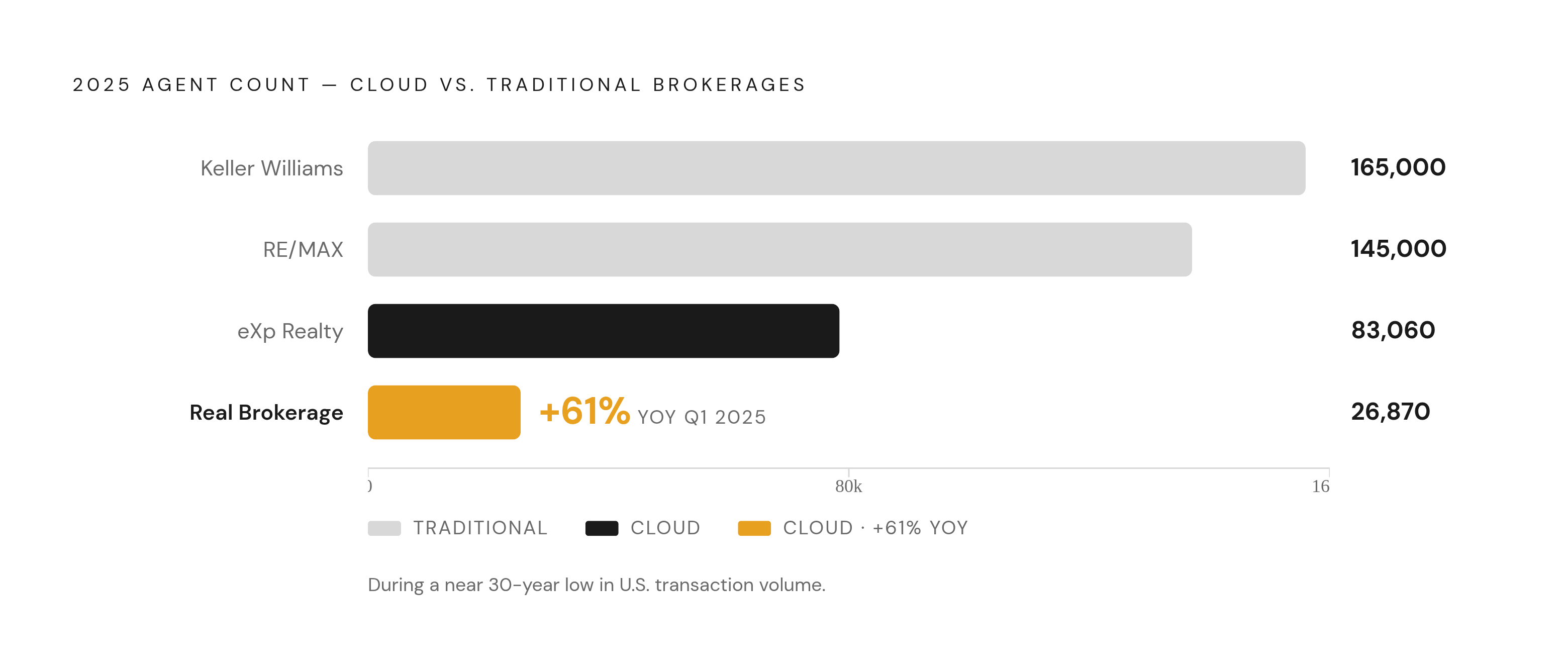
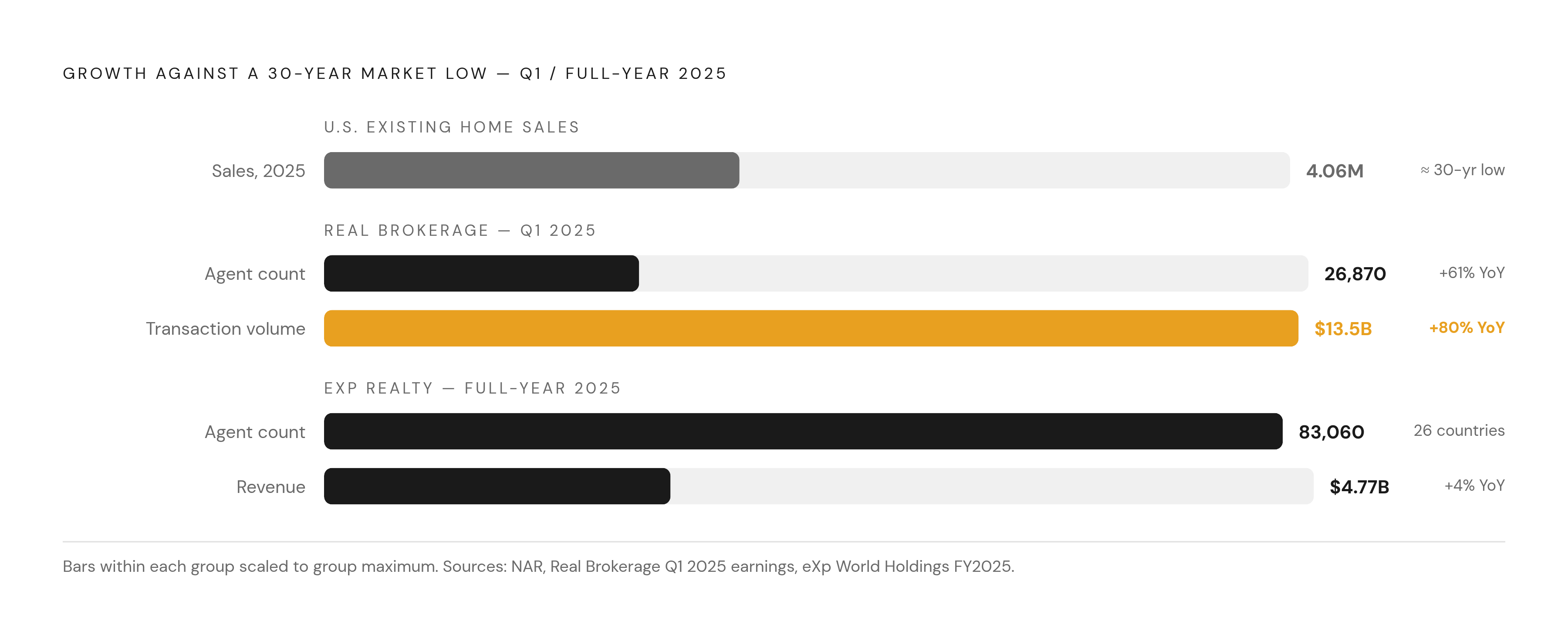
By the end of December 2025, eXp Realty had 83,060 agents across 26 countries and posted $4.77 billion in full-year revenue, a 4% bump over 2024; third-quarter transaction volume alone grew 7% to $54.1 billion. That makes it the largest cloud brokerage by both agent headcount and revenue, not a close second to anything.
Real Brokerage is smaller but growing faster. It ended the first quarter of 2025 with 26,870 agents, up 61% year over year, and $13.5 billion in transaction volume, an 80% jump from the same quarter in 2024.
Here's what makes that genuinely interesting rather than just impressive: both companies grew agent count and closed volume during the exact same stretch that overall U.S. transaction volume sat near a 30-year low. That growth didn't come from a bigger pie. It came from agents leaving other brokerages and walking into these two specifically, which tells you something concrete about what agents are actually optimizing for when the market gets tight: higher splits, no desk fees, tech that's already included, and in eXp's case, a shot at equity and revenue share that a traditional brokerage can't replicate without tearing up its entire business model.
That revenue-share layer is worth sitting with for a second. It creates a retention effect that goes past the commission split itself (agents get built-in incentive to stay and to recruit), which is a different kind of loyalty than "the split here is decent." And nobody joining either platform is signing up for a passive experience: both expect agents to handle their own lead generation and marketing without a branch office doing any of that lifting for them. The trade is explicitly financial in exchange for structural support, spelled out plainly rather than hidden in the fine print.
The trajectory is worth taking seriously: cloud-native brokerages aren't just competing with traditional networks for market share anymore. They're reshaping the competitive landscape from the outside in.
Where traditional brokerages still hold a structural edge (and what kinds of agents it benefits)
Traditional models aren't going anywhere for everybody, and the numbers back that up. Keller Williams held onto the top franchise brand spot in 2025 with roughly $370 billion in U.S. sales volume and about 165,000 agents spread across more than 1,000 market centers. Brand equity at that scale still means something in a lot of markets, especially where buyers and sellers pick an agent partly because they recognize the sign in the yard.
Compass, still fundamentally a traditional model despite its tech investment, posted $262.2 billion in 2025 U.S. sales volume, a 13.5% jump that made it the top brokerage by sales volume nationally. RE/MAX, meanwhile, counted more than 145,000 agents across over 8,500 offices in more than 120 countries, a global office network that matters quite a bit to agents working in markets where a recognizable local branch signals credibility to sellers deciding who to list with.
Traditional still wins outright in a handful of specific situations. New agents who need floor time and hands-on mentorship to build a practice from scratch. Markets where clients genuinely still choose an agent partly on the strength of the office's local reputation. Luxury and commercial segments, where hosting events and having a physical presence with real signage remains part of what clients expect. And agents who, if we're being honest, aren't self-directed enough yet to generate their own leads and hold themselves accountable without an office structure around them.
Brokerages that have sunk real money into proprietary technology (Compass's CRM being the most cited case) can close a lot of the tool gap that used to separate traditional from virtual. That closes the gap; it doesn't erase the cost of building and maintaining it, which is a bill somebody still has to pay.
The fair way to frame all this: traditional brokerage isn't dying. It's splitting in two. The very large national franchises and the tech-heavy luxury players are holding steady or growing. The tier actually getting squeezed is the mid-size regional brokerage with neither the scale of a Keller Williams nor a distinctive enough culture to stand out on its own.
A framework for making the decision based on where an agent or broker-owner actually is in their business
Four things actually move the needle here. None of them decides the question alone, but stacked together they narrow it down fast.
Transaction volume comes first. Agents closing enough deals each year to reliably hit their cap come out ahead in a virtual model, often by a wide margin. Agents closing three or four deals a year need to check whether that monthly fee is actually cheaper than what a traditional split buys them in training and support, because on low volume, it might not be. Career stage matters just as much: agents with an established client base and their own lead pipeline don't need what a branch office provides, while agents still building that pipeline from scratch might genuinely benefit from having one nearby.
Geography and lifestyle make up the third piece. Agents working across multiple markets, running things part-time, or juggling real estate alongside another job gain something structural from going virtual. Agents whose whole business runs on hyper-local relationships and community presence may lose more than they gain by cutting the physical anchor loose. And accountability is the piece people underrate most: agents who genuinely do better with a manager checking in, or a room full of colleagues to bounce ideas off, should be honest about that instead of assuming flexibility is always a win. Virtual freedom for the wrong personality type turns into virtual isolation fast.
Broker-owners have a fifth factor to weigh that individual agents don't: capital risk. A ten-year lease and a payroll of admin staff are fixed costs that don't move whether the market's up or down, and virtual models mostly sidestep that exposure. The real question for an owner is whether the physical office is pulling its weight in recruiting and retention, or whether it's just a habit nobody's questioned lately.
Worth noting, too, that the line between these two models keeps getting blurrier at the edges. Some traditional brokerages are shrinking their physical footprint while trying to preserve in-person culture through smaller hub-and-spoke setups instead of one big branch. Some virtual brokerages now offer optional coworking access for agents who want an occasional desk without full brokerage overhead. Neither model is staying still, which means whatever framework an agent uses today is worth revisiting again in a year or two, because the ground underneath both models keeps shifting.