Lead Generation Platforms for Real Estate Brokerages at Scale
Brokerages need platforms built for routing, not just capture.

Lead generation for a real estate brokerage is a completely different animal than lead generation for a single agent, and most of the software on the market still gets built like the agent is the only customer that matters. The real problem at scale isn't finding leads; it's routing them, tracking them, and making sure eighty different agents follow up the same way a good agent would follow up alone. This piece walks through what the buyer and seller data actually says, why speed becomes a math problem once you're running dozens of pipelines instead of one, what leads really cost once you follow them to closing, and how the major platforms hold up when you put them under brokerage-level weight instead of solo-agent weight.
One agent running a lead gen tool needs one pipeline, one drip sequence, one inbox to check. A brokerage running the same tool across eighty agents needs parallel pipelines, rules about who gets what lead and when, some way to check that nobody's ignoring their inbox for three days, and reports that roll up cleanly to the managing broker. Miss a follow-up as a solo agent and you lost one deal. Miss follow-ups across eighty agents because your routing logic is bad, and you're bleeding both revenue and the agents themselves, who tend to leave brokerages that hand them dead leads. The lead gen software market is growing fast, and cloud-based tools now make up most of it because multi-office brokerages need people to log in from anywhere and admins to see everything at once. But growth in the vendor pool doesn't make picking one easier. It makes the framework for picking one the actual scarce resource, which is what the last section of this piece is built to hand you.
What the underlying buyer and seller data tells brokerages about lead behavior
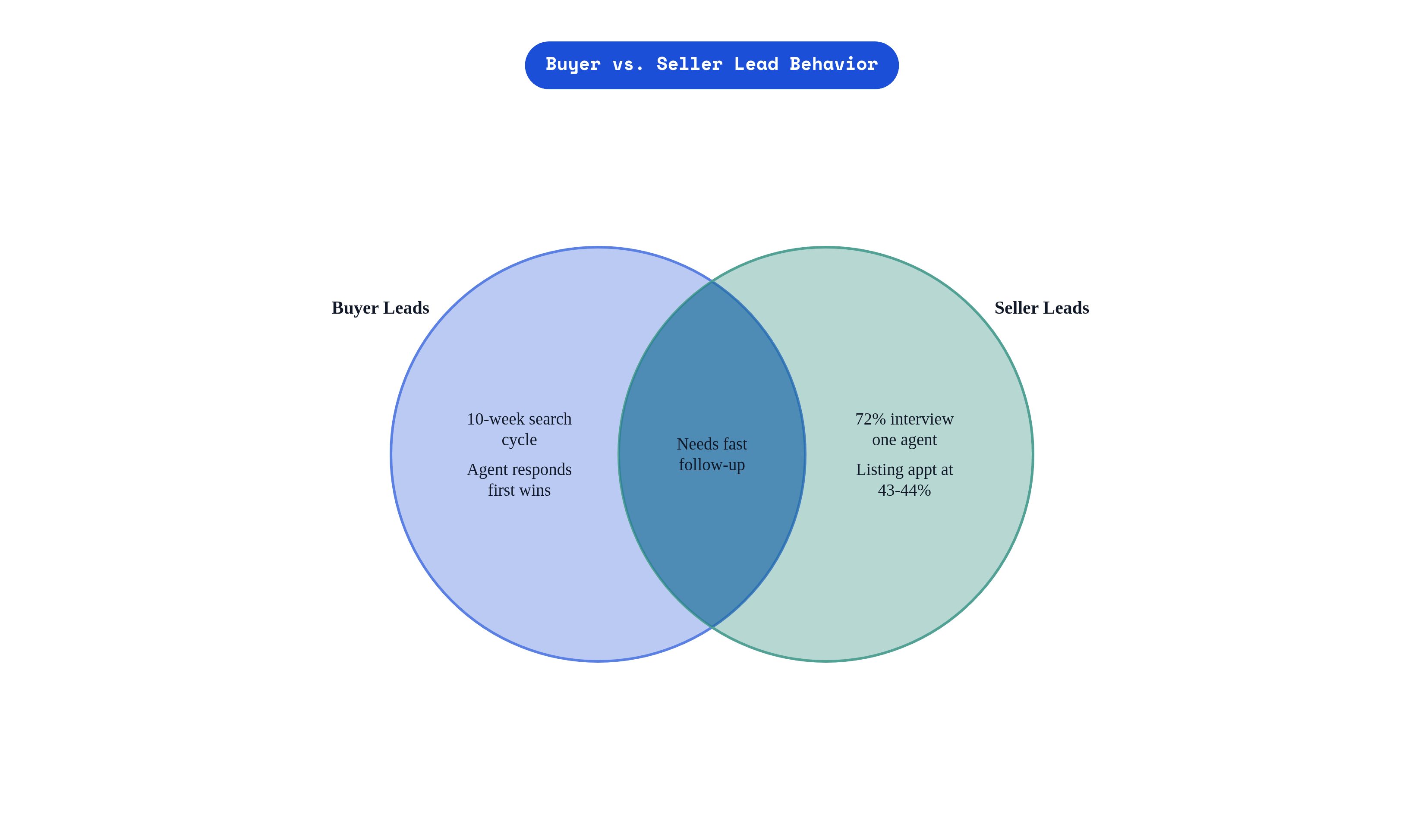
Start with the obvious: nearly all homebuyers use online tools somewhere in their search, according to NAR. Digital capture isn't a choice a brokerage gets to make anymore; it's just where the leads live. But here's the part that trips people up: digital capture is not digital conversion. The overwhelming majority of buyers, per NAR's 2025 data, still closed their purchase through an agent or broker. So the job of any lead platform isn't to collect form fills. It's to hand agents a relationship they can actually work.
That relationship takes time to build. NAR's 2025 numbers put the median buyer's search at 10 weeks before they purchased. Any platform whose nurture sequence quits after two or three weeks is structurally leaving buyers on the table right when they're getting serious.
Sellers behave differently, and the differences matter more than people give them credit for. NAR 2025 found that two-thirds of sellers found their agent through a referral or a past relationship, which means a platform that has no answer for sphere-of-influence nurture is ignoring the channel that converts best. Even sharper: 72% of sellers only interviewed one agent before listing. Read that again, because it changes how you think about the whole funnel. The agent who gets to that first appointment usually wins the listing outright; every appointment after the first one is competing for scraps. And sellers aren't going away. NAR clocked 91% of sellers using an agent in 2025, matching an all-time high. The market's not shrinking. What's shifting is who gets there first.
Put together, the data says a platform's real job is compression and endurance at the same time: shrink the gap between lead capture and the first real conversation, and keep nurturing long enough to survive a 10-week buyer decision cycle. Most platforms are decent at one of those two things. Few are built for both.
Speed-to-lead as the structural variable brokerages must engineer, not assume
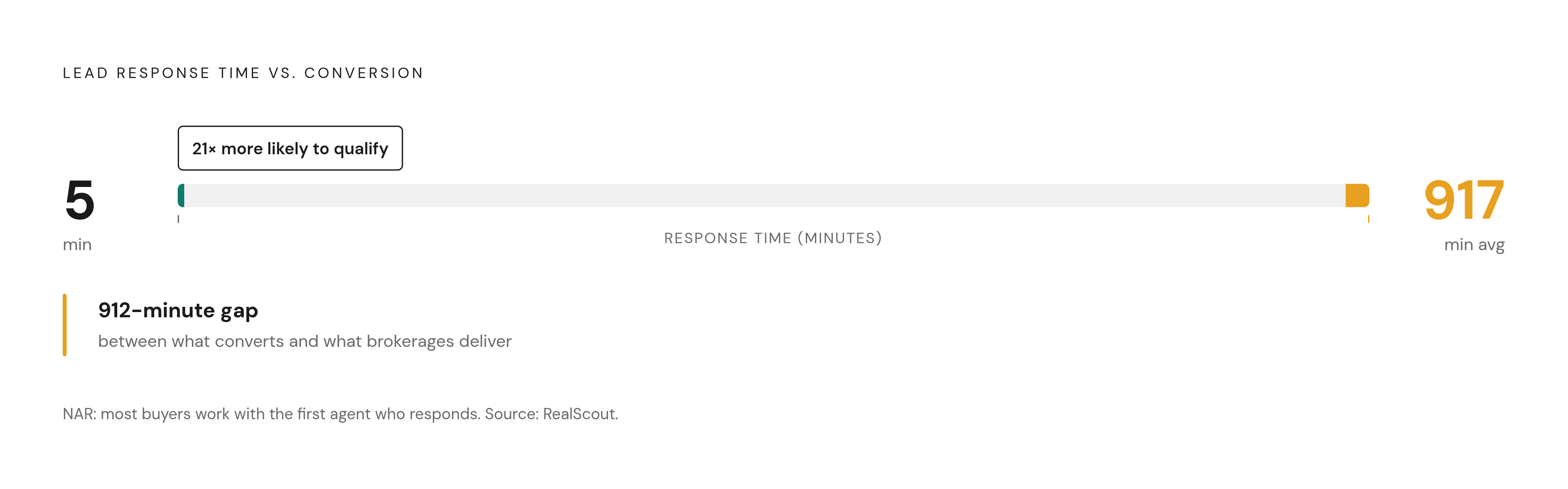
Here's a gap worth sitting with. Leads contacted within five minutes are widely cited as dramatically more likely to convert into a qualified opportunity — a ratio that has circulated across industry research for years. Meanwhile, the industry's average response time, per RealScout, sits around 917 minutes. That's not a typo; that's nearly 15 hours between a person raising their hand and an agent picking up the phone.
NAR data backs up why this matters so much: a large majority of buyers end up working with whichever agent responds first. At the individual level, that's a footrace you can occasionally win by being lucky or being glued to your phone. At brokerage scale, that same race is running dozens of times a day across dozens of agents, and depending on a human to win it consistently is like betting on eighty separate coin flips landing heads. Somebody's inbox is always going to sit unopened at 6 p.m. on a Saturday.
The follow-up depth problem stacks right on top of the speed problem. Converting an internet lead into an actual appointment typically takes 8 to 12 follow-up attempts, and leads who get six or more touches convert at substantially higher rates than leads who get fewer. No brokerage is managing that manually across a hundred-agent roster without something breaking. It has to be automated sequences with a clear trigger for when a human needs to step in and take over.
So the evaluation question shifts. It's not "does this platform generate leads." It's whether the platform routes instantly, fires off automated first contact without a human touching a keyboard, keeps a multi-touch sequence running on autopilot, and knows exactly when to escalate to a live agent. The platforms that handle this well, which we'll get to, treat speed-to-lead as something baked into the architecture, not a checkbox on a features page.
The real cost structure brokerages face across lead channels
The blended average cost per lead across the industry sits around $448, and based on Deal Machine OS and RealScout data, that number is expected to climb to roughly $503 by 2026, a jump of about 12.3% in a single year. This isn't some seasonal blip. It's a structural rise, and brokerages budgeting flat year over year are quietly falling behind.
Portal leads carry the sharpest inflation story. REDX's 2026 data pegs the rise in portal lead costs since 2015 at over 1,000%, with average portal cost-per-lead now around $181 and nurture cycles that regularly stretch past two years before they close.
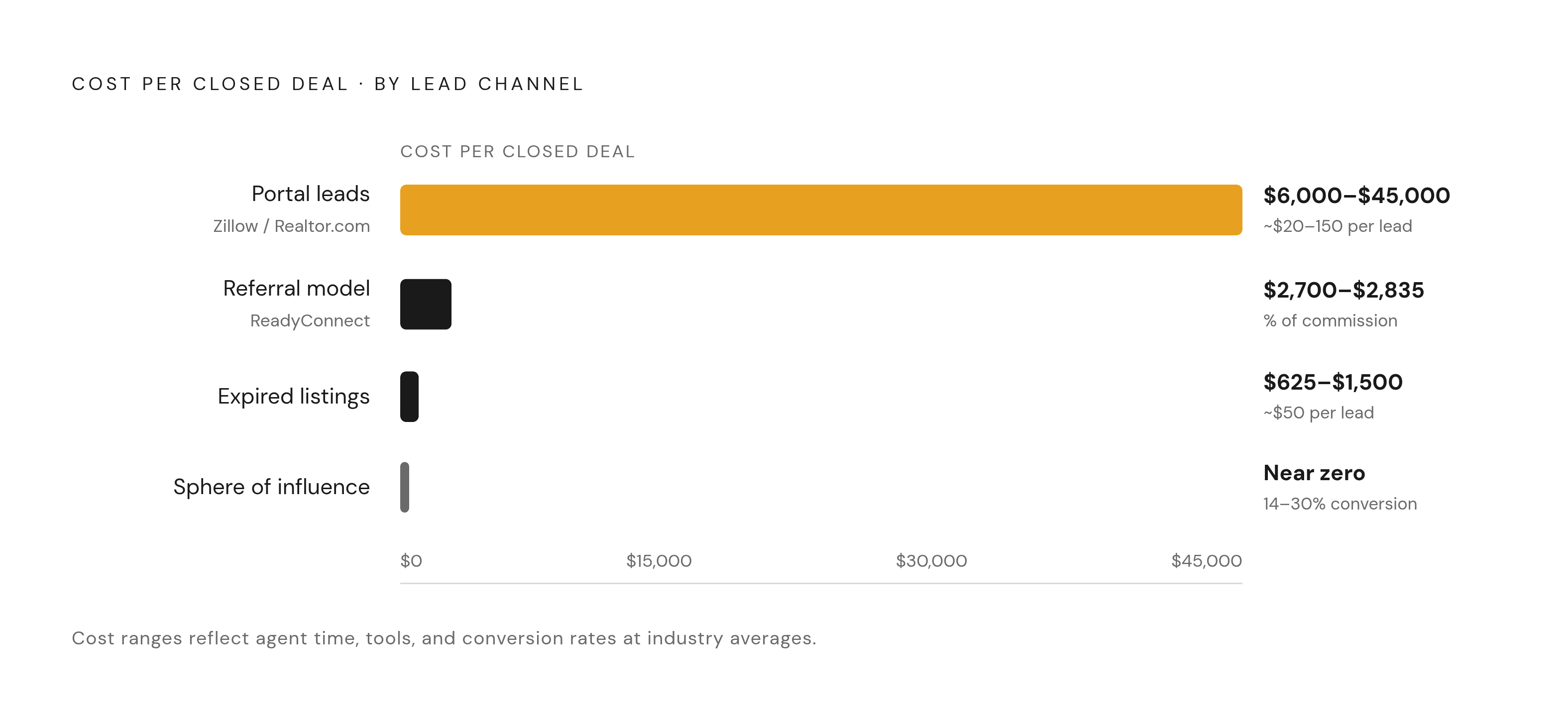
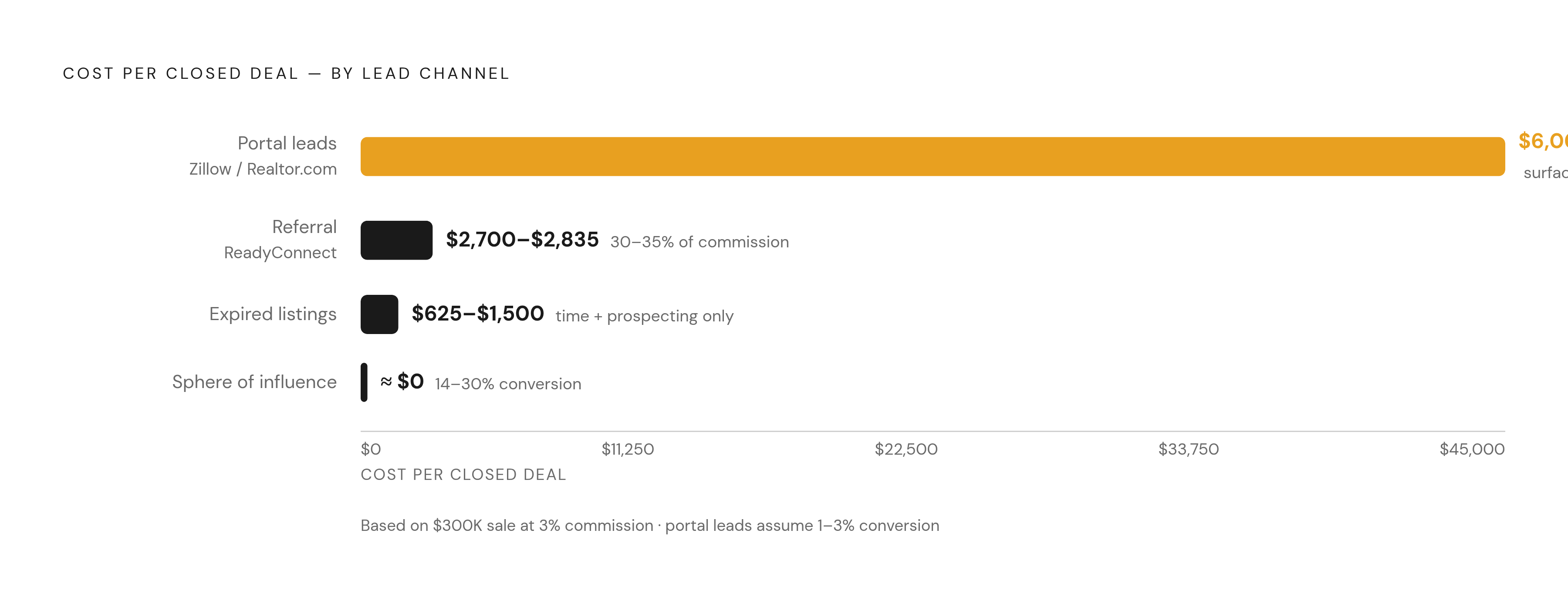
Cost-per-lead by itself is close to useless without looking at what happens after the lead comes in. Portal leads from sites like Zillow or Realtor.com might run $20 to $60 on the surface, cheap by any measure. But once you apply real conversion rates, based on data compiled from REDX, NAR, Ylopo, and Revalto, that same portal lead costs thousands of dollars per closed deal. Compare that to expired listings, which run $625 to $1,500 per closed deal, a fraction of portal economics. Sphere-of-influence leads cost next to nothing to acquire and convert at 14% to 30%. And referral models like Realtor.com's ReadyConnect skip the upfront cost entirely, instead taking 30% to 35% of the commission at closing; on a $300,000 sale at a 3% commission, that referral fee lands around $2,700 to $2,835 per closed deal.
Run that math across a brokerage's full lead volume and the picture gets uglier fast. A platform generating cheap portal leads at the low end of conversion can quietly drain a brokerage's gross commission income unless the agents on the other end are fast and thorough enough to compensate. Which means the real evaluation isn't a cost-per-lead comparison at all. It's a cost-per-closed-deal model, run against the brokerage's actual volume and commission splits, before anyone signs anything.
The conversion rate gap between platforms — and what actually drives it
Across all online sources, the industry average real estate lead conversion rate lands somewhere between 0.4% and 1.2%. Translate that into plain terms: out of 200 leads, you're looking at maybe one or two closings. That's the baseline everyone's competing against.
Top-performing agents pull 3% to 5%, and elite teams working bottom-of-funnel platforms like Zillow hit 7% to 9%, a gap of six or seven times the average. What explains that gap? Not lead quality alone. It's system discipline: consistent speed-to-lead, nurture sequences that survive an agent leaving the brokerage (because the sequence lives in the platform, not in that agent's personal spreadsheet), and matching lead source to the right kind of business. Expired listings convert to listing appointments at 43% to 44%; FSBOs convert at meaningfully higher rates than portal leads. Both blow portal leads out of the water. A brokerage chasing listing volume should be weighting its platform choices completely differently than one chasing buyer leads, and plenty of brokerages don't make that distinction until they've already signed a contract.
There's an AI layer worth naming here too. Platforms like Ylopo build AI assistants aimed at matching human response quality around the clock, with training drawn from large volumes of real platform interactions. When you're evaluating an AI nurture feature, the question isn't whether the feature exists; it's how deep the training data actually goes.
The pattern that surfaces repeatedly in platform case studies is that strong ad spend results depend entirely on what's running underneath them. Spend the money without the follow-up machine in place, and you're just paying for traffic that goes nowhere.
How the major platforms are actually positioned for brokerage-level use
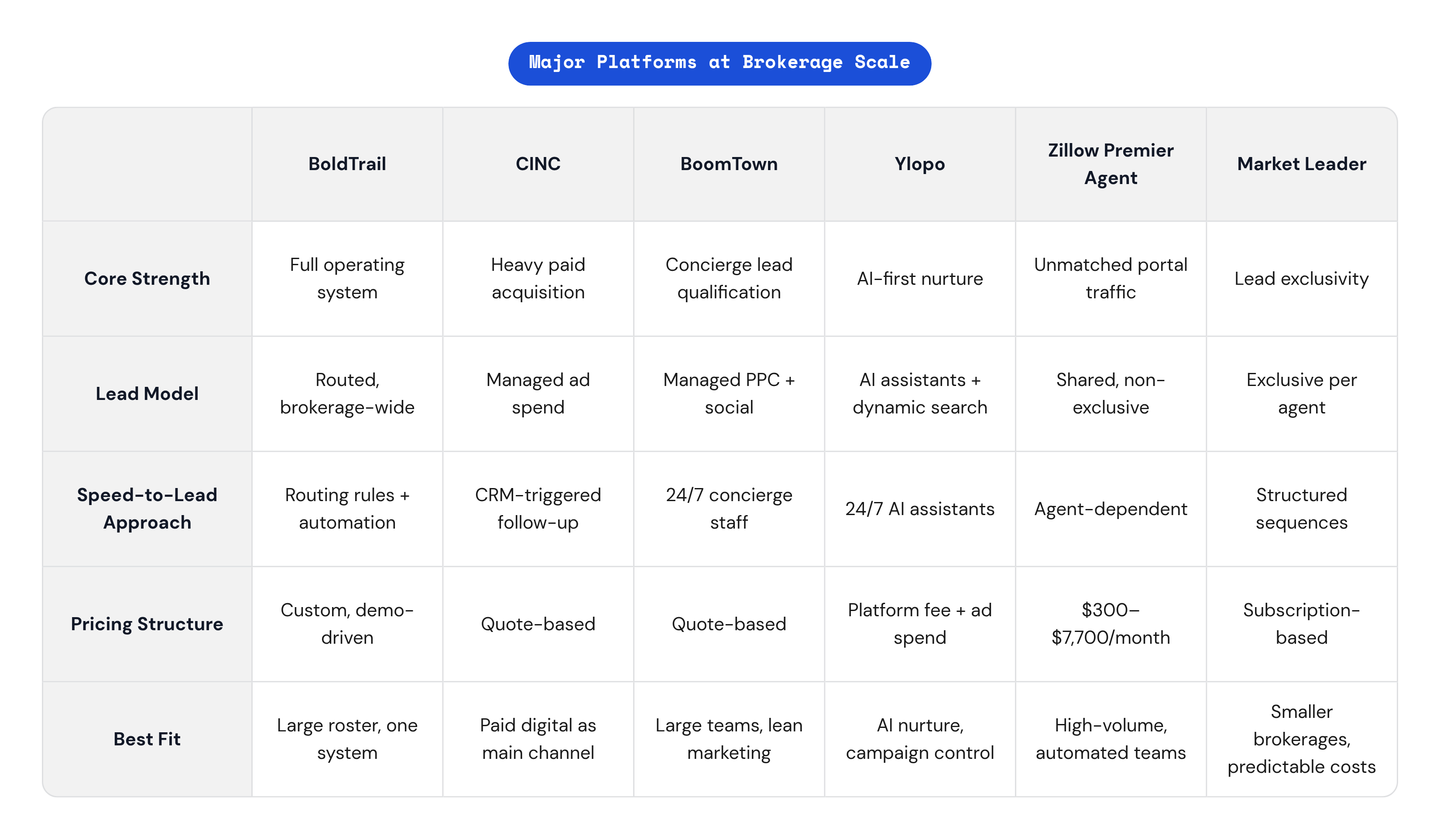
BoldTrail, the platform formerly known as kvCORE, from Inside Real Estate, positions itself as a full operating system: websites, CRM, lead routing, marketing automation, and analytics all in one place, with lead generation layered on through tools like BoldLeads. It fits brokerages that want a single system to route leads and hold a large roster accountable, with pricing that's custom and demo-driven, which tells you it's built for enterprise deals, not solo agents comparing monthly rates.
CINC, short for Commissions Inc., is built for brokerages running heavy paid acquisition. It bundles managed Google and Facebook ad spend with a conversion-focused CRM and IDX website, and it can micro-target down to specific neighborhoods or school districts. Tens of thousands of agents use it. Pricing is quote-based, and it fits brokerages where paid digital is the main channel, not a side experiment.
BoomTown is the mature all-in-one option: IDX websites, a predictive CRM, and professionally managed PPC and social advertising, wrapped around a "Success Assurance" concierge service that qualifies leads around the clock. That concierge piece is a direct answer to the speed-to-lead problem, handled by BoomTown's staff instead of the brokerage's own people. It suits organizations with a lot of agents but not much in-house marketing muscle.
Ylopo leans hardest into AI nurture, running automated assistants live 24/7 and aimed at maintaining contact through long buyer decision cycles. It layers in dynamic home search, home valuation tools, and AI-generated video ads, all pointed at a custom-branded IDX site. Its pricing structure separates the platform fee from ad spend, meaning the real monthly cost varies depending on campaign investment, though the base entry point is lower than fully managed competitors. It fits brokerages that want AI-first nurture without handing over full control of their campaigns.
Zillow Premier Agent brings the scale nobody else can match: Zillow operates at a scale of traffic that no competing portal comes close to matching. But here's the catch that brokerages need to sit with: leads aren't exclusive, meaning multiple agents may be competing for the same buyer inquiry simultaneously. Pricing runs $300 to $7,700 a month depending on market, with meaningful impression share in a market like Manhattan starting at the top of that range. That $20 to $60 per-lead price looks great on a spreadsheet until you factor in conversion and the true cost climbs to $6,000 to $45,000 per closed deal without serious speed-to-lead infrastructure sitting underneath it. It's a strong fit for high-volume teams that already have automation in place, and a rough fit as a standalone tool for anyone without one.
Market Leader takes a different structural bet on lead exclusivity, which removes the shared-lead competition that can erode the economics of portal-based platforms, and is positioned to give smaller brokerages a more predictable cost structure. It comes with hands-on support and scheduled training, though it's less built out for brokerages that need deep, granular routing and analytics across a very large roster.
Then there's content and inbound as its own channel, separate from paid platforms entirely. Neighborhood guides, market reports, and seller prep content build an audience a brokerage actually owns, which matters because owned audiences don't inflate in cost the way portal leads do. The catch at brokerage scale is production: publishing across dozens of agents and multiple markets needs an actual workflow behind it, not a blog post whenever someone finds a free afternoon. Tools that combine AI-assisted writing with real editorial oversight let a brokerage publish at volume without every post reading like it was written by committee, and that consistency is what turns content into a genuine hedge against rising CPLs instead of a nice-to-have side project.
The evaluation framework brokerages should use before committing to a platform
Start with the brokerage's actual bottleneck, not whatever's on the platform's homepage. Is the real problem lead volume? Lead quality? Routing and accountability? Nurture that dies after three weeks? Cost per closed deal that nobody's actually calculated? Each of those points toward a different kind of platform, and most brokerages, if they're honest, will find a routing and follow-up failure sitting underneath what looks like a lead volume problem.
Five things separate a tool built for brokerage scale from one built for a single agent's inbox. Can it route by geography, lead type, agent tier, and availability, and does it have a clear answer for what happens to a lead nobody's touched in an hour? Does it write data back into the brokerage's CRM of record, or does it just create a second system agents quietly stop using after six months? Does first contact happen inside five minutes without a human needing to be at a keyboard, nights and weekends included? Do nurture sequences survive an agent quitting and keep running for at least the ten weeks that NAR's 2025 data says the median buyer needs? And can the managing broker actually see conversion rates, response times, and cost-per-lead at both the agent level and the brokerage level, at the same time, without exporting six spreadsheets?
Lead exclusivity deserves its own line item in the negotiation. Shared leads, the Zillow model, demand a much faster speed-to-lead setup than exclusive leads under something like Market Leader's model; brokerages should run the cost-per-closed-deal math under both scenarios before signing anything, not after. Contract length matters too. Zillow Premier Agent typically requires a minimum six-month commitment in most markets, and a brokerage-level agreement spanning multiple ZIP codes is real financial exposure if performance benchmarks weren't pinned down in writing beforehand.
And then there's the spend question that sits underneath all of this. Surveying more than 50,000 professionals, RealEstateBees.com found that 63.7% of realtors spend less than $1,000 a month on marketing and lead generation combined. Compare that against the cost-per-lead and cost-per-closed-deal figures above, and the gap between what most agents are spending and what actually converts at scale starts to look less like a budget choice and more like a structural mismatch that brokerage leadership, not individual agents, needs to fix.