Commercial Property Listing Sites for Brokers and Tenants
Finding the right platform saves brokers and tenants from wasted time and money.

Commercial real estate search moved online fast, and JLL's own data backs that up: AI adoption in the industry went from a small minority of firms to something close to universal in about three years. That speed created a problem nobody really warns you about. Every platform does a different job, and picking the wrong one wastes time whether you're the one listing a building or the one hunting for space.
What separates these platforms before you evaluate any individual one
Five things actually separate one listing platform from another. Skip this part and they all start to blur together, which is exactly how brokers end up paying for the wrong tier on the wrong site.
Audience comes first. Some platforms are built for a retail tenant doing a self-guided search on a Sunday night, others for an institutional broker underwriting a deal at 11pm, others for a landlord running a forty-building portfolio. Inventory depth matters too: a site might be deep on office space in New York and Chicago and thin everywhere else, or spread wide across every asset class and shallow in each one. Access model is the third piece. Some platforms are free to search, some sit behind a subscription wall, some run tiered advertising where visibility is literally something you buy, dollar by dollar. Then there's the data layer, meaning comps, ownership history, debt records, market analytics, versus just a list of spaces with a few pictures slapped on. Last is workflow: does the platform stop at "here's a listing," or does it carry the deal through negotiation, lease management, and reporting after the ink dries?
Here's the part brokers miss constantly: where your listing gets seen and where the deal actually gets researched are often two completely different platforms. A tenant faces the mirror version of that problem. Is the space in front of you actually available, or did it go under contract three months ago and nobody bothered updating the status? No platform wins on every front at once. Every choice is a trade-off, and the rest of this piece is just working through what each one gives up in exchange for what it does well.
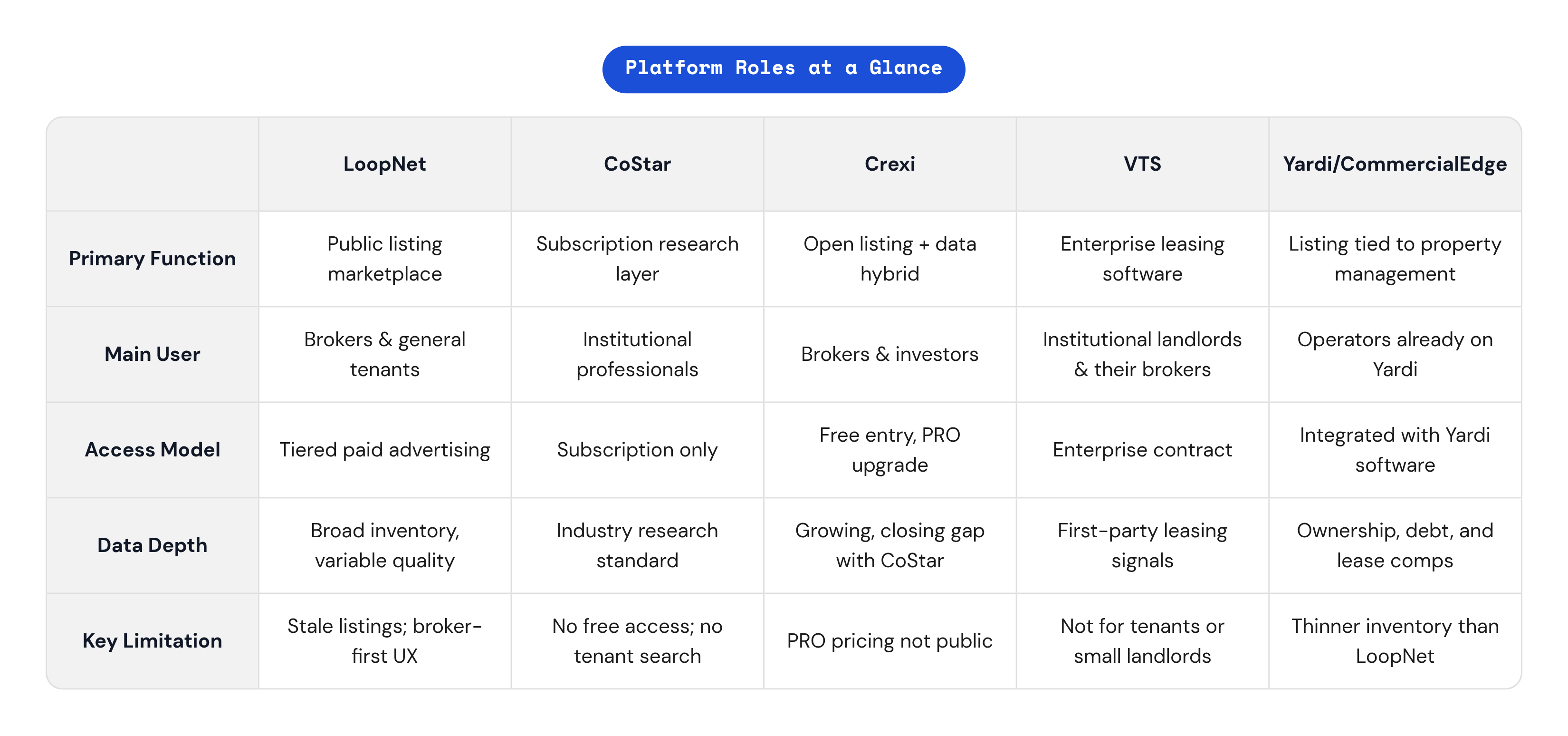
LoopNet as the default starting point for public listing visibility
LoopNet's whole identity rests on reach. It's the most visited commercial listing marketplace out there, and it isn't close. Ask ten brokers if they've heard of it and you'll get ten yeses, which puts it in rare company among platforms in this space.
For brokers, the model is tiered paid advertising: Silver, Gold, Platinum, Diamond, with visibility scaling roughly with how much you're willing to spend. There's no real free option if you want actual tenant eyeballs on your listing. What you do get, through LoopLink, is syndication: one upload pushes your listing across CoStar Group's affiliated properties like CityFeet and Showcase, and into CoStar itself, so you're not retyping the same square footage into five different forms.
For tenants, LoopNet offers broad inventory across office, retail, and industrial, covering most major markets and plenty of secondary ones too. The search experience draws steady criticism for feeling built for brokers first and tenants a distant second, and complaints about stale pricing or half-filled-out listings show up often enough to take seriously. LoopNet works well for brokers who need maximum exposure and have budget to spend, and for tenants running a wide first pass across a market. It works less well for brokers on a tight budget, or tenants who need current, granular data instead of a wide net full of holes.
CoStar's role as the research layer underneath the listings
CoStar isn't where tenants shop for space. It's a subscription data platform where professionals do the homework before, during, and after a deal, less a storefront and more the back office that makes the storefront trustworthy in the first place.
The scale of the data is the whole pitch: continuously updated ownership records, lease terms, debt data, and transaction history across a huge swath of commercial properties. That's why it's become close to the research standard in institutional CRE. Brokers use it to source off-market deals, pull comps, and check whether an asking rent reflects reality or just wishful thinking. Investors and lenders lean on it for underwriting. Market researchers track vacancy, absorption, and new supply through it.
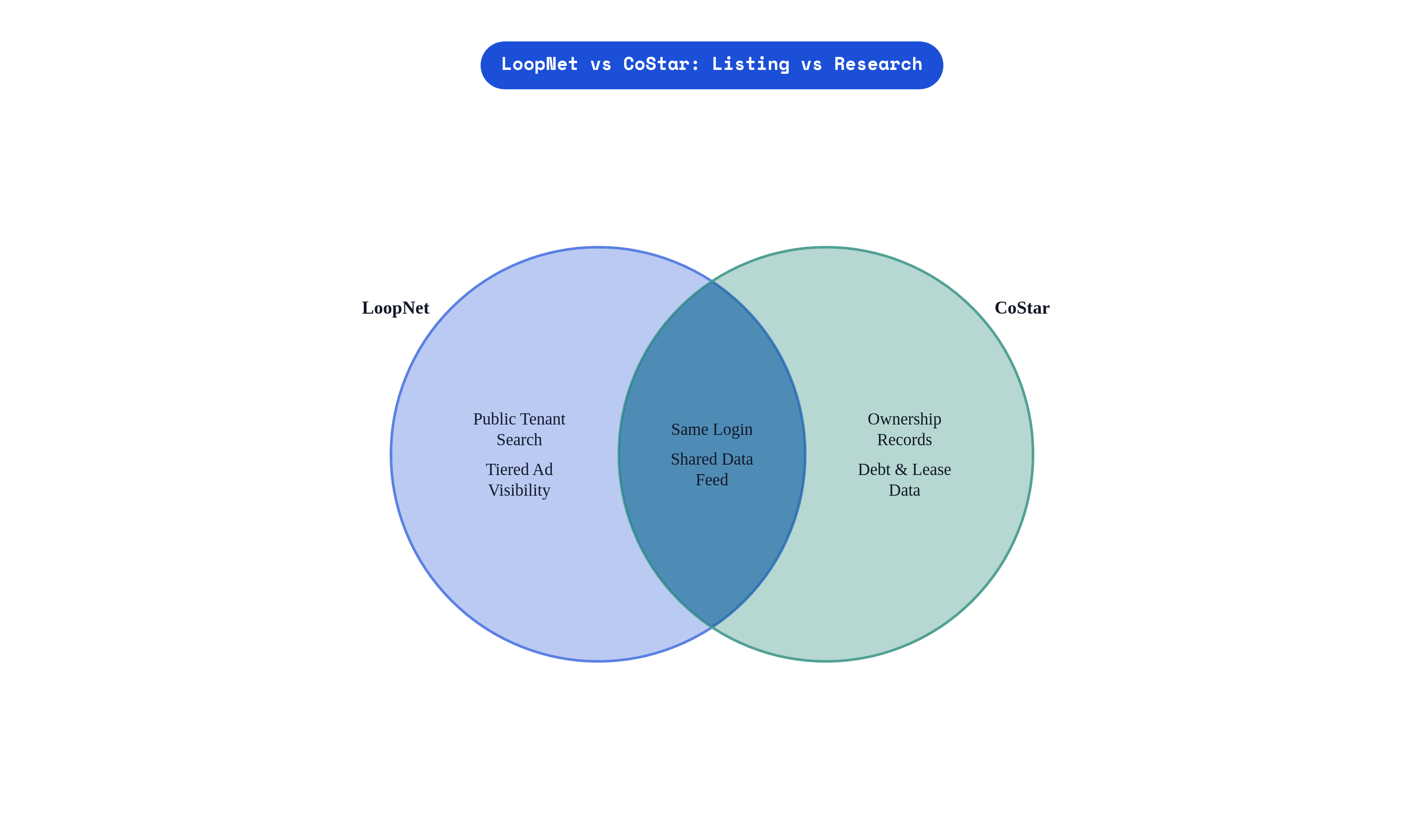
Access is the catch, and it's a real one. CoStar sits behind a subscription, full stop, and tenants without an account don't get in. A broker without a subscription is working half-blind on comps compared to a competitor who has one. CoStar and LoopNet function as two stages of the same pipeline: CoStar's data feeds LoopNet's listings, and a broker who subscribes to CoStar can list there and push out to LoopNet from the same login.
Two more pieces round out the ecosystem. Ten-X, also under CoStar, is the auction arm, built for fast turnarounds on distressed or time-sensitive assets with a hard window between listing and close. CityFeet and Showcase are smaller, more niche surfaces, useful for secondary markets or dense urban exposure, and they still carry CoStar's data underneath.
Crexi as the main alternative with a different balance of access and data
Crexi positions itself as the more open option: public listings paired with a data layer that's grown fast, aimed at being more accessible than CoStar while still competing on inventory depth. Basic search and listing are free. The advanced stuff, comps, analytics, lead tools, sits behind a PRO subscription, which is a meaningfully lower barrier than CoStar for a broker who just wants to kick the tires before committing budget.
The transaction numbers back this up as a real marketplace, not just a browsing site. Crexi has facilitated over a trillion dollars in transactions and billions of square feet leased, proof that deals actually close on the platform rather than just getting window-shopped. Crexi Intelligence, its data product, holds a large database of property records and sales comps, and 2025 updates noticeably improved property-level accuracy, closing some of the gap with CoStar for underwriting work.
Crexi Vault deserves its own mention: an AI tool that takes offering memoranda and deal documents and turns them into structured, searchable data. That matters a lot if you're a broker sitting on forty active pipeline deals and can't remember which OM had the good parking ratio buried on page 12. Crexi Auction has real momentum too; Q3 2025 was the platform's highest-volume quarter yet, with revenue up meaningfully year over year, which suggests it's becoming a legitimate alternative to Ten-X rather than a backup option. There's also an integration with NAR and RPR that bridges residential and commercial data for REALTORS®, handy for anyone crossing between the two worlds.
Crexi fits brokers who want a free entry point with room to grow, tenants frustrated by LoopNet's interface, and investors who want comps without committing to a full CoStar subscription. One catch: PRO pricing isn't posted anywhere public, so budgeting means an actual sales call instead of a quick lookup on a pricing page.
VTS for institutional landlords and the brokers who work with them
VTS is enterprise leasing software built for the landlord side of the table. A tenant looking for space will not find it here, and shouldn't bother trying.
The client list tells you exactly who it's for: Blackstone, Brookfield, Hines, BXP, plus the major brokerages, JLL and CBRE among them, that serve these landlords day to day. If a broker's clients are institutional owners, VTS is probably already baked into how those clients operate. Not knowing the platform means showing up to the meeting without the tools everyone in the room assumes you already have.
The data is the real differentiator: more than 57 billion square feet of leasing signals pulled from actual transactions, described as the largest first-party dataset in commercial real estate. That scale lets VTS spot demand shifts as they happen instead of waiting on a lagging quarterly report to confirm what already happened months earlier. VTS Data claims to capture close to all new demand in core markets, and its own numbers showed national office demand up 16% year over year in Q3 2025, with a forecast of 34 million square feet leased across tracked markets for the year. That context matters if you're advising a landlord on when to hold and when to push.
VTS AI, launched in 2025, takes that leasing signal data and automates lease abstraction, proposal analysis, and benchmarking, speeding up the deal cycle in ways that matter more the bigger the portfolio gets. This tool is built for Class A office landlords, large portfolio managers, and the brokers who serve them. It has nothing to offer a small landlord with one building, or a tenant searching solo on a Tuesday afternoon.
The Yardi ecosystem for operators who want listing and portfolio management in one place
Yardi's pitch is connecting the listing to the property management software, Voyager and Breeze, that the owner is already running, instead of treating the listing as its own separate task. That closes the gap between marketing a vacancy and actually managing the lease once it's signed, so nobody's retyping the same unit data into two systems that don't talk to each other.
CommercialEdge sits at the center as the research and listing management hub: a large nationwide database covering every major asset class, with tools to push listings across Yardi's own network and outside platforms alike. CommercialCafe and CommercialSearch are the tenant-facing search portals; inventory leans toward office and flex space, and coverage runs thinner than LoopNet in most markets, though that gap has been closing. PropertyShark handles ownership and data research, useful for title history and sales records, especially in dense urban markets like New York.
Yardi Matrix is the specialized piece, built for institutional investors and lenders: loan data, lease comps across a large number of U.S. markets, supply pipeline tracking, and its own building class rating system. It's an underwriting tool, so don't go looking for available space there, you won't find it. Recent acquisitions of Hubble and Deskpass signal Yardi pushing further into flex and coworking listings, relevant for any office tenant weighing a flexible space option against a traditional lease.
This ecosystem fits property managers already running Yardi software, brokers who want listing syndication tied directly to property management, and investors doing debt or ownership research. It fits less well for a tenant who wants the broadest possible inventory in one search, or a broker whose clients live outside the institutional owner-operator world entirely.
Niche and supplementary platforms worth knowing by asset class or use case
No single supplementary platform runs the table here. The right pick depends heavily on asset class and what you're actually trying to do, which is a less satisfying answer than a clean recommendation, but it's the honest one.
Industrial and logistics searches sometimes turn up better inventory on specialized industrial portals than on the generalist sites, which tend to under-index that asset class relative to office and retail. Retail listings often show up well on CityFeet for dense urban markets, while smaller regional platforms sometimes carry better hyper-local inventory than any national player manages. Flex and coworking space is where Yardi's Hubble and Deskpass acquisitions come into play, alongside platforms like LiquidSpace, built specifically for tenants who want short-term or shared arrangements outside a standard lease.
Land and special-purpose assets show up on both LoopNet and Crexi, but broker networks and auction platforms, Ten-X and Crexi Auction among them, tend to work better when the asset doesn't fit a standard mold. International work adds another layer: LoopNet runs separate country-specific platforms for the UK, Canada, France, and Spain, so a broker with a cross-border mandate needs to check whether the primary platform actually syndicates overseas or demands a separate listing altogether. Point2, also Yardi-owned, is a high-traffic portal reaching agents and brokers, useful as extra syndication layered on top of a primary platform rather than a replacement for one.
How brokers should decide where to list a given property
The question underneath all of this is simple to state and harder to answer honestly: who is the actual buyer or tenant for this specific asset, and where are they spending their time?
For broad exposure on office, retail, or industrial space, LoopNet remains the default high-reach channel, with ad spend calibrated to the asset's value and how badly it needs to move. For an institutional landlord or a large portfolio asset, the combination looks different: VTS for internal workflow, CoStar for comps and research, LoopNet layered on top for public visibility. A cost-conscious or mid-market broker might start with Crexi's free tier and upgrade to PRO only once lead volume justifies the spend. A distressed or time-sensitive asset probably belongs on Ten-X or Crexi Auction, where a fixed timeline creates urgency that an open-ended listing never quite replicates. An operator already running Yardi software gets the most value out of CommercialEdge, since listing management ties straight into infrastructure that's already sitting there.
Syndication acts as a multiplier. LoopNet feeding into the CoStar ecosystem, or CommercialEdge pushing out across the Yardi network, cuts down the grunt work of listing the same property five separate times. Still, more platforms doesn't automatically mean more qualified leads. Audience fit beats raw exposure count almost every time, and a listing on the wrong platform for the wrong buyer just sits there racking up views from people who were never going to sign a lease anyway.
Content quality matters just as much as platform choice, maybe more. A thin listing with three blurry photos and a one-line description underperforms no matter where it lands, while a listing with a well-written description, real floor plans, and decent photography consistently pulls a better response regardless of the site. This is exactly where brokers who treat listing copy as more than a box to check before a deadline separate themselves from everyone else, because the same building can read like two entirely different opportunities depending on how it's presented.
How tenants should approach the search depending on what they need
Tenants run into their own version of the fragmentation problem, just from the other side of the table. Inventory overlaps across platforms but isn't identical. Some spaces only ever get listed in one place, and data currency varies enough that a listing marked "available" might have gone under contract two weeks ago with nobody updating the status since.
Most tenants should start with LoopNet simply for breadth and name recognition, keeping in mind the experience leans toward what works for brokers over what works for someone clicking through search filters on their lunch break. Crexi makes a good second pass: the inventory mix differs enough by market to be worth the extra look, and the interface tends to be friendlier for someone without a CRE background trying to make sense of cap rates and NNN terms for the first time. For flex and coworking, dedicated platforms built around that exact use case surface options that never make it onto the generalist sites at all, since short-term and shared arrangements don't fit neatly into a standard listing format to begin with.
The practical lesson across all of it: no platform shows you the whole market. Checking two, sometimes with a broker's help reading what the data actually means, beats trusting any single site to show the full picture.