Off-Market Real Estate Listing Platforms for Investors
Small investors now need platforms built for off-market deals to stay competitive.

About 1.2 million homes sold off-market in the U.S. in 2024, roughly 30% of all transactions against 4.06 million total home sales, according to National Association of Realtors data and ResiClub/BatchService analysis. That is a structural shift in where deals actually happen, and it's forcing investors to rethink where they hunt. New listings dropped 1.7% year over year in late 2025, the steepest fall in over two years, squeezing anyone still betting their whole pipeline on the MLS. Meanwhile investors bought about 534,000 homes in 2025, up 0.7% even as overall non-investor sales fell 2.1%, and small investors making fewer than 10 purchases a year made up roughly 63% of that group. This piece walks through the platforms built to serve exactly that crowd, and how to tell them apart before you pay for one.
What the NAR policy shift means for where deals can legally live
The Clear Cooperation Policy is the rule everyone in this space either loves or resents: if a property gets publicly marketed, it has to go into the MLS within one business day. No stalling, no soft-launching to your favorite buyers list for two weeks while you build hype.
NAR softened its own rule in March 2025, though. The reform kept CCP alive but carved out a "delayed marketing exempt listings" category under something called "Multiple Listing Options for Sellers," which lets local MLSs hold a listing back from IDX syndication for however long fits their market. It took effect March 25, 2025, with full rollout required by September 30, 2025. Sellers have to sign a disclosure first, acknowledging they understand they might be trading exposure for privacy, and possibly leaving money on the table.
Here's the loophole that never closed: one-to-one broker-to-broker communication has never triggered CCP. That's the plumbing behind a lot of informal pocket-listing networks, and it's still legal in 2026. Layer on an open DOJ antitrust investigation and you've got a rulebook that's stable on paper but genuinely uncertain in practice. For investors, the takeaway is simpler than it sounds: there's now a defined, sanctioned window where off-market inventory can legally exist before it hits the public feed. Every platform in this guide is built to fish in that window.
The Zillow–Compass battle and what it reveals about the private-listing debate
Two philosophies are colliding in public, and the stakes are real for anyone trying to source deals. Zillow's Listing Access Standards, effective May 2025, ban any listing from ever appearing on Zillow if it was publicly marketed without hitting the MLS within 24 hours. Permanently. For the life of that listing. Compass runs a different playbook: a three-phase model that moves listings through private, coming-soon, and MLS stages on purpose, treating exposure like a dial instead of a light switch.
The scale of the fight is substantial. Of 1,390 listings Zillow refused to display under LAS, all but eight belonged to Compass. Compass responded by filing complaints across 26 states, 55 MLSs, and 30 Realtor associations, a broad and costly effort by any measure. Compass says the ban cut use of its own three-phase program from 39% to 22% of listings between April and July 2025, a real dent.
Compass sued Zillow in June 2025 for anticompetitive behavior, then dropped it in March 2026 after Zillow signaled it might loosen up on pre-marketing. Zillow, in turn, filed a federal antitrust suit of its own against Compass and Chicago's MRED over its Private Listing Network. For investors, the practical takeaway is this: the industry is splitting into open-access and semi-private camps, and picking a platform now quietly means picking a side. That affects what inventory you can even see.
How to read a platform before committing to it
Before you touch any tool mentioned below, ask what job you actually need done. Four things separate these platforms in ways that matter more than any feature list: what deal type they serve (wholesale, flip, BRRRR, buy-and-hold, luxury all attract different sellers and different motivations), whether the platform is a data source or a marketplace, whether it generates leads or supports a transaction that's already negotiated, and what price point and geography it's built around.
That last point has teeth. Small investors buy at a median price of $330,000, well under the overall market median of $440,000, so platforms built around distressed or wholesale inventory tend to skew toward that lower band on purpose. Budget isn't just the subscription fee either; skip tracing, direct mail, and list pulls often get billed separately, so a $99 monthly plan can turn into $300 fast once you start pulling contact data. Where you actually work matters too. Are you at a desk running comps, or driving neighborhoods with your phone mounted on the dash? That answer alone eliminates half the list.
Figure out your strategy before you read another word about any specific platform. The right tool here is the one that fits your deal type, regardless of how long its feature list runs on its pricing page.
PropStream: deep property data for research-intensive investors
PropStream runs a database of 160 million properties with filtering deep enough to satisfy the most detail-oriented analyst: equity position, lien status, pre-foreclosure status, absentee ownership, even estimated renovation costs. Its AI layer, PropStream Intelligence, scores property condition by analyzing MLS photos on a scale running from "disrepair" to "luxury," and separately scores foreclosure probability. That moves the tool past raw data dumps into something closer to a priority list.
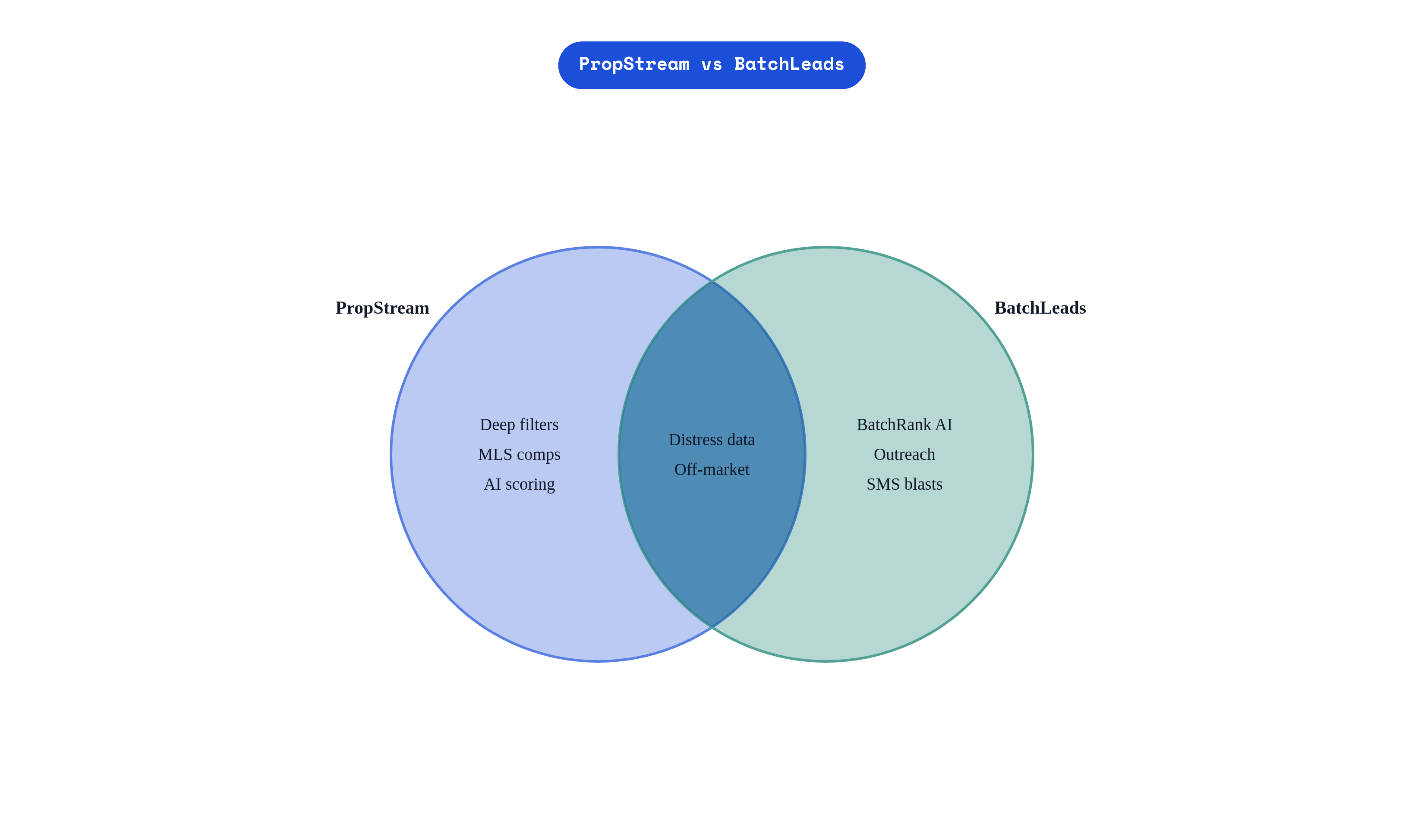
PropStream acquired BatchLeads and BatchDialer in July 2025, which made it the biggest consolidated property-data operation around. Worth knowing, though: BatchLeads still runs its own separate subscription post-acquisition, so you can't yet combine the two and save money. That merger is a promise, not yet a product.
This is the right tool for investors who source from a desk, want accurate comps, and don't mind a learning curve. And there is a learning curve; the depth of filtering rewards someone who already knows exactly what "absentee owner with 40%+ equity in a pre-foreclosure filing" means to their acquisition box. Someone who wants to knock on doors this afternoon will likely find it slower going than a mobile-first tool.
BatchLeads: AI distress ranking and built-in skip tracing for outbound campaigns
BatchLeads answers a question PropStream mostly leaves open: out of everyone on my list, who should I call first? Its BatchRank AI scoring ranks contacts by likelihood to sell, a genuinely different output than PropStream's deeper but unranked filtering.
Skip tracing comes included on every plan here, not billed as an add-on, and that's a real cost difference if you're running outbound calling or texting at any volume. PropStream's strength lies in depth: better filtering, stronger comps, MLS data access baked in. BatchLeads brings prioritization and skip tracing from day one. Since the acquisition hasn't merged the products yet, some investors end up paying for both, using PropStream to build the universe and BatchLeads to rank who gets called Monday morning.
If your operation runs on volume outreach, phone, text, SMS blasts, this is the tool that tells you where to start instead of just handing you a spreadsheet and a shrug.
DealMachine: mobile-first sourcing for investors who drive their markets
DealMachine started as the driving-for-dollars app, and it still does that job better than anyone else in this list. GPS tracks your route, owner lookup happens instantly from your phone, and you can send a personalized mail piece, complete with a photo of the actual house, before you've even left the block.
It offers 700 filters across homeowners and properties, and channels span mail, email, phone, text, and digital. The app carries a 4.8-star rating across more than 5,000 reviews, which tells you something about how much smoother this feels than clunkier desktop-first competitors squeezed into a phone screen. Pricing starts at $99 a month, the lowest entry point of any data tool in this piece.
This is built for investors who are physically out in their market, or anyone who wants the cleanest mobile-to-mailbox pipeline without bouncing between three different apps. Deep comp analysis from an office chair belongs to PropStream; this tool's strength lies elsewhere.
REsimpli: CRM-first platform for investors who want one system from list to close
Here's a friction point almost nobody talks about until they've lost a deal to it: PropStream and BatchLeads are great at finding leads, but neither one manages what happens after the third follow-up call. REsimpli positions itself as an all-in-one CRM covering list pulling, skip tracing, seller contact, AI follow-up, and deal tracking, all under one login.
The pitch is integration, and it's a fair one. Most investors using a pure data tool eventually bolt on a separate CRM anyway, which means double data entry and leads that fall into the crack between two systems. REsimpli removes that handoff entirely.
The tradeoff is real, though: no single feature inside REsimpli is going to out-filter PropStream or out-rank BatchLeads on distress scoring. You're trading best-in-class depth for one clean pipeline. If your problem is that leads go cold in your follow-up process, rather than difficulty finding leads in the first place, that trade is worth making.
InvestorLift: wholesale marketplace for assignment-ready deals
InvestorLift skips the entire lead-generation conversation. It's a marketplace where wholesalers post assignment contracts and investors browse deals that are already under contract and ready to close, a fundamentally different sourcing model than anything above.
Because the deal is pre-negotiated, you move from discovery to letter of intent faster; you're evaluating an assignment instead of cold-calling a homeowner who hasn't decided to sell yet. The tradeoff is that you're not the one setting the price from scratch, so proprietary pricing edge is smaller here than it would be sourcing your own leads.
This fits investors who want transaction volume without the grind of building their own contact list, and active wholesalers who need a reliable buyer network to move inventory fast. Worth flagging: your deal flow here depends entirely on how strong InvestorLift's wholesaler network is in your market, not on any list-building work you do yourself.
Off-Market.io and niche aggregators serving specific asset classes
Off-Market.io aggregates off-market residential and commercial listings, aiming for a more direct line between seller and investor with fewer people standing in the middle taking a cut of the conversation.
Niche aggregators earn their keep with multi-family, commercial, land, and note investors, whose deal types tend to get buried or poorly represented on residential-skewed platforms like PropStream or DealMachine. Findoffmarketrealestate.com and similar directory-style sites serve a similar purpose for investors working specific metros or asset niches where a national platform's filters just don't map onto local deal anatomy.
The tradeoff is volume for signal. A smaller network means fewer listings crossing your desk, but sellers who choose to list on a niche platform are often more motivated than the average name in a broad data pull. Use one of these when your asset class or geography sits outside the residential distressed-property lane that PropStream, BatchLeads, and DealMachine are optimized around.
Mashvisor: rental analysis layered on top of off-market sourcing
Mashvisor solves a problem the data tools above mostly ignore: none of them natively model rental yield. PropStream and BatchLeads are great at surfacing a distressed property, but they won't tell you what it rents for or what your cash-on-cash return looks like five years out.
Mashvisor's marketplace pairs off-market listings with rental income projections, occupancy estimates, and neighborhood-level cash-on-cash data, analytics built for someone planning to hold the property for the long term, not flip it in four months.
This fits small landlords and BRRRR investors trying to figure out if a deal actually pencils before making an offer. Worth being honest about the limits here, though: the off-market sourcing is really a side feature bolted onto the analytics engine. Mashvisor isn't the tool doing the heavy lifting if you already have a deal and just need lead generation.
Matching platform to strategy: a decision map across deal type, budget, and workflow
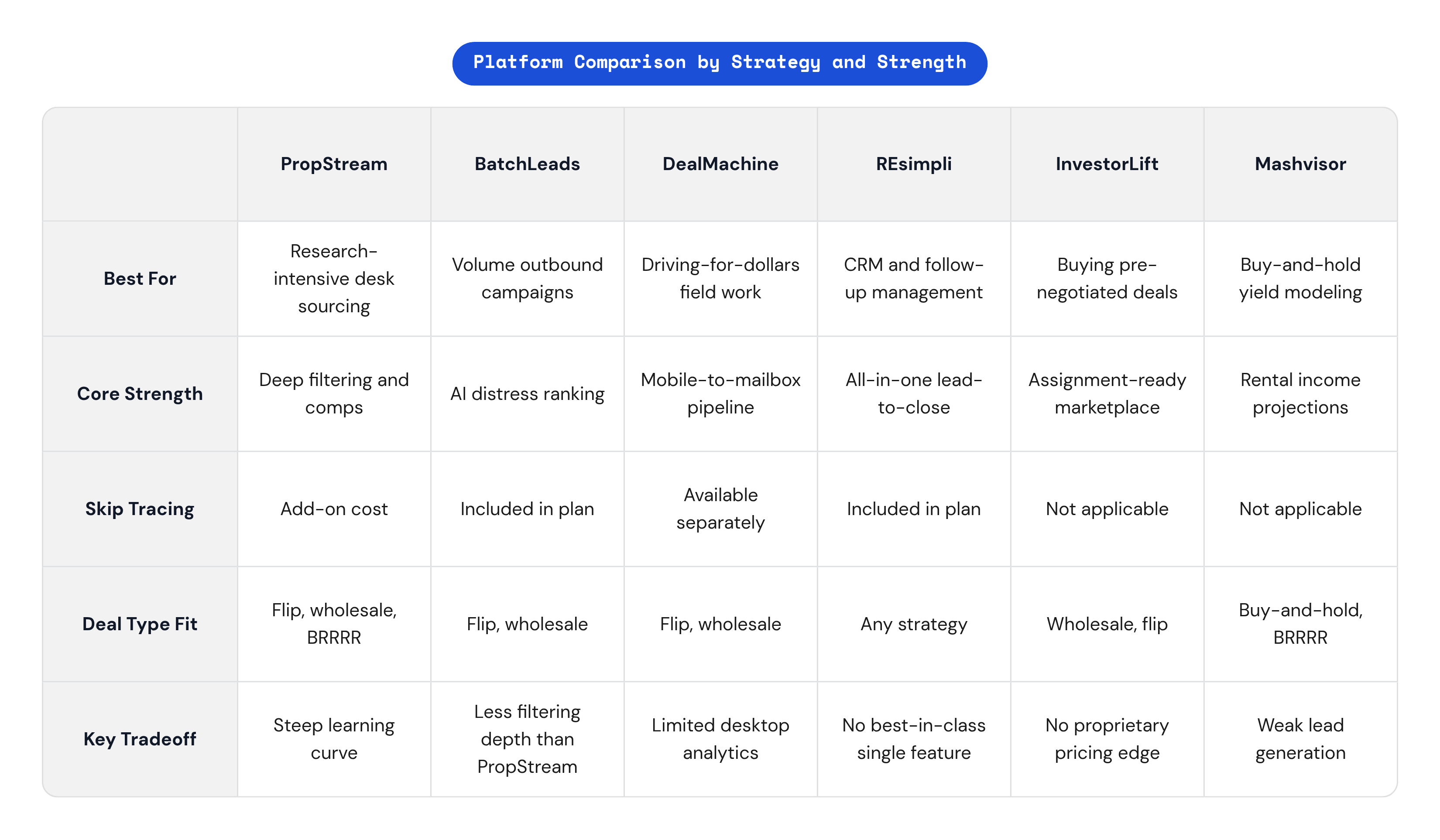
Start with strategy, not software. Fix-and-flip and wholesale investors will get the most mileage from PropStream or BatchLeads for building lists, InvestorLift if pre-negotiated deals sound appealing, and DealMachine if local, on-the-ground knowledge is your actual competitive edge. Buy-and-hold and BRRRR investors should lean on Mashvisor for yield modeling and pair it with PropStream on the sourcing side for distressed-property filtering. Multi-family, commercial, and land investors are usually better served by a niche aggregator like Off-Market.io than by squeezing their deal type into a residential-skewed tool. Anyone chasing luxury or semi-private inventory needs to keep an eye on how Compass's three-phase model and local MLS private networks keep evolving, because that regulatory ground is still shifting under everyone's feet.
Budget and workflow narrow things further. If you're mobile-first and sourcing in the field, DealMachine's $99-a-month entry point is hard to beat. If you're desk-bound and want deep comps, PropStream is the base layer, with BatchLeads bolted on separately if AI-ranked outreach matters to you. If your bottleneck is follow-up, not lead volume, REsimpli closes that gap.
Most active investors run two or three tools at once: one for sourcing data, one for outreach and CRM, one for deal-specific analytics like rental yield. No single platform on this list handles all three well, and that's fine; a tool built for one specific job tends to outperform a generalist trying to do five things adequately. The conditions that created this whole guide, tight supply, rising investor share, and a regulatory picture that's still being litigated in real time, aren't resolving anytime soon. Investors who build a repeatable sourcing system now, rather than waiting for MLS inventory to loosen up, are the ones who'll still be finding deals when everyone else is still refreshing Zillow.