Buyer Agent Search Platforms Ranked by Listing Coverage
Private listing networks now hide a meaningful share of homes from every major search platform.
For most of the internet era, searching Zillow or Realtor.com was functionally equivalent to searching the market. The MLS was the bedrock. If it was listed, you'd see it. That assumption is dead, and two structural forces killed it.
The first is MLS fragmentation. There are 481 separate MLSs operating in the United States as of late 2025, with no uniform national data-sharing agreement. No portal has gap-free coverage across all of them. The seams show most clearly in secondary markets and rural submarkets, where data-sharing agreements between regional MLSs are inconsistent or nonexistent.
The second force is the rise of private listing networks, and this one is accelerating fast. Brokerages are increasingly routing listings through exclusive internal channels before, or sometimes instead of, MLS syndication. Compass disclosed in its Q4 2024 SEC earnings filing that 55% of all new Compass listings in February 2025 started as a private exclusive or coming soon, never reaching the MLS on day one. That is not a rounding error. That is a structural redirection of inventory away from the feeds that power every major portal.
Zillow's own research shows sellers who list off-MLS receive between 1.5% and 3.7% less than comparable MLS-listed homes. Sellers and brokerages pursue private listings anyway, for reasons ranging from privacy to pricing strategy to the economics of keeping both sides of the transaction in-house. The financial incentive for the seller points one direction; the incentive for the brokerage often points another. Think of it as two compasses pointing at different norths — same instrument, entirely different destinations.
What this means practically: even a platform with excellent MLS integration is systematically blind to a meaningful share of available inventory in markets where large brokerages favor private networks. Every platform comparison that follows has to be read against this backdrop.
How the NAR Settlement Changed What a Buyer Agent Search Is Actually For
On August 17, 2024, NAR's $418 million antitrust settlement took effect, representing the most significant structural change to residential real estate transactions in decades. Its effects on how buyers should evaluate search platforms are still playing out.
Two rule changes matter here. MLS listings can no longer advertise buyer agent commission rates. And buyers must sign a written buyer agency agreement specifying agent compensation before they can tour a home. The second rule is the one that changes the platform calculus entirely.
By early 2025, commissions had actually rebounded, running around 2.65% to 2.67%, higher than 2024 levels. The market adapted faster than most predictions anticipated.
But the behavioral shift is real regardless of what happened to commission rates. Buyers are now committing to an agent earlier and more formally than before August 2024. A relationship that used to be implicit, built gradually through showings and follow-up calls, is now contractual from the first tour. That raises the stakes on where a buyer finds their agent in the first place, considerably.
Platforms that surface agent performance data, transaction history, and genuine specialization become more valuable in this environment than platforms that primarily sell visibility to the highest bidder. The question a buyer is asking when they open a search platform is no longer just "what homes are available?" It's "who should I commit to representing me, and does this platform help me figure that out?" Choosing the wrong platform at this stage is less like picking the wrong map and more like hiring the wrong guide before you've even seen the terrain.
Zillow's Listing Breadth and the Tradeoffs Built Into Its Premier Agent Model
Zillow's scale is not in dispute. The platform recorded 221 million monthly unique users as of its Q4 2025 SEC filing, the largest audience of any U.S. portal. Its Zestimate valuation model covers approximately 116 million homes, roughly 80% of U.S. housing stock, updating daily for active listings. Its agent directory is the largest in the country, filterable by neighborhood, specialty, ZIP code, price point, and property type.
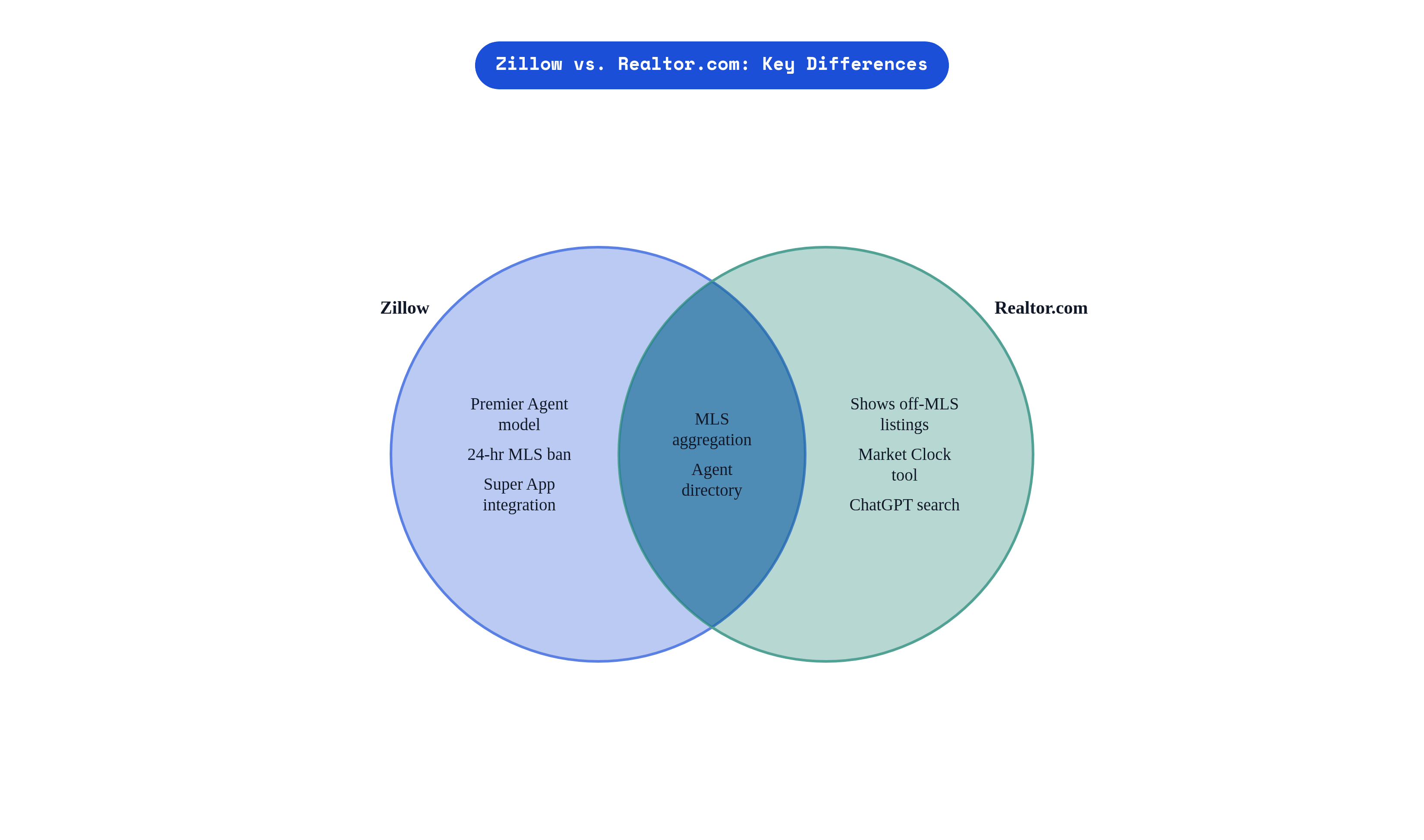
Starting in May 2025, Zillow added a policy designed to defend that breadth: any listing not added to the MLS within 24 hours of public marketing is permanently banned from the platform. The intent was to prevent brokerages from using Zillow's traffic to market homes while simultaneously withholding those homes from the MLS data that powers Zillow's feed. Several major brokerages signed on. Redfin followed. Compass filed an antitrust suit claiming Zillow was abusing market power. On February 6, 2026, a federal judge rejected Compass's request to block the policy, ruling it serves buyers and falls within Zillow's platform rights.
The policy has an enforcement gap worth noting. In Chicago, a private listing network operating through the MRED MLS continued operating without Zillow enforcement action, illustrating how difficult it is to police hundreds of MLSs and hundreds of thousands of agents uniformly. The policy is real. Its application is uneven.
The Premier Agent model is where Zillow's commercial logic and buyer interests diverge most visibly. Agents pay for prominence near listings. The first agent a buyer sees when they click "contact agent" on a listing is not the listing agent and is not necessarily the most qualified agent for that buyer's situation. They are the agent who spent the most on advertising that month. For a buyer who arrives at Zillow thinking they're contacting someone with genuine expertise on a given property, that gap is consequential. Knock knock. Who's there? The agent. Which agent? The one who paid the most — not necessarily the one who knows the most.
Zillow's 2026 Super App integration bundles Zillow Home Loans, ShowingTime for scheduling, and Follow Up Boss for agent CRM into a single platform experience. For buyers who want convenience and a single dashboard to manage the transaction, that integration is meaningful. For buyers who want to maintain independence across mortgage, agent, and search decisions, Zillow's architecture increasingly concentrates those decisions in one place. Know that going in.
Realtor.com's MLS Pipeline Advantage and Its Stance on Private Listings
Realtor.com's historical advantage was its proximity to the NAR data pipeline. That structural edge has narrowed as IDX feed standardization brought other portals onto comparable refresh schedules, but the relationship still shapes the platform's positioning and, in some markets, its data fidelity.
Traffic figures for Realtor.com require a methodological note before citing them as evidence of anything. The platform's CEO cited Comscore data showing 261 million average monthly visits in Q3 2025, with 31% market share. Realtor.com's own internal figure for the same period was 66 million average monthly unique users. That gap, more than fourfold, reflects different measurement methodologies: Comscore measures visits including multi-session users and bots, while unique user counts deduplicate. Neither number is fabricated; they measure different things. Treat all traffic comparisons across portals accordingly, because every company is doing some version of this.
On private listings, Realtor.com occupies a more complicated position than its public statements suggest. The CEO has criticized private listing networks publicly. But Realtor.com's MLS relationships are contractual, and those contracts require it to display all listings flowing through MLS feeds, including Delayed Marketing Exempt Listings. Zillow's ban cannot be replicated without restructuring those agreements, which is not a trivial undertaking. As of April 2025, Realtor.com had offered "thoughtful consideration" on how to handle the new NAR listing options but announced no ban.
For buyers, this creates a specific dynamic. Realtor.com shows listings that Zillow excludes under its 24-hour rule. Whether that's an advantage depends on what you're trying to accomplish. More inventory visible means more inventory to evaluate. But some of those listings are being withheld from peak MLS exposure deliberately, for seller or brokerage reasons, which means the buyer is looking at a listing that wasn't originally meant for broad public marketing.
New tools added in 2025, including a Market Clock feature that gives buyers a local read on market conditions and a ChatGPT integration for simplified early-stage search, are genuinely useful for buyers still in the research phase. Revenue for the platform's parent company grew modestly for the fiscal year ended June 2025, though lead volumes declined due to macroeconomic headwinds. The platform is growing carefully, not aggressively.
Homes.com's Agent-Centric Model and What Its Coverage Numbers Actually Represent
Homes.com reached 100 million average monthly unique visitors for the full year 2025, with January 2026 organic traffic up 134% year-over-year. CoStar has invested $1 billion in the platform since 2021, and the growth numbers are real. But the coverage logic here is fundamentally different from Zillow or Realtor.com, and conflating the two produces a misleading picture of what the platform actually shows.
As of Q4 2025, Homes.com had subscribers paying to promote 216,000 active listings, roughly 9% of all homes for sale in the U.S. at any given point. This is not a comprehensive MLS aggregation. It is a curated subset anchored to agent subscriptions. Agents pay to feature their listings prominently; the platform does not pull in MLS feeds wholesale. A buyer who assumes that high traffic equals comprehensive market coverage is going to miss things, sometimes significant things depending on the market.
That said, the "Your Listing, Your Lead" model has a specific implication for buyers that actually cuts in their favor. When a buyer submits an inquiry on Homes.com, that inquiry routes to the listing agent, not to a competing advertiser. The contact a buyer makes is actually associated with the property. That is a structurally different dynamic than Zillow's Premier Agent placement model, and for buyers who want to speak directly to someone with genuine knowledge of a specific listing, the distinction matters.
Homes.com added an AI search layer in February 2026, powered through Microsoft Azure OpenAI, enabling voice and text-based property search. Users in AI-assisted mode average nearly 17 minutes on site per session versus just over 4 minutes for non-AI users, and they submit significantly more email leads per session. Those are early numbers, but they indicate the AI layer is producing substantively different user behavior, not cosmetic improvement.
The traffic measurement caveat applies here more acutely than elsewhere. Third-party analytics tools reported visit figures for Homes.com in mid-2025 that differed substantially from CoStar's own Google Analytics figures. Both sets of numbers are accurate under their respective methodologies. Portal traffic claims across this industry are not comparable on any like-for-like basis, and Homes.com is the clearest illustration of why.
Redfin's Data Freshness and the Coverage Limits That Come With Being a Brokerage
Redfin's primary technical distinction is update speed. Half of its listings refresh every two minutes, among the fastest cadences of any major portal. In competitive markets where new listings go under contract in hours, that data freshness is a genuine edge, not a marketing claim. Redfin's valuation model also performs competitively on active listings, with an error rate close to 2% for on-market homes, comparable to Zillow's Zestimate on the same category.
The structural constraint is the brokerage model itself. Redfin is not just an aggregator; it is a licensed brokerage that employs agents directly. In markets where Redfin has strong local agent density, that integration produces a coherent experience. In smaller markets or submarkets where Redfin's footprint is thin, coverage narrows materially. The platform's own agents closed an average of more than 23 deals each in 2024, well above the industry average. High caseloads are baked into the model, and buyers should factor that into their expectations for agent availability and attention.
The Rocket Mortgage acquisition, completed July 1, 2025, repositioned Redfin as "Redfin Powered by Rocket," with an explicit goal of reducing total transaction costs by integrating mortgage origination with the home search and agent experience. For buyers who are already Rocket customers or who prioritize integrated financing, the combination is valuable. For buyers who want to shop mortgage products independently, the funnel orientation is something to register clearly before you're three conversations in.
Where Redfin cannot serve a buyer directly, whether due to geographic capacity or agent availability, it routes that buyer to a vetted partner agent through its Partner Program. The referral fee structure is substantial, around 35%, and partner agents are gated by performance data. That quality control is real, but it also narrows the pool of available agents compared to open referral networks.
On private listings, Redfin followed Zillow's May 2025 policy and banned listings not syndicated to the MLS within 24 hours of public marketing. That alignment narrows the inventory divergence between Redfin and Zillow relative to Realtor.com, which has taken no such step.
Agent-Matching Platforms That Don't Carry Listings and Why Their Coverage Logic Is Different
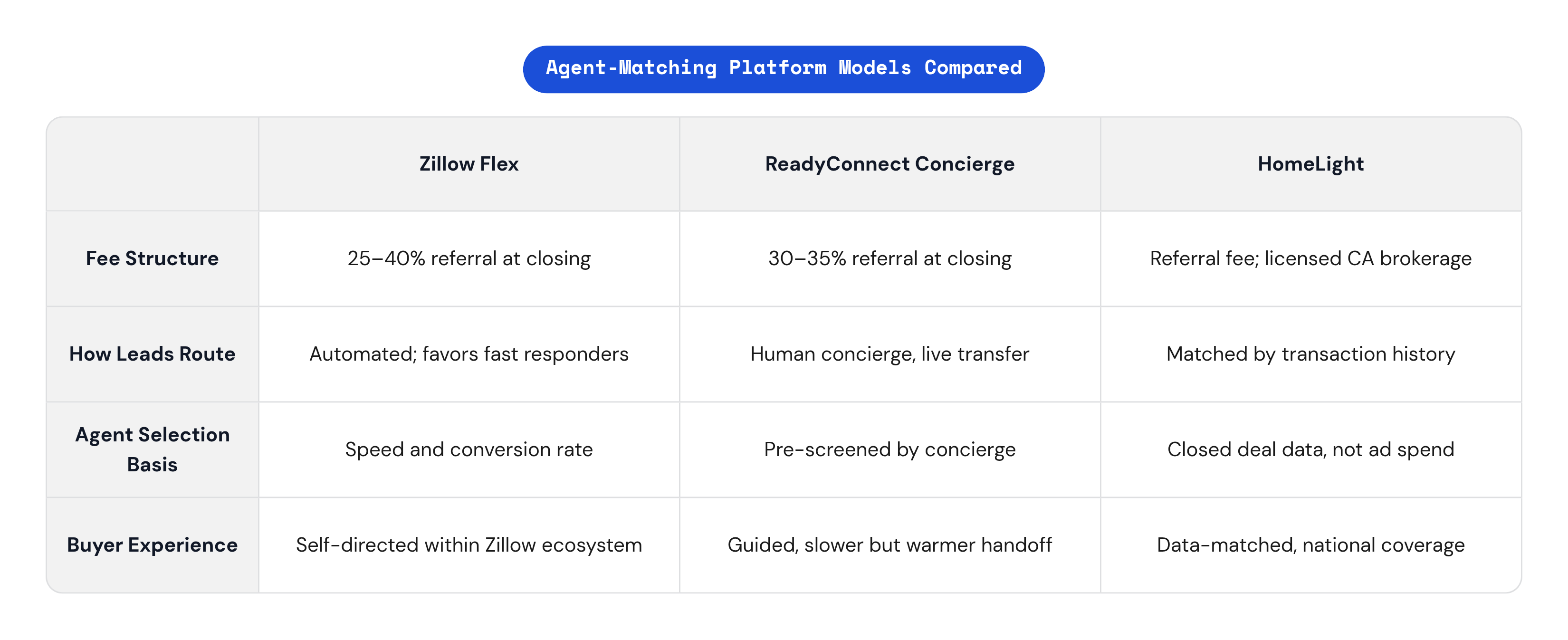
Agent-matching platforms operate on a different axis entirely. They carry no proprietary listing databases. Coverage here means agent network depth and vetting rigor, not MLS integration. Treating these platforms as listing search tools produces conclusions that don't hold.
Three models are worth distinguishing. Zillow Flex operates on a pay-at-closing referral structure, typically 25 to 35% of gross commission, reaching 40% in high-priced markets. Leads route more frequently to agents who respond quickly and convert at high rates; agents who don't perform get deprioritized. It functions as a meritocratic funnel inside Zillow's ecosystem, which is a substantively different dynamic than paying for static visibility.
Realtor.com's ReadyConnect Concierge, formerly branded as Opcity, uses a human concierge to pre-screen leads and execute a live transfer to an agent. The referral fee at closing runs 30 to 35% depending on price band. The handoff is slower than an automated system but warmer; by the time an agent receives the call, the buyer has already been qualified. For buyers, the experience is more guided than self-directed portal browsing, which some people genuinely prefer and others find irritating.
HomeLight describes itself as the largest agent-matching service in the U.S. and operates as a licensed brokerage in California. It matches buyers to agents based on transaction history data rather than advertising spend, a meaningful philosophical distinction from visibility-based models. The platform has raised substantial funding and has the infrastructure to support national coverage.
For buyers navigating this category, the operative question is not which platform shows more listings but which platform has agents with verifiable track records in the buyer's specific geography and property type. Post-NAR settlement, that question carries more weight than it ever did before, because the written buyer agency agreement requirement means buyers are committing to compensation terms at the outset of the relationship. How a referral platform's fee structure shapes the agent relationship is part of evaluating whether that platform actually serves the buyer's interests.
How to Match Platform Choice to Market Type and Buyer Situation
No single platform wins across all situations. The right choice depends on the buyer's specific market, property type, price tier, and where they are in the decision process.
In metros with heavy penetration by brokerages that favor private listing networks, Zillow's 24-hour MLS syndication ban actually reduces the inventory a buyer sees, because those listings are routed through private channels that never trigger the Zillow feed. In those markets, a platform that maintains MLS contractual relationships regardless of private listing activity, such as Realtor.com, surfaces more inventory, even if some of it arrived there for complicated reasons.
Property type matters too, and this is where a lot of buyers get caught off guard. New construction sits largely outside standard MLS feeds. Builder-direct listings often require going directly to builder websites or working with agents who have established builder relationships. Platforms that rely primarily on MLS syndication will have structural gaps in new construction coverage that no policy update will fully close.
Where the buyer is in the process shapes the choice as well. Early-stage research benefits from tools like Realtor.com's Market Clock or Homes.com's AI search layer, which help contextualize markets before any agent commitment is made. A buyer ready to move quickly benefits from Redfin's data freshness or Zillow's agent directory filtered by transaction history.
And what the buyer needs from the agent relationship matters most of all. A buyer who wants direct contact with listing agents and clear routing logic should look at Homes.com's model. A buyer who wants performance-vetted agent matching based on closed transaction data should look at HomeLight or Zillow Flex. A buyer who is already a Rocket customer and wants an integrated mortgage and search experience has a clear reason to start with Redfin.
The platform shapes the agent, and the agent shapes the transaction. In a market where inventory is fragmented, private listing networks are growing, and buyer agency agreements are contractual from the first tour, that sequencing is the most consequential early decision a buyer makes. Everything downstream follows from it.