iBuyer Platforms and Instant Offer Marketplaces Compared
iBuyers split into four competing models solving different seller problems.

Fewer than 1% of all home sellers used an iBuyer as of mid-2025, according to the NAR Realtors Confidence Index. That number gets treated like a verdict. It isn't one.
The national figure flattens what is actually a city-by-city story. During peak activity in Q4 2021, iBuyers claimed 1.7% of national home sales before pulling back to 1.3% by Q1 2022. Sun Belt markets told a different story entirely. Raleigh hit 2.9% in Q1 2021. Atlanta reached 6% of residential sales in 2022. In tight inventory markets where contingency offers routinely get passed over, those concentrations aren't marginal. They reflect something real about where the product actually fits.
The broader cash-buyer picture adds useful context. All-cash purchases reached 39.1% of home sales in 2025, the highest share since 2013, per ATTOM data. iBuyers account for a small fraction of that total; the rest flows from individual investors and second-home buyers operating entirely outside any platform. iBuyers aren't driving the cash economy. They're a specific instrument inside it, one calibrated for a specific kind of seller.
That seller isn't chasing the highest number. They're navigating a relocation deadline, an estate settlement, a divorce, or a genuine aversion to the theater of open houses and weekend showings. They're buying certainty, and certainty has a price. That narrowness, more than any competitive dynamic, is what pushed the category into four distinct models. When your addressable market is defined by a psychological profile rather than a price point, you stop competing for the same customer and start solving different problems.
The Four Models the iBuyer Space Has Split Into
Two pressures drove the fragmentation, and they're worth understanding separately because they pushed the category in different directions at the same time.
The first was margin compression. Buying homes at scale with proprietary capital through volatile rate environments is expensive in a way that doesn't soften with time or efficiency gains. The companies that pushed maximum velocity in 2021 and 2022 found this out in the most expensive way possible. The second pressure was a discovery about seller behavior: a single take-it-or-leave-it cash offer turned out not to be what every seller wanted from a technology-enabled transaction. The original premise assumed the problem was friction. For many sellers, the problem was something else entirely.
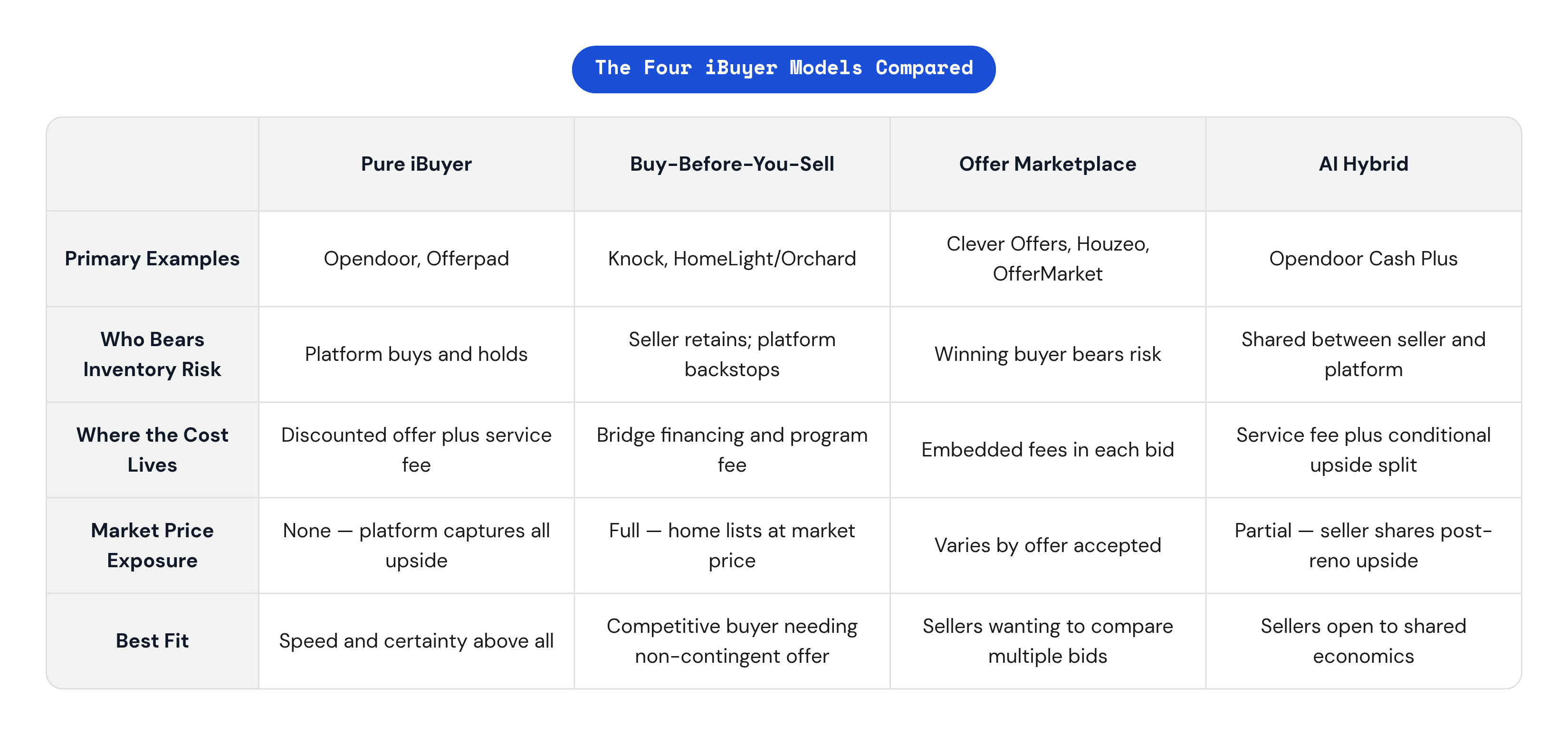
Each of the four models that emerged carries inventory risk differently, structures fees differently, and automates the process to a different degree.
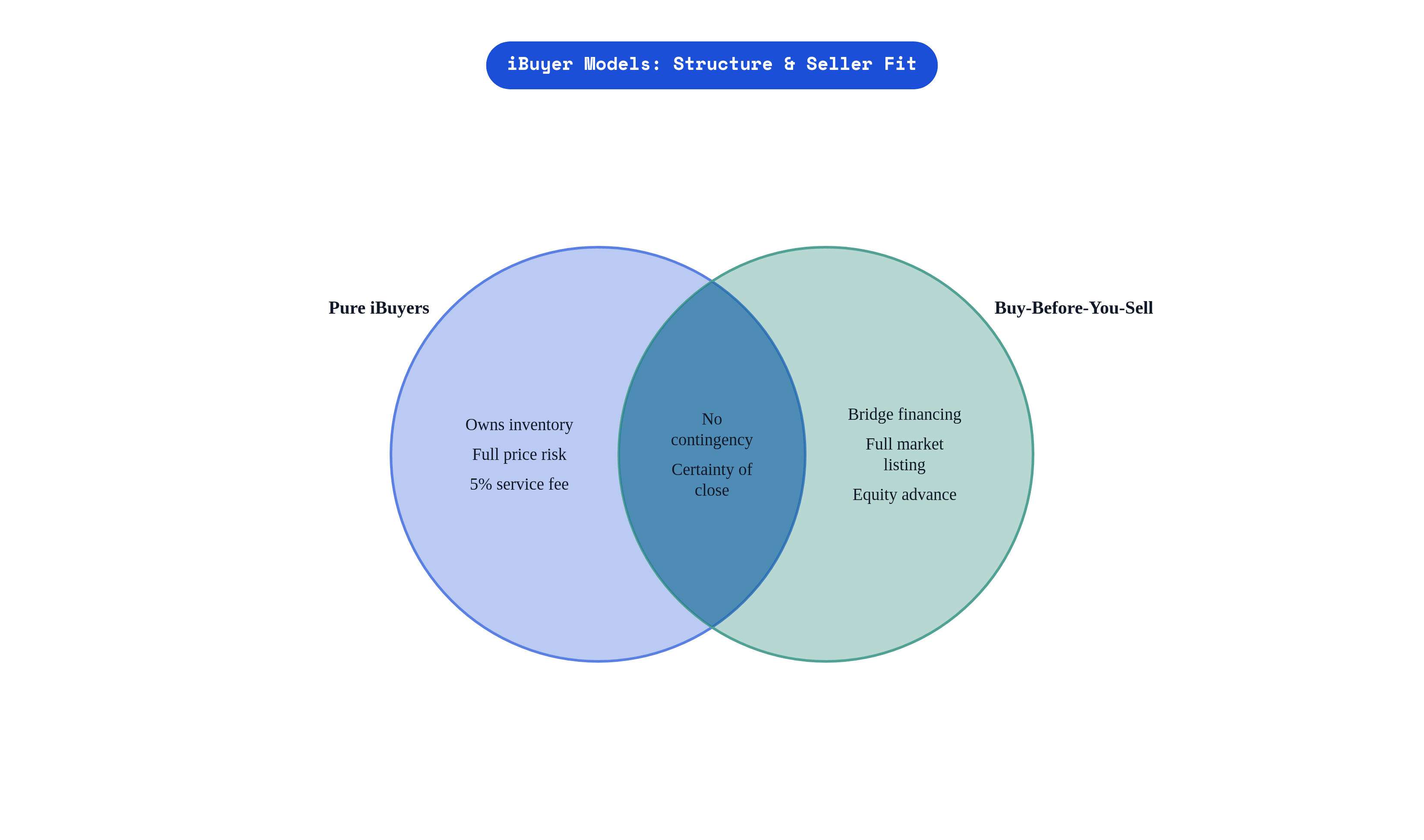
The pure iBuyer, Opendoor and Offerpad being the primary examples, buys the home outright. The company owns the asset between purchase and resale. The spread between acquisition price and eventual recovery is the business.
The Buy-Before-You-Sell platform, represented by Knock and HomeLight's acquired Orchard product, solves an entirely different problem. The seller doesn't sell to the platform. Instead, the platform advances equity or bridge financing so the seller can make a non-contingent offer on a new home before the current one sells.
The offer marketplace, platforms like Clever Offers, Houzeo, and OfferMarket, doesn't buy homes at all. It aggregates competing cash bids from multiple iBuyers and investors and surfaces them simultaneously. The platform is an intermediary, not a principal.
The hybrid AI-powered platform is the emerging fourth category. Opendoor's 2025 strategic pivot is the most developed public example of where it is heading, and it's worth examining closely because it signals something about the durability of every model in the space.
Pure iBuyers: How Opendoor and Offerpad Price, Charge, and Operate
Opendoor controls approximately 67% of total U.S. iBuyer volume, operating in more than 50 markets across 26 states and Washington, D.C. The core fee is 5%, applied as a service charge on top of any repair credits the company requests after inspection. That's the number you see in the marketing. It is not the number that determines your outcome.
The financial profile of running this business at scale is instructive. In Q2 2025, Opendoor posted revenue of $1.567 billion on 4,299 homes sold, generating gross profit of $128 million against a net loss of $29 million. That same quarter marked the company's first positive Adjusted EBITDA, $23 million, since 2022. At the end of Q1 2025, Opendoor held an inventory balance of $2.4 billion representing 7,080 homes. That is not a software company's balance sheet. It's a real estate investor's balance sheet, carrying full exposure to rate moves and demand shifts, and the distinction matters for understanding why the model behaves the way it does.
The revenue trajectory shows the vulnerability plainly: $15.6 billion in 2022, down to $6.9 billion in 2023, then $5.2 billion in 2024, and $915 million in Q3 2025 alone, still down 33.5% year-over-year. Accurate acquisition pricing and liquid markets keep this model solvent. When either condition breaks, losses compound quickly.
Offerpad operates across nine states, Arizona, Florida, Georgia, Indiana, Nevada, North Carolina, Ohio, South Carolina, and Texas, and differentiates on flexibility rather than footprint. Closing windows run from 8 to 90 days, and the company includes perks like complimentary local moves. In Q2 2025, Offerpad posted revenue in the low hundreds of millions of dollars on 452 homes, with a gross margin in the high single digits and an Adjusted EBITDA loss in the low single-digit millions. For scale context: Opendoor bought roughly six times as many homes across all of 2025.
Here is the structural reality both companies share, and the thing most sellers miss before signing anything. The stated service fee is a floor, not a ceiling. The actual cost is the spread between the offer price and what the home would fetch on the open market, and these two figures are rarely presented together on a seller's net sheet. The FTC's $62 million enforcement action against Opendoor, which distributed funds to more than 54,000 homeowners at an average of roughly $1,024 each, was specifically about that gap: what the marketing promised versus what sellers actually netted. The regulator didn't find the model fraudulent. It found the marketing overstated the proceeds sellers should expect. That distinction is worth sitting with.
Buy-Before-You-Sell Platforms and Who They Are Actually Designed For
The problem BBYS platforms solve has nothing to do with what Opendoor or Offerpad addresses. They're solving for a different moment entirely.
In competitive housing markets, submitting an offer contingent on selling your current home puts you at a structural disadvantage from the moment the offer lands. Sellers prefer certainty, and a contingency is the opposite of that. Traditional bridge loans exist to solve this, but they're opaque in pricing and operationally cumbersome in ways that surface at the worst possible moment in a transaction.
BBYS platforms insert themselves into that gap. The mechanics: the platform assesses your current home and advances a portion of its equity, either through a bridge loan, an equity unlock product, or a guaranteed backup purchase commitment. You use those advanced funds as a down payment on a new property, make a clean non-contingent offer, and compete on equal footing with buyers who have no contingency of their own. The current home then lists on the open market at full market price. If it sells within the program window, you capture the upside. If it falls outside the window, the platform steps in as buyer of last resort at a pre-agreed price.
Knock's Home Swap follows the bridge loan architecture with a guaranteed backup purchase embedded. HomeLight, which acquired Orchard, offers a Buy Before You Sell program that advances a set percentage of your home's equity before the property even lists.
The cost structure is fundamentally different from a pure iBuyer. There's a program fee on the equity advance and potential carrying costs if the two transactions don't resolve in clean sequence. But you retain full market exposure on the sale itself. The cost lives in the financing mechanism, not in a discounted offer.
This model suits one specific seller: someone in a competitive buyer's market, confident in their home's value, whose primary obstacle is the contingency rather than the sale itself. It isn't built for speed-above-all scenarios, or for sellers who simply want to avoid managing showings. BBYS also requires platform availability in your market and imposes condition and price-band eligibility requirements that many homes won't satisfy. If your situation fits, it's genuinely elegant. If it doesn't, the product doesn't bend.
Offer Marketplaces: What Competing Bids Look Like in Practice
An offer marketplace inverts the pure iBuyer relationship entirely. Instead of approaching one company and receiving one offer, you submit your property information once and the platform routes it to a network of iBuyers, institutional investors, and cash buyers who compete for the transaction. You compare bids and choose.
The platform earns revenue through referral fees or success fees, paid by the winning buyer, the seller, or both, depending on the platform's structure.
Clever Offers aggregates bids from Opendoor, local cash buyers, and other iBuyers, pairing sellers with a local agent to navigate the comparison. No cost to the seller. Houzeo is a tech-forward MLS listing platform that surfaces iBuyer offers alongside traditional buyer offers simultaneously; sellers pay a flat listing fee and gain exposure to multiple offer types in a single interface. OfferMarket skews toward investors and landlords rather than typical owner-occupants, connecting sellers to a pool of institutional and semi-institutional cash buyers.
The practical limitation is this: volume of offers is the same as quality of offers only when buyers are genuinely competing. Some bids arriving through a marketplace will be structured to leave maximum margin for the buyer. The discipline required is identical to any negotiation: know your number before you see theirs. Without a clear sense of your home's open market value, a collection of competing bids can feel more validating than it actually is.
What marketplaces expose almost incidentally is where pure iBuyer offers actually land in a competitive field. When sellers can compare bids side by side, Opendoor and Offerpad frequently land below the field. The single-platform experience obscures this because there's no comparison available. Once you can see all the bids simultaneously, the picture changes in a way that's hard to unsee.
The AI Pivot Opendoor Made in 2025 and What It Signals for the Hybrid Model Category
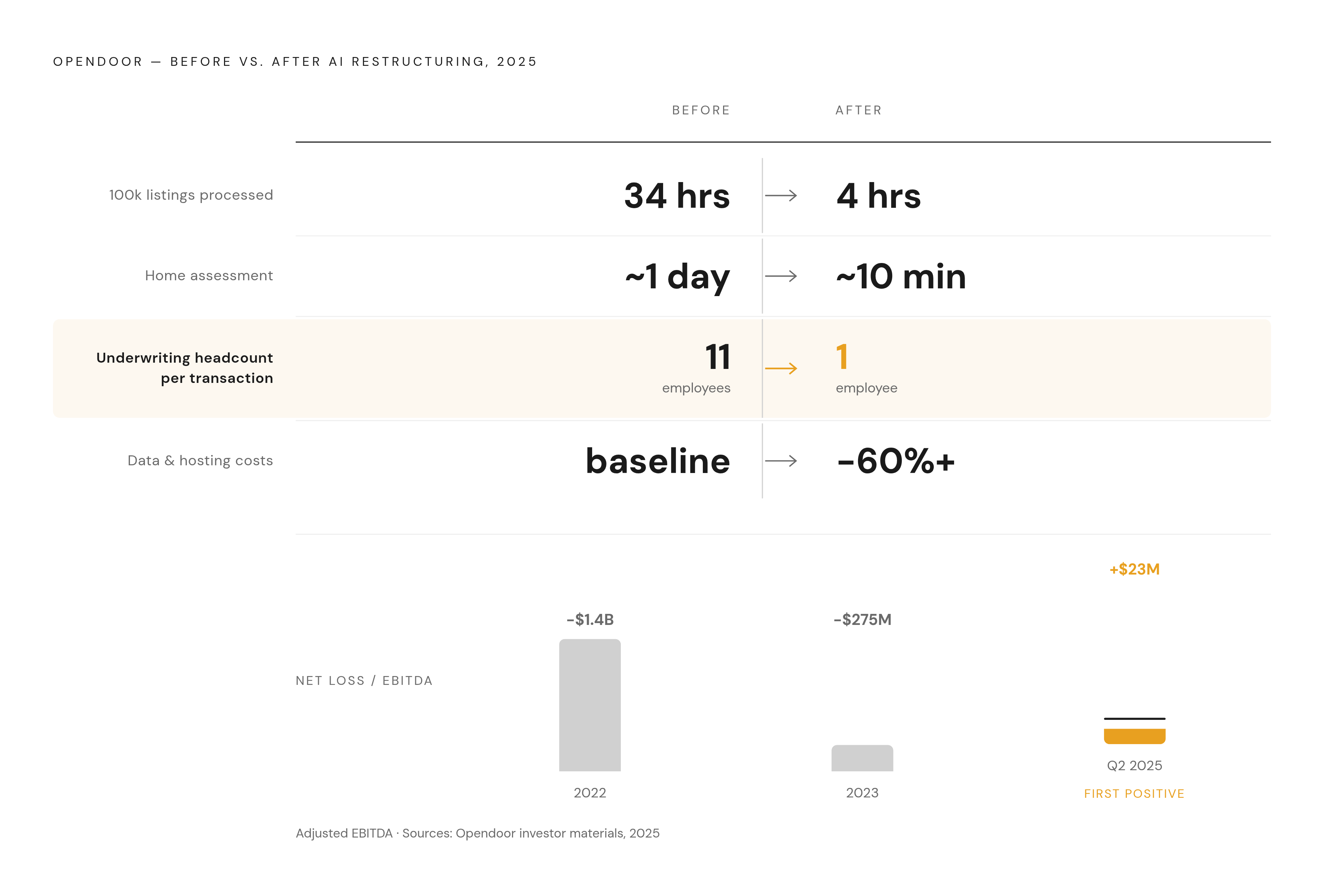
Opendoor's losses between 2022 and 2024 explain why the pivot was inevitable. A net loss of $1.4 billion in 2022, narrowing to $275 million in 2023, reflects what happens when a company bets its balance sheet on home price appreciation through a rate shock and loses. There is no software shortcut to avoiding a mispriced acquisition. The business of holding home inventory through volatile markets is punishing in a way that compounds quarterly, and three consecutive years of that punishment produces clarity about what needs to change.
Kaz Nejatian, formerly COO at Shopify and now Opendoor's CEO, declared in October 2025 that the company is refounding itself as a software and AI company. The operational changes already in place give that declaration credibility.
AI vision models replaced manual third-party appraisals. Processing 100,000 listings dropped from 34 hours to four. Annual data and hosting costs fell by more than 60%. Home assessments that previously required nearly a full day now take roughly 10 minutes. Underwriting headcount per transaction went from as many as 11 employees to one. The company also automated title and escrow workflows, deployed multilingual AI valuation agents, and rebuilt its inspection system. These aren't incremental improvements; the cost structure of the underlying business changed in a material way.
The product-level expression of the pivot is Cash Plus. Opendoor makes an upfront cash offer, renovates the home, and relists it on the open market. If the renovated property sells above all-in costs, the original seller receives a share of the upside. That's a genuine departure from the original model, where the seller absorbed a discounted offer and Opendoor captured all subsequent appreciation. Cash Plus creates a shared economics structure closer to a partnership than a straight purchase, and that shift carries implications for how sellers should evaluate the platform.
Early financials point in the right direction. Q4 2025 revenue beat analyst expectations by a substantial margin, and home acquisitions rose 46% quarter-over-quarter.
What Opendoor is building, structurally, is a platform that earns fees for orchestrating transactions rather than absorbing all the price risk itself. That shifts its economic profile closer to an offer marketplace than to the original iBuyer model, even as it retains direct purchasing capability. If the model holds, it suggests that AI-driven cost reductions allow a direct-purchase business to operate at lower fees and higher volume simultaneously, essentially the inverse of where the model stood in 2022. That would be a meaningful proof point for the entire category, not just Opendoor.
How to Read the Cost of Each Model as a Seller
Every model in this space carries three components that together determine your actual outcome: the discount from market value embedded in the offer, the explicit fee or program charge, and the carrying costs the model either eliminates or introduces. Any analysis that focuses on just one of those three will mislead you.
With a pure iBuyer, Opendoor's stated 5% service fee is the starting point. Repair credits requested post-inspection reduce the net further. The offer itself typically prices the home below what a well-executed traditional listing would achieve. What you get in exchange for that gap is real: certainty of close, no showings, no contingencies, no deal collapsing at the inspection table. For a seller under time pressure or managing a life transition, that certainty has genuine value. The question isn't whether the premium is large; it usually is. The question is whether it's proportionate to your specific circumstances. Sometimes it is.
With a BBYS platform, the explicit cost is the program fee on the equity advance, plus potential carrying costs if the two transactions don't close in clean sequence. There's no offer discount because the home lists at market price. You retain the upside from a competitive listing while eliminating the contingency obstacle. The cost lives in the bridge, not in the exit.
With an offer marketplace, the fee structure varies: some platforms charge sellers nothing and recoup from the buyer side, others charge a flat listing fee. The offers that arrive carry their own embedded service fees from participating iBuyers. Net proceeds depend on which offer you accept and how much genuine competitive tension the marketplace generated. The best case is materially better than any single-platform offer. The worst case is a collection of lowball bids and two wasted weeks.
With Opendoor's emerging hybrid model, the cost calculus is still evolving. Cash Plus introduces the possibility of post-sale upside participation, which changes the math in ways a simple fee comparison won't capture. A seller who would have absorbed a discounted price under the traditional iBuyer structure, under Cash Plus, may recover some of that spread if the renovated resale performed well. That conditionality is new, and it's the variable worth tracking most closely as the program scales.
Before engaging any of these platforms, build your own net sheet. Estimate what your home would sell for on the open market, then evaluate every offer against that anchor. No platform will build that sheet for you, and none of them has an incentive to.