Property Management Software for Independent Landlords
Enterprise software wastes money and workflows on features small landlords never need.

The property management software market is projected to grow from roughly $3.61 billion in 2025 to nearly $5.89 billion by 2033. Almost none of that growth is being built for landlords who own four units.
Enterprise operators managing hundreds or thousands of units command the most product development attention because that's where vendor revenue concentrates. The platforms that result are loaded with multi-entity accounting, investor portals, commercial lease modules, staff permission hierarchies, and org-level reporting dashboards. A solo landlord with four units needs none of that. You end up paying for features you'll never open, navigating menus designed for teams, and wrestling with a tool that manufactures work instead of reducing it.
Pricing compounds the problem in a specific, underappreciated way. Per-unit minimums mean a landlord with five properties often pays the same base cost as one with fifty. Some platforms set explicit unit floors that effectively exclude small portfolios by design. And the advertised price is almost never the real number once screening fees, ACH charges, and locked feature tiers enter the picture.
This isn't about wanting simpler software. It's about needing differently scoped software: tools calibrated to the workflows a solo landlord actually runs, not enterprise platforms with the advanced modules obscured behind an upgrade wall.
The Three Workflows That Actually Matter for a Small Portfolio
Every other feature in a platform evaluation is secondary noise until these three are working correctly.
Rent Collection and Payment Tracking
Automated payment reminders and ACH collection reduce late payments and eliminate the awkward manual follow-up that most landlords quietly dread. This is the workflow where software earns its keep fastest, often within the first billing cycle. If a platform does this well and nothing else, it's still ahead of a spreadsheet and a text thread.
Tenant Screening and Leasing
With four units, one bad placement costs you months of income, legal fees, and the particular misery of an eviction process. The screening decision is the highest-stakes judgment call in the entire management cycle, and the right platform supports it without forcing you out of the workflow midway.
What that means practically: integrated credit and background checks, state-specific lease templates, and e-signature capability inside the same tool. What it means to avoid: platforms that redirect you to a third-party screening service mid-process, adding a separate fee relationship and splitting your workflow across multiple logins. Leasing should be contained.
Maintenance Tracking and Expense Recording
Disorganized expense records mean deductions left on the table at tax time, and at small-portfolio scale that's a more common problem than landlords admit. A landlord spending fewer than four hours a month on management needs maintenance requests, vendor communication, and expense logging consolidated in one place. The goal is clean Schedule E documentation, not full GAAP accounting. Platforms that understand this build accordingly. Platforms that don't bundle accounting suites designed for businesses with bookkeeping staff, which just creates a different kind of overhead.
Investor reporting, multi-entity accounting, and commercial lease modules fall entirely outside the core for most solo landlords. A platform that leads with those features is not designed for this buyer.
How the Current Platform Tiers Actually Break Down
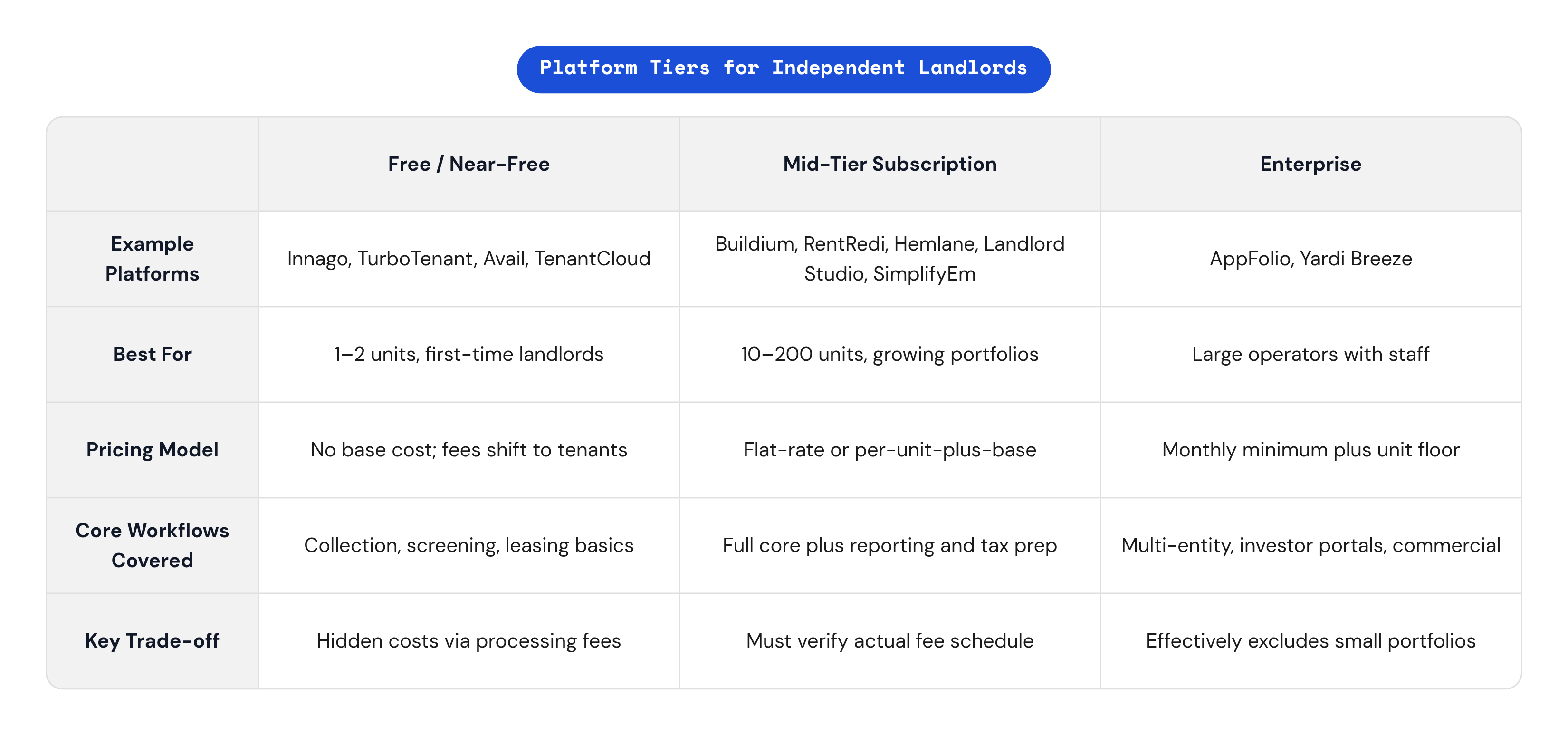
Three meaningful tiers exist for independent landlords, defined by portfolio size and pricing model. Understanding where each tier begins and breaks down is more useful than reading any individual platform's marketing page.
Free and Near-Free Tools
Innago, TurboTenant, and Avail serve landlords in the one-to-twenty-unit range at no base cost. TurboTenant offers free access for unlimited properties, with a premium tier at roughly $149 per year. Avail provides a free plan for smaller portfolios. TenantCloud offers a free entry point with a higher unit ceiling before paid plans begin.
These platforms cover the three core workflows adequately. They're the right starting point for a landlord with one or two properties, or for anyone who hasn't yet determined which tasks actually consume their time.
The free model doesn't eliminate costs; it relocates them. The revenue has to come from somewhere, and it typically comes from tenants via application fees and ACH processing charges passed to applicants and renters. That affects who applies and what their first financial interaction with you feels like. Know who pays what before your first tenant calls to dispute a $2.50 processing fee on their rent payment, because that call will come.
Mid-Tier Subscription Tools
This tier serves landlords managing roughly ten to two hundred units and represents the most genuinely competitive segment of the independent landlord market.
Buildium starts at $62 per month with no unit minimum, meaning you can access mid-market software before your portfolio formally justifies it. It covers ACH collection, maintenance tracking, TransUnion tenant screening, and owner reporting. The no-minimum entry is its real differentiator for small landlords who want room to grow without switching platforms at an inconvenient moment later.
RentRedi runs on a flat-rate subscription at the lower end of the monthly price range and prioritizes simplicity over feature depth. Fast setup, no complicated onboarding. If you want to be operational in an afternoon, it delivers that.
Landlord Studio offers a free plan with paid tiers starting modestly. Its clearest differentiation is expense tracking and tax preparation workflows. It's particularly well-suited for landlords who think about their portfolio primarily through the lens of what they hand their accountant in April, a framing that more landlords should probably adopt.
Hemlane uses per-unit-plus-base-fee pricing and offers something genuinely unusual: a 24/7 human repair coordination desk on its higher tier. I've watched landlords dismiss this feature as unnecessary right up until the moment they needed it. A tenant's water heater fails at 11 p.m. on a Thursday. You're three time zones away. Without that coordination layer, you're either the one making calls you don't have the context to make efficiently, or the problem sits until morning and gets worse. For landlords managing at a distance or those whose schedules don't accommodate midday repair calls, that single feature can justify the cost differential over competing tools.
SimplifyEm uses flat-tiered pricing with no per-unit charges, which produces predictable monthly costs as a portfolio grows. For landlords who want to eliminate billing surprises entirely, that structure has practical value.
Enterprise Tools
AppFolio carries both a monthly minimum and a unit floor that effectively disqualifies it for small portfolios. Yardi Breeze targets smaller operators than AppFolio but arrives with a learning curve built for teams. Both are worth naming here so they can be ruled out deliberately rather than discovered and abandoned after several hours of evaluation.
The Hidden Cost Problem That Pricing Pages Don't Show
Advertised base pricing is almost never the real number.
Common additions that appear after sign-up include tenant screening fees ranging from roughly $15 to $35 per application, payment processing fees calculated as a percentage of rent collected, and gated access to features like e-signatures, premium listing syndication, and document storage that many landlords assume are included in the base price.
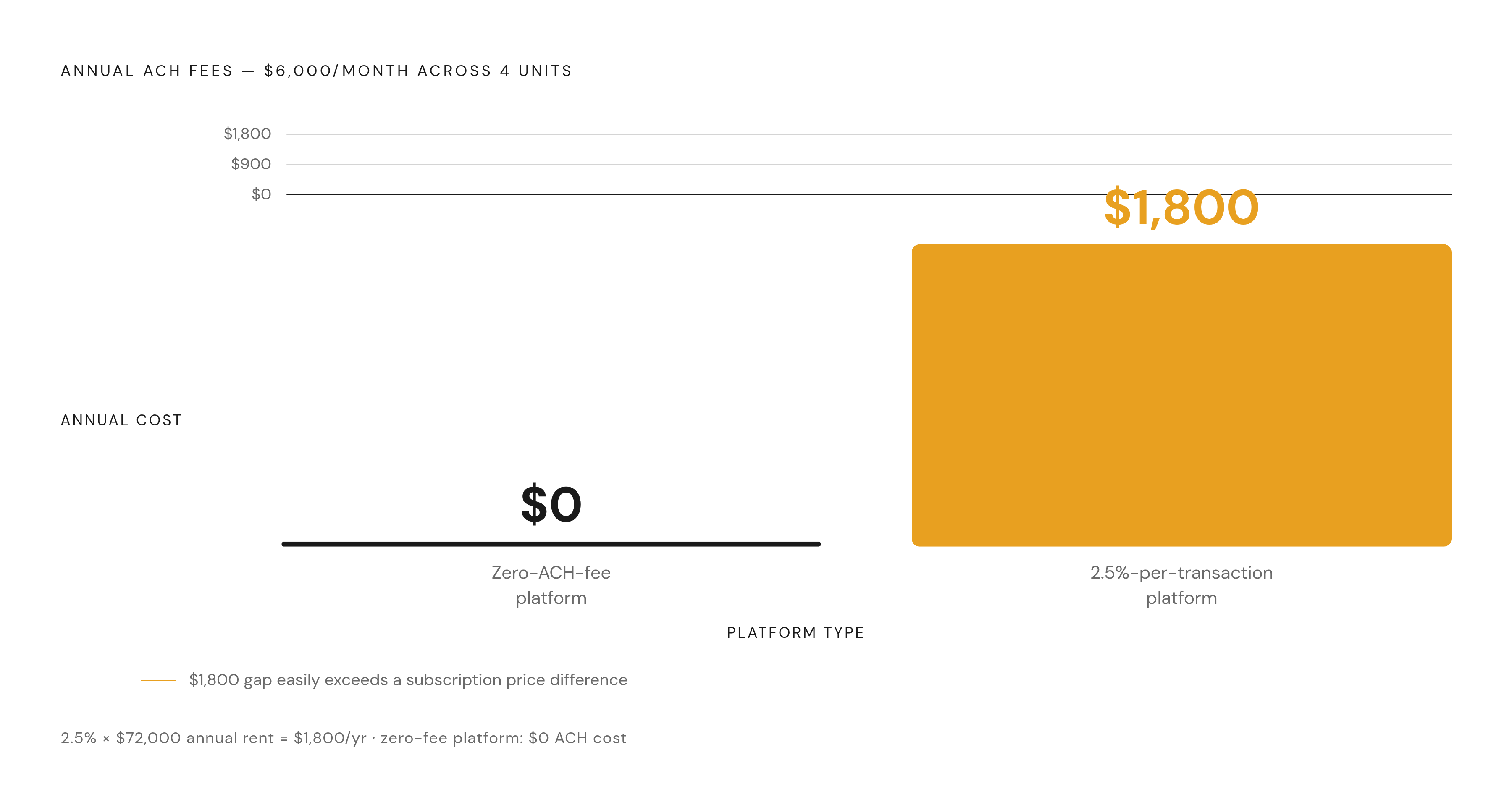
Consider a specific scenario: a landlord with four units collecting $6,000 per month in rent. The difference between a platform charging no ACH fee and one charging 2.5% on collected rent works out to $1,800 annually. That gap alone is sufficient to outweigh a lower subscription price entirely. Most landlords never calculate that number before signing up. They compare feature lists instead, which is a category error.
Free platforms shift costs rather than eliminate them. Some pass screening and payment fees to tenants. Others monetize through upsells that gradually become necessary, eroding the value of the free base tier over time in a way that's easy to miss because each incremental charge seems small.
The only accurate comparison method is to estimate your monthly transaction volume, apply each platform's actual fee schedule to it, and add that to the base subscription. Comparing base rates is not comparing costs.
What AI Features Are Actually Useful at Small-Portfolio Scale Right Now
AI adoption in property management has accelerated recently. The marketing has outpaced the utility, and at small-portfolio scale, the gap between those two things is worth examining before it influences a purchasing decision.
A few features deliver genuine value today. Listing copy generation reduces time-to-publish by producing rental descriptions from basic property inputs, which is genuinely useful if you've ever stared at a blank text box trying to make a two-bedroom in a mid-tier market sound compelling. Maintenance triage tools that categorize and route repair requests cut the back-and-forth between landlord and tenant that consumes disproportionate time relative to what it accomplishes. Rent pricing suggestions that surface comparable local rates help landlords who otherwise rely on intuition or informal market scanning, which is most of them. Document parsing for lease review and move-in inspection logging closes a workflow gap that previously required tedious manual entry.
Two features sound more useful than they are at this scale. Predictive maintenance across one to four units produces no meaningful signal; the dataset is simply too small to generate a pattern worth acting on. AI-driven portfolio analytics require both sufficient unit count and meaningful transaction history. At four units, neither condition is met, and what you get is a dashboard that confidently surfaces information you already know.
The useful question is not "does this platform have AI?" It's "does this specific AI feature replace a task I currently do manually?" AI branding and workflow automation are not synonymous, and treating them as equivalent is how landlords end up paying for a feature set that demos impressively and improves nothing.
Matching Platform Choice to Portfolio Size and Landlord Type
The First-Time or Single-Property Landlord
Low friction, fast setup, no monthly overhead. The free tier from TurboTenant or Innago covers the core workflows without a financial commitment or significant learning curve. The mistake to avoid here is over-investing in software before you understand which tasks actually consume your time. Most first-time landlords discover the administrative burden is lighter than anticipated; starting free and upgrading when a specific friction point appears is the right sequence.
The Landlord with Two to Ten Units Managing Locally
At this scale, the need shifts from access to consolidation. One tool handling screening, leases, payments, and expense records is worth paying for, because managing those functions across separate tools creates coordination overhead that compounds across every tenant, every month, every renewal cycle. Mid-tier platforms with flat-rate pricing, including RentRedi, Landlord Studio, and SimplifyEm, address this directly. Tax documentation also becomes a genuine annual concern at this unit count, and platforms with solid income and expense reporting earn their cost at year-end even if they contribute nothing else to the workflow.
The Remote or Part-Time Landlord
Physical distance makes maintenance coordination disproportionately costly in time and stress. A landlord who can't take repair calls during business hours and can't quickly assess a situation in person needs problems pre-sorted before they arrive. Hemlane's human repair desk on its top tier addresses this specifically. It costs more per unit than alternatives. For remote landlords, it frequently costs less than the actual alternative, which is reactive, disorganized repair management that surfaces at unpredictable intervals and always at inconvenient times. The comparison isn't Hemlane versus a cheaper platform; it's Hemlane versus the accumulated cost of every maintenance situation that goes sideways without a coordination layer.
The Landlord Growing Toward Ten-Plus Units
This is the inflection point where the limitations of free tools in reporting depth, screening volume, and document management become genuine friction rather than minor inconvenience. Buildium's no-unit-minimum entry makes it accessible before a portfolio formally justifies mid-market software. The more important evaluation at this stage is migration path. Switching platforms mid-growth creates data continuity problems; tenant records, payment history, and maintenance logs become a switching cost that grows with the portfolio and becomes expensive at the worst possible moment. The platform chosen at five units should be capable of serving you at fifteen.
What to Verify Before Committing to a Platform
State Compliance
Lease templates must reflect current local landlord-tenant law. Some platforms maintain state-specific form libraries and update them when statutes change. Others provide generic templates that require customization and legal review on your end. Ask directly: does the platform's lease library cover your state, and when were the forms last updated? A lease template that doesn't reflect current local law is a liability, not a convenience.
Tenant-Facing Experience
If the tenant-facing application and payment flow is confusing or unreliable, adoption will be low regardless of how clean the landlord-side interface looks. Request a demo of the tenant experience specifically. Evaluate it from the perspective of someone who is not particularly tech-savvy and who is completing a rental application under mild time pressure. The friction they encounter is the friction that generates phone calls to you.
Real Cost Calculation
Take your monthly transaction volume: rent collections, screening runs, maintenance tickets. Apply each platform's fee schedule to those numbers, add it to the base subscription, and compare totals. Then compare that total to what you currently spend, in both time and money, managing without software. Feature comparison is not cost comparison, and conflating them produces a bad decision.
Data Portability
Before signing up, confirm you can export tenant records, payment history, and maintenance logs in a usable format if you decide to move later. Data that can't leave a platform is a switching cost that accumulates quietly until the moment you need it to move.
Support Model
Free platforms typically offer community forums or email-only support. Know this before your ACH collection fails on the first of the month and you realize there's no phone number to call. Some mid-tier platforms offer phone or chat support, and at the solo landlord scale that access is often worth a higher subscription tier. Software failures are infrequent. When they happen, they happen at the worst possible time, and your resolution speed depends entirely on how fast you can reach someone with the ability to fix it.
Trial Period
Most mid-tier platforms offer a trial or money-back window. Use it to run an actual workflow through the system: create a listing, process a simulated application, log a maintenance request, record an expense. A platform that demos well and performs poorly in operation will reveal the gap quickly. Do not commit based on a sales walkthrough alone.