New Property Management Technology Entering the Market
AI-powered tools now deliver measurable returns, not just conference promises.
Not long ago, AI in property management meant a vendor cornering you at a conference, showing you a dashboard, and promising it would "learn your portfolio." Most operators walked away skeptical. That was the correct response.
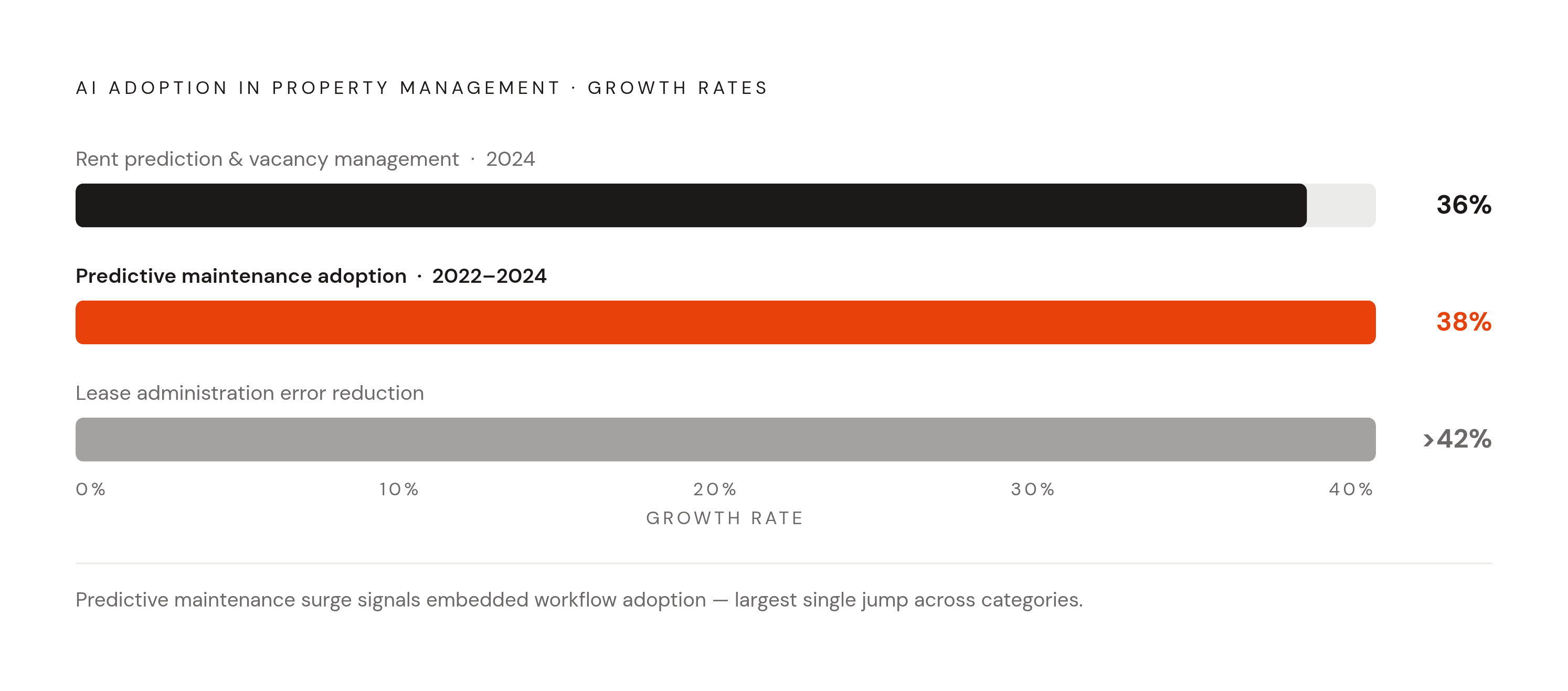
That moment is over. AI ranked as the top technology trend across real estate and construction in 2024, and the numbers behind that ranking are production numbers, not pilot program numbers. AI-powered rent prediction and vacancy management tools grew 36% in 2024. Predictive maintenance adoption surged 38% between 2022 and 2024. These are not proof-of-concept deployments.
The use cases that have actually graduated into embedded workflows: predictive maintenance that catches equipment degradation before it turns into an emergency service call, tenant screening that scores applicants against data-driven models and cuts manual review time significantly, automated rent collection with compliance tracking built in, and 24/7 resident communication handled by virtual assistants that escalate to humans only when the situation requires judgment. Those four categories cover a meaningful portion of where property managers actually spend their time.
AI can decrease lease administration errors by over 42%, and automation saves property managers more than ten hours per week. That second figure is the one I think about most. Ten hours is not just recovered time, it is redirected attention. A portfolio manager who is not chasing paperwork is instead having retention conversations with residents, thinking through renewal strategy, evaluating a capital expenditure that will affect NOI for the next decade. That is where the real value transfer happens.
One thing I have watched operators get wrong consistently: they bolt AI onto broken workflows and wonder why the results are messy. The technology is not a corrective. It amplifies whatever it touches, including your dysfunction. Strategy and clean data have to come first. The operators who got that sequencing right in 2023 and 2024 are now running on a materially different capability curve than everyone else.
What the major platforms are actually shipping in 2025
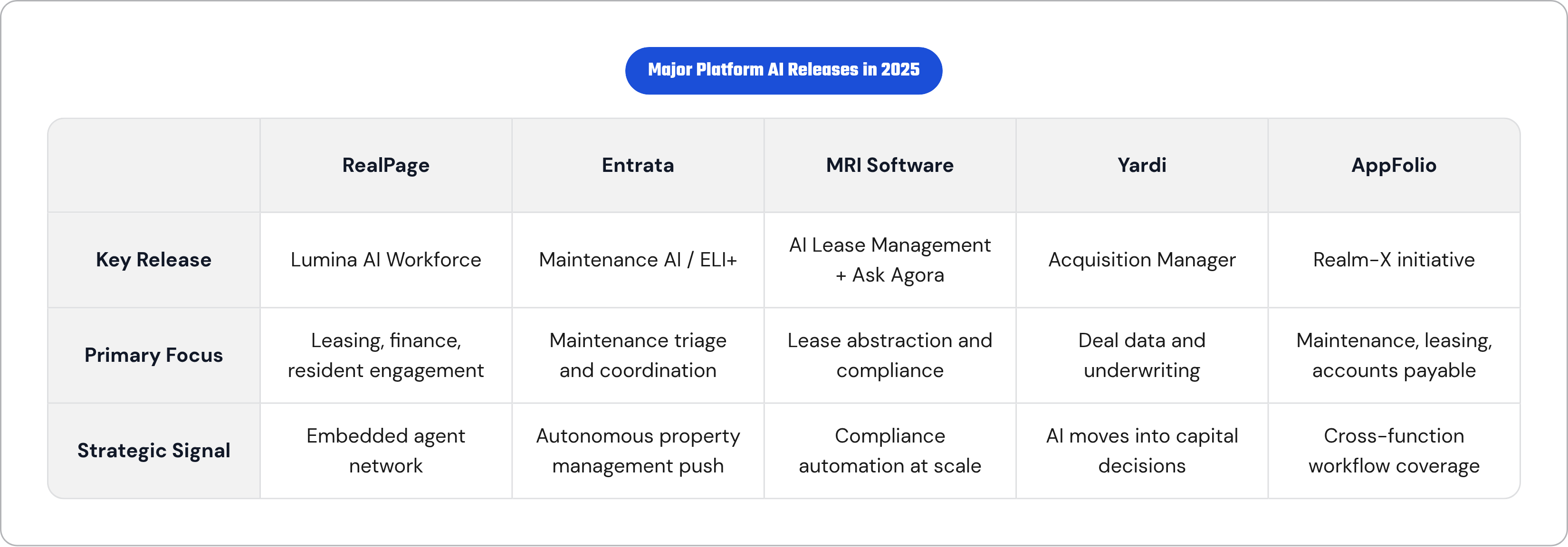
The major platforms stopped hedging. They are shipping, and the releases this year are substantive enough to read as strategic commitments rather than roadmap theater.
RealPage launched Lumina AI Workforce at NAA Apartmentalize in June 2025: a network of intelligent agents embedded across leasing, finance, and resident engagement. Entrata unveiled Maintenance AI the same month, pairing a resident-facing triage assistant with a backend coordination system, positioned as part of its "Autonomous Property Management" push through the ELI+ suite. MRI Software launched an AI-driven lease management tool in July 2025, automating lease abstraction and compliance tracking, then expanded its Ask Agora AI assistant in October. Yardi moved into acquisition workflows in May 2025 with Acquisition Manager, centralizing deal data, underwriting models, and due diligence. That last one matters: AI has moved upstream into the decisions where real capital gets committed.
AppFolio's Realm-X initiative touches maintenance automation, leasing communications, and accounts payable. Entrata's Layered Intelligence spans lead nurturing through fraud detection. And Greystar, one of the largest operators in the world, expanded its use of AppFolio Property Manager Plus in February 2025 across its portfolio. When an operator at that scale makes a commitment rather than running a pilot, you stop asking whether the technology works.
Every major release in 2025 carries the same messaging: AI augments human teams, it does not replace them. That framing is accurate for where the technology actually sits today, and it is also where operator trust currently sits, so the platforms are selling into reality rather than against it. But watch that framing evolve. The autonomy claims will grow as the trust grows.
One data point that explains where product investment is concentrated: 76% of PropTech startups target multifamily assets for commercial deployment. If you are a residential operator and every new tool feels like it was built for you, that is not an accident.
Predictive maintenance and IoT: what connected buildings actually change about operations
Smart building IoT technology accounted for nearly 41% of new building system installations in 2024. That share makes it a standard expectation, not a differentiating feature. Which means if you are still running a fully reactive maintenance operation, you are not operating at baseline anymore.
The logic is not complicated once you see it. Sensors on HVAC systems, plumbing infrastructure, and electrical panels generate continuous performance data. AI analyzes that stream and flags anomalies before they cascade into failures. You schedule the repair before it becomes an emergency. Cheaper fix, no after-hours callout premium, no resident displaced while you scramble. Smart buildings integrating AI and IoT reduce operational costs by up to 40%. The economics are not subtle.
The energy savings alone close the instrumentation argument for most operators. Occupancy-integrated HVAC systems reduce energy consumption by roughly 8 to 11% during peak summer periods in peer-reviewed field studies. Real deployments have produced sharper numbers: Verdigris AI cut a commercial property's energy costs by 22%; 75F delivered 40% energy savings for a multi-tenant office building; Aquicore helped Boston Properties save USD 1.2 million annually. These results are directionally consistent with what the underlying technology is actually capable of when implemented with discipline.
Here is what I think gets underappreciated about IoT: every resident interaction with a connected system generates data that feeds back into the AI layer and improves the accuracy of every downstream recommendation. Instrumentation is not just a maintenance investment. It is a data asset that compounds over time. The longer it runs, the smarter the system gets about your specific buildings, your specific failure patterns, your specific residents' behavior.
There is also a regulatory dimension that is hardening faster than most operators realize. Smart sensors are becoming compliance infrastructure. SFDR and CSRD are pushing landlords toward mandatory sustainability reporting, and the operators who instrumented for operational reasons in 2024 and 2025 will be ahead of those requirements when they fully land. That is not a coincidence you should wait to stumble into.
Digital twins: running a virtual version of your property before making real-world decisions
A digital twin is not a 3D model, and collapsing the two concepts is where most operator confusion starts. A 3D model is a representation. A digital twin is a live simulation, a virtual replica updated in real-time with data from sensors, equipment, and operational systems. You can run decisions through it before you commit capital to them in the physical world.
The functional architecture: real-time data capture from IoT sensors, AI algorithms that analyze that data to detect inefficiencies and predict failures, and a scenario simulation layer that lets you test changes before implementing them. Considering a major HVAC upgrade? Run it through the twin first and see what the energy cost projections actually look like. Thinking about a floor plan change that will affect how residents move through a building? Simulate it. The twin does not guarantee you make the right call. It narrows the range of expensive mistakes, which is the actual value proposition.
Matterport is the most accessible entry point for operators who want to start building toward this capability: spatial models used across real estate, construction, and facility management. It is not a full operational digital twin in the sense described above, but it is a legitimate first step in the right direction.
Where is this technology on the adoption curve? Genuinely powerful and genuinely earlier-stage for most operators. I am not suggesting you implement it tomorrow. I am suggesting you plan for it, because the foundational investment that makes digital twins useful, IoT instrumentation and clean connected data, is the same investment that makes everything else work. You are not making a separate bet. You are building toward multiple capabilities at once.
The platform consolidation question operators are navigating right now
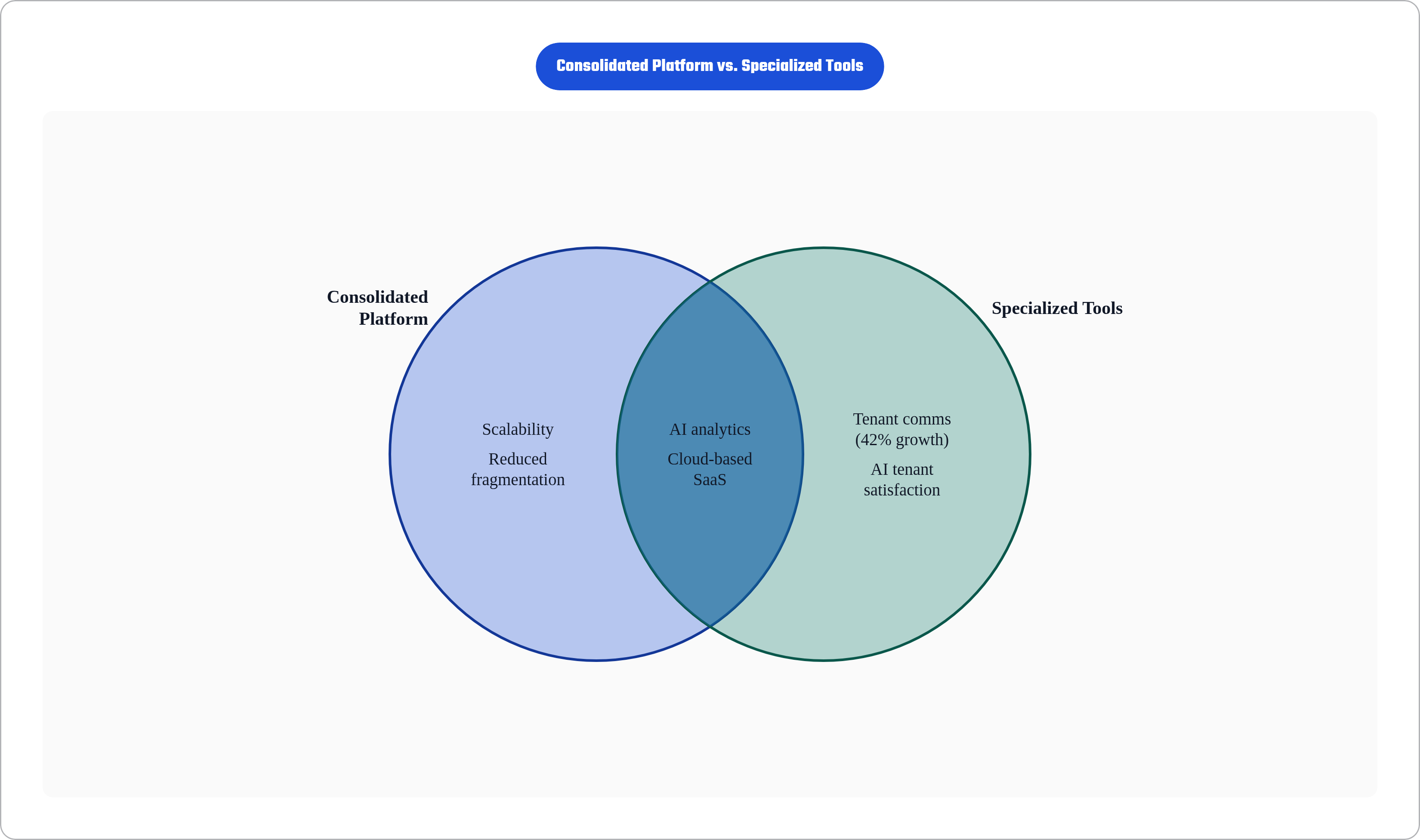
Every operator running a portfolio above a certain size eventually hits the same fork: consolidate everything into one platform, or build a stack of specialized tools that each do one thing exceptionally well. There is no universally correct answer, and anyone selling you one is working from a motivated position.
The consolidation case is real. Cloud-based SaaS platforms commanded 61.2% of property management software revenue in 2025. Cloud deployment has grown from 57% of installations in 2021 to 64% in 2024. The arguments for consolidation, scalability, integration, reduced data fragmentation, are winning most decisions in the market. The top ten vendors now account for 68% of global installations.
But consolidation carries a risk that does not always show up until the damage is done. When an all-in-one platform optimizes for its highest-margin modules, certain workflows get deprioritized. Lease renewal is the documented casualty I have watched play out most often. An operator whose platform has quietly deprioritized the renewal experience in favor of rent optimization or marketing automation will see higher vacancy rates, rising turnover costs, and compressed NOI. The platform gets credited for the efficiencies. The operator absorbs the churn and spends months trying to figure out where it came from.
Fragmentation at the edges persists because specialized tools keep outperforming in specific workflows. Mobile-based tenant communication solutions grew 42% since 2023, much of that driven by point solutions that moved faster than the large platforms. And 47% of commercial property firms deployed AI-driven analytics specifically for tenant satisfaction tracking in 2024, frequently through dedicated tools rather than their primary platform.
The framing that actually serves operators: let workflow priorities drive platform choice, not the other way around. Identify which operational failure is costing the most, whether that is maintenance response time, lease renewal friction, or communication gaps, and evaluate whether consolidation or a specialized tool solves it more directly. MRI Software's acquisition of Proptech Labs in October 2025 to expand into Australia and New Zealand is instructive: even the largest platforms grow by acquiring specialist capabilities rather than attempting to build everything from a single codebase. The market has already answered whether one platform can do everything well.
What early adopters are gaining that late movers will have to catch up on
The compounding dynamic is the piece that gets most consistently underestimated, and it is the reason timing matters here more than it does with most technology decisions.
AI tools improve with historical data. An operator who instruments their buildings, feeds clean data into an AI system, and standardizes their workflows today is building a data asset that gets more accurate and more valuable every quarter. An operator who starts that process two years from now is not just two years behind on features. They are two years behind on the model's ability to understand their specific portfolio, their specific residents, their specific failure patterns. That gap does not close quickly.
91% of commercial occupiers would pay a premium for tech-enabled space. The market is already pricing the difference. Tenant expectations are moving independently of whether any given operator has caught up.
Approximately 24 million rental properties globally are managed using some form of software, which means basic software adoption is already the floor. The differentiation now sits in what operators have layered on top: predictive maintenance, AI-assisted leasing, resident experience automation, and the data infrastructure that ties all of it together.
The product landscape will get more crowded. More than half of PropTech startup founders expect additional competitors in their space within the next year. That means operational fluency, actually knowing how to run a tool inside your real workflows with your real team, will matter more than early purchase. Buying the platform is the straightforward part. Embedding it into how your organization actually operates is where the gap between good and great opens up, and where most implementations quietly fail.
Two technologies worth tracking without overstating their current readiness: blockchain-based smart contracts for lease execution are moving in a clear direction, but adoption in real estate remains slow. VR and AR are reducing friction in the leasing process and expanding marketing reach for portfolios with geographically dispersed assets. Neither is a near-term operational necessity for most firms. Both reward operators who are paying attention now rather than scrambling to understand them later.
Start with whichever workflow is costing the most or frustrating residents the most. Instrument it. Build outward from there. The operators doing that today are not just ahead on features. They are operating on a fundamentally different capability curve, and that curve is only getting steeper.