AI Property Management Software Use Cases
AI property management tools work best when matched to specific workflows, not adopted wholesale.

AI property management software is not a single product and it does not solve a single problem. It is a cluster of distinct tools, each built to handle a different operational bottleneck, and the property managers extracting real value from it are the ones who matched a specific tool to a specific workflow before they bought anything. Think of it like a toolbox: a hammer is useless when you need a wrench, and the wrong AI tool applied to the wrong problem is just expensive noise. According to Buildium's 2026 State of the Property Management Industry Report, AI adoption among property managers jumped from 20% in 2024 to 58% in 2025. That number sounds transformative until you read the next line: only 8% of companies had fully automated any process. Most are experimenting. A separate NAA/AppFolio benchmark puts 2025 adoption at 34%, measuring a slightly different segment, and the gap between those two figures tells you something important: "adoption" is a word that covers everything from a single chatbot trial to platform-wide deployment. JLL data cited by getsurface.ai found that 92% of companies had initiated AI pilots by mid-2025, which means near-universal exploration paired with very shallow execution. The adoption gap is itself the argument for clarity. What follows maps the specific workflows where AI creates documented value, so you can match use cases to your own operation rather than chasing a headline statistic.
The Shift from AI Features to AI Agents: Why It Changes What Software Can Actually Do
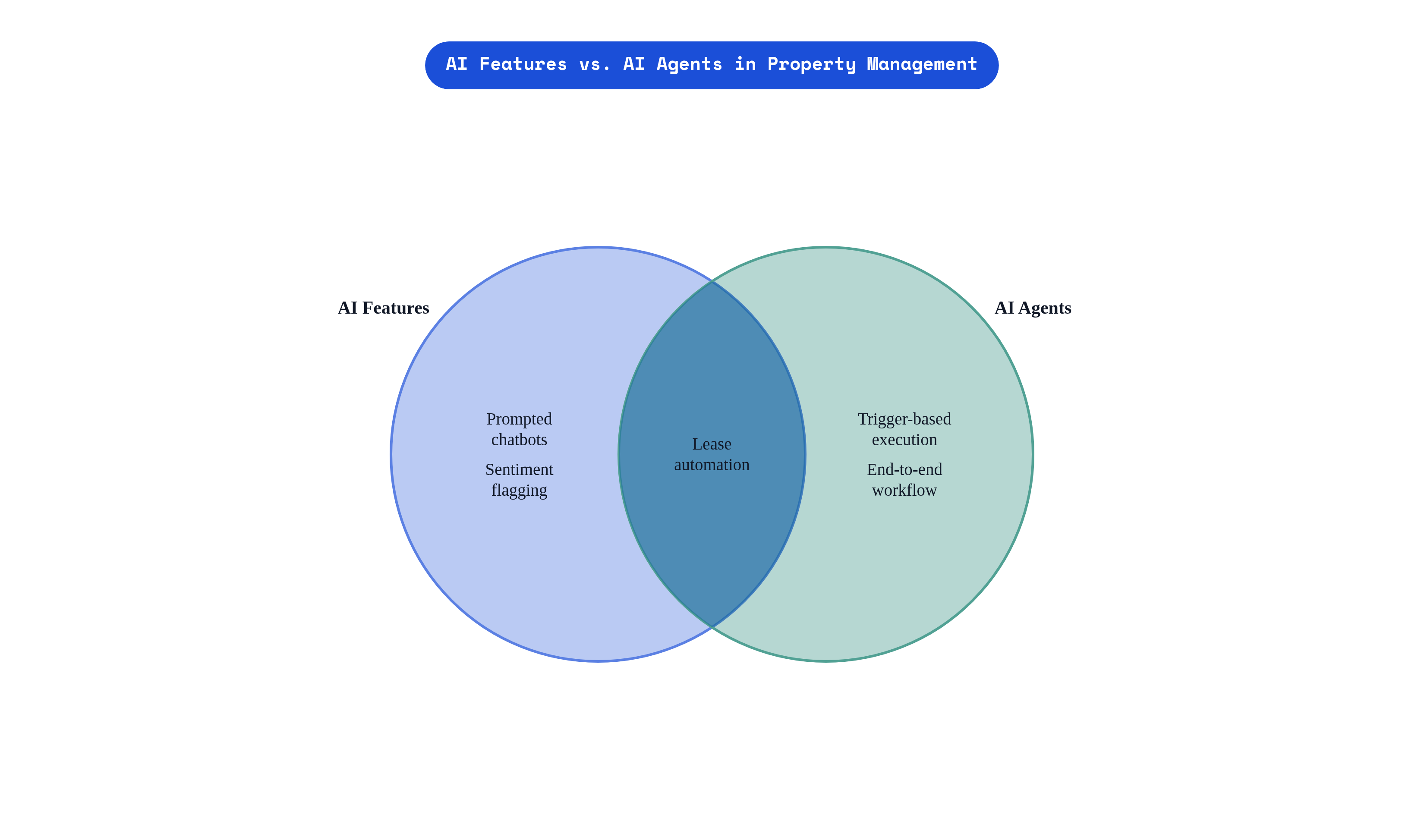
The defining change in property management software since 2025 is not that more tools have AI built in. It is that the architecture of what AI does inside those tools fundamentally changed. The older model was discrete features: a chatbot that answered questions when prompted, a sentiment flag on a resident message, an auto-draft you reviewed before sending. Useful, but still requiring a human to stage each step.
The newer model is AI agents. An agent does not wait for you to prompt it. It watches a trigger, executes a sequence of tasks, and escalates to a human only when the situation falls outside policy parameters. The difference in practice is significant. A feature drafts a lease renewal letter when you ask it to. An agent watches the expiration calendar, drafts and sends the letter, schedules the renewal call, and updates the record in the system. You are involved when something unusual happens, not when everything is routine. In other words, a feature is a tool you pick up; an agent is a colleague who handles things while you sleep.
In March 2026, Entrata announced more than 100 embedded AI agents spanning leasing, maintenance, accounting, payments, and resident operations. AppFolio's Realm-X agentic workflows, launched mid-2025, reportedly save an average of 10 hours weekly on routine tasks, and as of February 2026, 98% of AppFolio customers use at least one AI-native capability. These are not chatbot add-ons. They are workflow owners.
This distinction matters for everything that follows. When each section below describes what AI does in a specific workflow, it is describing what the agent or feature actually owns end-to-end, not just that AI is somewhere in the vicinity of the process.
Tenant Communication and Leasing: Where AI Handles Volume and Speed
The problem here is simple and expensive. According to JLL research, 60 to 70% of tenant contacts involve routine questions with predictable answers, and each one consumes somewhere between five and fifteen minutes of staff time. Across a busy property, that adds up to four to twelve hours daily of staff attention spent answering the same questions repeatedly.
AI chatbots resolve 65 to 75% of tenant inquiries without human intervention, and they do it in seconds rather than hours. But resolution rates are not uniform across question types, and it is worth being precise about where the technology performs and where it does not. Payment and account questions automate at 80 to 90%. Maintenance request intake runs 70 to 80%. Leasing inquiries sit around 60 to 70%. Complex lease or legal questions drop to 20 to 30%, with most requiring human escalation. The tool handles the predictable; humans handle the consequential.
The speed advantage is most pronounced at night and on weekends, when 40 to 55% of inquiries arrive and staffing is thinnest. That is precisely when the automated resolution rate matters most, because the alternative is a prospect or resident waiting until Monday morning.
On the leasing side, the numbers are compelling. AI leasing assistants reduce lead-to-move-in time by up to seven days and improve conversion rates from 10% to 20%, per NAA Industry Pulse 2024. AppFolio's Realm-X reports 73% higher lead-to-showing conversion rates in its agentic leasing workflow. EliseAI claims its platform saved onsite teams over 10.8 million hours in 2025, and 38 of the NMHC Top 50 operators use their products.
The ROI case is strongest here for teams managing high inquiry volume. The automation handles routine contact; staff handles exceptions. What AI does not replace is relationship-building, lease negotiation, and any communication involving legal complexity or conflict. Those remain human work, and they should.
Tenant Screening and Fraud Detection: What AI Catches That Manual Review Misses
In February 2026, Snappt published an analysis of 1,462,338 applicant submissions from 2025. The average fraud rate was 5.1%, and the dominant method was what the report called "template farms": services that mass-produce fake pay stubs and bank statements at scale. The documents are visually convincing. A human reviewer looking at a well-made fraudulent pay stub has a real chance of missing it. The fraudsters have gotten very good at their craft — so good, in fact, that spotting their work by eye is like trying to find a typo in someone else's text message: you see what you expect to see.
AI screening tools use document forensics and bank-verified income data to catch the kinds of edits and inconsistencies that escape visual review. Tools like Snappt, Plaid, Findigs, and Two Dots each approach this differently, using varying combinations of document analysis and direct data verification, but the shared premise is that the fraud detection happens at a level of detail manual review cannot sustain across high application volume.
Beyond fraud, AI screening layers in rental history patterns, employment verification, and behavioral signals that go beyond a static credit score. The picture of applicant risk becomes more granular.
Here is where the honest caveat becomes essential. In May 2024, HUD confirmed that the Fair Housing Act's disparate-impact standard applies to algorithmic screening tools. Landlords cannot transfer that liability to a third-party screening vendor. They remain responsible for the outputs. In November 2024, SafeRent Solutions settled a class action for $2.275 million over a screening score alleged to disadvantage Black and Hispanic applicants. That case is not a theoretical risk. It is a documented outcome from a deployed system.
AI catches more fraud and processes faster. That is true. But operators must actively govern for bias, build in audit capability, and maintain human oversight of the outputs. The tool does not make compliance automatic.
Predictive Maintenance: Moving from Reactive Repairs to Scheduled Interventions
The economics of reactive maintenance are punishing. Emergency repairs for the same failure mode typically cost three to five times more than planned maintenance interventions. The entire value proposition of predictive maintenance is shifting the ratio, catching failures before they happen rather than responding to them after they do.
HVAC systems are the primary target, accounting for more than 40% of maintenance emergencies in multifamily properties. AI models trained on sensor data can detect compressor degradation, airflow anomalies, and motor stress before mechanical failure occurs. The workflow in practice: IoT sensors and smart devices feed real-time data into machine learning models, the system flags anomalies and generates work orders proactively, and maintenance teams receive prioritized task queues rather than emergency calls.
The results from documented deployments are substantial. A property management firm with a two-million-square-foot portfolio ran predictive analytics across 186 HVAC units for 14 months, producing a 38% drop in maintenance costs, a 71% reduction in emergency shutdowns, and $1.44 million in annual savings, according to oxand.com data from 2026. McKinsey's 2025 Digital Infrastructure Outlook projected that predictive maintenance improves operational productivity by up to 30% and extends equipment lifespan by 20 to 40%.
Property Meld's January 2025 acquisition of Mezo brought AI-driven intake and triage to its platform; Mezo's diagnostics drive 30% faster work order resolutions. SmartRent, deployed in over 828,000 units as of June 2025, reports that multifamily communities using its smart technology have reduced energy and water utility costs by nearly 20%.
The honest constraint: predictive maintenance requires sensor infrastructure. It is most accessible to larger or newer portfolios. Older buildings without IoT hardware cannot easily deploy it, and the capital investment to retrofit that infrastructure is real. This use case is not universally accessible. Size and building vintage matter.
Dynamic Rent Pricing: What the Tools Do and What the RealPage Case Revealed About Limits
Dynamic pricing tools analyze historical occupancy, local market trends, competitor pricing signals, and demand indicators to generate rent recommendations. In most implementations, a human reviews and accepts or overrides those recommendations. The tools do not set rent autonomously; they inform the decision. The reported upside is meaningful: dynamic pricing tools typically increase net operating income by 3 to 7%, per showdigs.com data from 2025.
The RealPage case is not a sidebar. It is essential context for anyone evaluating these tools.
In August 2024, the DOJ filed suit against RealPage and six major multifamily operators including Greystar, alleging that RealPage's YieldStar platform facilitated price-fixing by sharing nonpublic competitor pricing data among users. The November 2025 settlement prohibited RealPage from using real-time confidential competitor data for pricing recommendations and required that any nonpublic data used to train algorithms be at least 12 months old. A three-year court-appointed monitor was established. There were no fines and no admission of wrongdoing. Private class action settlements totaling roughly $359.9 million followed, including $218 million approved in a second batch.
What the case actually established matters for how you read it. The legal exposure identified by the DOJ was not in using AI for pricing. It was in what data the algorithm consumed: specifically, real-time nonpublic competitor pricing information shared across competing operators. That is the line that was drawn. Algorithmic pricing using a property's own historical data and publicly available market signals was not the target of the suit.
Property managers evaluating third-party pricing platforms should understand what data sources feed the recommendations. And separately, algorithmic pricing that disadvantages protected classes creates Fair Housing Act liability regardless of intent. Revenue optimization AI is legitimate and widely used. The RealPage case drew a specific line around data-sharing, not dynamic pricing itself.
Financial Reporting and Compliance: Where AI Reduces the Lag Between Operations and Insight
Multi-property portfolios carry a chronic reporting problem. Manual reconciliation across income, expenses, occupancy, and vendor payments produces insight weeks after the operational reality it describes. By the time the numbers are clean, some of what they reveal is no longer actionable. It is like reading yesterday's weather forecast to decide what to wear today.
AI addresses this lag in several specific ways. Automated rent roll reconciliation and variance flagging happen continuously rather than at month-end. NOI reporting becomes available across the portfolio in real time, not just per-property on a lag. Anomaly detection in expense patterns flags unusual vendor charges or duplicate invoices before they are buried in a quarterly reconciliation. Owner reports and investor summaries can be generated from live data rather than assembled manually.
On the compliance side, AI can monitor lease expiration dates, inspection deadlines, and regulatory filing windows, triggering action queues before a deadline is missed. In regulated markets with rent control or rent stabilization requirements, manual tracking at scale is genuinely error-prone; automated monitoring reduces the exposure. Fair Housing Act compliance monitoring, applied as an audit layer on top of the screening pipeline, can flag inconsistencies in how applicants are treated across the process.
AppFolio benchmark reports from 2025 and February 2026 found that firms with broad AI adoption projected roughly 31% portfolio growth in 2026, compared to approximately 12% for non-adopters. One plausible driver of that gap is operating leverage: when financial and compliance workflows stop requiring proportional headcount growth as a portfolio scales, growth becomes less constrained by administrative capacity.
The realistic note: AI-generated financial outputs still require human review before going to investors or regulators. The value is speed of synthesis and early anomaly detection. Autonomous decision-making in financial reporting is not where the technology is or where it should be.
How to Evaluate Which Use Case Fits Your Portfolio First
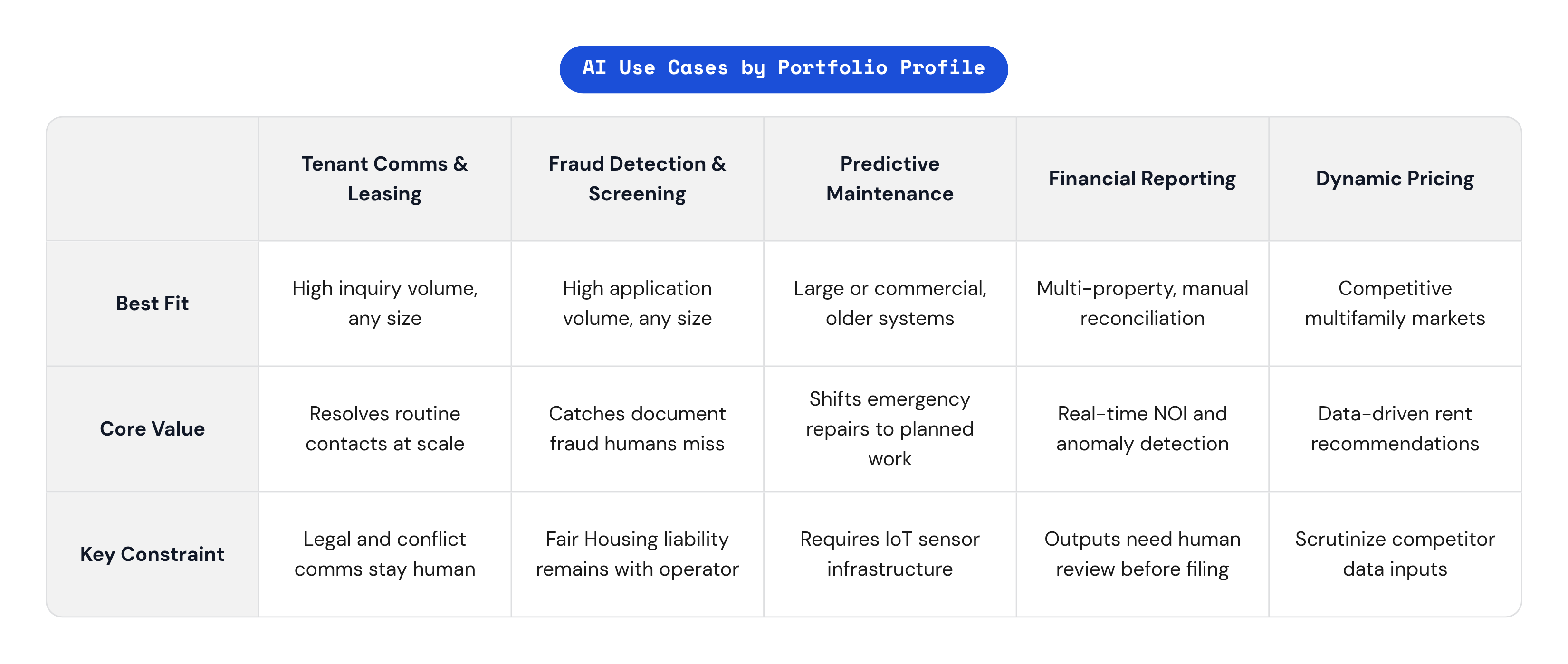
The question to start with is not which AI feature is most impressive. It is where your team is spending the most time on work that follows a predictable pattern. That is where automation creates margin.
A rough triage framework, by portfolio profile:
High inquiry volume, mixed portfolio size. Tenant communication and leasing AI has the shortest path to measurable ROI. The volume makes the automation count; the resolution rate data is well-documented.
High application volume, any portfolio size. Fraud detection and screening AI addresses a documented and growing risk. A 5.1% average fraud rate in 2025 across more than 1.4 million analyzed submissions is not a theoretical problem. Govern for fair housing compliance from the start.
Older mechanical systems, large or commercial portfolio. Predictive maintenance delivers the highest dollar savings per intervention, but requires sensor infrastructure. Factor that capital cost into the evaluation honestly.
Multi-property portfolio with manual reconciliation. Financial reporting AI reduces the operational drag that limits portfolio growth. The leverage it creates is most visible as portfolio size increases.
Pricing in competitive multifamily markets. Dynamic pricing tools deliver documented NOI gains. Understand what data inputs the platform uses before deployment. The RealPage case drew a specific line; know which side of it your vendor sits on.
The adoption gap, 58% experimenting and 8% fully automated, reveals the common failure mode. Operators deploy a tool without integrating it into the actual workflow, and it sits alongside the process rather than inside it. The question to ask vendors is not "does your platform have AI" but "which step in my workflow does this agent own end-to-end." That question separates the features from the systems.
One consistent caution across every use case: AI handles volume and pattern recognition. Human judgment remains necessary for legal exposure, tenant conflict, and any output that goes to a regulator or investor. The technology does not eliminate professional responsibility. It relocates where your attention is most needed.