Asset Management Technology Platforms Compared
Asset management platforms span four distinct industries requiring different evaluation criteria.
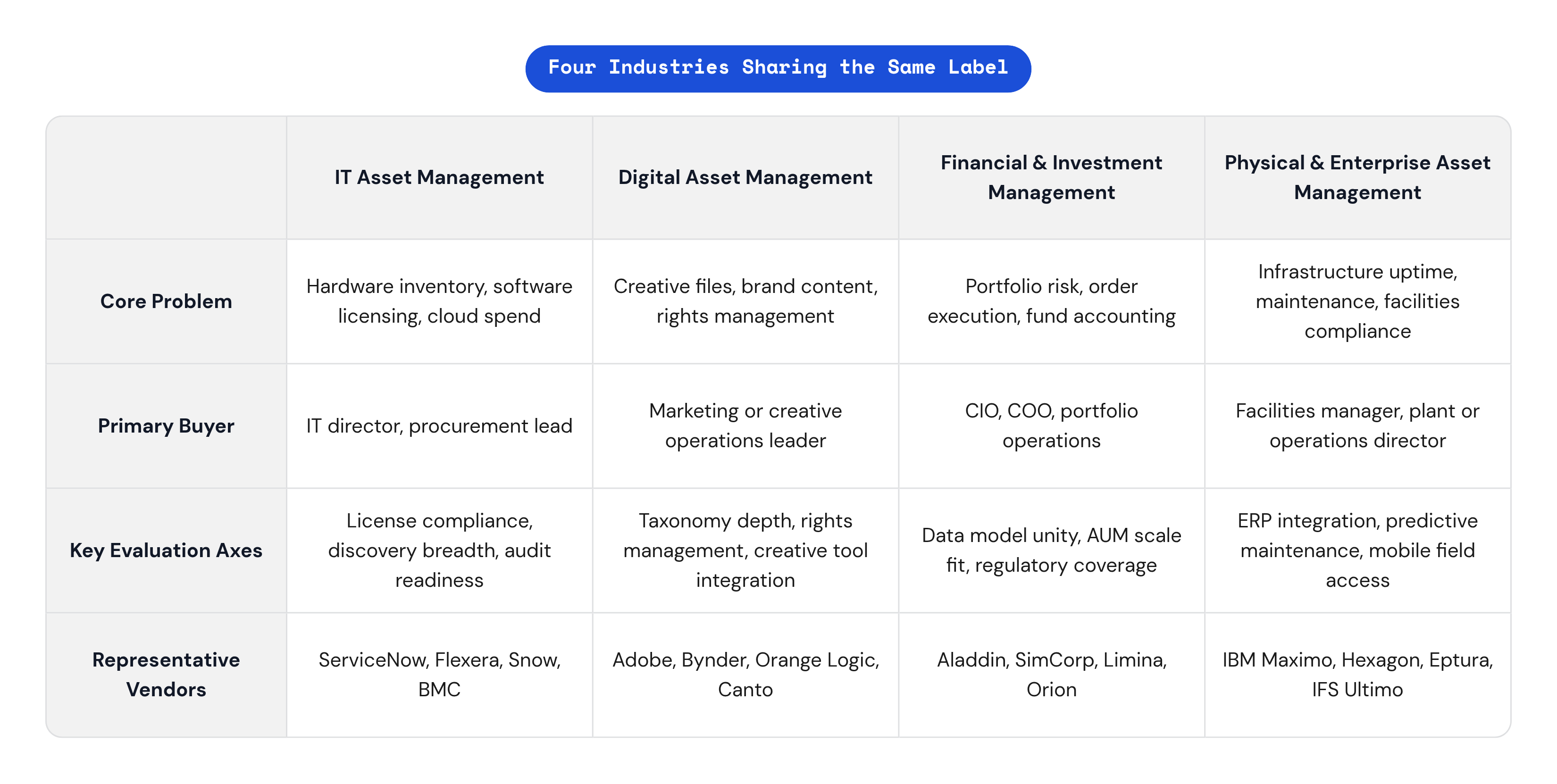
Before you open a single vendor's website, you need to know something most buyers learn too late: "asset management platform" is not a category. It is four completely separate industries that borrowed the same phrase. Establish which of those four industries you are actually operating in before any demo or RFP, then apply an evaluation framework built specifically for that industry.
The four categories sharing this terminology are IT asset management (hardware inventory, software licensing, cloud spend), digital asset management (creative files, brand content, rights management), financial and investment management (portfolios, risk analytics, order execution, fund administration), and physical and enterprise asset management (infrastructure, maintenance, facilities). They share almost no vendors, almost no evaluation criteria, and almost no buyer personas. A procurement lead choosing an IT asset management tool and a plant operations director choosing an enterprise asset management platform are solving entirely different problems. Conflating them produces the most common and most expensive mistake in this space: walking into vendor demos without a category anchor, then grading unlike things against generic feature lists.
The combined market across these four categories runs well into the tens of billions. The global asset management software market alone was valued at USD 5.2 billion in 2025 and is projected to reach USD 11.8 billion by 2033, and that figure covers only a slice of the full landscape. The fragmentation is real, and it is sizable.
Three questions should precede any feature comparison. Which category are you actually in? What is your scale and complexity, measured in AUM tiers, asset count, team size, or geographic spread depending on the category? And what is your genuine tolerance for implementation complexity versus time-to-value? Those three questions will eliminate more wrong platforms than any feature checklist.
Once you have answered them, hold every platform you evaluate against four axes.
Deployment model. True cloud-native versus lifted-on-premise versus hybrid. This affects upgrade cadence, data sovereignty, and total cost of ownership across a five-year horizon. "Cloud" gets claimed constantly and means very different things. A platform architected from the ground up for cloud infrastructure and a platform ported from an on-premise codebase and hosted on someone else's servers are not the same thing, regardless of how the sales deck reads.
Integration architecture. Open APIs and composable design versus locked ecosystem. This determines how a platform fits the stack you already have, and how painful extraction becomes when you eventually need to switch.
AI maturity. Embedded and functional versus roadmap marketing. By 2025, 90% of asset managers were already using some form of AI according to PwC, which means "AI-powered" is table stakes. The relevant question is what the AI actually does and whether it runs on your data.
Data model. Unified single ledger versus loosely coupled modules. A fragmented data model does not stay inside the platform. It transfers to your team as reconciliation work.
Keep those four axes in mind as you read the category-specific analysis below.
IT asset management platforms: what separates the tools that actually reduce audit risk
The ITAM market was valued at roughly $4.66 billion in 2025 and is growing at approximately 8% annually, driven by hybrid workforce complexity and tightening software license audit exposure. Organizations running distributed workforces across cloud, on-premise, and endpoint infrastructure face audit risk that scales directly with sprawl. The platforms that actually reduce that risk share a consistent capability set: hardware discovery, software license reconciliation, cloud asset visibility, lifecycle automation, and compliance reporting. Buyers who do not verify all five before signing a contract tend to discover the gap during an audit, which is precisely the worst time.
ServiceNow ITAM is the strongest option when an organization already runs ServiceNow for IT service management. The single data model eliminates the reconciliation gap between asset records and service records, which is typically where audit errors originate. The January 2026 addition of real-time anomaly detection and automated remediation across Oracle Cloud and Microsoft Azure in ITAM Pro is a meaningful differentiator for large hybrid estates. The weakness is cost and implementation weight. For organizations that do not need the full ServiceNow platform, paying for it to access the ITAM module is a poor use of capital.
Flexera One is built for license compliance complexity in large, heterogeneous environments. Multi-source discovery and an extensive technology catalog produce accurate license positions, which is the core requirement in any license audit. The November 2025 acquisition of a cloud cost-optimization company for USD 52 million adds automated resource-allocation analytics, making Flexera more useful for organizations managing significant cloud spend alongside traditional on-premise licensing.
Snow Software and Ivanti formalized a partnership in December 2025 that integrates ITAM with endpoint security visibility. IT teams where asset inventory and device security need to operate from a shared data source across hybrid workforces should pay attention to this one. The integration is newer, so probe implementation maturity carefully before committing.
BMC Helix Discovery is strongest in infrastructure-heavy environments where understanding the dependencies between assets matters as much as counting them. The AI-driven risk monitoring is practical rather than ornamental. Consider it seriously when asset relationships, not just asset lists, drive your compliance decisions.
The core tradeoff in this category: platforms with native IT service management integration reduce data silos but increase vendor lock-in. Specialized ITAM tools offer deeper license intelligence but require deliberate integration work to connect with service management workflows. One contextual note for financial services readers: the BFSI sector led ITAM adoption with a 22.81% revenue share in 2025. In regulated industries, ITAM is a compliance instrument, not a back-office convenience. That distinction should inform how much implementation weight you are willing to absorb.
Digital asset management platforms: matching capability to content volume and rights complexity
DAM is the most consistently underscoped category in this group. Buyers benchmark on storage capacity and search functionality, then discover six months post-implementation that the actual differentiators are taxonomy depth, rights and licensing management, and integration with creative production tools. By the time they discover it, the contract is already signed.
The 2025 Gartner Magic Quadrant for Digital Asset Management Platforms and the Forrester Wave from early 2026 converge on a consistent Leaders tier: Adobe, Aprimo, Bynder, Orange Logic, and Storyteq appear in the Gartner Leaders quadrant, with OpenText featured prominently in Forrester's assessment. Consensus at the top of independent analyst evaluations is meaningful; it meaningfully narrows your shortlist before you spend a day in demos.
Adobe AEM Assets is the strongest option when the creative stack already runs on Creative Cloud, Workfront, and Firefly. Adobe is building toward an agentic content supply chain through GenStudio and Brand Intelligence, which is a significant architectural direction for enterprise marketing operations. The tradeoffs are real: pricing is quote-only, implementations are measured in months, and ecosystem lock-in is substantial. For large enterprise marketing organizations where Adobe already dominates the creative workflow, those tradeoffs make sense. For mid-market teams, they usually do not.
Orange Logic Cortex is purpose-built for the largest and most complex asset libraries: media and entertainment companies, museums, NGOs, government archives. Deep taxonomy and rights management combined with hybrid storage architecture are the signature capabilities here. This is not a platform for organizations chasing fast time-to-value. It is a platform for organizations that need to manage assets at archival scale with legal-grade rights precision, and nothing else in this tier does that combination as well.
Bynder sits between Adobe's weight and simpler mid-market tools. The brand portal and creative workflow features are solid. It fits mid-to-large marketing teams that have outgrown basic file storage but are not running broadcast media archives or managing complex licensing portfolios.
Canto wins on ease of adoption. Quick implementation, mid-market pricing, and an AI Library Assistant introduced in late 2025 make it the right choice when time-to-value and low IT overhead outrank rights management depth on the priority list.
The AI angle in DAM deserves direct attention. AI-assisted tagging and search are standard at the Leaders tier now; every major platform offers them. The more meaningful development is Adobe's push toward agentic content workflows, where the DAM functions as an active production system rather than a passive repository. That architectural shift matters if you are evaluating whether your next platform is a storage tool or an operational one, because the answer changes which vendors belong on your list.
The practical decision split: complex rights requirements, archival scale, or multi-format media complexity point toward Orange Logic and Adobe. Brand consistency and fast onboarding without extensive IT involvement point toward Bynder and Canto.
Financial and investment management platforms: how AUM scale and asset class mix determine the right architecture
This category is architecturally distinct from every other one in this piece. The core problem is not inventory or content storage. It is risk calculation, compliance, order execution, and accounting reconciliation across asset classes and jurisdictions, often running simultaneously, in real time, under regulatory scrutiny. Platform selection mistakes here carry material financial and legal consequences that mistakes in other categories simply do not.
Scale creates genuinely different platform requirements. This is not a continuum where the same platform adds more features at the high end. It is a categorical difference in what the architecture needs to do.
Enterprise tier
BlackRock Aladdin operates at a scale that is difficult to contextualize without pausing on the numbers. As of December 2025, approximately $25 trillion in assets were managed on the platform, tracking over 30,000 investment portfolios and processing risk analytics for roughly 7 to 8 percent of the entire global financial system. BlackRock's technology and subscription revenue reached $2.0 billion in 2025, up 24%, with annual contract value growth of 31% including the Preqin integration. Aladdin is increasingly a standalone technology business. The Microsoft partnership adds Aladdin Copilot for workflow integration. The correct fit is institutions managing $50 billion or more in AUM with the implementation resources to match the platform's complexity.
SimCorp One manages $35 trillion across more than 300 institutions following its €3.9 billion acquisition by Deutsche Börse and subsequent merger with Axioma. The unified database architecture is the genuine differentiator: it eliminates the reconciliation problem that plagues modular stacks, where position data in the order management system disagrees with the accounting system at month-end. Insurance companies and pension funds managing liability-driven investment alongside traditional portfolios consistently gravitate toward SimCorp for this reason. Cloud deployment is available, but architecturally it is a lift-and-shift from the on-premise codebase, not a cloud-native build.
Charles River (State Street) delivers institutional-grade strength in order management and compliance workflow. The natural fit is managers already embedded in State Street custody and services, where the integration surface area is already defined.
Clearwater Analytics closed its acquisition of Enfusion in 2025, creating a front-to-back proposition that is compelling in theory. The integration is actively in progress, so evaluate current-state capability rather than the roadmap. Clearwater remains strongest for insurance companies and institutional investors where accounting precision and regulatory reporting are the primary requirements.
Mid-market and cloud-native tier
Limina IMS was purpose-built cloud-native for managers in the roughly $100 million to $30 billion AUM range who need institutional-grade capability without the implementation weight of enterprise platforms. For managers who have outgrown spreadsheets and lightweight tools but are not yet at the scale where Aladdin or SimCorp is justified, Limina is one of the more coherent architectural fits in the market.
SS&C Eze is strong in trading, specifically in the combination of order management and execution management. The documented pain point is data synchronization between modules: the order management system and portfolio accounting can reflect conflicting positions, creating reconciliation overhead for operations teams. The right fit is trading-focused hedge funds that prioritize execution capability over integrated workflows.
Enfusion (now within Clearwater) was a proven cloud-native option for hedge funds and liquid alternatives managers before the acquisition. It offered less customization flexibility than bespoke enterprise systems but considerably more agility than legacy platforms. The post-acquisition integration trajectory is the key variable to watch.
Wealth management tier
Orion holds the number one market share position for CRM, portfolio management and reporting tools, and portfolio design solutions according to the 2025 T3/Inside Information Advisor Software Survey. Integrated billing, trading, and automated rebalancing in a single system is the value proposition for registered investment advisors managing scale without institutional infrastructure teams.
Addepar was founded by engineers from Palantir and built for a specific problem: ultra-high-net-worth clients with multi-LLC and multi-trust structures whose assets span public markets, private investments, and alternative holdings. The consolidated dashboard and API-first architecture make it the defensible choice for that complexity tier.
Envestnet operates at enterprise scale within the wealth management space, with data aggregation and compliance tools designed for the largest advisory platforms.
Alternative investment platforms
eFront, acquired by BlackRock in 2019 and now integrated within the Aladdin ecosystem, covers private equity, real estate, infrastructure, and venture capital: fund administration, portfolio monitoring, and performance analysis for private market managers already in or considering the Aladdin environment.
Dynamo Software offers a full-stack cloud platform spanning deal sourcing, ESG tracking, fundraising, and investor relations for private equity, venture capital, hedge fund, real estate, and LP operations. The comprehensive lifecycle coverage appeals to alternatives managers who want to avoid assembling multiple point solutions.
One structural trend worth naming directly: leading firms in 2025 are increasingly moving away from monolithic systems, separating an AI and data ingestion layer, an accounting and ledger layer, and a visualization and business intelligence layer into a composable stack. The evaluation question is not only what a platform does in isolation. It is how cleanly it connects to the layers sitting alongside it.
Physical and enterprise asset management platforms: matching EAM capability to operational environment
The EAM buyer is typically a facilities manager, operations director, or plant manager. This is a different person with different success criteria than anyone else buying software covered in this piece. Uptime, maintenance cost, and regulatory compliance for physical infrastructure are the measures that matter. Feature lists built for IT asset managers or portfolio managers are irrelevant here.
The core capability set to evaluate in EAM: asset lifecycle tracking, preventive and predictive maintenance scheduling, work order management, mobile access for field teams, and integration with existing ERP systems. Organizations that skip the ERP integration question during evaluation tend to answer it, painfully, during implementation.
IBM Maximo (MAS) is strongest for large-scale infrastructure and complex enterprise operations. The Maximo Application Suite integrates asset management, IT service management, AI-powered visual inspection, and facilities management in one platform, available as dedicated SaaS on AWS, Azure, or Google Cloud. The deployment complexity is significant. This is the right choice for organizations with the IT resources to match the platform's scope, not for teams that need to be operational within weeks.
Accruent positions as a comprehensive option covering maintenance, energy management, document management, and lifecycle visibility in a connected platform. The appeal is breadth without multi-vendor assembly. Organizations that want wide coverage from a single vendor relationship, and can accept that no individual module will be best-in-class, should find Accruent a reasonable fit.
Hexagon EAM is strongest for asset performance management and operational reliability in asset-intensive environments: utilities, oil and gas, manufacturing. The emphasis on reliability analytics rather than pure inventory tracking makes it the right consideration for operations where unplanned downtime carries direct financial or safety consequences.
Eptura Asset is built mobile-first for distributed environments where field teams need asset visibility across multiple locations. Some platforms treat mobile as an add-on. Eptura treats it as the primary interface, and that architectural priority matters when field access is a core workflow requirement, not a secondary feature.
IFS Ultimo is purpose-built for manufacturing and field service operations, with strong service coordination capabilities. The right fit is environments where maintenance workflows need to connect tightly with production schedules, because that integration is where IFS Ultimo was designed to operate.
The central tradeoff in EAM: broad platforms offer comprehensive coverage but require significant implementation investment. Specialized platforms offer faster time-to-value within a defined operational context. Which problem you are actually trying to solve, breadth of coverage or depth of fit, determines which direction makes sense.
Three cross-cutting forces reshaping every platform decision right now
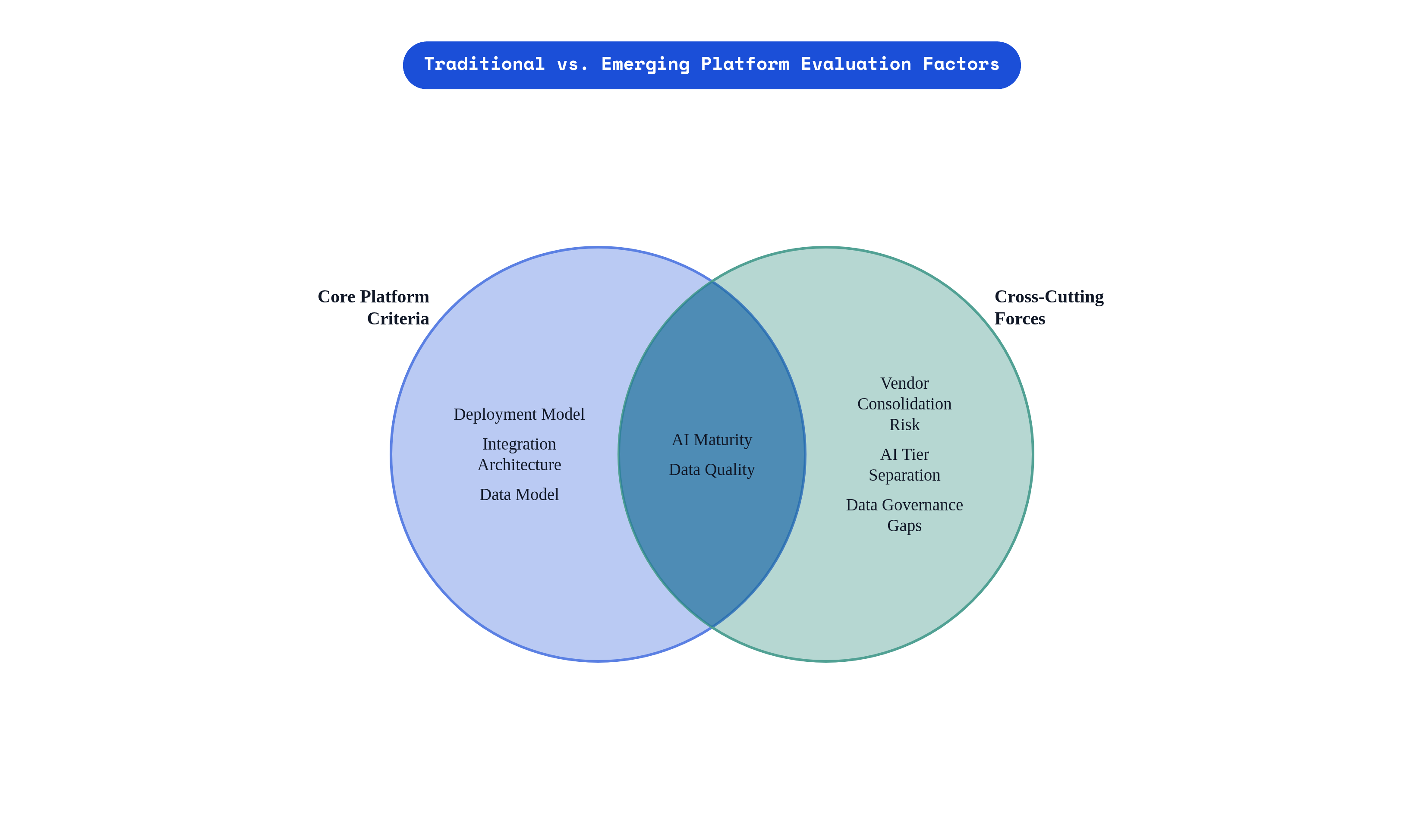
Regardless of category, three forces are currently reshaping how platform decisions play out in practice. Ignore them during evaluation and you risk making a decision that is technically correct today and strategically exposed within two years.
Data quality as the binding constraint
72% of asset managers identified data quality as a primary concern in 2025, up from 45% in 2022. That acceleration is not incidental. As AI capabilities have expanded, organizations attempting to use them have discovered the hard way that the models are only as useful as the data fed into them. Only 13% of investment and asset management firms reported having fully mature data governance frameworks in recent surveys. That gap between aspiration and infrastructure is where most platform implementations actually fail, quietly, months after go-live.
A superior platform running on poor data will underperform a simpler platform running on clean, well-governed data. Data quality is not a precondition that vendors solve. It is a precondition buyers must solve, before or concurrent with implementation. Evaluating platforms without auditing your data quality first is sequencing the problem backwards.
AI is separating into two tiers
There is now a real and consequential separation between AI as a feature (search enhancement, automated tagging, anomaly flagging) and AI as an architectural layer (agentic workflows, real-time risk inference, autonomous remediation). Most platforms marketed as AI-powered in 2025 occupy the first tier. A smaller number are building genuine second-tier capability.
Ask vendors specifically whether the AI is embedded in the workflow or bolted onto the surface, and whether it operates on your proprietary data or on generic models. Accepting "AI-powered" as a sufficient answer is how buyers end up surprised during post-implementation benchmarking.
Vendor consolidation is creating integration risk
The acquisitions catalogued in this piece, Flexera acquiring a cloud optimization company, Deutsche Börse acquiring SimCorp, Clearwater acquiring Enfusion, BlackRock expanding Aladdin's scope through Preqin, are not isolated events. They reflect a consolidation dynamic reshaping vendor stability across every category. When a platform you depend on gets acquired, the integration roadmap changes. Pricing structures shift. Product emphasis can redirect toward the acquirer's existing customer base rather than your use case.
The risk is not that acquisitions are inherently bad; some produce genuinely better platforms. The risk is that buyers who evaluated a platform in its pre-acquisition state and signed a multi-year contract are now operating under a different set of assumptions than those that justified the original decision. Contractual protections around product continuity, pricing stability, and integration commitments deserve serious attention in any deal negotiation right now.
All three forces point at the same underlying reality. The platform selection itself is one component of the decision, not the conclusion of it. Data readiness, integration architecture, and a realistic read on vendor durability are the rest. Treat the platform as the finish line and you will find out, eventually, that it was not.