AI Tools for Property Management
Evaluate AI tools by function, not as monoliths, to avoid costly mismatches.

The core mistake most operators make is evaluating AI platforms as monoliths rather than as bundles of function-specific capabilities. A platform can be excellent at lease management and mediocre at maintenance triage. Buying it for the former and expecting it to perform on the latter is like hiring a surgeon to fix your plumbing — the credentials look impressive until the pipes burst. This mismatch reveals itself six months post-implementation, when the demo is a distant memory and the support tickets are not.
Two broad categories deserve distinction before anything else. Embedded AI is built into an existing property management platform; AppFolio Realm-X, Buildium Lumina, and RealPage YieldStar are the clearest examples. Standalone or point solutions are purpose-built for one job: Property Meld for maintenance, SmartRent for IoT operations, LeasingAI for lead conversion. Neither category is inherently superior. The right choice depends on the function, the portfolio size, and how much integration overhead the team can realistically absorb. A 200-unit operator with one property manager probably cannot absorb much.
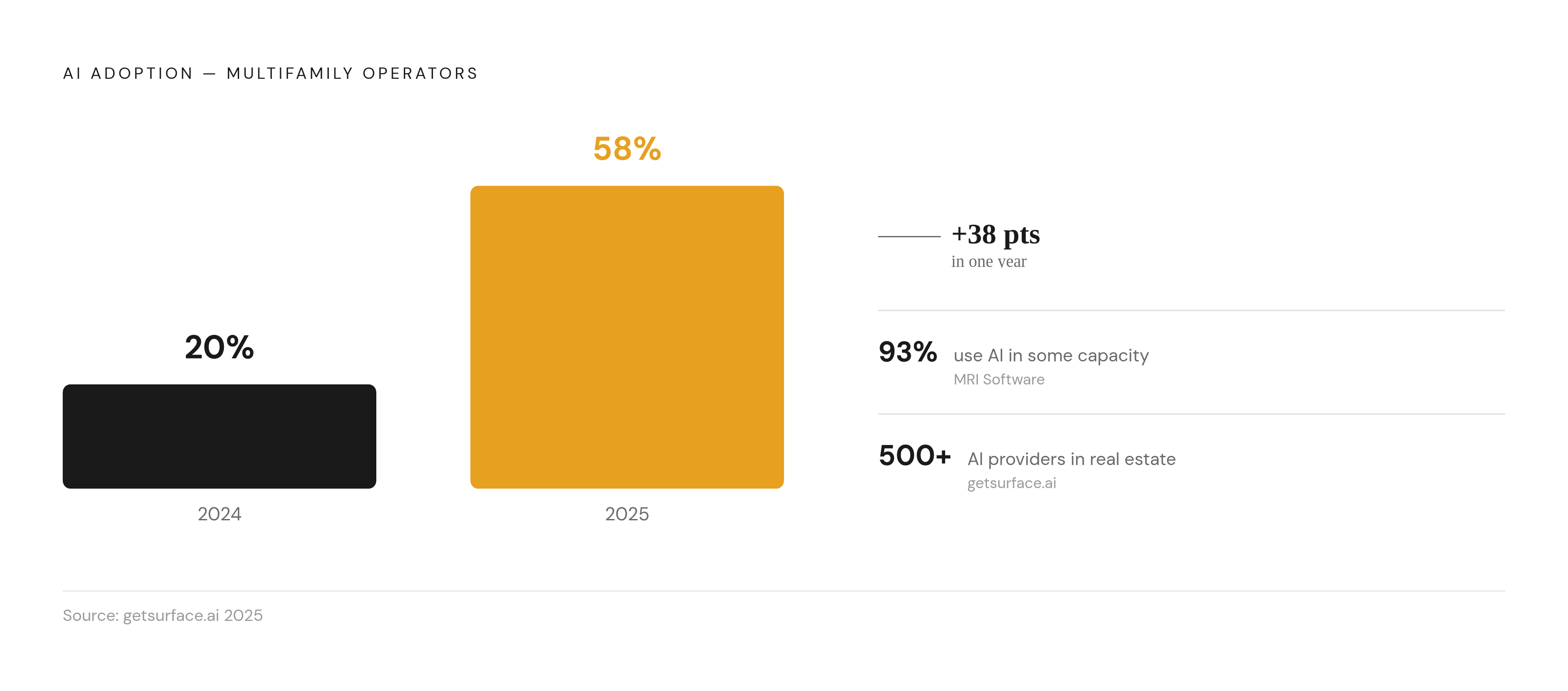
Consider the pace of adoption before assuming the market has sorted this out for you. AI adoption among multifamily operators jumped from 20% in 2024 to 58% in 2025, per getsurface.ai. MRI Software reports that 93% of multifamily operators now use AI tools in some capacity. Over 500 companies provide AI-powered services to real estate. The vendor landscape is not just crowded; it is cacophonous, and the noise makes it difficult to distinguish a tool that solves a specific operational problem from one that simply demos well.
Three questions are worth internalizing before moving into the functional sections below. What specific task does this tool automate or augment, not in sales deck language but in operational terms? Where does human judgment still have to enter the process? And what does measurably good output look like for this specific function? These are the filter through which every vendor conversation should run.
AI tools that touch tenant communications, screening, or pricing carry Fair Housing risk when outputs are not reviewed by a human being. That is not a compliance footnote to address at the end of a deployment. It is a structural feature of how these tools have to work, and it bears on almost every functional category below.
AI Tools for Tenant Screening and Leasing Lead Management
Leasing is where the performance numbers are most legible, and probably where AI is delivering the most demonstrable return right now. AppFolio's Realm-X Performers reported 73% higher lead-to-showing conversion rates and saves an average of 10 hours weekly on tasks. Across the broader industry, 85% of operators using AI have seen measurable improvements in lead-to-lease conversion rates, per re-leased.com. LeasingAI handled enough volume to save onsite teams 10,830,860 hours in 2025 and supports 47 languages, which matters considerably in mixed-language markets.
What AI actually does here: it qualifies leads, answers common questions, schedules tours, and analyzes applicant data beyond credit scores, including rental history, income verification, and behavioral signals. Speed is also precisely where the compliance exposure lives.
Any automated screening output that disparately impacts a protected class creates liability regardless of whether the discrimination was intentional. The Fair Housing Act does not require intent. A model trained on historical approval data that encodes prior discriminatory patterns will reproduce those patterns, and it will do so efficiently. Human review of AI screening recommendations is not optional; it is the compliance mechanism, and it cannot be delegated back to the tool that generated the recommendation in the first place.
For embedded options, AppFolio Realm-X and Buildium Lumina AI Workforce both handle leasing workflows within their core platforms. For point solutions, LeasingAI operates as a standalone leasing assistant with significant volume credentials. Entrata acquired Colleen AI in June 2024 specifically to automate resident communications and lease renewals. Buying a standalone tool today does not guarantee it remains standalone tomorrow, and consolidation through acquisition has a way of changing pricing, roadmaps, and support quality in ways that are invisible at the point of purchase.
AI Tools for Maintenance Requests and Predictive Operations
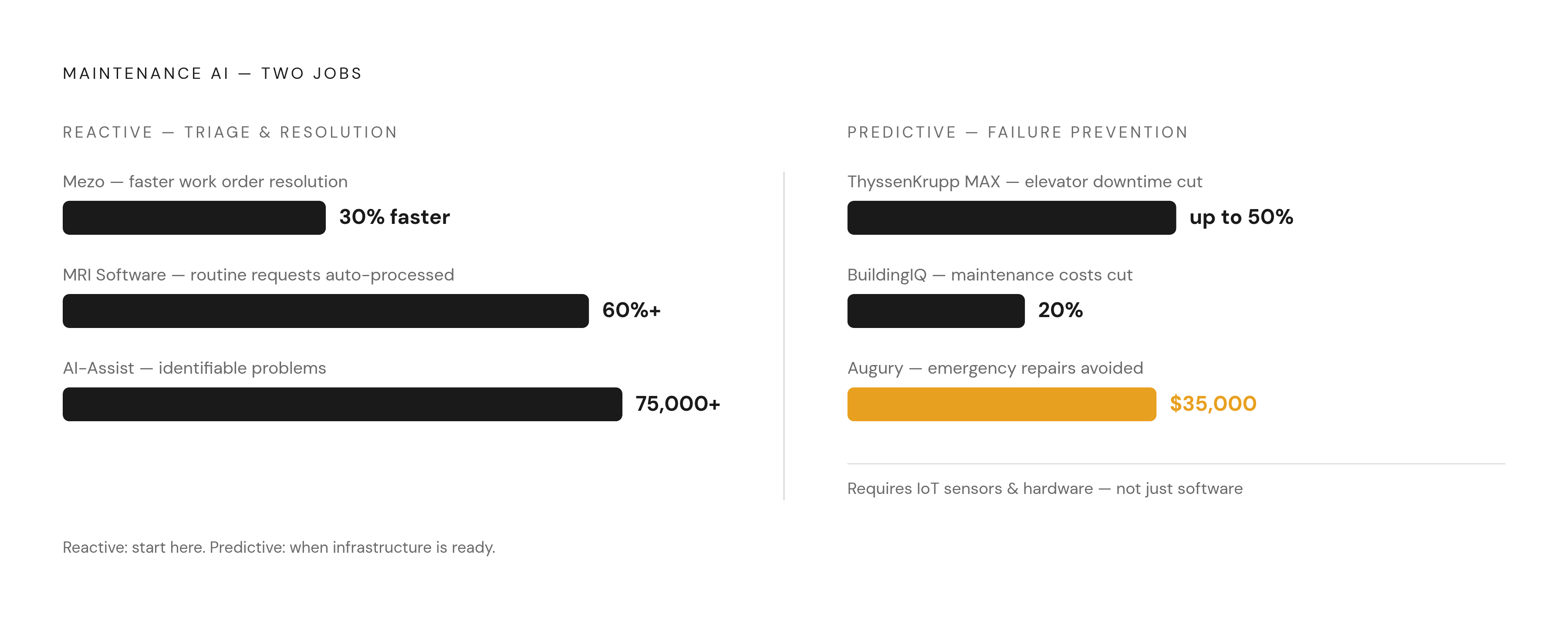
Maintenance AI splits into two distinct jobs, and conflating them produces muddled purchasing decisions. The first is reactive: triaging and routing inbound maintenance requests, reducing miscommunication, and accelerating work order resolution. The second is predictive: anticipating equipment failures before they happen using sensors, IoT data, and machine learning. These require different infrastructure, different budgets, and produce different categories of return.
On the reactive side, the tools are mature and relatively low-barrier. Property Meld's MAX collects information, resolves issues, and mitigates emergencies before escalating to staff. Mezo's diagnostics drive 30% faster work order resolutions. MRI Software's chatbot automatically processes over 60% of routine maintenance requests. AI-Assist uses natural language processing to identify issues from over 75,000 identifiable maintenance problems — which addresses the very real phenomenon of a tenant submitting a work order that reads "the thing in the bathroom is making a noise."
Predictive tools are where the cost savings are largest and the setup cost is highest. Augury's machine learning system detected early HVAC failure in a large apartment complex, saving $35,000 in emergency repairs. ThyssenKrupp's MAX system for elevators has been shown to reduce downtime by up to 50%. BuildingIQ helped a commercial property management firm reduce maintenance costs by 20%. These figures are also attached to deployments that required IoT infrastructure, hardware installation, and vendor relationships that look nothing like a software subscription.
Predictive maintenance is not a pure software decision, and operators who commit to the vision without accounting for the infrastructure requirements arrive at disappointment on a predictable schedule. For most portfolios, the practical sequencing is reactive tools first: lower barrier, immediate return, and a foundation of operational data that makes predictive tools more effective when the organization is actually ready for them.
AI Tools for Tenant Communications and After-Hours Support
After-hours communications is one of those operational problems that sounds manageable until you are three years into a portfolio and have personally fielded enough 2 a.m. calls to understand the cumulative toll. AI addresses this with varying degrees of sophistication. Zumper's virtual assistant handles 70% of initial rental inquiries without human intervention. Livly's AI assistant reduced after-hours maintenance calls by 35% for a 500-unit portfolio. Across operators using AI broadly, 77% report moderate to significant reductions in operating expenses, and communication automation is a meaningful contributor to that figure.
Per the NAA and AppFolio 2025 Performance Ecosystem Report, 53% of operators now rely on general-purpose AI tools like ChatGPT or Claude for at least some of their work. General-purpose tools can draft responses faster and handle a surprising range of inquiries. But they lack property context and, more critically, they lack the compliance guardrails built into purpose-specific tools. A chatbot that answers differently based on perceived applicant characteristics, even unintentionally through patterns in its training data, can trigger Fair Housing violations. General-purpose tools were not trained to avoid that failure mode. Property-specific tools were, at least ostensibly, built to address it.
That raises an important question: is the lower licensing cost of a general-purpose tool actually lower, once you account for the compliance overhead of deploying it correctly? Audit communication outputs for consistency across inquiry types. Review training data for bias before deployment. Accept that these are ongoing responsibilities, not one-time onboarding tasks. The cost of getting this wrong is not evenly distributed between you and the vendor.
AI Tools for Lease Management and Financial Operations
Lease management software is projected to grow at the highest CAGR of 9.5% during the 2024 to 2030 forecast period, per MarketsandMarkets. That concentration of vendor investment reflects where the industry expects return to be clearest, and the operational case is straightforward.
AI in lease management automates abstractions and renewals, flags expiring leases and renewal windows, and identifies clause anomalies or missing terms. These are tasks that are simultaneously tedious, high-stakes, and easy to systematize: precisely the conditions under which automation earns its cost without generating novel risk. On the financial side, invoice data extraction cuts manual vendor data entry substantially. Agentic reconciliation tools cut month-end close time by roughly half, per MRI Software. AppFolio early users save an average of 11.9 hours per week on communication-related tasks and 10.3 hours per week on to-do list completion.
Revenue management AI sits at the intersection of lease management and financial optimization. RealPage YieldStar and Yardi Elevate AI, introduced in February 2026 with generative AI for dynamic rent pricing and ESG reporting, are the most prominent examples. The capability is real. The regulatory environment around algorithmic rent-setting has attracted federal and state scrutiny, and the legal landscape is actively evolving. Deploying a dynamic pricing tool is not a purely technical decision; it is a legal and strategic one that warrants counsel review before rollout, not after.
For smaller operators, AI-assisted accounting within platforms like Buildium or RentRedi provides a meaningful entry point to these savings without enterprise pricing. The returns are smaller in absolute terms, but the ratio of return to cost often favors lighter platforms at lower unit counts.
AI Tools for Smart Building Operations and Energy Management
SmartRent is the clearest reference case in this category: deployed across hundreds of thousands of units and hundreds of properties as of June 2025, with 15 of the top 20 multifamily operators using it daily. Wide adoption tells you the tool solves a real problem at scale. It does not tell you whether it solves your problem at your scale.
Multifamily communities using integrated smart technologies have reduced energy and water utility costs meaningfully, per re-leased.com. Avigilon's AI-powered surveillance helped a property management firm reduce security staff costs by 30% while improving coverage. ButterflyMX's smart intercom improved package delivery success substantially in multi-tenant buildings. At scale, these savings compound across units in ways that change the ROI calculus substantially.
Smart building tools require hardware installation, not just software onboarding. The budget, the timeline, and the vendor relationship look fundamentally different from a SaaS subscription, and that difference is underrepresented in the sales process. For mid-to-large portfolios, the energy savings case is strong. For smaller operators with fewer units, the math is harder and deserves honest modeling before commitment. RealPage unveiled Voyager 2026 in November 2025 with integrated IoT sensors for smart building automation, signaling that enterprise platforms are absorbing this layer into their core offerings. Whether that consolidation simplifies or complicates the buying decision depends entirely on what else the organization is already running on those platforms.
How the Major Platforms Stack Up Across These Functions
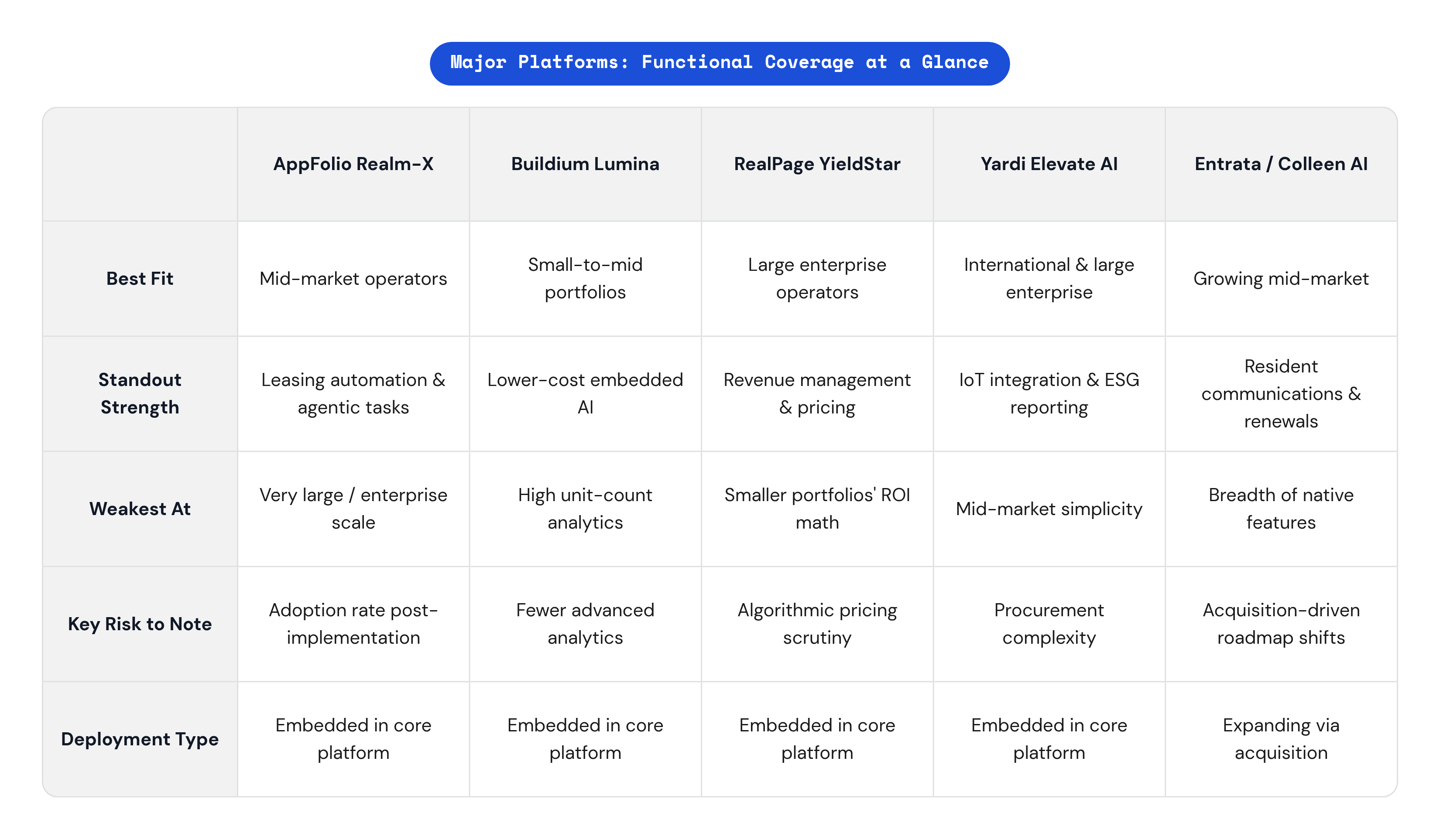
This is not a comprehensive ranking. It is a functional coverage map, and the differences in emphasis matter more than any composite score.
AppFolio Property Manager leads in leasing automation and agentic task management. Its Realm-X platform is built into the core OS, rated highest for autonomous task execution on the G2 Grid Report for Property Management from Spring 2026, and carries a high user adoption rate. That adoption figure is as important as the feature set. A 79% autonomous task execution score means nothing if the team is not using the tool, and most platforms lose the adoption battle quietly, after the implementation team has left the building. The ROI payback period of roughly 10 months compares favorably to heavier enterprise platforms, making it a strong fit for mid-market operators who want embedded AI without enterprise procurement complexity.
Buildium's Lumina AI Workforce, introduced in 2025, added digital coworkers for leasing, accounting, and resident engagement. It fits smaller-to-mid portfolios well and carries a lower entry cost.
RealPage excels at revenue management through YieldStar, predictive analytics, expense benchmarking, and ESG reporting. It is purpose-built for large operators managing tens or hundreds of thousands of units. The regulatory scrutiny on its algorithmic pricing approach is a relevant consideration that warrants explicit attention during evaluation, not deferral until after signing.
Yardi's Elevate AI, introduced in February 2026, adds generative AI for rent pricing and ESG. Voyager 2026 integrates IoT at the platform level. Yardi is the appropriate choice for international operators and large enterprises that need breadth across geographies and asset types.
MRI Software's chatbot and maintenance automation are strong, with AI features distributed across multiple functions. Entrata is actively expanding its AI surface through acquisition, most visibly through the Colleen AI purchase in June 2024.
Three variables should govern the selection decision. Portfolio size: embedded platforms earn their cost when the operator can utilize most of their functions; a 150-unit operator paying enterprise pricing for features that require 5,000 units to generate meaningful ROI has made an expensive mistake. Integration depth: embedded AI avoids data silos; point solutions often require API work that is invisible in the sales conversation. Adoption rate: features the team does not use do not generate returns, and projected adoption rates supplied by the vendor are not adoption rates.
What to Check Before Deploying Any AI Tool in a Compliance-Sensitive Context
Three compliance pressure points appear across multiple functions and deserve direct treatment.
Tenant screening: AI that produces disparate impact on a protected class is a Fair Housing violation regardless of intent. The model does not need to have been designed to discriminate. If the output disparately affects a protected class, the liability is real, and "the algorithm did it" has not proven to be a successful legal defense. Human review of recommendations is required, not optional.
Communications: chatbots trained on biased historical data can answer inquiries inconsistently based on perceived applicant characteristics. Audit AI communication outputs regularly, and regularly means more than once at onboarding. The bias that surfaces in month seven was present in month one; you just were not looking.
Rent pricing: algorithmic rent-setting tools have attracted federal and state regulatory attention. The legal landscape is shifting. Understanding local law before deploying dynamic pricing is the minimum viable standard, not an abundance of caution.
On data privacy: AI tools that ingest tenant data must comply with applicable state privacy laws, including CCPA and its equivalents. Verify vendor data handling agreements before onboarding. Do not assume compliance is the vendor's problem because the contract language will clarify that it is not.
The practical checklist for any new deployment: identify which protected categories the tool's outputs affect; confirm indemnification and liability language in the contract; establish a review cadence for AI outputs that continues past the first month; train staff explicitly on where AI recommendations end and human judgment begins. Per the Foundation for Community Association Research's July 2025 survey, 71% of community managers already use AI in their work. Most are deploying faster than compliance frameworks are catching up. The gap between adoption rate and review readiness is where the exposure concentrates.
Matching Tools to Your Portfolio's Actual Operational Gaps
Start with the gap, not the demo. Where is the team losing the most time? Where are tenant complaints concentrating? Where is the month-end close consistently late? Those questions produce a short list of functional priorities, and that list should govern every vendor conversation. A tool that solves a problem you actually have is worth more than a platform with a broader feature set addressing problems you do not.
It is also worth considering what happens when a tool solves the wrong problem efficiently. Automation accelerates outcomes — for better or worse, it is a river that carves whatever channel you give it. If the underlying process has a flaw, the flaw scales. Getting clear on the actual operational gap before evaluating vendors is not a preliminary step; it is the work.
Point solutions are often the smarter path at smaller scale, with the trade-off being integration overhead that grows as the number of standalone tools increases. That overhead is real, and it is invisible until someone has to reconcile data across three platforms at month-end.
Build the human review layer before the AI layer, not after. The compliance requirements are not aspirational. They reflect how AI-assisted decisions in property management actually create liability. Knowing where the AI ends and the human begins is an operational question that should be answered before the first tenant interaction goes through the system, not during the first compliance conversation.
The tools available today are capable. Whether they improve your operation depends almost entirely on whether you knew what you needed before you started looking.