Property Management Technology Trends Shaping 2025 Portfolios
Most property managers have adopted AI but haven't scaled it far enough to justify the cost.

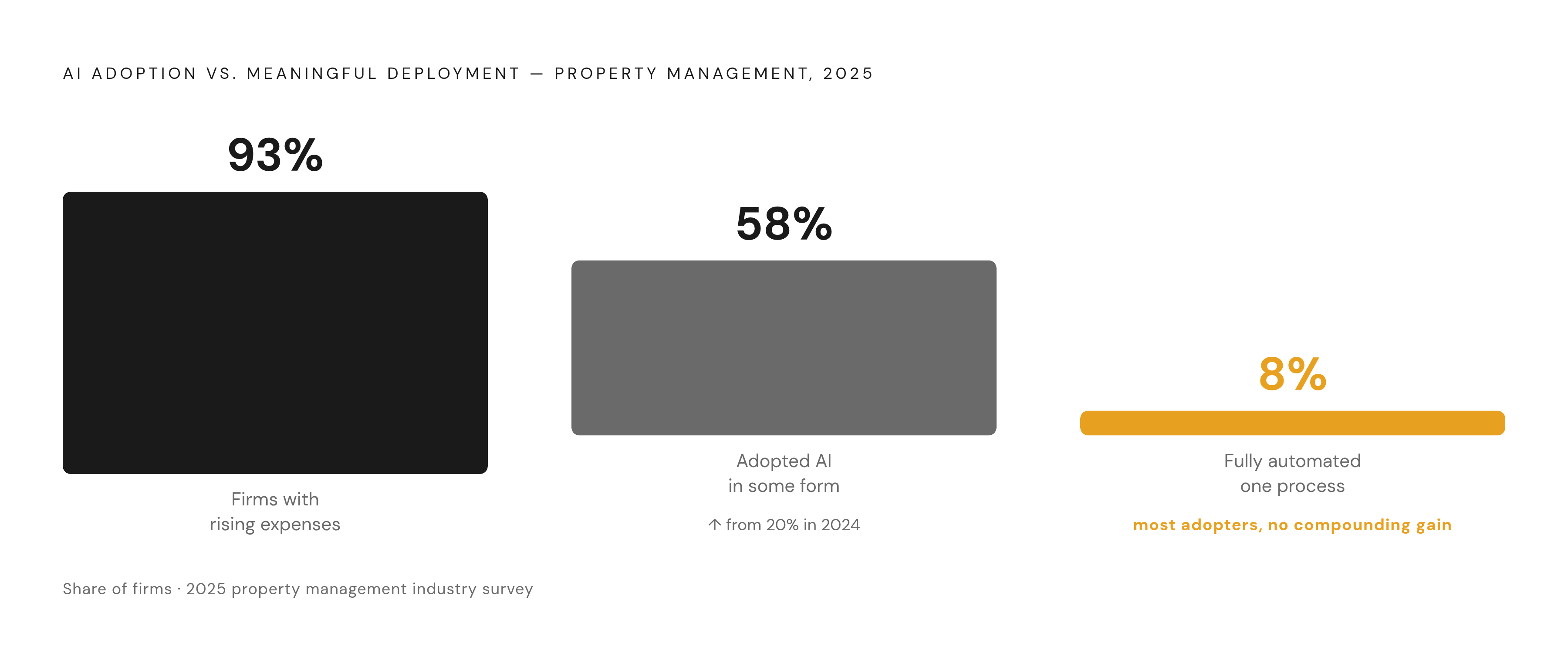
AI adoption in property management reportedly jumped from 20% in 2024 to 58% in 2025, yet only 8% of companies had fully automated even a single process. Most firms are somewhere uncomfortable in the middle: running AI in a few workflows, measuring outputs inconsistently, waiting to see what shakes out. That middle position carries the cost of adoption without the compounding benefit of scale, and a lot of operators don't realize they're in it.
The adoption driver isn't curiosity. Expenses increased for 93% of property management companies, and half of those firms planned to cut costs through new tools or better deployment of existing ones. AI is a direct response to margin compression, not a strategic vision exercise.
What AI is actually doing in 2025 spans more territory than most operators have mapped. Automated leasing communications, maintenance routing, and workflow orchestration are reducing administrative overhead in ways that show up in staffing ratios. AppFolio's generative AI Smart Leasing Assistant, launched in Q2 2025 under the Realm-X initiative, is a working commercial example of this applied to residential property management. On the revenue side, dynamic rent pricing algorithms forecast scenarios and flag renewal risk before a vacancy materializes. Automated valuation models have achieved median error rates around 2.8%, down from roughly 10 to 15% five years ago. These figures should be verified against current published research before being used in underwriting or strategic decisions. That kind of accuracy shifts when you make acquisition, disposition, and renewal decisions, because the signal is no longer quarterly; it's continuous.
The horizon worth watching is agentic AI: autonomous systems capable of coordinating multi-step processes like tenant onboarding, lease negotiation, and portfolio rebalancing with minimal human prompting. Some analysts estimate these systems will automate up to 70% of junior staff tasks by 2027, though no specific source for this figure has been identified here and readers should treat it with caution. The organizational question it raises is real regardless of the exact figure. Portfolio managers who aren't thinking now about what that does to their staffing model will be thinking about it later, under conditions that don't favor careful deliberation.
The strategic bifurcation is already visible in the numbers. AI-centered PropTech companies grew at 42% annualized in 2025 versus 24% for non-AI firms. The AI-native PropTech unicorns that emerged since mid-2024 — EliseAI at a reported $2.2 billion valuation, Bedrock Robotics at $1.75 billion, Vantaca at $1.25 billion, and Juniper Square at $1.1 billion — operate across leasing, construction, HOA management, and investor relations. The spread matters: AI isn't concentrated in one function. It's threading through the entire operating stack.
Colliers has identified what they call the "AI productivity gap," the growing performance distance between firms scaling proven applications and firms still running pilots. Every month in pilot mode is a month of that compounding handed to someone else.
One dependency runs underneath all of it. AI's impact is entirely contingent on clean data and integrated systems. Without stack cohesion, AI outputs are incomplete at best and actively misleading at worst.
What Predictive Maintenance and Smart Building IoT Actually Do to the Asset's Financial Profile
Spend enough time walking properties and you start to recognize the pattern: the HVAC unit nobody flagged until it failed on a Saturday in August, the water leak discovered because a resident finally called, the elevator that cost three times what it should have because deferred maintenance compounded quietly for two years. IoT in 2025 is a systematic attack on that pattern. Smart HVAC, keyless access, water and electrical sensors, environmental monitors — these aren't discrete device categories so much as an ecosystem of continuous data replacing the periodic, often delayed signals that property management has always run on.
AI-driven predictive maintenance reportedly reduces operational costs by 17.6% and extends equipment lifespans by 25 to 30%. At portfolio scale, that lifespan extension is a capital expenditure deferral, which flows directly into asset valuation. U.S. Department of Energy data shows predictive maintenance saves roughly 8 to 12% on preventive maintenance costs and up to 40% on reactive maintenance costs; readers should consult the Department of Energy's published reports directly to confirm these figures. The largest savings come from avoiding emergency repairs entirely, not from scheduling routine ones more efficiently. There's a difference, and it matters when you're doing underwriting.
Energy compounds the case further. IoT real-time monitoring reportedly produces energy savings of up to 17%, and smart building systems deliver average energy savings of 14% alongside a 91% resident satisfaction score; the sources for these specific figures are not identified here and should be verified before being cited externally. Most amenity investments force a trade-off between cost reduction and resident experience. Here, both move in the same direction at once, which is worth noting when you're prioritizing a renovation budget.
The emerging frontier is digital twins: IoT sensor data feeding a simulation model of a property that can test performance under varying conditions before changes are made to the physical building. The shift is from historical reporting to forward simulation — less like a dashboard and more like a flight simulator.
The demand signal from renters reinforces the capital case, though survey data always has a gap between stated preference and actual behavior worth keeping in mind. Sixty-five percent of renters reportedly find apartments more appealing with smart home technology; 58% would prioritize smart features over traditional amenities like pools or gyms, particularly when rent savings are attached; 54% now expect smart locks, thermostats, and security cameras as a baseline. These figures are drawn from surveys whose methodology and sponsorship operators should review before relying on them for capital allocation decisions. That last number is the one that should recalibrate how operators think about amenity investment, because expectations function as a floor, not a selling point.
The counterweight is real. Meaningful percentages of renters express concern about app-based lockouts, location tracking, indoor surveillance, and unauthorized management access. These concerns don't prevent adoption, but they create a trust deficit when deployment outpaces communication. An operator who rolls out smart technology without a clear, resident-facing privacy and reliability protocol is trading short-term leasing appeal for long-term retention friction.
Prioritize IoT investment on maintenance cost reduction and equipment lifespan extension first, resident experience second. When both vectors point in the same direction, as they do on energy and access control, the capital case is straightforward. When they create friction, implementation sequencing is what determines whether that friction is temporary or structural.
Why Platform Consolidation Is the Decision That Determines Whether the Other Trends Deliver
The AI pricing model running on fragmented data isn't just less effective than one running on clean integrated data. It's potentially worse than no model at all, because it produces confident wrong answers. Platform consolidation is the infrastructure condition that determines whether the trends in every other section of this piece actually deliver. Operators who treat it as a software procurement question rather than a portfolio architecture decision are making a consequential category error, and they usually don't discover the cost of that error until they're trying to scale something that won't scale.
The structural shift underway is centralized operations: leasing, renewals, and marketing workflows moving into centralized hubs with shared CRMs, standardized playbooks, and integrated communication platforms. The goal is portfolio depth without proportional headcount growth. That model only functions when the underlying data infrastructure is cohesive.
The market signals where value is accumulating. Lease and tenant management holds the largest revenue share in 2025, but integrated payments is the fastest-growing module. The growth is in connectivity, not in any single feature.
The competitive landscape is consolidating around major platforms. AppFolio is building its AI strategy through the Realm-X initiative and its generative AI Smart Leasing Assistant. MRI Software expanded its AI companion Ask Agora in October 2025 and acquired Spaceflow for tenant experience in Q2 of that year. Yardi Systems and Buildium anchor residential and mixed-use portfolios at scale. Vantaca has established vertical specialization in HOA management as a distinct competitive position, which explains a significant portion of its $1.25 billion valuation.
The all-in-one versus best-of-breed tension is genuine and unresolved. Operators who consolidate too quickly into a single vendor's ecosystem can find themselves cut off from specialist tools that outperform on specific functions. Operators who build elaborate best-of-breed stacks risk collapsing under their own integration overhead. The resolution isn't a vendor choice. It's a structural criterion: the right platform provides open APIs and strong third-party integrations, because that's the infrastructure condition that allows AI and IoT investments to compound rather than operate in silos.
Centralization also enables a different staffing model, shared leasing and renewal teams serving multiple properties, faster response times, more consistent resident outcomes. Platform decisions made in 2025 will set the ceiling on AI and IoT returns for the next several years — a literal constraint on what the data environment will permit, not a figure of speech.
How ESG and Sustainability Requirements Are Shifting from Compliance Cost to Asset Value Driver
The three items sitting at the top of commercial real estate professionals' 2025 priority lists — energy efficiency and expense reduction, utility bill data capture and ESG reporting, water efficiency and conservation — all require the same sensor infrastructure and platform integration covered in the preceding sections. That overlap isn't coincidental. It's the consolidation of what used to be two separate workstreams, operations and compliance, into one. Operators still running them separately are doing duplicative work and producing less accurate outputs than operators who've integrated them.
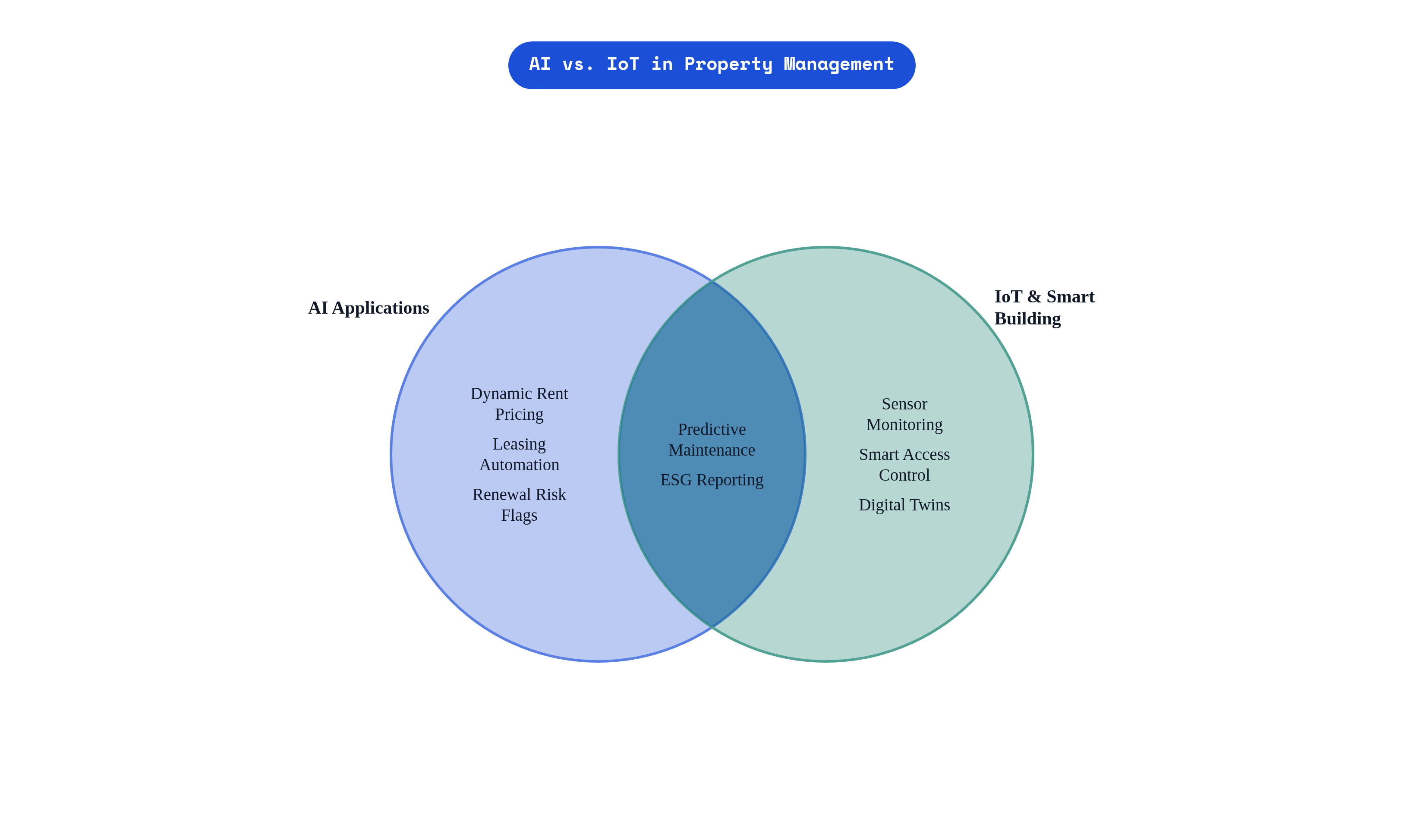
The same IoT sensors enabling predictive maintenance generate the energy and water consumption data that feeds ESG reporting. It's a practical observation about where the data lives, not a philosophical argument about sustainability strategy.
Smart building energy savings translate into operating expense reduction and NOI improvement. They also generate documented performance data that increasingly affects asset pricing in institutional transactions. The same numbers show up in two different conversations, and operators who understand that are running one data collection process instead of two.
The investor relations dimension is where the stakes become explicit. Juniper Square's $1.1 billion valuation is built specifically on AI-powered investor relations and fund administration. Institutional investors are demanding real-time portfolio performance data, and operators who can't provide it are at a disadvantage in capital raising independent of the underlying asset quality. The quality of the reporting has become part of the product being sold to capital partners — a shift that happened quietly and is now fairly difficult to reverse.
The compliance horizon is tightening. Energy benchmarking mandates and building performance standards are expanding in major U.S. markets. Operators without automated utility data capture are accumulating a reporting liability that compounds the longer it goes unaddressed. Retrofitting compliance infrastructure is generally more expensive than building it correctly the first time, and the operators who've already built it are sitting on a competitive advantage they didn't entirely intend to create.
The floor here is compliance cost. The operators treating it as the ceiling are leaving the more interesting part of the return profile unexamined: NOI improvement from energy savings, asset valuation impact from documented performance data, and capital access implications from investor-grade ESG reporting.
The Resident Experience Layer and What It Actually Affects in Portfolio Performance
When 54% of renters expect smart locks, thermostats, and security cameras as standard features, the conversation about resident experience technology has already shifted. It's no longer a differentiation question. It's a lease-up question. Operators without it are competing for a shrinking pool of renters who don't have those expectations, and that pool is contracting by cohort. These survey figures should be verified against their original source before being used in capital planning.
The amenity trade-off has direct capital allocation implications that many operators haven't fully internalized. When 58% of renters reportedly say they would prioritize smart home technology over pools or gyms, particularly when associated with rent savings, smart building technology is competing directly with traditional amenity investment for the same renovation budget. An operator underwriting a pool renovation as a retention strategy without testing it against smart building alternatives is working with an outdated demand model.
The highest-leverage application of resident experience technology is AI-driven renewal risk identification: flagging tenants showing early churn signals before lease expiration, enabling proactive intervention before a vacancy is realized. Preventing a single vacancy is worth more than most individual amenity installations in most markets. This is where resident experience connects most directly to NOI, and it's the application most dependent on integrated leasing and building data. You can't identify early churn signals if your leasing data and your building engagement data are living in separate systems — that's not a technical observation; it's an organizational one.
EliseAI's $2.2 billion valuation reflects where institutional capital has located a high-leverage point: the leasing funnel, where speed and consistency of follow-up have a direct, measurable impact on occupancy rates. The leasing funnel is a conversion problem. AI treats it as one, without the inconsistency of human follow-up schedules or the variability of staffing levels.
Renters have documented concerns about app-based lockouts, location tracking, indoor cameras, and unauthorized management access. These concerns don't prevent adoption, but they govern the trust relationship that influences renewal decisions. The operators who've figured this out communicate proactively about privacy and access protocols before residents ask, which turns a potential objection into a demonstration of competence.
Evaluate resident experience technology on renewal rate impact and vacancy reduction. Operators who connect their leasing and retention data to their smart building data will measure this with precision. Operators who run them as separate programs will be estimating, and estimating is a fine strategy until a competitor stops doing it.
How to Evaluate Which Technology Investments Will Compound Returns Versus Which Will Add Noise
Platform integration comes first. Not because it's the most exciting investment, but because AI and IoT running on fragmented data stacks produce unreliable outputs, and unreliable outputs at scale are worse than no outputs at all. The stack cohesion question is upstream of every other technology decision in this piece, and skipping it to chase a more visible application is a sequencing error that announces itself at the worst possible moment.
From there, the evaluation organizes around a simple question: does this investment affect both the cost structure and the revenue line simultaneously? AI renewal risk identification, predictive maintenance, dynamic pricing models — all of these carry higher compounding potential because they accumulate returns on two dimensions at once. Investments that affect only one dimension aren't wrong, but they require a higher individual ROI threshold to justify the implementation burden and the organizational attention they consume.
The "AI productivity gap" Colliers identified is a central strategic risk for operators in 2025. Firms in extended pilot mode aren't holding a neutral position. They're ceding compounding time to operators who are already scaling. The benefit of better pricing models, earlier renewal interventions, and lower maintenance costs grows with data accumulation over time, which means the gap between the pilots and the scalers isn't static. It's widening.
Three questions cut through most of the noise. Does this investment require or improve platform integration? If not, it's probably additive complexity rather than structural advantage. Does it affect revenue-side decisions or only cost-side ones? Both matter, but they compound differently. Does it generate data that improves future decisions, or does it only optimize the current one? That last question is the one most operators skip, and it's where the real performance gap gets built, quietly, over several years of decisions that each looked reasonable in isolation.
The operators who treat 2025's technology decisions as portfolio architecture decisions will have built something durable by the time the next cycle of tools arrives. The ones still running pilots in 2026 will know exactly what they deferred.