Property Management Technology Solutions for HOA Communities
Software built for HOAs manages money and maintenance better than generic tools can.
About 373,000 community associations now govern roughly 78 million Americans, which works out to something like 35% of all U.S. housing as of 2025, according to the Foundation for Community Association Research. That's a lot of pool schedules and parking rules to keep straight, and the software built to manage all of it is what this piece is actually about: which category of HOA tech solves which problem, and how a board should figure out what it needs before it starts shopping.
The money alone should tell you why this matters. Homeowners across these associations pay more than $112 billion a year in assessments, every dollar of which has to get collected, tracked, and reported without someone's board treasurer losing sleep over a spreadsheet formula gone wrong. This isn't a temporary bubble, either. U.S. Census data shows the share of new homes built inside an HOA climbed from 49% in 2009 to 65% in 2023, a structural shift in how America builds housing. That means more associations are forming every year, plenty of them self-managed, all of them inheriting the full weight of financial operations, maintenance, communication, and legal compliance on day one, whether or not anyone on the board has done this before.
Each of these challenges maps to an actual, buyable category of software, and the rest of this piece walks through them in the order most boards actually encounter them: money first, then the physical stuff that breaks, then the people who complain about both.
Why HOA boards and managers are adopting dedicated software rather than generic tools
Cloud-based platforms make up around 70% of HOA software sales at this point, and mobile access plus automated billing have been the two features pulling adoption forward between 2023 and 2025. Still, only a bit more than 30% of U.S. HOAs currently run their financial and governance operations on cloud software, which tells you something worth sitting with for a second: most communities are mid-transition, not post-transition. The shift is real, but it's nowhere near finished. Meanwhile 57% of associations report moving toward mobile-enabled access and automated billing specifically, which is a slightly different metric than full cloud adoption and worth keeping separate in your head.
Spreadsheets and generic accounting software work fine until they don't, and the failure point is always connection. A dues ledger in Excel doesn't talk to the maintenance log in a shared Google Doc, which doesn't talk to the email thread where the board actually voted on the roof repair. Every one of those gaps is a place where information dies and someone has to reconstruct it manually, usually right when a resident is angry and demanding an answer.
Specialized platforms consolidate those workflows, and the administrative overhead they save tends to grow faster than the community itself does. Bigger community, more transactions, more work orders, more angry emails; a fragmented toolset scales worse than the population it's serving. Self-service portals are the most measurable piece of this. When residents can look up their own payment history instead of calling the office, inbound call volume drops, and that's not a vague productivity claim, it's a number a management company can watch shrink on its own phone logs.
The real question a board should ask is which category of software addresses the most urgent problem right now, because trying to fix everything at once usually means fixing nothing well.
Financial management and dues collection tools — where most communities start
Dues collection is the foundation, full stop. Every other function of an HOA, from pool maintenance to legal compliance, runs on assessment revenue, and if that revenue is unreliable, everything downstream is underfunded.
Financial platforms built for HOAs typically handle a consistent set of jobs: automated payment reminders and late-fee workflows, multiple payment channels (ACH, credit and debit, autopay), real-time budget tracking and reserve fund visibility, vendor payment processing tied to the same ledger, and audit-ready reporting boards can hand straight to a CPA. The late-payment problem, it turns out, is more behavioral than technical. Nobody wants to be the board member calling a neighbor about a missed payment; automated reminders take that awkward conversation off a volunteer's plate entirely, which quietly does more for delinquency rates than any late fee ever could.
The differentiator worth actually checking before signing anything: is the accounting module built for HOA fund accounting and reserve schedules, or is it a generic small-business tool with an HOA-flavored skin slapped on top? Those are not the same product, even when the sales page makes them sound identical.
Pricing runs a wide range. Entry-level plans generally start somewhere in the $40 to $90 per user per month range, while full-featured platforms with financial automation built in can run $350 to $600 per user per month. Before buying anything, confirm that the payment portal actually integrates with the general ledger. If it doesn't, someone on staff is manually reconciling transactions every month, which defeats a good chunk of the point.
Maintenance tracking and work order management for common areas and shared infrastructure
Deferred maintenance on a pool, an elevator, a roof, or an HVAC system isn't just an inconvenience; it's a liability the board is legally and financially exposed to. That reframes maintenance software as something closer to risk management than a convenience purchase.
The core functions look like this: residents submit work orders through a portal or app, requests get assigned and tracked to vendors or on-site staff, photo documentation and status updates stay visible to whoever submitted the request, and maintenance history gets logged per asset or location, which matters enormously when reserve studies come around. Vendor management (bids, contracts, certificates of insurance) usually lives in the same system too.
Here's the pattern behind most board-member complaints, if you actually trace them back: a resident submits a request and never hears anything again. Silence generates the angriest emails, often more than the underlying problem itself. Software that closes that loop, even with something as simple as an automated status update, addresses the actual source of frustration rather than the surface complaint.
One thing worth checking before you buy: are maintenance records siloed from the financial system, or connected? An invoice that doesn't trace back to the work order that generated it breaks the audit trail, and that's the kind of gap that only becomes visible during a dispute, which is exactly the worst time to discover it.
Most communities are still managing maintenance reactively, meaning something breaks and then gets fixed. The gap between that approach and a scheduled, predictive one is where AI tools are starting to compete, and that's worth its own section.
How AI and predictive tools are beginning to shift maintenance from reactive to scheduled
IoT sensors on HVAC systems, elevators, water systems, and common-area lighting can now track performance continuously, flagging anomalies before anything actually fails. Industry benchmarks suggest AI-driven predictive maintenance can meaningfully cut total maintenance costs while improving resident satisfaction at the same time, though adoption so far is still limited to a minority of facilities. That gap between what's possible and what's actually deployed is where the money gets left on the table: communities are still paying emergency-service rates for failures that sensor data could have flagged weeks in advance.
Smart building management systems can also cut energy consumption meaningfully through automated HVAC optimization and lighting controls, which matters most for communities running large common areas or amenity buildings (think clubhouses, fitness centers, big shared lobbies).
On the vendor side, platforms like Vantaca report customers saving a substantial number of staff hours each month through automated workflows spanning invoices, maintenance scheduling, and vendor coordination. RealPage expanded its analytics suite with predictive maintenance tools back in 2023, a useful signal in itself: major platforms are folding this into standard offerings rather than keeping it locked behind a premium tier.
The catch, and it's a real one: predictive tools need sensor infrastructure, and that's an upfront capital cost, not a software subscription line item. A community with an aging single elevator and a modest clubhouse should think hard about whether that infrastructure investment pencils out before buying software that depends on data those sensors haven't been installed to generate yet.
Resident communication platforms and the self-service portal as the front door to the HOA
Ask any long-time property manager what actually drives resident complaints, and it's rarely the rules themselves. It's the feeling of being uninformed or ignored, a communication failure dressed up as a governance dispute.
Communication platforms typically cover broadcast messaging across email, SMS, and push notifications, segmented by building, street, or resident category; searchable document libraries for CC&Rs, bylaws, minutes, and architectural guidelines; announcement boards and event calendars; two-way messaging threads with management; and violation notices that include photo evidence and response tracking. Self-service portals do the quiet, unglamorous work here: a resident who can check their payment history or find the pool hours at 10 p.m. doesn't call the office at 9 a.m. the next morning.
AppFolio's 2025 mobile update reportedly pushed 60% of resident interactions, covering payments, maintenance, and communication, onto smartphones. That's a real convergence point: the portal and the app are becoming the same thing, easing what used to be two separate tools a resident had to juggle.
Two features worth checking specifically. Does the platform support segmented messaging, so a parking notice doesn't land in the inbox of residents who don't even own a car? And can document permissions be scoped, since some board materials genuinely shouldn't be public? There's also a compliance angle hiding in plain sight here: a time-stamped, logged communication trail doubles as a governance record. A platform that tracks outbound notices and resident responses is quietly building the paper trail a board might need someday in a dispute.
AI in the communication workflow — what's actually being adopted and where trust is still uncertain
The Foundation for Community Association Research ran a Snap Survey in May 2025 with 478 respondents, and the results are more specific than most AI-adoption claims floating around right now. Seventy-one percent said they currently use AI in some form; 29% use it daily. Among that group, the most common uses were large language models for writing and editing (80%), AI meeting-summary tools (51%), and chatbots handling resident questions (29%).
Look at that pattern for a second. Adoption is clustered around low-stakes, high-volume writing tasks, the kind where nobody's legally or financially on the hook if the output is a little off. Drafting a newsletter blurb with AI carries basically no risk. Drafting a legal violation notice does.
AI chatbots for resident Q&A are genuinely useful for after-hours questions about dues, rules, and amenity hours, and STAN.ai has rolled this out across a large number of communities serving millions of homeowners, so this isn't a fringe experiment anymore. But trust in the output itself is still shaky. The same CAI survey found only a small minority of respondents trust AI-generated content more than a traditional search, a sizeable share said they flat-out don't trust it, and 57% said it depends on the topic. That "depends" is doing a lot of work in that number: AI seems fine for drafting and triage, but a human still needs to read the violation letter before it goes out.
One practical thing to check in any AI-assisted platform: can the AI actually be trained on your community's own governing documents, or is it giving generic HOA answers that might not match your specific CC&Rs? That distinction matters more than almost any other feature on the sales sheet.
E-voting, virtual meetings, and the digital governance stack for board operations
Board governance carries a compliance dimension most other HOA functions don't: quorum requirements, notice periods, secret-ballot rules, and record retention are all dictated by state law layered on top of the community's own governing documents. Get any of that wrong and the risk isn't a minor inconvenience — it's a challenged election.
As of 2025, 32 states allow or don't explicitly prohibit e-voting in managed communities. California went further with AB 2159, effective January 1, 2025, which formally authorizes electronic secret-ballot voting and requires associations to update their election rules and record-keeping practices to match. That's the kind of legislative detail that turns "should we adopt e-voting" into "are we even allowed to, and if so, what does the paperwork need to look like."
Digital governance platforms generally cover electronic voting with audit trails and anonymous ballot options, meeting management (agenda distribution, Zoom integration, attendance tracking), version-controlled board document management for resolutions and minutes, and proxy management for annual elections. There's a real participation benefit buried in here too: virtual meeting access pulls in owners who travel for work, have mobility limits, or live somewhere else for half the year, which matters a lot in communities with seasonal residents or absentee owners who'd otherwise never show up to a vote.
Before adopting e-voting, a board needs to check three things: does the state actually permit it, do the CC&Rs require a bylaw amendment first, and does the vendor's platform generate the specific documentation the state requires if someone challenges the results later. That record-keeping requirement isn't paperwork for paperwork's sake; it's legal protection the day someone contests an election outcome.
Access control and security technology in HOA communities — gates, credentials, and common-area monitoring
Security needs vary widely across HOAs, and that's worth saying plainly. A gated single-family community, a mid-rise or high-rise condo, or anything with a gym, pool, or parking garage has a lot more to manage than an open-street suburban development with no shared amenities at all.
For communities that do need it, access control platforms typically manage credential-based entry (key fobs, mobile credentials, license-plate recognition, biometric options), visitor and delivery management through temporary codes or virtual gate guard services, common-area access logs tracking who entered the gym and when, and integration with cameras and alarm systems.
A 2024 Smart City Report found that smart security systems, Ring, Nest, and comparable platforms among them, were linked to a 20% reduction in neighborhood crime rates in urban communities, though the actual outcome for any single HOA depends heavily on installation density and how the system gets configured, not just whether it exists.
The integration question matters as much here as anywhere else in this piece: does the access control system talk to the property management platform, or does it sit off in its own silo that staff have to reconcile by hand? And keep in mind that biometric and license-plate systems require physical hardware installation, which makes this a capital expense decision that belongs in the reserve study conversation, not just a software line item someone signs off on quietly. For smaller gated communities that can't sustain a full-time staffed gatehouse, virtual gate guard services offer a middle path: real oversight without the payroll of a 24-hour position.
All-in-one platforms versus point solutions — how to think about the build-vs-integrate decision
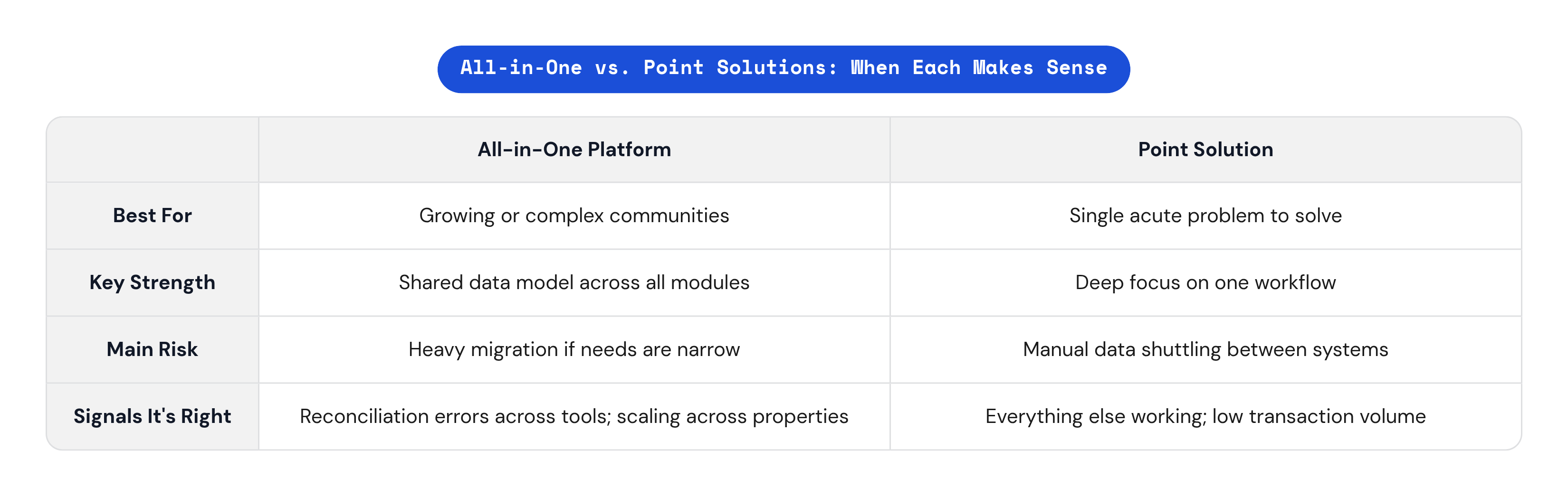
One login, one vendor relationship, one shared data model across financials, communication, maintenance, and governance: that's the pitch behind every all-in-one platform, and it's a genuinely appealing one. The cost of not having it shows up in small, repeated ways: dues payments live in one system, maintenance requests in another, board documents in a third, and staff end up spending real time manually shuttling information between them that should just flow on its own.
An all-in-one migration isn't automatically the right call for every community, though, and it's worth being honest about when a point solution actually makes more sense. If a community has one specific, acute problem, say, collections delinquency, and everything else is working fine, ripping out the whole stack to fix one module is overkill. Same goes for a community that's self-managed with low transaction volume and a genuinely narrow administrative footprint; the overhead of a full platform migration might exceed the problem it's solving.
The case for going all-in-one gets stronger under a few conditions: the community is growing in units or complexity and the current tools are throwing off reconciliation errors, staff or board time is disproportionately eaten up by manually moving data between systems, or a management company is scaling across multiple properties and needs one system of record instead of five.
A handful of named platforms are active in this space in 2025: Vantaca, AppFolio, Yardi Breeze, and CINC Systems, each covering a different mix of the categories laid out across this piece, and none of them dominating every category equally. That's worth remembering the next time a sales deck implies otherwise. The one question every board should ask any vendor before signing: which of my specific workflows does this platform handle start to finish, and where would I still need a separate tool or a manual workaround? Get an honest answer to that, and the rest of the decision usually sorts itself out.