Use of Technology in Property Management Today
The proptech market is doubling as AI, sensors, and apps reshape how buildings operate.

Property management crossed a real threshold, and most people outside the industry haven't noticed. The global proptech market hit $47.08 billion in 2025 according to Precedence Research, and separate forecasters, including Grand View Research and IMARC Group, land in roughly the same neighborhood: this market doubles or triples by the early 2030s. Three research shops with different methods landing on the same story isn't a coincidence. It's a trend already baked into how the industry buys software, and this piece is about what that actually looks like on the ground: how AI, sensors, and tenant-facing apps are turning into something closer to a nervous system for buildings than a pile of separate tools bought at different times for different reasons.
Why AI adoption has jumped so sharply (and what operators are actually doing with it)
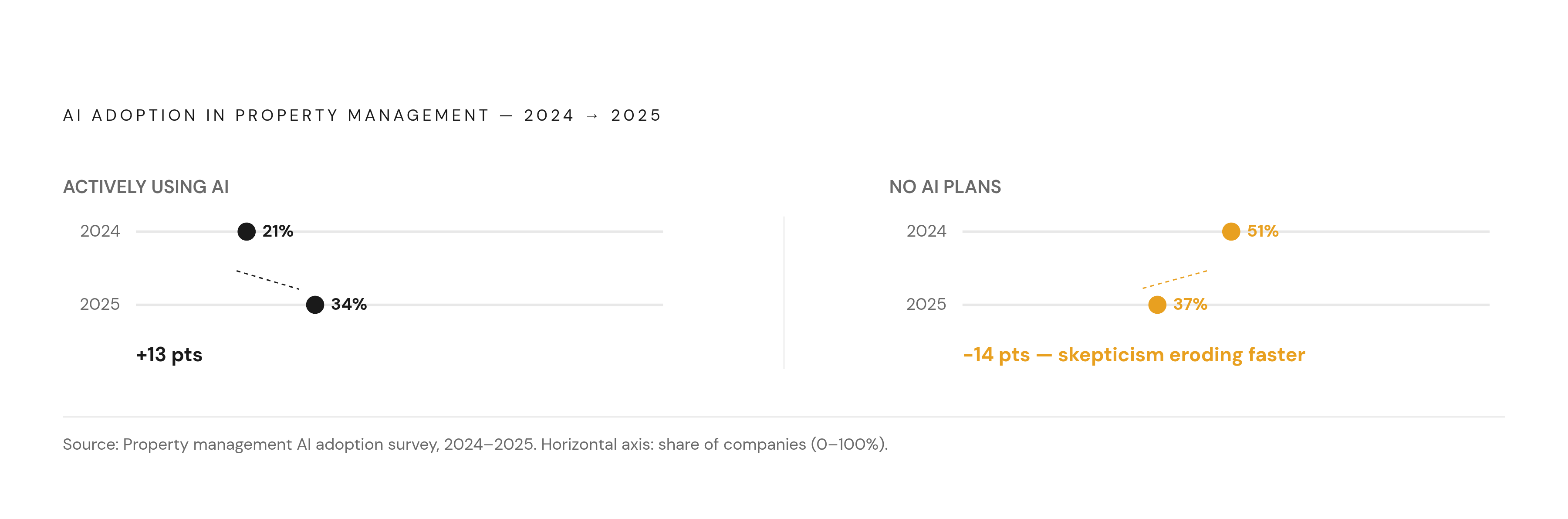
AI use among property management companies jumped from 21% in 2024 to 34% in 2025, according to DoorLoop's industry data. Thirteen points in twelve months is fast for an industry that ran on paper files and legacy desktop software for most of its existence.
The number sitting next to it tells you more, honestly. The share of companies with zero AI plans dropped from 51% to 37% over the same stretch. That's a bigger move than the adoption number itself, and it says something specific: skepticism is eroding faster than actual use is growing. Toss in the 29% who say they're adopting soon, and you've got an industry where sitting this one out starts to carry real cost.
Size matters here, and not in a subtle way. Among companies managing large portfolios of thousands of units or more, 47% use AI. Drop down to portfolios under 50 units and that number falls to 28%. Big operators are pulling ahead in a way small operators can't easily close, and the reason isn't mysterious: these tools favor volume. A leasing bot that fields 40 inquiries a day for a large portfolio is fielding 2 a day for a small one, and the subscription math only pencils out once you hit scale. It's a little like buying a commercial dishwasher for a food truck. Technically it works, but you're never going to run enough covers to justify it.
Adoption right now is wide but thin. Only a small slice of operators have automated a workflow start to finish; most are still poking at the tool, kicking the tires, figuring out what it does before they commit anything that actually matters. AppFolio's 2025 survey found about half of operators using general tools like ChatGPT, basically as a smarter search bar, while a smaller and more deliberate group used AI features already built into their property management software.
Then there's the number that explains why nobody's waiting around to find out if this is a fad. In EliseAI's 2025 State of AI in Multifamily report, a large majority of operators said they'd already lost business to a competitor using AI. That's not an upgrade decision anymore. That's table stakes.
What AI actually does inside a property management operation today
Adoption numbers tell you the industry moved. They don't tell you where. So look at the actual work being done.
Leasing is the clearest case. AI leasing agents field inquiries, book tours, and chase leads at 2 a.m. without anyone on staff lifting a finger. EliseAI, used by more than 600 operators including 38 of the NMHC Top 50, runs as a centralized system for leasing and resident communication. Operators using tools like this report real gains in lead-to-lease conversion, and the hours saved industry-wide in 2025 added up into the millions. That's headcount that never got hired, or got moved somewhere more useful than answering "is the app fee refundable" for the ninth time that day.
Maintenance is less flashy, but arguably where the money actually is. AI models chew through sensor data and repair history to flag a failing HVAC compressor or an elevator motor drawing weird current before either one strands a resident on the 14th floor. Limble CMMS research puts the cost reduction from predictive maintenance programs at up to 30%. What's shifting is posture, not just the savings line: moving from reactive (where something breaks and a technician gets dispatched at overtime rates on a Sunday) to scheduled (where a work order gets written up two weeks ahead of failure with parts already on order).
Screening and fraud detection got weird fast. Sixty-five percent of property management companies now use AI-driven tenant screening, because the fraud itself went industrial. Snappt's February 2026 Multifamily Fraud Report, analyzing more than a million applications submitted in 2025, found an average fraud rate of around 5%. The dominant method now is what the industry calls "template farms," essentially assembly lines producing fake pay stubs at scale. Catching that means cross-referencing document metadata and income patterns in ways no leasing agent squinting at a PDF on a Friday afternoon is ever going to manage on their own.
Then there's agentic AI, which is worth watching closely over the next two years. The distinction sounds small but changes everything: a feature answers a question, an agent finishes a task start to finish without anyone checking in along the way. Entrata announced a system in March 2026 with more than 100 embedded AI agents spanning leasing, maintenance, accounting, and resident operations. AppFolio's Realm-X agentic workflows shipped mid-2025, and the company says most of its customers now use at least one AI-native capability. That's the line between AI as a smart assistant and AI as an actual operator, and it's probably the single biggest competitive fault line forming in this sector right now.
Does any of this pay off? The numbers say it pays off. Companies using AI: 83% expect revenue growth versus 71% for non-users. Seventy-three percent expect NOI growth versus 61%. Seventy-two percent expect growth in units under management versus 57%. AppFolio's Benchmark Reports project roughly 31% portfolio growth in 2026 for firms with broad AI adoption, against about 12% for holdouts. Underneath all of it sits a plain staffing fact: employees below leadership level say they spend 36% of their time on tasks they themselves call busywork. That's the exact seam AI automation is built to pry open.
How IoT and smart building infrastructure create the data layer that AI depends on
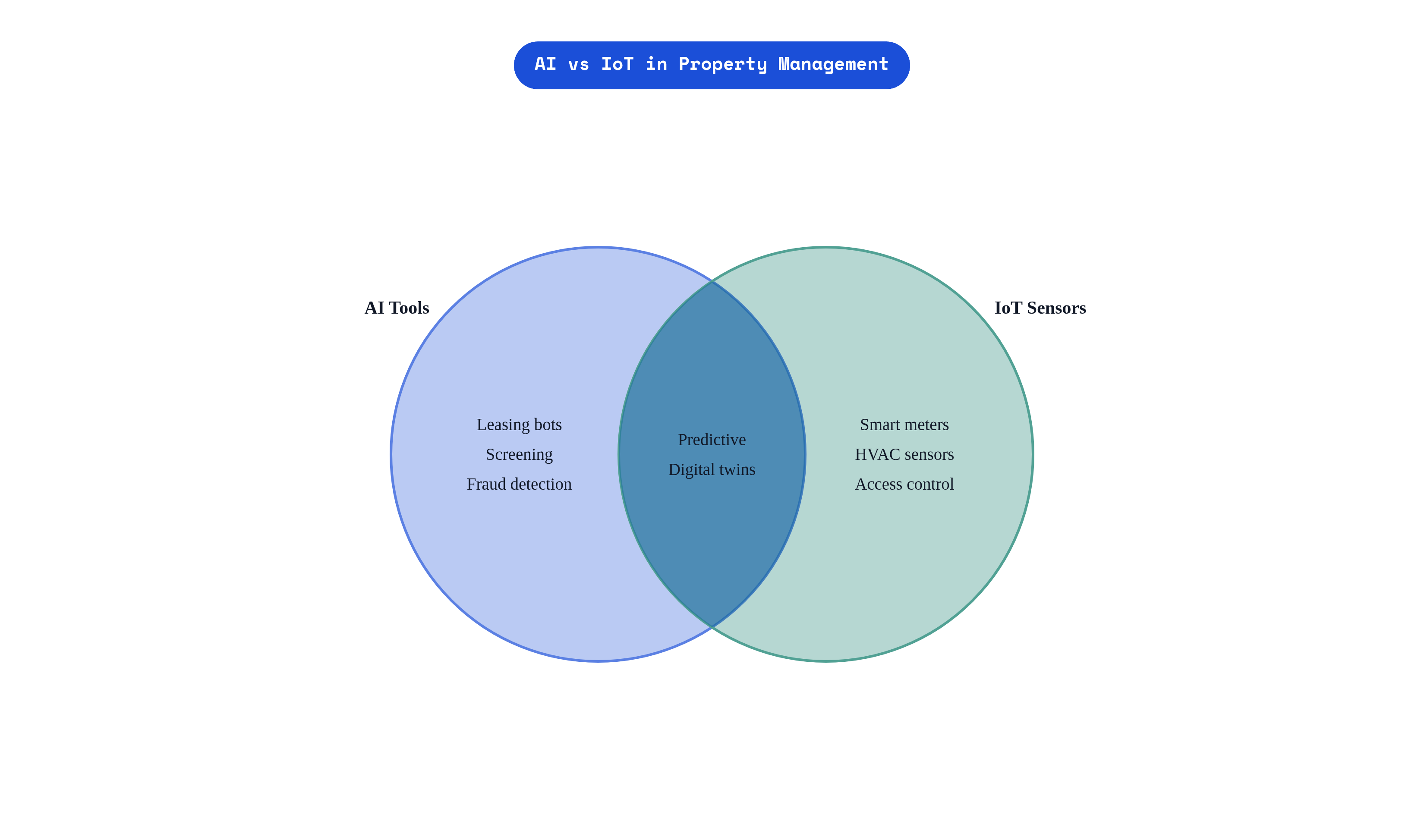
None of the AI use cases above work without data, and the data has to come from somewhere real. That somewhere is IoT: sensors, meters, and smart controllers wired into HVAC systems, lighting, access control, and water monitoring, generating a steady stream that AI models actually feed on.
Software makes up 68% of PropTech revenue in 2025, which might make you think hardware is an afterthought. It isn't. Software processes information. IoT supplies the raw signal underneath it, and neither one does much of anything alone; you can have the smartest model in the world and it's still just guessing if the sensor feeding it is broken or missing.
The energy numbers alone justify the spend. Building automation systems cut overall energy use by 20 to 40% and shave peak demand by 15 to 30%, according to industry research. Lawrence Berkeley National Laboratory's work on analytics-enabled buildings found reductions as high as 50% in some cases. Mordor Intelligence found commercial real estate owners cutting operating costs by up to 30% after deploying building management and analytics platforms together, not as separate purchases.
SmartRent is a useful case study of what this looks like once it's actually at scale: deployments across hundreds of thousands of units as of mid-2025, with multifamily communities using its integrated smart tech reporting significant reductions in energy and water costs. Fifteen of the top 20 multifamily operators use SmartRent daily. At that point it's not a boutique play anymore, it's infrastructure, the same way you'd call elevators infrastructure rather than a nice amenity.
Digital twins deserve a mention, being one of the more advanced things now in actual use rather than just a slide in a vendor deck. A digital twin lets an operator simulate a change, say swapping out a chiller or adjusting airflow schedules, inside a model before anyone touches the physical building. With the global smart building market projected to reach hundreds of billions of dollars by 2028, this is where the sensor and hardware side of proptech is moving fastest.
Here's the part operators sitting on the sidelines don't love hearing: skipping IoT investment doesn't just mean missing out on smart thermostats. It caps what your AI can ever do for you, full stop, because AI running on bad sensor data is just guessing with extra steps and better formatting.
What tenants now expect from digital-first property management and where operators are falling short
Renters quietly rewrote the baseline expectation somewhere in the last few years, and plenty of operators still haven't gotten the memo.
Online rent payment is now offered by the vast majority of property management respondents in 2025. Tenants expect it to just work, and nobody brags about having it anymore. Flexible rent payment options are the next frontier, growing notably over the prior year, tracking pretty directly with rising rent burden.
AppFolio's 2025 Renter Preferences Report, surveying more than 2,000 U.S. renters, found a large majority value online rent payment and 72% prioritize rent reporting and reward programs, the kind that let on-time payments build credit. Reasonable asks. Increasingly assumed rather than requested, too, which is its own quiet shift.
Where it falls apart is move-in. Moving is stressful for nearly everyone who's done it, yet only 30% of renters report having access to digital move-in tools. That gap, between near-universal frustration and rare digital relief, is about as clear a case of unmet demand as this sector has to offer.
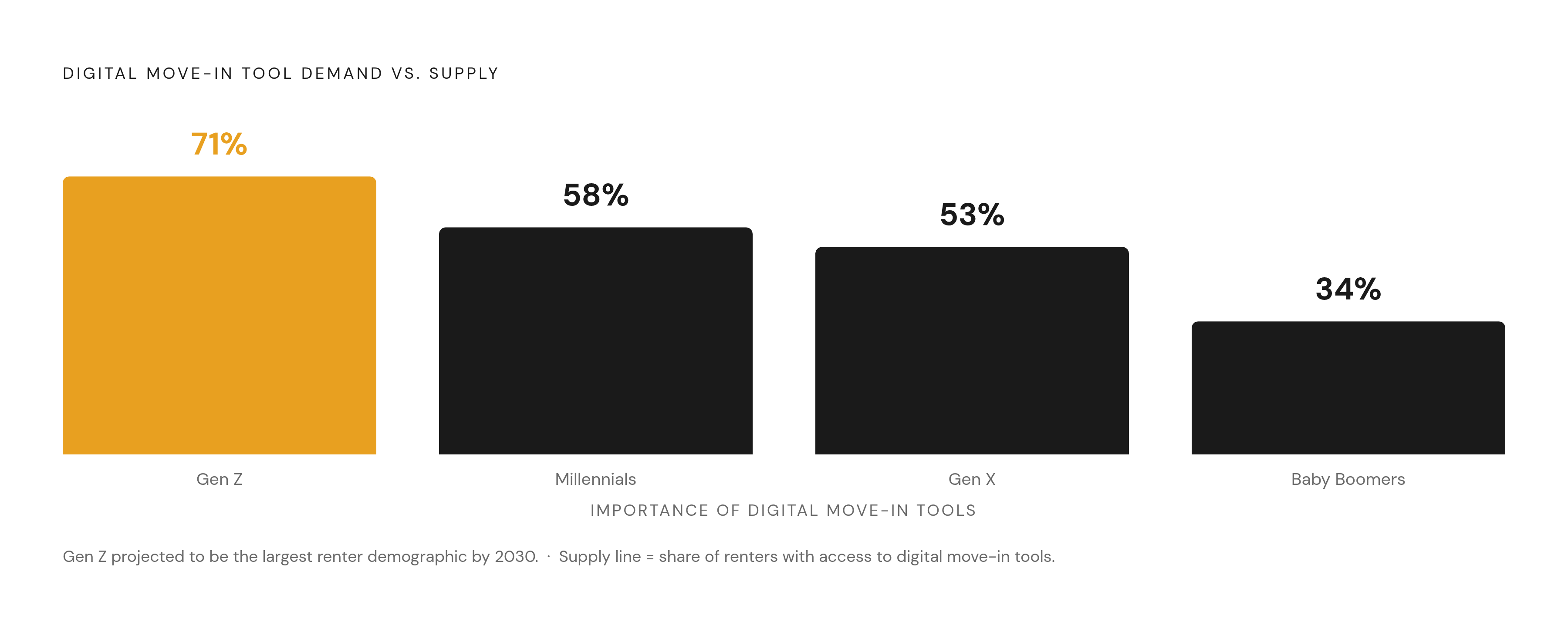
The generational split makes the stakes obvious. Seventy-one percent of Gen Z renters call digital move-in services important, versus 58% of Millennials, 53% of Gen X, and 34% of Baby Boomers. Gen Z is on track to become the largest renter demographic by 2030. The gap between what's offered today and what the incoming majority expects doesn't shrink on its own; it widens, unless operators build for it now instead of later.
And the retention math is blunt about it. Residents satisfied with their property manager are 73% more likely to plan a lease renewal. That number shows up directly in revenue, measured in the cost of not having to re-lease a unit, market it, screen new applicants, and eat 30 to 60 days of vacancy while the meter's still running.
Tenant portals and self-service maintenance requests are the standard answer here, but a portal is only as good as the system sitting behind it. If a maintenance request submitted through a slick app lands in the same email inbox nobody checks on weekends, the process is exactly as broken as before. It's just got a nicer front door bolted onto it. The tools already exist. What's usually missing is the will to wire them together properly.
How the technology stack fits together (and what it takes to operate it as one system rather than a collection of tools)
Here's the part nobody selling you software wants to dwell on: AI, IoT, and tenant portals don't create value sitting next to each other. They create value when they actually talk to each other.
A predictive maintenance alert only matters if it opens a work order automatically, notifies the resident through the portal, and updates the accounting system once the invoice lands. When those four things live in four platforms that don't share data, you get four separate silos connected by nothing sturdier than a shared electric bill.
Software leads PropTech at 68% of revenue, cloud is the dominant deployment model, and that much is settled. What's not settled, and what actually separates the winners from everyone else, is integration depth. Platforms like Yardi, AppFolio, Buildium, MRI Software, and Entrata have spent the last several years morphing from glorified ledgers into something closer to an operating system, one place orchestrating AI agents, IoT feeds, payment processing, and resident messaging together.
There's a parallel worth drawing to content operations, an unglamorous corner of the business that still eats an enormous amount of time. Property managers need vacancy listings written, lease renewal notices sent, compliance documentation produced, often on tight deadlines and often for dozens of units at once. That's exactly the kind of task where AI-assisted drafting, paired with an actual human checking the output before it reaches a resident or a regulator, belongs in the same conversation as leasing bots and smart thermostats. It's the piece people skip past because it doesn't come with a sensor or a dashboard attached to it.
The fragmentation risk is real, and worth naming plainly instead of dancing around it. An operator running ChatGPT for one thing, a specialized leasing tool for another, and an IoT dashboard nobody's opened since month two ends up with a stack of disconnected subscriptions rather than an actual system. That's part of why the push toward all-in-one platforms with embedded agents keeps picking up speed: consolidation is the fix for a mess that fragmentation created in the first place.
Remember the earlier stat about how few operators have automated even one workflow completely? That points to a redesign gap more than a technology gap. Buying the tool is the easy part. Rebuilding the process around it, and actually killing the old process instead of running both in parallel forever out of habit, is the part almost everyone skips.
The operators pulling ahead aren't the ones with the longest software list. They're the ones who mapped their own friction points first (leasing cycle length, maintenance response time, whatever's actually bleeding money) and built backward from there instead of buying forward from a pitch deck.
Where property management technology is heading in the next two to three years and what operators should prioritize now
The move from AI features to AI agents is the headline shift coming. An agent that runs a multi-step process unattended is only as good as the data feeding it, which loops straight back to the IoT conversation above. Operators who haven't built that data foundation are going to find their shiny new agentic tools arrive and just underperform, because there's nothing solid underneath holding them up.
Generative AI applied to real estate has grown into a sizable market from a modest 2023 starting point, and the trajectory points one direction: content generation, lease drafting, and resident communication tools stop being separate add-ons and get folded directly into the major platforms as default features nobody thinks twice about.
Fraud will get worse before it gets better, so plan for that now rather than later. The 5.1% application fraud rate Snappt measured for 2025 is a floor, not a ceiling, and template farms will keep getting more sophisticated as the AI tools used to build fake documents improve right alongside the AI tools used to catch them. Snapshot-based screening (checking a document once at application time and calling it done) won't hold up much longer. Continuous, updating verification needs to become the norm rather than the exception.
The Gen Z renter deadline is real, and closer than it sounds. 2030 is roughly a lease cycle and a half away for a lot of portfolios. Operators have a real window right now to close the digital move-in gap before that generation becomes the majority of the renter pool, not after the fact when it's a scramble.
Geography matters too, and it's easy to forget from a North American vantage point. Asia Pacific is growing at an 18.6% CAGR, the fastest of any region, a reminder that proptech's growth story runs well past a mature, slower-growth North America. Operators with any international ambition are walking into markets where digital-first property management is the baseline from day one, not something you get credit for having.
So what's the actual move here? Map the friction first: where the leasing cycle stalls, where maintenance requests sit unanswered for three days, where satisfaction scores dip and nobody's asked why. Build the stack backward from those specific points, not from whatever's trending in a vendor's pitch deck this quarter. And don't skip the unglamorous stuff, like the speed and quality of content production for listings and tenant notices, because a slow manual bottleneck there drags down every fast, automated system sitting around it. The whole setup only moves as fast as whatever piece got neglected longest, and that piece is rarely the one anyone thought to check first.