Technology in Property Management Operations
Capital concentration shows AI leasing tools are the industry's most urgent unsolved problem.
The property management industry crossed a threshold it cannot walk back from. Technology is no longer a convenience layer sitting on top of traditional operations; it is the infrastructure through which leasing, maintenance, tenant communication, and financial reporting now run. The question operators face is not whether to adopt, but which tools are actually restructuring how work gets done versus which ones are just giving existing inefficiencies a digital interface — like putting a fresh coat of paint on a crumbling wall.
Where capital is flowing and what that signals about which operational problems are considered unsolved
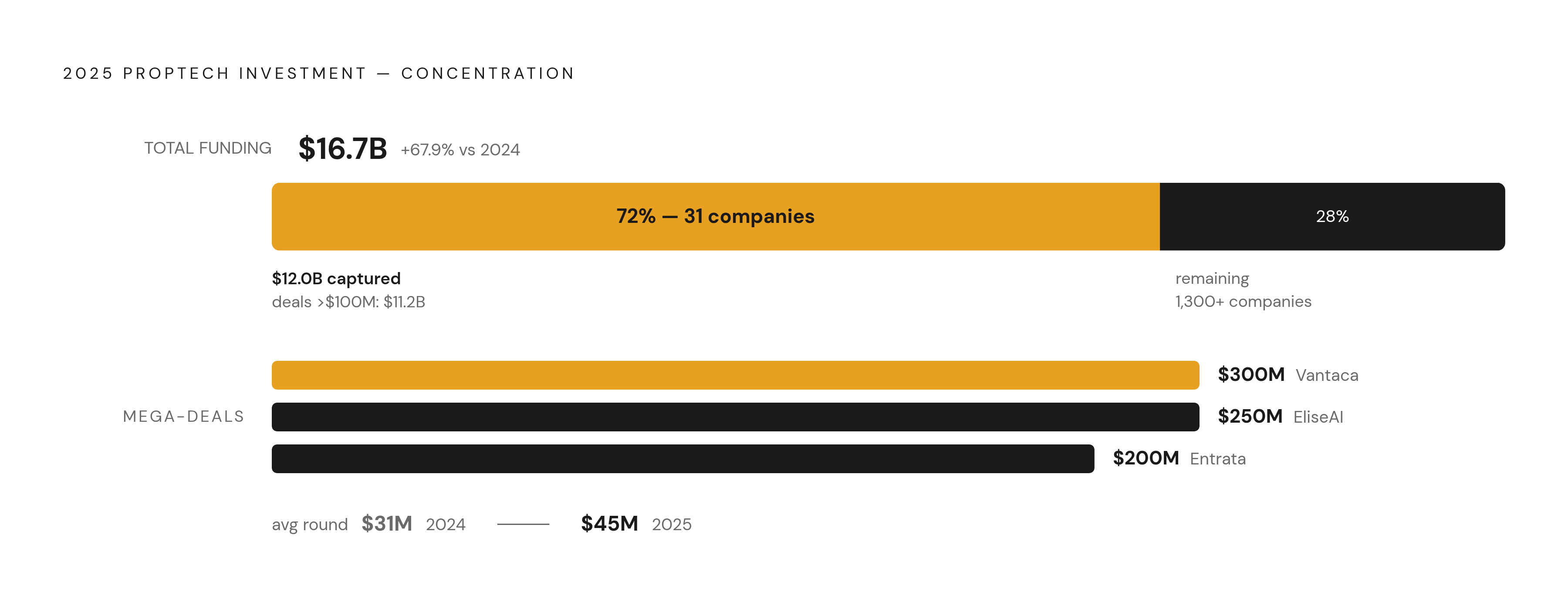
The clearest signal about which operational problems remain genuinely unsolved is where serious capital is going. Proptech investment hit $16.7 billion in 2025, a 67.9% surge over 2024, surpassing pre-pandemic highs and confirming that the down cycle is over. More telling than the headline figure is the structure of it: just 31 companies captured over 72% of all 2025 investment, and more than $11.2 billion came from deals exceeding $100 million. This is not seed-stage experimentation. This is late-stage conviction capital backing platforms with proven operational traction.
Average funding round sizes jumped from $31 million in 2024 to $45 million in 2025. Larger rounds mean investors are scaling something that already works.
The deals themselves reveal where the friction is. EliseAI raised $250 million at a $2.25 billion valuation; its conversational AI now touches one in eight U.S. apartments and targets leasing and maintenance workflows specifically. Entrata raised $200 million from Blackstone, serving more than 35,000 communities and 12 million residents, positioning itself as an operating system rather than a point solution. Vantaca raised $300 million to scale AI-powered community association management across 6 million U.S. households. These are not bets on adjacent categories. They are concentrated bets on the operational core of property management.
AI-centered proptech companies grew at an annualized rate of 42% in 2025, nearly double the 24% growth rate for non-AI companies. The capital is saying, with unusual specificity, that AI-enabled operations are the unsolved problem worth paying to fix.
RET Ventures VP Jameson Hartman described 2025 as effectively "the year of leasing," with screening, CRM, marketing automation, and geo-optimization drawing the greatest investor demand. That framing identifies leasing not as a solved problem that needs polish, but as the operational frontier with the most measurable inefficiency remaining.
Integrated payments are growing at a 10.77% CAGR, the fastest of any module. That appears to be an unglamorous footnote next to the AI numbers. It is not. Payments are the highest-frequency transaction between tenant and manager, and high frequency means high friction. When engineers start solving mundane problems with this kind of investment intensity, it means the mundane problems were more expensive than they looked.
How AI is changing leasing operations specifically, not just making them faster
Lease and tenant management holds 35.44% of property management software revenue in 2025. It is the largest module by sales and the domain with the most active development. That share reflects where operators have historically lost the most time, revenue, and talent to manual process.
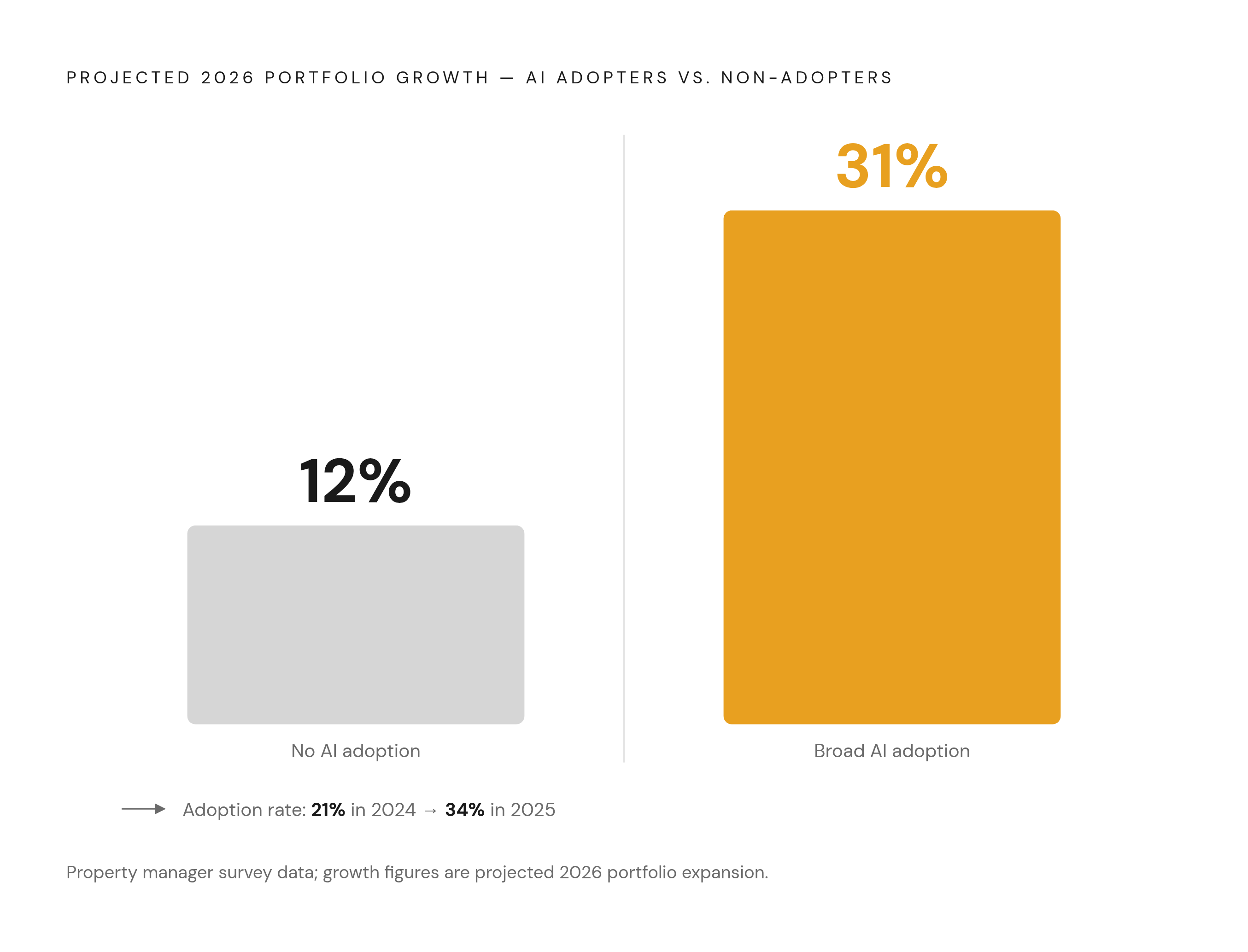
AI adoption among property managers rose from 21% in 2024 to 34% in 2025. Firms with broad AI adoption project roughly 31% portfolio growth in 2026, compared to roughly 12% for non-adopters. That gap is structural. AI allows leasing teams to handle significantly more units without adding headcount, which means the operational ceiling moves. A team that previously managed 300 units effectively can now manage substantially more without degrading performance, because the system handles the volume that was overwhelming them.
The specific capabilities doing this are worth naming precisely. AI-powered dynamic pricing analyzes real-time market conditions and historical data to adjust rental pricing continuously, removing guesswork from one of the highest-stakes decisions a leasing team makes. Platforms like Entrata, which acquired Colleen AI in June 2024, now automate resident communications, maintenance tickets, and lease renewals from within a single system. Centralized leasing hubs consolidate leasing, renewals, and marketing into shared CRM environments with standardized playbooks, enabling operators to scale without proportional headcount growth.
RealPage launched its Lumina AI Workforce at NAA Apartmentalize in June 2025, deploying coordinated intelligent agents across leasing, finance, and resident engagement. The distinction from earlier AI tools is important: this is not a single chatbot fielding inquiries. It is an integrated agent layer coordinating across workflows simultaneously.
The 24/7 capability matters in ways that operators initially underestimate. One multifamily operator who deployed an AI leasing assistant saw inquiry response times decrease substantially while tenant satisfaction scores rose. Prospects inquire when it is convenient for them, often evenings and weekends, and a system that answers immediately converts at higher rates than one that follows business hours.
The consolidation trend reinforces where this is heading. Fifty percent of rental housing organizations now manage fewer than 10 technology applications, up from a much lower share previously, per RETTC's 2025 Customer Experience Technology Survey. Operators are replacing fragmented point solutions with integrated platforms that handle leasing end-to-end.
What predictive maintenance actually changes about how property managers handle physical assets
Traditional property maintenance runs on two modes: scheduled preventive work and emergency reactive repair. Both are expensive, but in asymmetric ways. Preventive maintenance is a predictable cost you can budget for. Reactive repair is the cost you cannot predict, the one that arrives with a tenant's phone call at 11 p.m. and cascades into contractor markups, displacement logistics, and potential liability — like finding a leak not when the pipe starts dripping, but when the ceiling caves in.
The U.S. Department of Energy puts predictive maintenance savings at roughly 8 to 12% on preventive costs and up to 40% on reactive costs. The biggest gains are not in optimizing scheduled work; they are in eliminating the unplanned failures that cause the most operational disruption.
Predictive systems work by connecting IoT sensors to analytics platforms that detect anomalies in equipment behavior before failure occurs. The intervention happens before the tenant calls. Cloud maintenance automation specifically cuts emergency repairs significantly and maintenance costs meaningfully, per Mordor Intelligence. Those figures explain why risk-averse operators are moving critical maintenance workflows to these platforms.
The operational payoff extends beyond the repair bill. Maintenance failure is one of the most consistently cited reasons tenants do not renew leases. Preventing it has revenue implications that compound over time, because the cost of a non-renewal, including vacancy carrying costs, turnover preparation, and leasing commissions, almost always exceeds the cost of the maintenance event that triggered it.
AppFolio's Realm-X AI engine automates maintenance workflows alongside leasing communications and accounts payable. The signal there is significant: maintenance automation is becoming a bundled expectation inside platform software, not a separate purchase decision. If you are evaluating a platform for leasing, you should expect maintenance automation to come with it. If it does not, that is a gap worth questioning.
The adoption case is strongest for mid-to-large portfolios where equipment failures cascade and manual tracking breaks down entirely. But smaller operators, digitizing at the fastest rate in the market right now, will encounter these tools as defaults inside the platforms they are adopting. The question of how to configure predictive maintenance well is the one worth asking.
How IoT sensors and smart building systems convert physical infrastructure into operational data
Smart-building technology reached approximately 41% of new installations in 2024, meaning IoT sensors, digital twins, and connected controls are now common features of new construction rather than premium retrofits on legacy buildings. The shift from exception to baseline changes how managers should think about this category.
The operational value of IoT is not the sensors themselves. It is the continuous data stream they produce, making visible what was previously invisible between inspection cycles — the difference between taking a photograph once a month and watching a live feed.
Energy management is the most quantified use case. IoT automation for HVAC and lighting through occupancy-responsive smart controls produces meaningful reductions in energy consumption, per Transforma Insights research. The Empire State Building reduced energy consumption substantially through a technology-driven retrofit, generating millions of dollars in annual energy savings. The economics work on old infrastructure when the implementation is executed properly.
A case study from Ontario schools and offices found that thousands of sensors and AI gateways saved more than $250,000 in just three months by optimizing air quality, temperature, and occupancy controls. That payback timeline is short enough to change the capital allocation conversation at even conservative organizations.
Beyond energy, IoT enables access control and security monitoring integrated with property management platforms, occupancy data that informs both maintenance scheduling and lease negotiation in commercial contexts, and water and utility monitoring that catches leaks before they become damage claims. These are operational tools with documented outcomes.
The counterpoint is worth stating plainly: smart buildings create cybersecurity exposure that traditional buildings do not have. Unauthorized access to connected systems would mean control over HVAC, lighting, or building access, not just data exfiltration. Ongoing security updates carry cost and operational overhead that will slow adoption in smaller portfolios where IT capacity is limited.
The global smart building market is projected to exceed $230 billion by 2028, driven partly by energy regulations tightening in major markets. In markets where energy performance requirements are becoming mandatory, connected building systems are unlikely to remain optional for long.
What technology means for tenant communication and the expectations it creates
Tenant communication has historically been reactive and fragmented: phone calls during office hours, paper notices slid under doors, individual emails sent whenever someone remembered to send them. Technology is replacing this with continuous, multi-channel, often automated interaction. The operational implication runs deeper than convenience.
AI chatbots and virtual assistants now handle 24/7 inquiry support for rent payments, maintenance requests, and lease renewals. Tenants submit a maintenance request at midnight and receive confirmation immediately. They ask a renewal question on a Sunday and get an accurate answer. The experience is no longer defined by the manager's availability; it is defined by the platform's responsiveness.
This matters for retention because the calculus of non-renewal is built on accumulated friction. Slow response to maintenance requests and communication gaps are among the most consistent drivers of tenants not renewing. Automation reduces both, systematically, without requiring staff to be perpetually available.
Centralized communication platforms change the manager's role in a specific way. Shared CRMs consolidate all tenant interactions into a single record, so any team member can pick up a conversation without the tenant re-explaining their history. Automated lease renewal workflows initiate renewal conversations at the right time without requiring a manager to manually track expiration dates across a portfolio. Integrated payments remove friction from the most frequent transaction the tenant and manager share.
The risk of automation is depersonalization, and it is real. The operational challenge is configuring AI to handle volume while routing relationship-sensitive situations to human staff. Platforms that make this routing configurable are better suited to operators managing mixed portfolios with varying tenant expectations. A workforce housing community and a luxury high-rise have different communication cultures; the platform should accommodate both.
Property managers and agents account for 42.73% of 2025 software outlays. Their purchasing behavior reflects that tenant-facing communication tools rank as a high priority alongside back-office functions.
How technology is changing financial reporting and the visibility managers have into portfolio performance
Financial reporting in property management has traditionally been periodic and backward-looking: monthly or quarterly snapshots assembled from multiple sources, delivered after the decisions they could have informed were already made. Integrated platforms change this to continuous. Rent collection, expense tracking, maintenance costs, and vacancy data feed into dashboards in real time.
The portfolio-level implication is not cosmetic. Real-time financial visibility allows managers to respond to performance signals as they emerge. A property trending toward higher vacancy, a maintenance category consuming a disproportionate share of budget, a unit class where renewal rates are softening: these become visible early enough to act on, not after the quarter is done.
AppFolio's Realm-X explicitly includes accounts payable automation alongside maintenance and leasing workflows, confirming that financial operations are being bundled into the same platform layer. AP processing is repetitive, high-volume, and error-prone when handled manually. Automating it reduces administrative overhead and the category of mistakes that come from processing at scale by hand.
For owners and investors, the transparency that integrated platforms provide has become a structural expectation. Institutional capital managing portfolios at scale needs reporting granularity that disconnected tools cannot deliver consistently. That is one concrete reason why a $200 million investment went into an operating system serving tens of thousands of communities, not into a point solution handling one function well.
What this does not solve is worth naming clearly. Data quality depends entirely on what gets entered. Managers who adopt platforms without standardizing their intake workflows often find they have better-formatted versions of the same incomplete data. The technology surfaces what is there. If what is there is inconsistent, the dashboards will be too.
How to evaluate which operational tools drive measurable change versus which add complexity
There are over 9,000 proptech companies as of 2025. The abundance of choice does not make selection easier. It makes it harder, because most of those tools are solving narrow versions of problems that integrated platforms are solving more comprehensively, and the proliferation creates the illusion that more coverage equals better operations.
The consolidation happening at the top of the market, with 31 companies capturing over 72% of investment, does not make the long tail disappear. It means operators need a framework for evaluation, not just a shortlist.
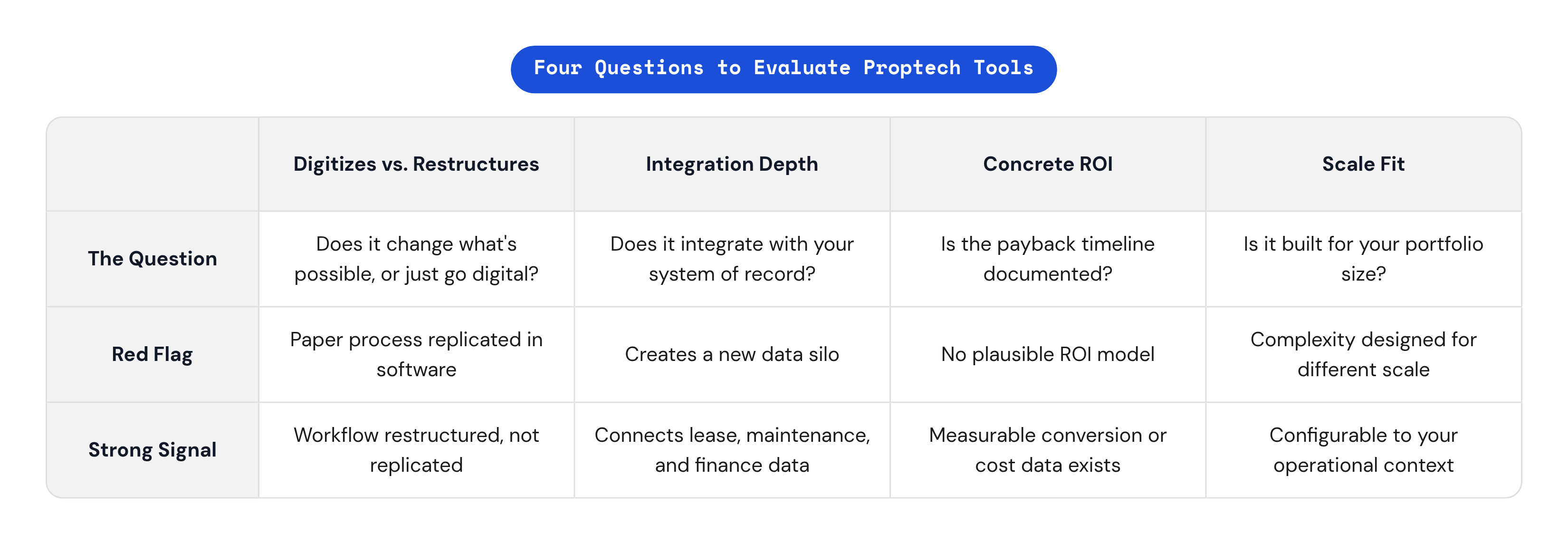
Four questions separate operationally impactful tools from the noise.
First: does this change what is possible, or does it digitize what you already do manually? The strongest tools in this market, AI leasing assistants, predictive maintenance platforms, real-time financial dashboards, restructure workflows rather than replicate them in software. If the tool's primary value is converting a paper process into a digital one without changing how the process operates, the efficiency gain is marginal and the switching cost may not be worth it.
Second: does it integrate with your system of record, or does it create another silo? The platforms winning capital right now are winning on integration depth, not feature novelty. A tool that handles one function brilliantly but does not talk to your lease data, your maintenance records, or your financial system creates reconciliation overhead that quietly eats the efficiency it generates.
Third: is the ROI timeline concrete? Predictive maintenance programs have documented payback periods. AI leasing tools have measurable conversion rate and response time data. Tools without a plausible ROI model in your specific portfolio context warrant real skepticism, especially in a market where vendors are incentivized to describe every product as transformative.
Fourth: does it handle your scale? The fastest-growing adoption segment right now is small operators digitizing at an accelerating rate. But tools engineered for mid-sized portfolios often underserve smaller operations while simultaneously overwhelming them with configuration complexity designed for a different use case.
The AI adoption gap is widening fast enough to affect competitive position. Firms with broad AI adoption project roughly 31% portfolio growth in 2026 versus roughly 12% for non-adopters. That delta is about market share.
But adoption without strategy compounds cost rather than reducing it. The move from 22% to 50% of organizations managing fewer than 10 applications is the market correcting for over-purchasing. Tech stack sprawl is a documented failure mode, not a theoretical risk.
The practical framework is this: audit by operational domain, leasing, maintenance, tenant communication, financial reporting. Identify where process breakdowns are most costly in your specific context. Evaluate tools against that specific friction before assessing the broader platform. Strategy first, then tool. The operators who apply that sequence are making adoption decisions that compound over time. The ones who reverse it are buying solutions to problems they have not yet defined.