How Commercial Property Management Works
Different property types demand different management skills and operational priorities.

Commercial assets sort into three broad categories: office, retail, and industrial. Each has its own operational logic, and that logic determines what competent management actually requires. The five core responsibilities covered below look substantially different depending on which asset type you are managing. A manager who excels in one category can be genuinely out of their depth in another. That shows up in the work within the first ninety days.
Office buildings, particularly Class A full-service towers, are among the most management-intensive assets in the commercial space. You are coordinating systems, aesthetics, and tenant expectations simultaneously. HVAC reliability matters because a senior law firm's office that runs hot in July is not a minor inconvenience; it is a lease-renewal conversation that goes sideways. Elevator uptime, common-area presentation, lobby experience: in a Class A building, these are revenue variables, not cosmetic details.
Retail centers operate on a different logic entirely. The manager's job is as much about commerce as it is about operations. Foot traffic and tenant mix are the underlying revenue drivers, and a competent retail manager thinks about how a property draws shoppers, holds them, and positions tenants for productive adjacencies. Coordinating among multiple tenants in direct proximity, whose success or failure affects one another, requires a kind of operational diplomacy that office management rarely demands.
Industrial properties, warehouses, distribution centers, manufacturing facilities, shift the emphasis again. The priorities are logistics coordination, equipment maintenance, and compliance with sector-specific building regulations that often have no analog in office or retail. Loading dock functionality is not a footnote; it is a core business requirement for every tenant in the building. When a dock plate fails at a distribution center, the call comes before sunrise. Managing an industrial portfolio without understanding logistics creates significant operational risk.
Mixed-use properties compound all of this. A single management team is simultaneously responsible for retail ground-floor tenants, office tenants on upper floors, and residential occupants, each with different lease structures, different operational expectations, and different regulatory frameworks. The management fees should reflect that complexity. They often do not, and the gap between what is being paid and what the work actually demands has a way of becoming apparent all at once rather than gradually.
The five core responsibilities that keep a commercial property running
Every commercial property management engagement, regardless of asset type or market, is built around five functional areas. They are not sequential. They operate concurrently, and they affect one another in ways that are easy to underestimate until something breaks.
Tenant relations and communication
The property manager is the primary point of contact for every tenant concern: billing questions, maintenance requests, lease interpretation disputes, and everything in between. This is relational work as much as it is operational work. A manager who treats tenant communication as a reactive function, responding only when problems escalate, risks driving up turnover.
Re-leasing a commercial space is expensive. The costs of vacancy, broker commissions, tenant improvement allowances, and lost rent during transition accumulate faster than many owners expect the first time they go through it. Strong tenant relationships are a retention strategy with a direct impact on net operating income.
Lease administration
This is where management engagements succeed or fail, often without the owner realizing it until something has already gone wrong. Lease administration means tracking every critical date: renewal options, rent escalations, lease expirations, tenant improvement deadlines. It means enforcing use clauses when tenants operate outside the permitted scope of their lease. It means knowing, on any given day, what each tenant owes and what each tenant is entitled to.
Commercial leases are legal documents, frequently negotiated individually, often with counsel on both sides. The manager's job is not to be the attorney, but to understand the provisions well enough to administer them accurately and to recognize when the attorney needs to be involved. That judgment is a genuine competency, and the one most likely to generate expensive surprises in a low-fee engagement.
Financial management
Commercial property financial management is more granular than many owners anticipate before they are in it. Rent collection and expense payment are the baseline. Above that sits budgeting: the annual operating budget and the longer-horizon capital improvement plan. Above that sits financial reporting to ownership, the periodic accounting of how the property is performing against projections, where variances exist, and what is driving them.
CAM reconciliation deserves specific attention because it is one of the most operationally sensitive processes in the management cycle. Throughout the year, tenants pay estimated common area maintenance charges based on prior-year experience or negotiated projections. At year-end, actual costs are tallied and compared against those estimates. Tenants owe the difference if actuals exceeded estimates; owners owe credits if they came in below. This process requires meticulous, continuous record-keeping. CAM reconciliation errors, even small ones, generate disputes, and disputes generate turnover.
Maintenance, repairs, and vendor management
Routine maintenance scheduling, emergency response, and building system monitoring are the operational core of the function. For most commercial properties, that means managing a network of third-party vendors and contractors rather than employing in-house trade staff. The manager's job is to source qualified contractors, supervise their work, and quality-check the output.
Managers typically apply a markup to contractor invoices, commonly in the 10% to 20% range, as part of their compensation structure. That markup reflects the coordination, supervision, and liability the manager assumes in the vendor relationship. It should be explicit in the management agreement before the relationship begins.
Compliance
Zoning, safety codes, building permits, ADA requirements, environmental regulations: the compliance landscape for commercial real estate is not static, and the consequences of falling behind it are serious. Inspections need to be tracked. Certifications need to be renewed. Regulatory changes affecting a specific asset type need to be identified and acted on before they become violations.
This is the highest-stakes area of a manager's work, even if it is rarely the most visible. Compliance gaps expose owners to liability that can dwarf the cost of the management fee many times over. It is also the category where inexperienced managers most reliably fall short, because the work is unglamorous and the consequences are delayed.
Capital improvement planning
Running alongside the five operational areas is a longer-range function: identifying when building systems need replacement or significant upgrade, and building those costs into multi-year financial plans. A roof, an HVAC system, an elevator: these are not surprises. They are predictable capital events that should appear in the budget long before they become emergencies. Deferred maintenance does not disappear; it becomes more expensive and more disruptive the longer it is avoided. This is where asset value is either protected or steadily eroded.
How commercial lease structures drive everything else
The lease is the foundational document of every commercial tenancy. Its structure determines who bears financial risk when operating costs rise, who is responsible for which maintenance obligations, and how the manager's financial reporting workload is organized. It also sets the tempo of the management relationship in ways that are not always obvious upfront.
Commercial leases run longer than many people expect before they encounter them directly. Retail and office terms commonly fall in the three-to-five-year range. Industrial leases can extend considerably beyond that. The duration creates management complexity: economic conditions, building system conditions, and tenant business conditions all change over a multi-year term in ways the lease has to accommodate, or that generate conflict when it does not.
Gross and full-service leases
In a gross lease, the owner covers most operating expenses and the tenant pays a flat rent. This structure is common in Class A office buildings, where tenants expect predictability and the building's operating costs are essentially absorbed into the rental rate. For the manager, a gross lease means controlling operating costs carefully, because overruns reduce the owner's return with no pass-through mechanism available.
Modified gross and modified net leases
Here, the allocation of costs between owner and tenant is negotiated individually. Some expenses pass through; others do not. The arrangement requires clear contractual documentation of who covers what, because ambiguity in a modified gross lease is a reliable source of disputes at reconciliation time. The more individually negotiated the lease, the more precisely the manager needs to administer it.
Net leases
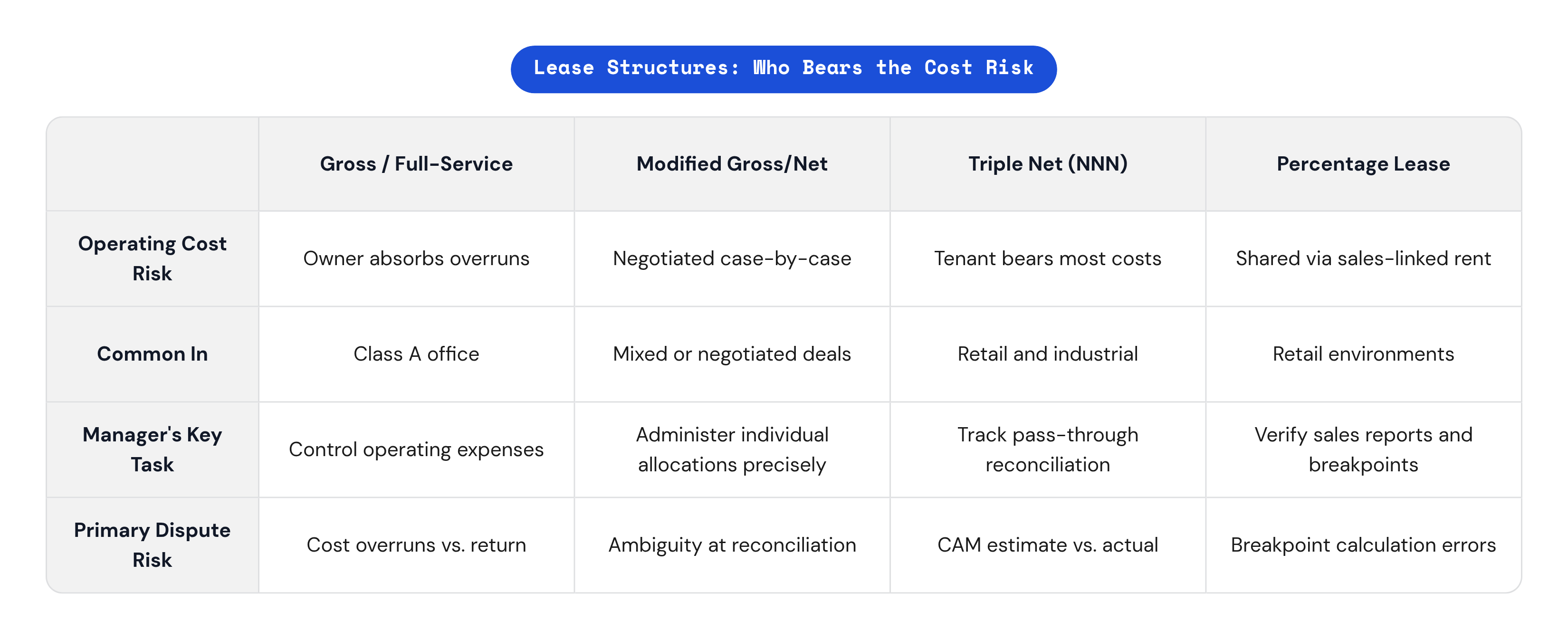
Net leases come in three principal variants, each expanding the tenant's cost exposure. In a single net lease, the tenant pays rent plus a proportionate share of property taxes. A double net lease adds a portion of property insurance. The triple net, or NNN, lease requires the tenant to cover pro-rata taxes, insurance, and common area maintenance costs. The NNN structure shifts operating cost risk to the tenant and is most prevalent in retail and industrial properties.
Percentage leases
In a percentage lease, the tenant pays a base rent plus a percentage of gross sales above a defined threshold, the breakpoint. This structure requires the manager to track tenant sales reports and verify that breakpoint calculations are being applied correctly. It is most common in retail environments where landlord and tenant are economically aligned around the property's commercial performance. It also requires a level of tenant financial transparency that not every operator is comfortable providing, which can become its own management challenge over time.
Even in a gross lease, year-end reconciliation of variable charges is a standard process. The lease structure determines who bears the financial exposure, but it does not eliminate the accounting work. A gross lease in a year of rising utility costs means the owner absorbs those increases; an NNN lease means they pass through to tenants. That distinction is a core consideration for any owner evaluating the long-term financial profile of an asset.
How property managers are paid
The most common compensation model in commercial property management is a percentage of collected rent. Fee ranges vary by market, asset type, property size, lease complexity, and scope of services; owners should obtain current benchmarks from local market data before negotiating. Owners who negotiate aggressively on the fee without examining what they are actually getting risk ending up with a level of service that reflects what they paid.
The flat fee alternative, a fixed monthly amount regardless of rent collected, offers predictability for owners with stable income but removes the manager's financial incentive to maximize occupancy. In a percentage-based relationship, the manager's income rises with occupancy. In a flat-fee relationship, it does not. Neither structure is universally superior; the right choice depends on the asset, the market, and what the owner is trying to optimize.
In investment and syndication contexts, an asset management fee operates separately from the operational property management fee. This is typically calculated as a percentage of invested equity, property value, or total revenue, and it compensates for strategic oversight rather than day-to-day operational execution. The two fees serve different functions and should be evaluated separately.
Additional charges beyond the base fee are standard and should be anticipated before signing. Lease-up fees for securing new tenants, lease renewal fees, and the maintenance markup on contractor invoices are part of the compensation structure. Advertising costs for vacant spaces may be bundled into the management fee, split with the owner, or charged directly; the terms vary by contract and should be made explicit before the agreement is executed.
Some owners negotiate hybrid structures combining elements of percentage and flat-fee models, occasionally with performance incentives tied to occupancy thresholds or NOI targets. The incentive alignment question is worth examining carefully, because the fee structure shapes the manager's behavior in consistent and cumulative ways across a multi-year engagement.
Where commercial property management sits as an industry today
The U.S. commercial property management market has been growing in recent years, though conditions vary significantly by asset class. Commercial management has grown at a faster rate than residential management in relative terms, even as residential assets continue to hold the larger share of total property management market volume.
The office sector requires particular attention. According to CBRE's 2025 U.S. Office Figures report, national office vacancy reached approximately 19.8% in Q4 2024, a figure that reflects both remote work adoption and a structural shift in demand for office space. Managers working office-heavy portfolios are simultaneously navigating lease-up pressure, re-leasing strategy, and cost containment against a backdrop of elevated vacancy. The financial outlook for some of those portfolios remains challenging.
CBRE, JLL, Cushman and Wakefield, and Colliers have each reported strong performance driven by gains in leasing commissions and property management fees in recent earnings cycles. Industrial and retail have absorbed a meaningful share of the activity that office has shed.
AI adoption among property management firms has accelerated, with automation moving into lease abstraction, maintenance scheduling, financial reporting, and tenant communication. The capabilities and limitations of these tools vary, and owners and managers should evaluate vendor claims carefully against demonstrated performance.
What professional management actually delivers for an owner
The five core responsibilities do not operate in isolation. Lease terms shape what goes into financial reports. Financial reports drive capital planning decisions. Capital planning affects the building's physical condition, which affects tenant satisfaction. Tenant satisfaction determines renewal rates. Renewal rates drive leasing activity and broker relationships. Pull any one piece and the others feel it.
What breaks when the system is poorly managed follows a predictable sequence. CAM reconciliation errors generate tenant disputes; tenant disputes generate lease terminations. Deferred maintenance accelerates capital deterioration and creates emergency expenditures that overwhelm operating budgets. Compliance gaps expose ownership to liability that arrives suddenly and at the worst possible time. Poor tenant relationships accelerate turnover, and re-leasing commercial space is expensive at every stage: the broker commission, the legal costs, the tenant improvement allowance, the rent abatement period before income resumes.
The owner's real decision is not whether to manage the property. It is how, whether through self-management, a third-party professional firm, or some hybrid of the two, and that decision requires an honest accounting of what the full management function involves. Owners who attempt self-management on a complex commercial asset frequently underestimate the lease administration and compliance workloads. By the time problems surface, the cost of the error can exceed what professional management would have cost for the preceding period.
For owners evaluating third-party management options, the key questions cluster around three areas: the scope of services relative to the fee structure, the quality and frequency of financial reporting, and the manager's approach to lease administration and compliance. Those are the functions with the greatest long-term consequences for asset value, and they are the functions most likely to be inadequately scoped in a low-fee engagement.
Technology has become a genuine differentiator among management providers. Firms using integrated platforms for lease tracking, work order management, and financial reporting can deliver better ownership visibility and faster operational response than those relying on fragmented or manual systems. For any owner comparing service providers, the technology infrastructure question belongs in the first conversation, not the last.