Real Estate Syndication Software for Operators and LPs
A guide to choosing syndication software that works for both deal operators and their investors.

Real estate syndication runs on two people wanting different things from the same deal, and the software sits between them, trying to keep both happy. The market grew from $19.6 billion in 2012 to over $50 billion in 2023, an 8.5% compound annual growth rate, and that kind of growth is exactly why the spreadsheets and email chains that used to hold this business together are starting to buckle. This piece walks through why the software has to serve both sides at once, what each side actually needs, and how the current crop of platforms, from Juniper Square down to Covercy, splits along price and capability lines that matter more than most sponsors realize until they've already picked wrong.
Capital is moving fast, and back offices have not caught up. Per PERE data cited by Agora, Q1 2025 fundraising rose 76% from 2024, and nearly 50% above 2023 levels, the first year-on-year jump since 2022. Private markets overall are on pace to top $60 trillion within a decade, with retail investors now showing up next to pension funds and endowments. So the number of GP/LP relationships keeps climbing, and each one gets more complicated at the same time. Sponsors who wait this out are making a choice whether they realize it or not.
The two jobs syndication software must do at once
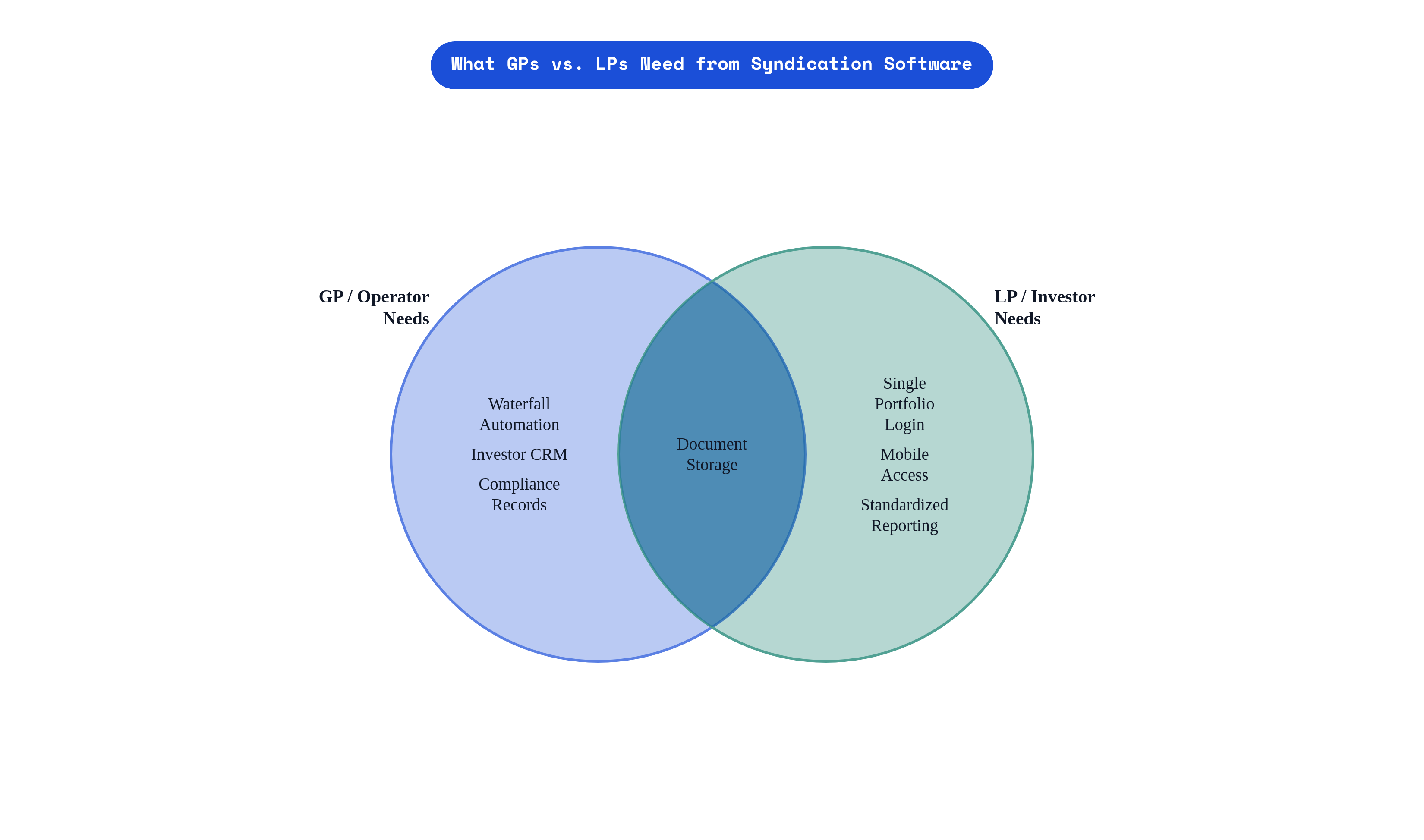
Every syndication has two people trying to get different things out of the same deal, and the software sits right in the middle of that tug-of-war. The operator, meaning the GP or sponsor, is running deal sourcing, fundraising, compliance, capital calls, distributions, and investor communication. The LP wants to know how their money is doing, get their documents on time, receive distributions when promised, and generally never have to email anyone to feel informed.
Where this breaks is easy to spot once you've seen it happen a few times. Picture an investor sitting in six different syndications, each run through a different white-label portal, with six logins, six interfaces, and six separate waits for GP approval just to check on money that's already theirs. LPs read that friction as a signal. An operator whose investor-facing tech feels cobbled together probably runs the rest of the business the same way, and re-up decisions get made on that impression whether the GP ever finds out or not.
So the design problem splits into two directions that don't naturally point the same way. Operator workflows need depth, configurability, and the ability to handle deal structures that get genuinely messy, while LP-facing screens need to be about as complicated as checking a bank balance and nothing more. The design problem splits into two directions that don't naturally point the same way: operator workflows need depth and configurability, while LP-facing screens need to be about as complicated as checking a bank balance, and if either side falls short, the whole platform feels half-finished to whoever is using it.
What operators actually need the software to handle
Start with the investor CRM, because it's the piece most generic tools get wrong. A real estate CRM has to track a person from first phone call to committed capital, built around how LP relationships actually develop over months or years, not treated like a sales pipeline built for pushing software subscriptions. Pipeline tracking, task assignment, a full communication history: none of that is exotic on its own, but it has to fit the actual rhythm of these relationships, which move slower and involve a lot more hand-holding than a typical B2B sale.
Fundraising tools come next: data rooms for deal documents, subscription flows that don't make an LP fill out the same form six times, accredited investor verification for KYC and AML, e-signature built in instead of bolted on as an afterthought.
Then there's the part that separates real platforms from good-looking wrappers: waterfall automation. Waterfalls differ deal to deal, with preferred returns, catch-up provisions, promotes, tiered splits, and separate treatment for different investor classes. If an operator is still running that math in a side spreadsheet and just typing the final number into the platform, nothing has actually changed. The risk of a manual error sits exactly where it always sat, just hidden behind a nicer screen now. Juniper Square supports over 200 waterfall structures natively, and that's not a bar every platform needs to clear, but it tells you how much variation shows up once you get into the weeds of real deals.
Distribution processing matters just as much: calculating, approving, and pushing out payments, ideally without exporting a file to some separate bank portal and hoping nobody fat-fingers a routing number. Covercy, for instance, integrates banking functionality directly into the platform to streamline payment flows. Tax documents are their own yearly headache; K-1 preparation and delivery happens every single year without fail, and platforms that handle it natively save operators from chasing accountants every March, which is a smaller miracle than it sounds. Add compliance recordkeeping, audit trails, and accreditation records needed for Reg D and Reg A+ raises, plus custom reporting so operators aren't rebuilding the same investor update from scratch every quarter. For firms already running AppFolio or Yardi on the property management side, integration with those systems keeps two versions of the truth from existing at once, and that matters more than it sounds like it should.
What LPs need from their side of the portal
LPs are not sitting around waiting to be impressed by whatever the GP happens to build. Sophisticated allocators, especially family offices and anyone spreading capital across multiple sponsors, size up portal quality the same way they size up deal terms. Preqin's 2025 Global Real Estate Report put private real estate at 12% of alternative allocations for U.S. accredited investors, which tells you these are people making the same kind of judgment call, about the same kind of software, over and over again.
What do they actually want? One login that shows their whole portfolio across every deal with a sponsor, ideally across sponsors too, though almost nobody has actually cracked that yet. Documents on demand, including PPMs, operating agreements, amendments, and K-1s, all sitting there without an email to the GP asking for a resend. Distribution history, plus some sense of what's coming next. Performance dashboards showing IRR, equity multiple, and cash-on-cash, updated on a schedule the LP can count on instead of whenever someone remembers to refresh a spreadsheet.
Mobile access isn't a bonus anymore either; it's expected the way a banking app is expected to just open without crashing. And institutional LPs, family offices, endowments, funds-of-funds, add another layer on top of that: they want standardized reporting formats and audit trails that signal the GP runs things at a professional level, not a hobbyist one.
Here's the thing nobody says out loud enough. When an LP can watch the investment perform and get what they need without friction, the case for re-investing gets made passively, without anyone picking up the phone. The portal does the relationship maintenance the GP would otherwise be doing by hand, one email at a time, and it does it without ever taking a lunch break.
How the platform landscape is actually segmented
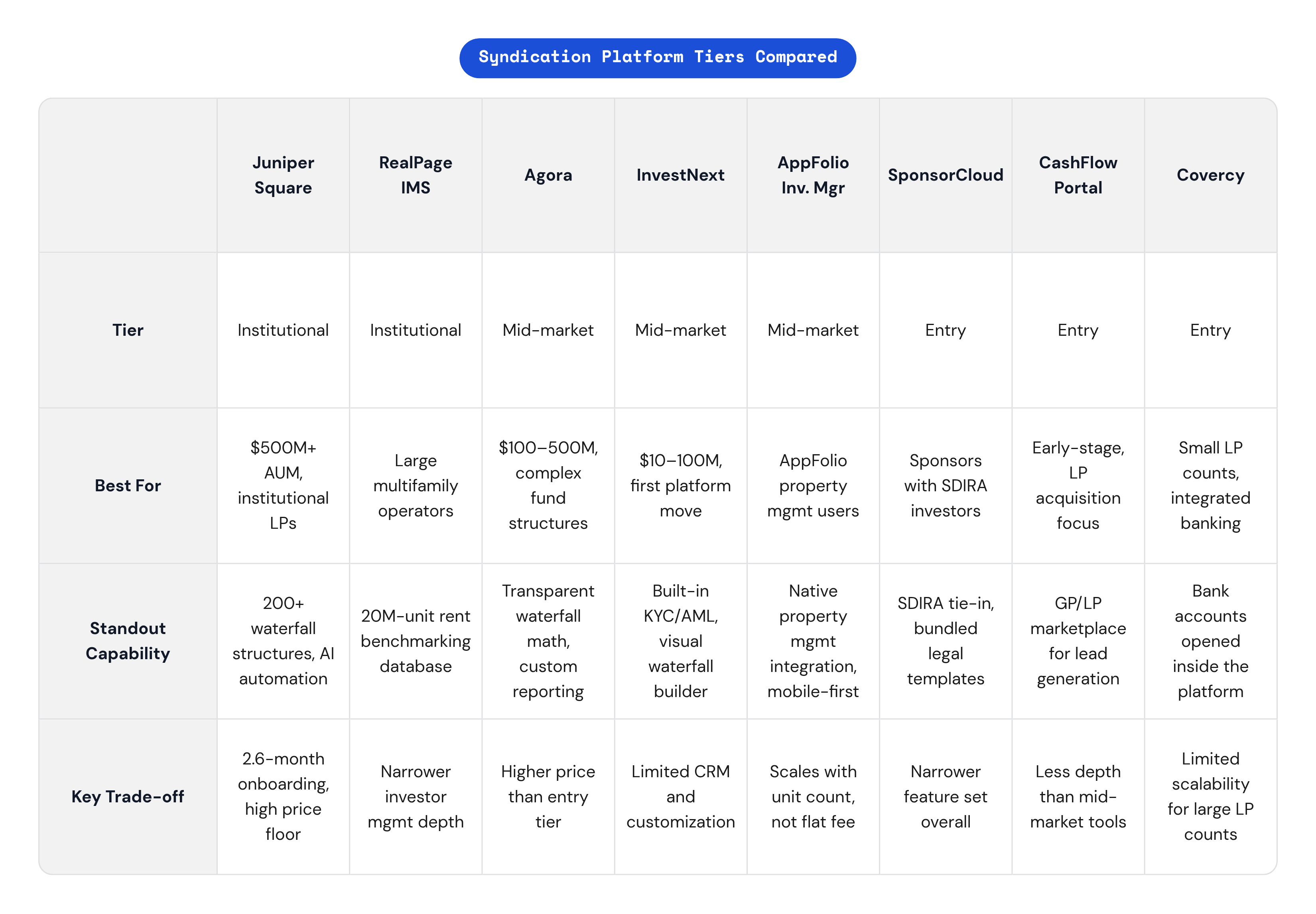
The market in 2026 has nine major platforms, ranging from $99 a month to $1,500 or more. That spread reflects real differences in capability, built for real differences in business size, and not just margin padding dressed up as a feature list.
Three tiers are worth knowing before you shop. Institutional and enterprise platforms, namely Juniper Square and RealPage IMS, are built for GPs running hundreds of millions or more, with large LP counts, complex fund structures, and institutional-grade LP relationships. Mid-market platforms, Agora, InvestNext, and AppFolio Investment Manager, serve growing sponsors managing multiple deals and anywhere from dozens to hundreds of LPs who need real waterfall automation and custom reporting. Entry-tier platforms, SponsorCloud, CashFlow Portal, and Covercy, give sponsors earlier in their growth a workable starting point with a narrower but still useful set of features.
The line between tiers isn't drawn by price alone, but by fund structure complexity, LP count, whether those LPs are retail or institutional, and whether the firm needs embedded fund administration or just wants clean software. A common mistake runs in both directions: some sponsors buy up, paying for institutional tooling they never fully configure, and others buy down, starting cheap and migrating everything eighteen months later once their LP count outgrows what the platform can handle. With fundraising up sharply in 2025, sponsors moving off manual processes mid-raise don't get the luxury of fixing that mismatch later, and end up simply living with it.
Institutional-tier platforms: Juniper Square and RealPage IMS
Juniper Square operates at a scale that's hard to line up against anything else in the category: over 2,100 GPs, more than $1 trillion in LP capital, over 40,000 funds, and 600,000 LP accounts running through the platform. That scale comes with depth to match: over 200 native waterfall structures, embedded fund accounting, LP communications, compliance, treasury, and business intelligence, all inside one system instead of stitched together from six different add-ons.
Pricing runs from $1,000 to $3,000 or more a month depending on investor base size and feature tier, and onboarding averages 2.6 months. That's a real chunk of a fiscal quarter before a firm sees the platform running at full tilt. In June 2025, the company closed a $130 million Series D led by Ribbit Capital at a $1.1 billion post-money valuation, bringing total funding to roughly $371 million. JunieAI, launched that same year, automates LP communications, pulls terms out of documents automatically, and flags accounting exceptions before a human ever catches them; the company calls it the first enterprise-grade AI built specifically for private markets GPs. That's a real shift toward software that works the file instead of just recording what happened after the fact. Worth noting too: the company's fund administration business has grown at over 100% CAGR across the past three years, so what's being sold increasingly is software plus a services team standing behind it.
All of which makes Juniper Square the right call for institutional GPs at $500 million-plus in AUM, or sponsors with institutional LP relationships who need embedded fund admin. It's the wrong call for a growing sponsor still building out their LP base; the onboarding timeline and price floor aren't built for that stage, and pretending otherwise just burns runway for no reason.
RealPage IMS takes a different angle, combining portfolio accounting, asset management, and market analytics, with particular strength in multifamily and affordable housing. Its AIM module draws on a proprietary database covering over 20 million apartment units, running AI-driven rent benchmarking and revenue optimization that nothing in the pure investor-management category really matches. For large operators concentrated in multifamily who want investment management and asset performance intelligence under one roof, that combination is the whole pitch, and it's a good one.
Mid-market platforms: Agora, InvestNext, and AppFolio Investment Manager
Agora covers the full range of entity types: open-end funds, closed-end funds, syndications, custom structures. Its waterfall tool shows the supporting math alongside the result, letting operators check their own numbers instead of trusting a black box, which matters more than it sounds when real money is riding on the calculation. The platform also handles custom report building, tax prep, and bookkeeping natively. It won Private Equity Wire's 2025 Fundraising Solution of the Year, and one customer, Metonic, reported a 70% jump in investor engagement and back-office work running 10 times faster after switching over. That's a concrete example of what mid-market automation actually delivers when it's done right, not just promised in a sales deck. Agora fits mid-market firms in the $100 to $500 million AUM range who need custom reporting and flexibility across fund structures without paying institutional prices.
InvestNext covers syndications, debt and equity funds, and REITs, with KYC and AML verification built directly in. Priced at $55 to $125 a month, it's the most accessible option at this tier, a real entry point for sponsors moving off spreadsheets for the first time without jumping straight to enterprise pricing. The trade-off, per 2025 reviews, is limited CRM prospecting and follow-up functionality, along with narrower customization than Agora or AppFolio offer at similar price points. Still, for growing sponsors in the $10 to $100 million range who want a visual waterfall builder and compliance built in without enterprise overhead, it does the job it's meant to do.
AppFolio Investment Manager leans into a mobile-first investor portal, automated waterfall distributions, AI-assisted document drafting through Smart Compose, and an Org Chart Builder that maps investor hierarchies without manual entry. The real differentiator is native integration with AppFolio's property management system: for firms already running AppFolio on the property side, that removes a data synchronization headache that otherwise eats hours every month, hours nobody gets back. Pricing starts around $1.40 per unit per month with a $280 monthly minimum, scaling with portfolio size instead of charging one flat fee. It's the natural fit for sponsors already in the AppFolio ecosystem, or anyone running syndications alongside a large unit count who'd rather run one system than babysit two.
Entry-tier platforms: SponsorCloud, CashFlow Portal, and Covercy
SponsorCloud from SyndicationPro in 2024, now calls itself a full fund operating system rather than just portal software. Two things set it apart: SponsorDocs, which bundles legal templates, and a direct tie-in with Equity Trust Company for self-directed IRA investors. That's a real edge for sponsors actively courting SDIRA capital, since plenty of platforms don't bother supporting it well at all. It's built for early-stage sponsors whose LP base includes a meaningful share of SDIRA investors.
CashFlow Portal, backed by Y Combinator's W22 batch, starts at $99 a month, the cheapest dedicated fund admin platform on the market. It holds a 5.0 out of 5 rating across 112 G2 reviews as of 2026, a notably high mark for software at any price point, let alone the entry tier. Its GP/LP Marketplace is built for lead generation, letting an operator surface deals to prospective LPs instead of just managing the ones already committed, and it covers real estate, private equity, venture capital, and startups, a wider asset class range than most real estate-only tools bother with. For sponsors just getting started who want something credible and affordable, with the marketplace as a bonus for LP acquisition, it's a solid place to start.
Covercy rounds out the entry tier with something the others don't offer: GP and LP bank accounts opened directly inside the platform, so distributions move without a separate export to a banking portal and the small anxiety that comes with it. For sponsors managing smaller LP counts who want distribution processing and basic fund administration without stepping up to mid-market pricing, that built-in banking layer solves an operational gap most entry-level tools just leave sitting there, unaddressed, like a chore nobody wants to claim.