Opportunity Zone Investment Platforms for Tax-Advantaged Real Estate
Platforms differ sharply on compliance expertise and deal structuring.

A capital gains tax bill has a clock attached to it: 180 days from a liquidity event to reinvest into a Qualified Opportunity Fund, or the deferral disappears for good. Opportunity Zone platforms exist to get investors into a compliant QOF before that window shuts. I've watched enough of these deals close (and a few blow up) to tell you the platforms are not interchangeable, and picking the wrong one can quietly undo the entire tax benefit that made the deal worth doing. So that's what we're actually digging into: what these platforms do day to day, how the recent legislative overhaul rewrites the calculus, and what separates a platform built to last from one that's going to leave you holding a compliance letter you didn't see coming.
A QOZ platform is a fund sponsor, an online marketplace, or a self-directed legal structure that packages real estate projects into IRS-compliant QOFs and lets investors buy in. Simple enough, until you look at the mechanics underneath. The fund has to hold at least 90% of its assets in qualifying property. The improvement work has to hit specific spending thresholds within set timelines. And the whole arrangement has to survive multi-year holding periods without tripping a compliance failure that unwinds the entire tax case. A regulatory skeleton sits underneath the real estate, and that skeleton shapes the deal as much as the property itself. First-time investors tend to underestimate this by a wide margin.
Some scale, for context: roughly 12,800 QOFs are active nationwide, holding about $112 billion in deployed Qualified Opportunity Zone Property, spread across 77% of designated census tracts. This is a mature program, and it was built for people sitting on serious capital gains, not casual retail buyers. Data on Form 8997 filers puts the median adjusted gross income at $738,000. Investors typically reach a QOF through one of three doors: dedicated OZ fund sponsors, broader alternative investment marketplaces that list OZ deals next to other offerings, or self-directed structures built with legal counsel. Each door trades off access, control, and complexity differently, and we'll walk through all three before we're done.
How the tax benefit actually works, in the order an investor experiences it
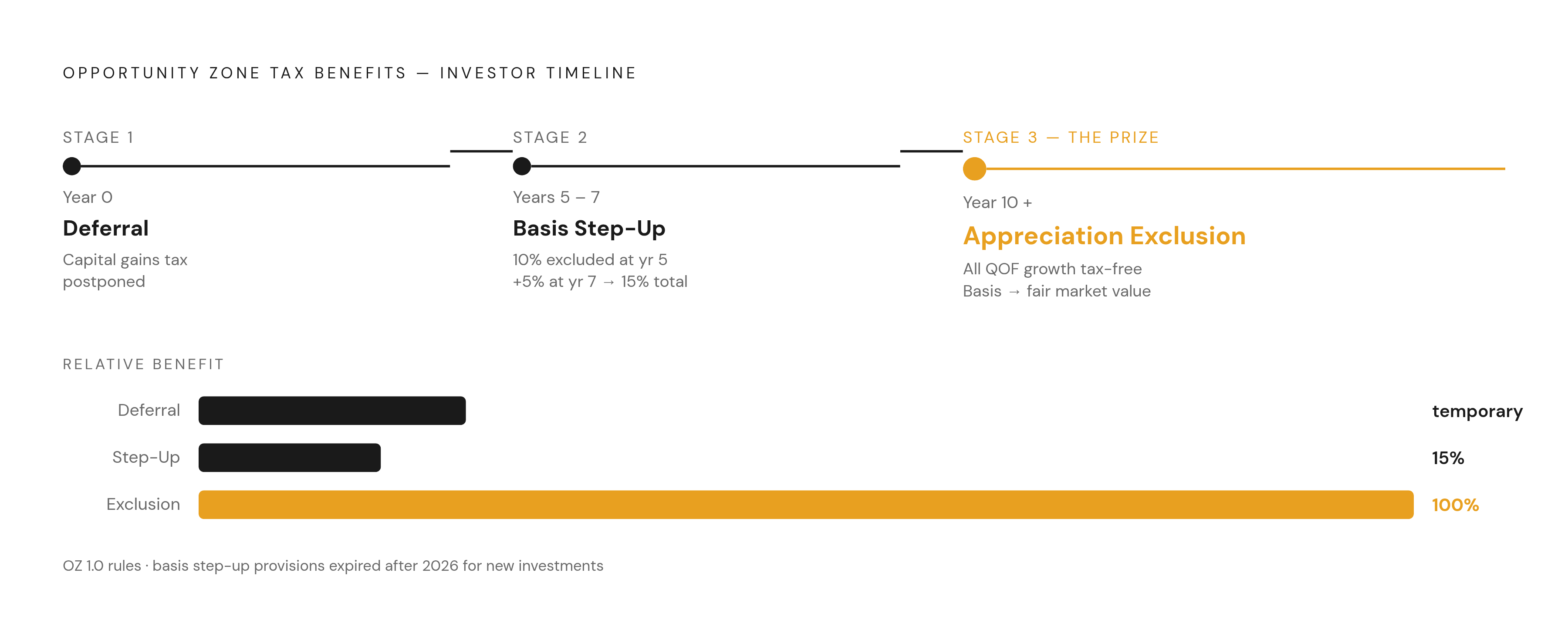
Start with what actually happens, step by step, because the benefit doesn't arrive all at once. It unfolds in stages, and each stage rewards patience differently.
Step one is deferral. Invest capital gains into a QOF and you defer the tax bill on that original gain. Under the original 2017 rules, OZ 1.0 if you want a shorthand, the inclusion event (the point where you actually owe the deferred tax) lands at the earlier of a disposition or December 31, 2026. Invest under the old framework today, and that 2026 date is coming for you no matter what else happens with the deal.
Step two is the basis step-up, and holding periods start to matter here. Hold five years and your basis increases by 10% of the deferred gain. Hold seven and you pick up another 5% on top of that. These thresholds still govern money already invested under OZ 1.0, though the new legislation changes the picture for money going in from here forward, which we'll get to.
Step three is the one that actually drives the economics for most people: the ten-year hold. Cross that line and all appreciation on the QOF investment itself becomes exempt from capital gains tax. The original deferred gain still comes due, sure, but everything the investment earns after year ten is untouched by the IRS. The deferral is nice. The step-up is a bonus. Tax-free appreciation over a decade is the actual prize, and it's why sophisticated investors put up with the illiquidity.
There's a second benefit that doesn't get mentioned enough: at the ten-year mark, basis steps up to fair market value at sale, wiping out depreciation recapture along with the appreciation gain. For real estate investors, that's not a footnote. Depreciation recapture drags on returns in a conventional deal, sometimes more than people expect, and eliminating it here adds up over a ten-year hold.
Here's a detail platforms handle with wildly varying clarity: eligible gains aren't limited to stock or business sales. Qualified 1231 gains, reported on Form 4797, also qualify. Plenty of investors selling business assets have no idea their gain qualifies for this treatment, and a platform that doesn't flag this proactively is leaving its own clients' money on the table. None of it matters, though, if the fund itself falls out of compliance. A QOF that fails its 90% asset test doesn't just underperform; it can unravel the whole tax case retroactively. The platform's actual job, stripped down, is sourcing a decent deal and making sure the wrapper around it doesn't come apart at the seams.
What OZ 2.0 changes for investors evaluating platforms today
The One Big Beautiful Bill Act, signed July 4, 2025, is the biggest change to this program since it was created in 2017. Any due diligence checklist built before that date is out of date, because several of the load-bearing rules moved underneath it.
First, the program is now permanent, with no sunset. That kills the "shrinking window" urgency that used to hang over every OZ pitch deck, the one where sponsors leaned hard on the ticking clock to close you. There's no clock to lean on anymore. At least not that one.
Second, and this one actually reshapes the timing conversation: for investments made after December 31, 2026, the deferral period becomes a rolling five years from the date of investment, instead of anchoring to a fixed calendar date. Under the old rules, everyone investing today shared the same 2026 inclusion event, a strange synchronized pressure across the whole investor base. Going forward, your five-year clock starts whenever you put money in, on your own schedule. Capital gains can be rolled into QOFs under these rules through December 31, 2033.
There's also a new 30-year cap. Hold a QOF investment past 30 years and the basis step-up locks in at fair market value as of that anniversary, not whatever it's worth later. Most investors will never bump into this ceiling, but anyone thinking in multi-generational holding periods wants a platform that discloses it upfront instead of burying it in an appendix nobody reads.
Zone eligibility is tightening too. Starting January 1, 2027, only tracts meeting stricter income and poverty thresholds qualify: median family income below 70% of the statewide or metro median, or a poverty rate of at least 20% paired with median family income capped at 125% of that benchmark. That redraws the map. Some platforms are currently building pipelines in tracts that won't survive redesignation, and it's fair to ask, point blank, whether a platform's current pipeline holds up after 2027 or evaporates.
That gap between now and then has practitioners calling out something informally known as the "2026 dead zone," the theory that investors might just pause new OZ commitments in late 2026, waiting to see the new zone map take effect on January 1, 2027, rather than lock into a tract that might not make the cut. Whether that pause actually materializes is genuinely up in the air. But it's real enough that it's worth asking any platform how it plans to advise clients through that stretch.
The compliance burden got heavier too. OBBBA introduces detailed new reporting requirements, with penalties reaching up to $50,000 for large funds that fall short. That's not a rounding error on anyone's spreadsheet. A platform's compliance infrastructure, its actual systems for tracking and reporting, not the language on its website, deserves at least as much scrutiny as its projected returns. Arguably more.
One relief valve worth knowing about: the Working Capital Safe Harbor now extends to 60 months, giving QOZ businesses more runway to deploy capital. For development-stage projects, ground-up construction especially, that extra time matters quite a bit. A platform doing new builds benefits from this more than one buying stabilized assets.
The rural opportunity fund tier and why it matters for platform selection
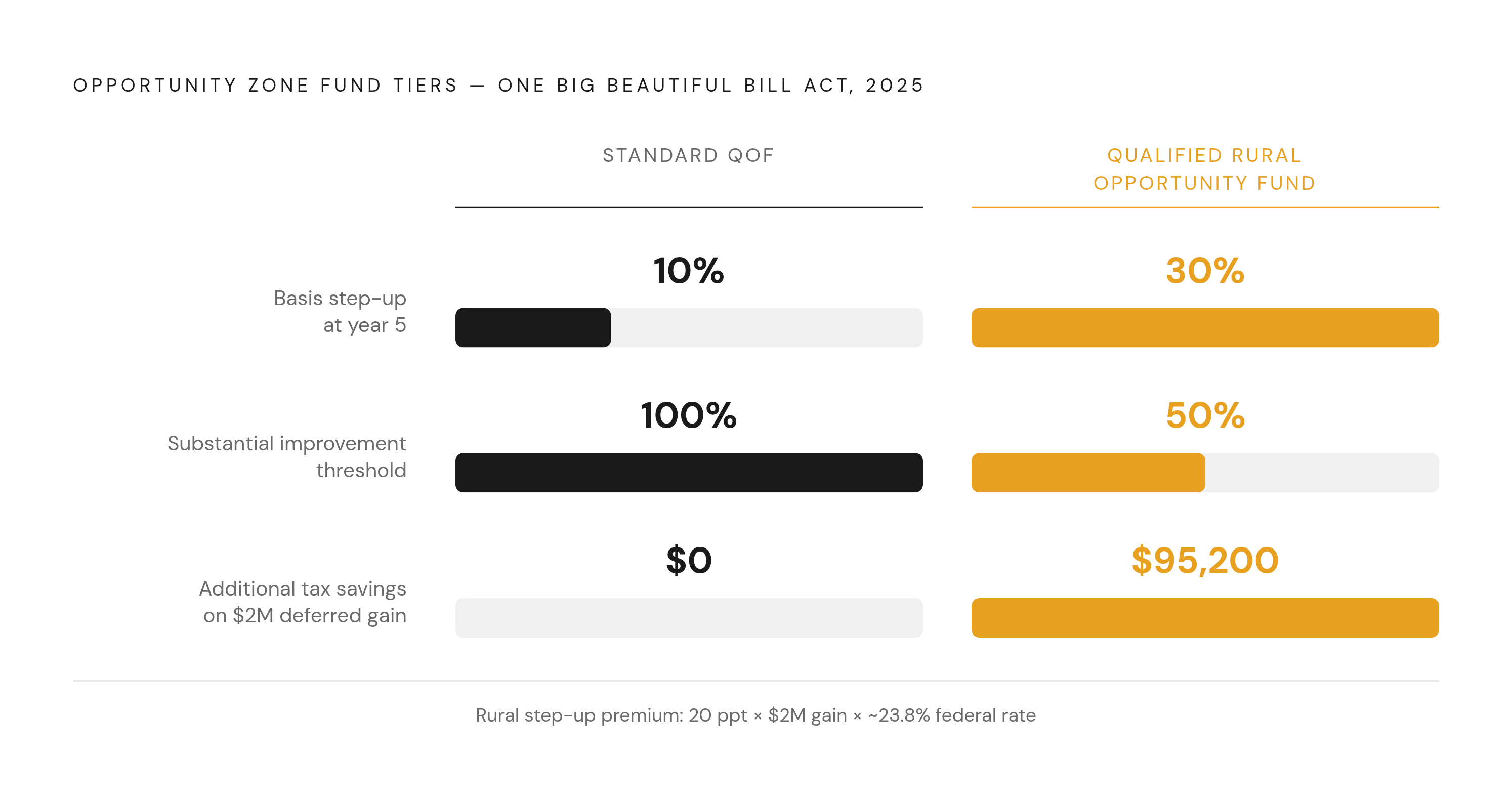
Buried inside OBBBA is a new fund category that changes the math in a meaningful way: Qualified Rural Opportunity Funds, or QROFs. These hold at least 90% of assets in QOZ property located outside cities and towns with populations over 50,000.
The benefit gap here isn't small, it's the whole ballgame for some investors. QROFs get a 30% basis step-up at the five-year mark, triple the standard 10%. They also get a reduced substantial improvement threshold of 50%, compared to the standard 100%, meaning less capital has to go into rehab to qualify. According to madrasaccountancy.com, 3,309 rural opportunity zones have been identified as qualifying for this treatment.
Let's put a number on it, because abstractions don't move anyone. On a $2 million deferred gain, the difference between a standard 10% step-up and the rural 30% step-up works out to $95,200 in additional tax savings. That's not a rounding error either. It's a material shift in after-tax return sitting there for investors willing to go rural.
So the obvious question when you're evaluating a platform: how much actual rural deal flow does it have, versus offerings clustered in cities and inner suburbs? A platform stuck exclusively in urban and suburban tracts is leaving the highest-benefit tier on the table.
Rural deals aren't a free lunch, though, and it's worth resisting the urge to treat the tax premium as the whole story. Rural submarkets tend to be less liquid, lease-up can drag longer than projected, and there are fewer comparable transactions to sanity-check an underwriting assumption against. The tax benefit is real. It just has to be weighed against real estate fundamentals that behave differently in a small town than they do in a growing metro, and no spreadsheet fixes that tension for you.
Worth noting too: the 50% substantial improvement threshold for rural deals is new under OBBBA, which means most platforms are early in building out rural pipelines, some barely started. The useful question isn't whether rural QROFs show up in the marketing copy. It's how far along that pipeline actually is, and in which specific geographies.
How platforms are structured and what that means for investor control
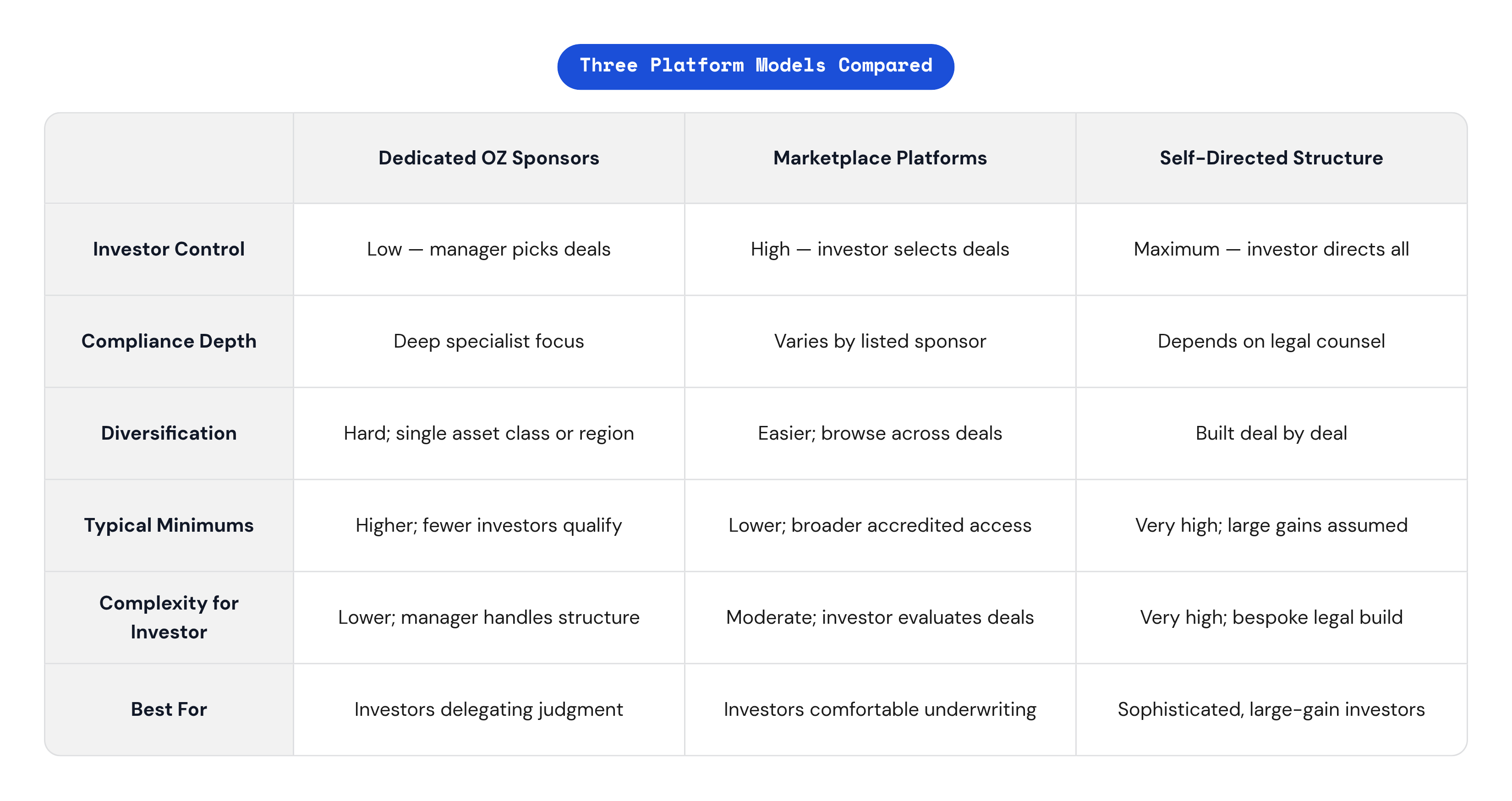
Three broad models exist, and they hand investors very different amounts of control over the outcome.
Dedicated OZ fund sponsors focus exclusively on managing QOFs, usually specializing in one asset class or region: multifamily in the Southeast, say, or mixed-use in a specific metro. Investors commit capital to a specific fund and generally have limited ability to exit before the holding period runs its course.
Broad alternative investment marketplaces, platforms like CrowdStreet or RealtyMogul, list vetted OZ deals alongside other real estate offerings. Accredited investors browse and pick deals themselves. Minimums vary by deal and platform, often accessible to a broader range of accredited investors than dedicated fund sponsors. This model demands more due diligence from the investor, since you're picking the deal instead of delegating that judgment to a fund manager, but it hands you real say over asset class and geography in return.
Then there's the self-directed route: investors with large gains, enough sophistication, and usually enough capital work with legal counsel to build a single-asset QOF from scratch. Maximum control. Also maximum complexity, and not something to try without experienced counsel already at the table, full stop.
One structural fact worth sitting with for a second: 84% of QOFs invest in a single census tract. This market is concentrated by nature, not by accident. An investor wanting to spread risk across multiple projects generally needs to either find a genuinely multi-asset fund or build a portfolio deliberately across several single-asset QOFs. Real estate remains the dominant use of QOZ capital across the whole program, so platforms built around real estate specifically are working with where the money actually flows.
Liquidity deserves a blunt word here, because I've seen investors get surprised by this one. QOF investments are illiquid by design. The ten-year hold that unlocks the appreciation exclusion means the capital should be treated as locked away for a decade. A secondary market exists in some form, but it's thin enough that "liquid" is the wrong word for it, and any platform hinting otherwise earns a skeptical follow-up question.
Entity structure matters more than it gets credit for, too. QOFs can be organized as partnerships or corporations, and pass-through treatment in a partnership changes how gains and losses actually flow through to individual investors. It varies platform to platform and fund to fund, so ask directly rather than assume. Accreditation is generally required across most platform-based QOF investments, which lines up with the high-income profile the program attracts, but confirming eligibility before engaging with a platform is still step zero.
The criteria that separate well-structured platforms from poorly structured ones
Compliance infrastructure comes first and it's non-negotiable. Does the fund actually hold 90% of its assets in QOZ property, and can the platform show you the mechanism, not just assert the number? How does it handle the substantial improvement rule, including the new 50% rural threshold, and what's its real track record hitting the 30-month improvement timeline? Does it have reporting systems built for the new OBBBA requirements, or is it hoping the $50,000 penalty question never comes up in a client call?
Sponsor track record matters independently of the tax structure. A bad real estate deal wrapped in a good tax wrapper is still, at the end of the day, a bad deal. Has the sponsor actually hit development milestones on prior QOF projects, the kind that preserve the tax benefit rather than just look good in a pitch deck? And what's the concentration risk sitting underneath: if this is a single-asset fund in a single tract, what happens to your tax position if that one project gets delayed or falls apart entirely?
Fee structure needs real scrutiny, not a glance and a nod. Management fees, promote or carried interest, acquisition fees, these stack up fast in OZ deals and quietly erode the return that justified taking on the tax complexity in the first place. The comparison that actually matters isn't raw tax savings against doing nothing; it's the after-fee, after-tax projected return measured against a plain taxable alternative.
Asset class and geography alignment is worth checking against where the program is headed, not just where it's been. Does the platform offer rural QOZ deals, the highest-benefit tier under the new rules? Is its geographic footprint likely to survive the zone redesignation taking effect January 1, 2027, or is a chunk of its pipeline sitting in tracts about to lose eligibility overnight?
Reporting and documentation round this out. Does the platform actually hand investors the forms they need, Form 8997, K-1s, and communicate compliance status clearly given the heavier OBBBA reporting load? Access matters practically too: minimums vary a lot, from a few thousand dollars per deal on a marketplace platform to substantially higher commitments at dedicated sponsors, and smaller minimums let an investor spread capital across multiple QOFs instead of betting everything on one tract. Last, and maybe the most telling question of all: has the platform actually updated its fund documents for the rolling deferral mechanism, the 30-year cap, and the 2027 zone redesignation? Or is it still running on paperwork drafted before July 2025, hoping nobody checks the date?
How leading platforms compare on these criteria
CrowdStreet runs a marketplace model for accredited investors, focused on commercial real estate, with a $25,000 minimum per deal. Since investors pick individual deals themselves instead of handing that judgment to a fund manager, the platform demands more upfront work, but it grants real control over which asset class and market you're exposed to. It suits investors who are comfortable evaluating commercial real estate underwriting on their own.
RealtyMogul has facilitated OZ deal exposure and publishes investor education that walks through core QOZ mechanics, including a distinction that trips up plenty of first-timers: only the capital gains portion needs reinvesting, not the full sale proceeds, unlike a 1031 exchange where the whole amount typically has to roll over. RealtyMogul runs both QOF and non-QOF offerings on the same platform, so investors need to actively filter for OZ-eligible deals rather than assume everything listed qualifies.
Dedicated OZ fund sponsors, as a category, tend to bring deeper specialist expertise and tighter compliance systems, since QOF management is the whole business rather than one product line among many. That specialization is also the tradeoff: these sponsors concentrate in one asset class or region, minimums run higher, and diversification across projects gets harder when you're working with a single sponsor.
The one question worth asking any platform, in any category, regardless of model: how has it actually adapted its deal pipeline and fund documents to bring in rural QROFs since July 4, 2025? That's the highest-benefit tier available right now, and a platform's answer here tells you a lot about whether it's tracking the new rules closely or coasting on marketing copy written before the ink dried.
Risks and limitations that no platform eliminates
None of this changes the basic rule that governs any tax-advantaged investment: the tax benefit should never be the reason a bad deal looks good. An OZ wrapper doesn't fix a weak market, a mediocre sponsor, or an overpriced asset. It just changes how the government treats the gain when things go right. If the underlying real estate doesn't work on its own merits, the tax treatment is decoration on a structure that was never sound, and no platform, however well-run, can compliance its way around that fact.
Illiquidity is real, and it doesn't go away regardless of which platform you pick. Ten years is a long time to have capital locked up. Life happens in ten-year windows: divorces, business changes, medical bills nobody budgeted for. Anyone committing to a QOF should be genuinely comfortable not touching that money for a decade, not comfortable in theory, which is a different thing entirely when the actual moment arrives.
Legislative risk hasn't vanished just because OBBBA made the program permanent. Permanent, in tax law, has historically meant "until Congress changes its mind again," and the rules governing zone eligibility, reporting, and benefit tiers can shift with future legislation the same way they just did in 2025. Betting on a specific tax outcome a decade out means betting, implicitly, that the rules stay roughly where they are. No platform can guarantee that, and any that implies otherwise is selling something.
Concentration risk sits quietly underneath most of this program, since most QOFs, as noted, sit in a single census tract. That's a structural fact about the program, not a flaw unique to one platform, but it means diversification has to be built deliberately by the investor, deal by deal, rather than handed over automatically by the product.
And compliance failure remains the one scenario that undoes everything else. A fund that fails its 90% asset test, or misses a substantial improvement deadline, doesn't just underperform. It can retroactively unwind the tax treatment that was the entire point of the exercise. That's the risk no marketing page will ever emphasize, and it's exactly the one a serious platform evaluation has to weigh most heavily, because the returns, the deal quality, the sponsor's track record, none of it matters if the tax structure underneath actually gives way.