Real Estate Tokenization Platforms and How They Work
Blockchain lets investors buy fractional stakes in buildings and trade them like stocks.

Real estate tokenization takes a slow, illiquid asset class and cuts it into digital pieces that trade on a blockchain. That's the pitch, and it's a real one: a multimillion-dollar office building can become hundreds of thousands of tokens, each worth a small fixed amount, each carrying a fractional claim to rental income and eventual sale proceeds. The token represents a claim on a legal entity that owns the property, and that distinction runs through everything else in this piece.
Here's the setup investors actually deal with. An asset owner sets up a special purpose vehicle, or SPV, and transfers the property title into it. The owner then issues tokens representing membership interests in that SPV, not the deed itself. Most jurisdictions don't recognize a blockchain token as a land title, so the token and the deed stay separate, connected by legal paperwork rather than by code. A multimillion-dollar building split into hundreds of thousands of tokens at a small fixed price each means every token is a fractional stake in the SPV, representing an interest in the entity rather than a direct claim on the drywall.
What do token holders get for their money? Proportional distributions of rental income, usually automated through a smart contract, plus an on-chain record of ownership that can't be quietly altered after the fact. There are generally three flavors of token in circulation. Equity tokens are membership interests in the SPV that holds the property. Debt tokens work more like bonds, collateralized by a mortgage or a development project, with repayment terms written into the contract. Revenue participation tokens give a contractual right to a slice of rental income or sale proceeds without conveying ownership or creditor status. Three structures, three risk profiles, one shared vulnerability: the token is only as trustworthy as the legal chain sitting behind it. That's the thread the rest of this piece follows.
The SPV layer: why every deal starts with a legal wrapper
Nothing gets tokenized until the SPV exists. Property title transfers into the SPV, or sometimes a trust, and investors end up holding interests in that entity rather than the deed. This reflects close to the only option available, since land registries and securities law in the U.S. and the U.K. simply don't have a slot for "blockchain token" as a title instrument yet.
The SPV's operating agreement is where the real rulebook lives: distribution mechanics, sponsor buyback provisions, governance rights, what happens if someone wants out early. Some platforms use a Series LLC setup, where each property sits in its own series. That isolates liability property by property, so a lawsuit or default tied to one building doesn't drag down the others, and it lets a platform scale across a growing portfolio without each new asset adding shared risk.
Who actually forms the SPV? Usually the asset owner or the platform sponsor, and this happens before a single token gets minted. That sequencing matters, because it determines how the token gets classified under securities law, which is the next layer of this whole structure. Equity interests in an SPV are securities under U.S. law, full stop, and that triggers a compliance regime covered in the next section. For an investor, the practical upshot is this: your rights are contractual, spelled out in the SPV's governing documents. The blockchain confirms who owns what, while enforceability in court depends on those governing documents and legal counsel.
How securities law shapes what platforms can issue and to whom
Because SPV interests are securities, issuing tokens in the U.S. means either registering the offering with the SEC or fitting into an exemption. Three exemptions do most of the work here: Regulation D, Regulation A+, and Regulation S.
Reg D is the fast lane, and under the 506(b) exemption it restricts sales to accredited investors with no general solicitation allowed. Reg A+ opens the door to retail investors up to certain dollar limits, but it requires SEC qualification first, which costs time and money that Reg D deals skip. Reg S covers offshore offerings, the tranche of a deal aimed at non-U.S. investors.
None of this works without KYC and AML checks, which form a core part of the process rather than optional add-ons bolted on later. Identity verification, accreditation checks, jurisdiction eligibility, all of it happens before a wallet gets whitelisted, not after tokens go out the door. For a platform working across borders, this gets complicated fast. DigiShares operates across multiple countries, which means navigating numerous separate securities regimes, a broader challenge than U.S. rules alone would present. Contrast that with government-led tokenization initiatives in jurisdictions like the UAE, which operate under an entirely different regulatory model than a private U.S. platform issuing securities to accredited investors. Same underlying idea, tokenized property, wildly different legal scaffolding.
This compliance burden carries real weight. It's the first real fork in the road between platforms, shaping which asset types and which investor audiences each one can realistically serve.
What smart contracts do in a tokenized deal — and what they can't do
A smart contract in a tokenized real estate deal is doing three jobs at once: it's the cap table, the distribution engine, and the compliance gate. Ownership percentage per token, pro-rata rental income splits, transfer restrictions, sponsor buyback terms, all of that gets written into code that runs without a human pressing "approve" every time.
This is why platforms use standards like ERC-1400 and ERC-3643 instead of a plain ERC-20 token. Those standards bake investor whitelisting and transfer restrictions directly into the token itself, so a wallet that hasn't passed KYC simply cannot receive it. The code refuses the transaction outright, without a manual check or a compliance officer catching it after the fact.
That sounds airtight, and it mostly is, provided the code was written correctly. This is why a security audit before deployment matters so much. A bug in a live smart contract can freeze investor funds or permanently misallocate ownership stakes, and unlike a bank reversing an erroneous wire, there's no undo button on a blockchain once a transaction confirms.
Smart contracts also need outside information to do their job, since they're closed systems by default. That's where oracles come in: they feed the contract real-world data it can't see on its own, current rent rolls, FX rates, updated appraisals, fresh KYC status, so the contract has something to act on when it's time to trigger a distribution or enforce a condition.
But how far does the code actually reach? Not as far as people sometimes assume. A smart contract cannot walk into court and enforce the SPV's operating agreement. It cannot compel a sponsor to actually manage the property well or make a distribution the sponsor is dragging their feet on. The code automates mechanics; the law is what makes those mechanics enforceable when something goes wrong. That gap between automation and legal enforceability is worth sitting with before treating any smart contract as a guarantee of anything.
Which blockchain a platform runs on and why it matters in practice
Ask which blockchain a platform runs on, and the answer tells you a fair amount about who it's built for. As of 2025, real estate tokenization platforms are spread across Ethereum, Tezos, Binance Smart Chain, Polkadot, Solana, and purpose-built chains like Chintai.
Ethereum has the deepest developer ecosystem and the most battle-tested token standards, including ERC-3643 and ERC-1400, and it carries the most institutional familiarity of the group; Securitize runs BlackRock's BUIDL fund on it. Tezos and Polkadot appear among the chains platforms have chosen, each offering attributes that can be useful when a deal involves high-volume distribution events. Chintai is a purpose-built chain, and Kin Capital chose it for a $100 million real estate debt fund because of its institutional compliance tooling. Solana brings speed and low fees to the table, though Ethereum's longer track record gives it a head start in institutional familiarity.
Why should an investor care which chain sits underneath their token? Three reasons, in practice. Tokens on different chains generally can't trade against each other without bridging, and bridging adds cost and its own layer of risk. Secondary market depth tends to follow wherever the most platforms and trading venues already operate, and right now that's Ethereum. And there's continuity risk: if a chain goes through a rocky upgrade or developer support thins out, every token built on it feels that shift. None of this is a red flag by itself. It's a question worth asking before capital moves, not after.
How secondary trading actually works for tokenized real estate
The liquidity pitch is the whole reason tokenization exists as an idea: instead of waiting years for a property sale to cash out, token holders trade peer-to-peer whenever they want. In practice, that promise is only partly built yet.
Two kinds of venues handle this. SEC-regulated Alternative Trading Systems, or ATSs, are required for security token trading in the U.S., and some platforms operate their own ATS, letting them run compliant peer-to-peer trades for tokens they have issued. Some platforms instead run their own internal marketplaces for token holders, with regulatory clarity and actual trading depth varying quite a bit from one to the next.
The compliance gate that governs the initial sale doesn't disappear at resale. A buyer still needs to be whitelisted before receiving a token, the smart contract enforces that automatically, and that same rule that keeps a deal compliant also shrinks the pool of people who can legally buy in on the secondary market. Add to that the lock-up periods common in Reg D deals, and "liquidity" starts to look less like an ATM withdrawal and more like a waiting room with a shorter line than a traditional property sale.
Where does that leave things today? Secondary trading volume for real estate tokens is still thin outside the largest platforms. The plumbing exists, ATSs are live, smart contracts enforce transfers correctly, but the depth of buyers willing to trade at a fair price is still catching up to the technology. RealT's 970-plus tokenized U.S. properties, with minimum buy-ins as low as $50, represent the retail end of this market, and broad token distribution doesn't automatically mean a deep pool of buyers shows up when a holder wants to sell. Even so, the advantages over a traditional property sale are real: faster settlement, lower transaction costs, a market that's open around the clock instead of during business hours. The current state falls short of trading public equities, yet marks a meaningful step past the old model of "call a broker and wait six months."
How the major platforms differ from each other in practice
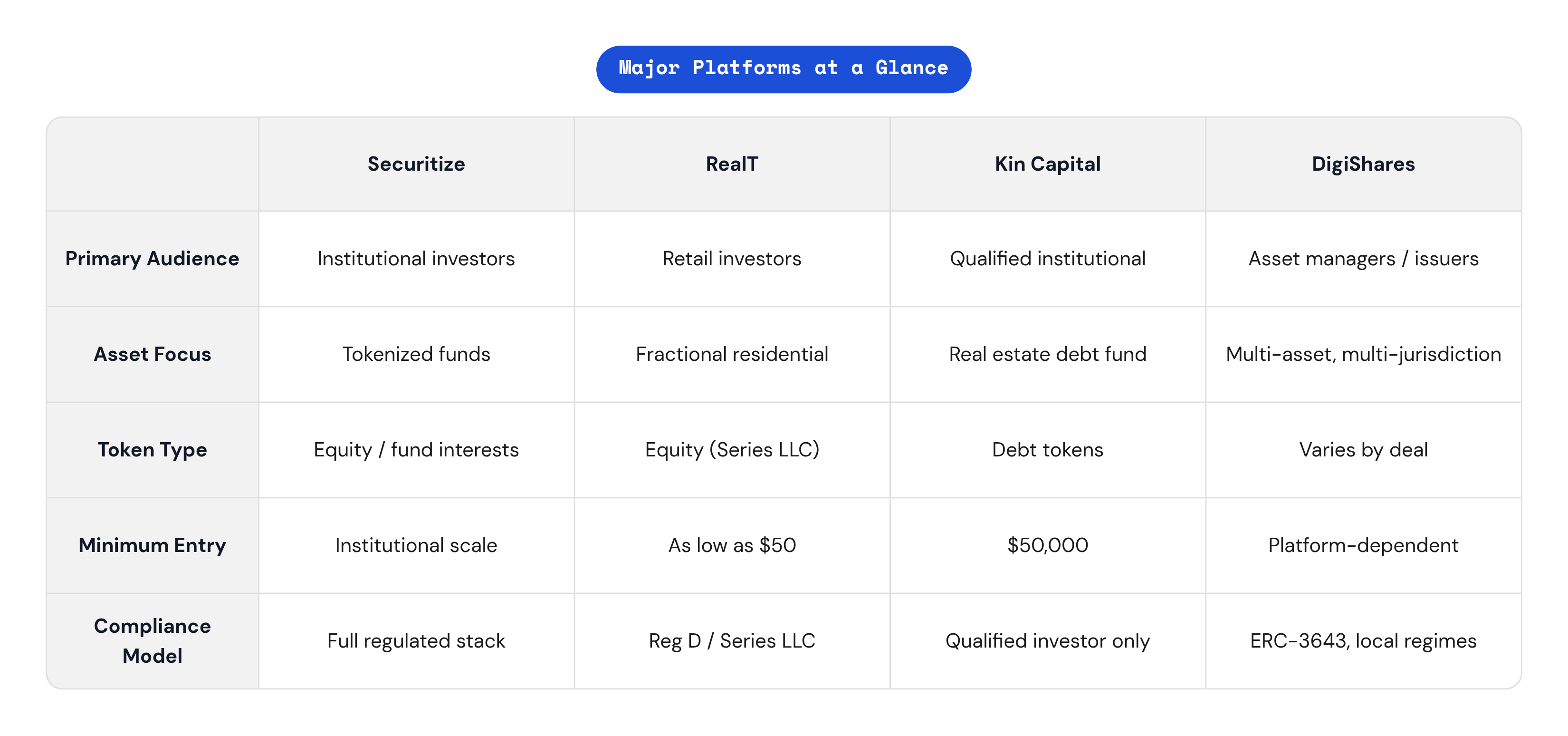
Line up the major platforms side by side and a pattern falls out fast: who they're built for, retail or institutional, decides almost everything else about them, including asset type, minimum check size, blockchain, and compliance model.
Securitize sits at the institutional end with a regulated stack that covers multiple functions under one roof. It powers tokenized funds for BlackRock, whose BUIDL fund grew from $400 million to $2.9 billion over the course of 2025, along with fund tokenization work for other institutional asset managers. A SPAC deal in October 2025 valued the business at $1.25 billion pre-money, a number that says institutional money is betting on this sector's direction. Securitize's focus stays on tokenizing institutional funds rather than selling fractional shares of a strip mall to retail investors.
RealT sits at the other end. Over 970 U.S. properties tokenized, entry points as low as $50, and 88% of its users have invested less than $5,000 total. Its Series LLC structure isolates each property, so a token there is an equity interest in one series, not a claim on the underlying deed. Yields run 7% to 20%, distributed weekly, aimed squarely at retail investors chasing income rather than a fund-management relationship. Properties span a range of U.S. cities.
Kin Capital, working with Chintai, represents a different animal entirely: a $100 million real estate debt fund with a $50,000 minimum, restricted to qualified institutional investors. These are debt tokens tied to trust deeds, carrying a different risk and return profile from any equity play above.
DigiShares takes a step back from all of this and focuses on infrastructure, operating across a broad range of jurisdictions with a wide range of wallet integrations. Other infrastructure-focused platforms play a similar role but lean into compliance as the core product, built around standards like ERC-3643 and serving asset managers who need to meet local regulatory requirements. Some platforms focus on U.S. commercial real estate fund issuance, bundling investor onboarding with secondary trading as part of their offering.
Step back and the split is clean: retail fractional ownership on one side, institutional funds and debt on the other. Legal structure, minimum check, blockchain choice, compliance model, all of it flows from that first decision about who the platform is actually built to serve.
What investors and asset owners actually encounter when using these platforms
Sign up for one of these platforms as an investor, and the first thing you'll notice is that nothing happens instantly. KYC verification, accreditation checks, jurisdiction eligibility screening, all of it runs before your wallet gets whitelisted. Expect days, not the two-minute signup flow you'd get opening a brokerage account.
What do you actually own once that's done? A token representing an interest in an SPV, governed by an operating agreement that sits in a law firm's files somewhere, not on the blockchain. The chain gives you a record of ownership. The agreement gives you rights. Income distributions arrive automated by smart contract on a set schedule, but how reliable that schedule is depends on whether the underlying property is actually generating rent, not on how well-written the code is. Before committing capital, it's worth checking whether a secondary market exists for the specific token you're buying, what lock-up period applies, and how deep the pool of eligible buyers actually looks, because liquidity varies a lot from platform to platform. And fractional interests in a real estate SPV generally throw off taxable income, so a conversation with a tax adviser about your specific jurisdiction is not a step to skip.
Asset owners and sponsors face a different set of realities. Legal work, forming the SPV and drafting the governing documents, comes before any of the technical build, since the platform sits on top of that legal structure rather than replacing it. Choosing between equity, debt, and revenue participation tokens changes who you can sell to and which regulatory path applies. A smart contract audit is a real line item in the budget, and compliance obligations don't stop once tokens are issued: investor re-verification, reporting, and ongoing distribution management continue for as long as the token exists. Picking a platform also locks in your blockchain, your secondary market access, and your investor network, and switching later tends to be expensive and slow.
The adoption numbers back up that this is moving past the experimental stage. Deloitte's research found that as of June 2024, 12% of real estate firms worldwide had already implemented some form of tokenization, with another 46% piloting it. A 2025 survey from EY-Parthenon and Coinbase found 57% of institutional investors expressed strong interest in tokenized assets. Demand is running ahead of the infrastructure in a lot of markets right now, which is exactly the gap the earlier sections on secondary trading and blockchain choice were pointing at.
Where the tokenized real estate market goes from here
Every layer covered here, the SPV, the securities exemption, the smart contract, the blockchain, the trading venue, has to work correctly and work together for a token to deliver what it promises. That's a lot of moving parts for what sounds, on the surface, like a simple idea: cut a building into shares and sell them.
The technology side of this has largely arrived. Smart contracts enforce compliance automatically, ATSs exist for regulated secondary trading, and platforms from Securitize to RealT to DigiShares show the model works across very different investor segments. What hasn't caught up yet is depth: the buyer pools that make secondary trading genuinely liquid rather than technically possible. Institutional interest, per the EY-Parthenon and Coinbase survey, is sitting well ahead of where the trading infrastructure currently stands, and Deloitte's adoption numbers suggest more real estate firms are experimenting with tokenization than there are active secondary markets to support them.
That gap will probably close as more capital flows in and more platforms mature, but it hasn't closed yet, and anyone evaluating a tokenized deal today should treat that as the honest state of the market rather than a settled fact. The legal wrapper matters. The compliance layer matters. The blockchain matters. And the buyer on the other side of a trade, whenever you decide you want one, matters most of all.