Ways Startups Are Disrupting the Real Estate Industry
Proptech's funding surge is concentrating on startups solving one operational problem completely.

Proptech investors are funding deals again because Real estate kept resisting digitization, which reshaped retail, finance, and news for years. Each check chases a clear, entrenched friction. Three-week closings, fragmented HOA files, one leasing office fielding waves of phone inquiries with a tiny team. Transaction delays, loan opacity, patchwork property management systems, affordability limits, and extra compliance work feed off each other. They pile up. This article maps the consequential proptech disruptions of 2026 by whichever problem each solves, not the tech driving it, since the problem shows which startups will stick around and which are just old 2021 buzz dressed up as AI.
How proptech investment rebounded and where the money is concentrating
CRETI says proptech venture funding worldwide reached $16.7 billion during 2025, rising nearly 68% over the previous twelve months. In Q1 2026, funding stayed strong, with $3.3 billion over 125 transactions. Over 190 funding rounds in this field totaled $5.8 billion during 2025, jumping 33% over 2024 levels.
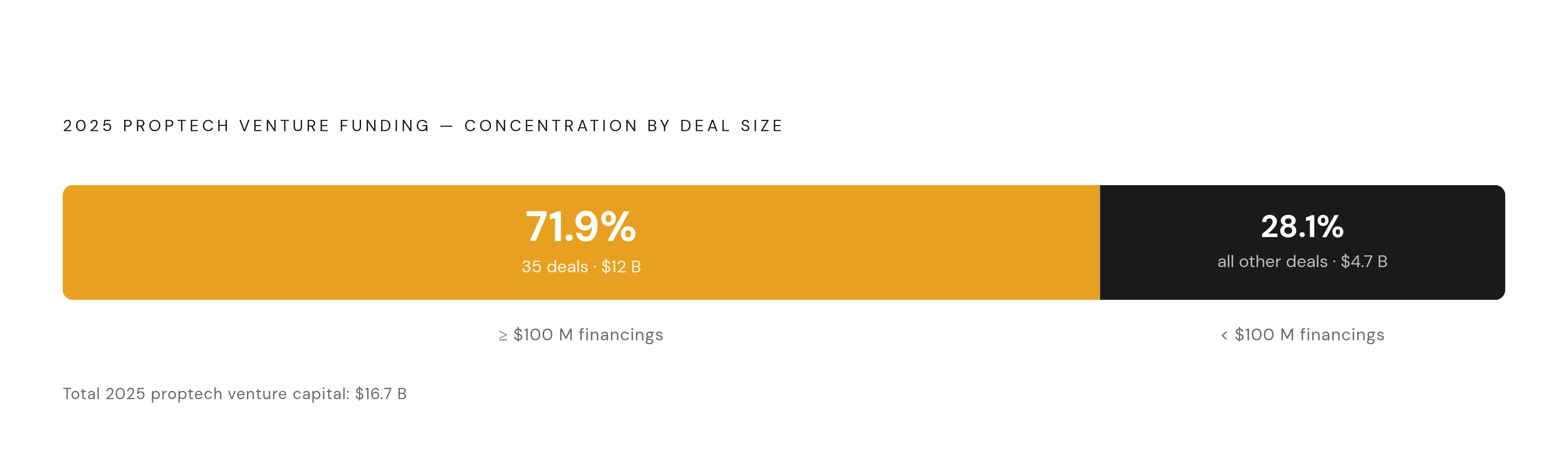
The real reveal hides beneath the top figure: it's all clustering. Only 35 financings at $100 million or higher absorbed $12 billion, with 71.9% of 2025 capital, according to CRETI. Over 55 deals passed $20 million, with 26 that topped the $50 million mark, yet most of the capital landed in a few big bets rather than many little ones. In the stretch from July through September 2025, roughly $4.2 billion in venture capital went to 126 proptech firms.
This is unlike 2021, as consumer-facing iBuying platforms and some fractional-ownership tools attracted capital during earlier cycles. Many of these models have since closed, ending a debate running over years: story-driven proptech fails when interest costs rise, while operator-driven proptech holds up. Today's funding rounds are less common, larger, and directed toward AI-native businesses solving a single operational problem well. After mid-2024, 4 AI-native proptech unicorns arrived: EliseAI hit a $2.2 billion valuation, Bedrock Robotics reached $1.75 billion, Vantaca got $1.25 billion, Juniper Square $1.1 billion. As of mid-2026, property management systems got the most investor capital of any category: $365 million, accounting for 60.4% in disclosed funding, across 8 financings.
This isn't optimism about the broad-market. It looks like money going to firms holding one piece of operational tooling, and holding all of it.
Automating property management communications, the problem EliseAI is solving at scale
Property managers deal with a huge number of tenant touchpoints: answering prospects, scheduling visits, signing paperwork, handling repairs, and renewal talks. Before, all of it was handled manually by call, message, and any add-on their property management software included. An identifiable source lay behind all that friction. No leasing office had enough people staffed for that many messages.
EliseAI created its platform to automate communication through calls, messages, and digital channels throughout the full lifecycle. CEO Minna Song says it already handles over 90% of its renter communication wherever it touches, with EliseAI reaching more than 2 million homes plus 70% of the 50 biggest housing firms using it, such as Asset Living, Avalon Bay, Bozzuto and Greystar. Recurring sales topped $100 million by the start of 2025. It pulled in Series D funding of $75 million during August 2024, followed by Series E backing of $250 million in August 2025 from Andreessen Horowitz, with a possible $300 million round at a valuation of $3.7 billion. That trajectory, from Series D to a $3.7 billion talk in under two years, is the clearest evidence in this entire sector that solving one workflow completely beats solving ten workflows partway.
That familiar friction appears lower in the industry and among office properties, just less widely. Door, launched from Las Vegas in 2023 with $6.59 million of funding, serves mom-and-pop landlords through AI which automates payments, tenant inquiries, the books, and chat summarization in any tongue, and says landlords reach as much as 5x their old baseline in output. Started in Boston during 2018 with over $200 million collected, HqO brings that approach to office buildings using a platform built mobile-first for maintenance, space booking, entry management, plus analytics on tenants.
Several firms, several segments, and the same thread running through them all. Workflows that used to require a person answering a phone at 9pm now run as automated loops around the clock.
Fixing the transaction bottlenecks that slow every deal
Real estate closings almost never stall for just one cause. Compliance paperwork, fragmented software systems, missing HOA documents, manual data entry, and disconnected brokerage tools each tack on days, and they tend to hit at the same time, which is why closings that should take a week routinely stretch past three.
One venture capital group that's affiliated with a large business body picked 6 firms to join the 2026 REACH accelerator program, each focused on another node, not the whole deal pipeline. AiRE, the short form of Ai.realestate, merges brokerage info, property, loan, plus client documents into one living source built to win new business and stay close to its clients. One startup focuses on HOA visibility and paperwork, an area where stale records routinely drag out closing timelines. BrokerBot works as an operational AI embedded inside brokerage systems to help with compliance, teaching staff, and paperwork. LotRoll builds the infrastructure behind factory-built housing, adding clear cost transparency with current listings as the market draws more interest while affordability tightens. By automating compliance workflows, MaxHome.ai reduces manual tasks for agents and brokerages. StackWrap pulls brokerage tools into a single dashboard, showing companies how their agents really engage with software they've bought but quietly ignored, which is often why these stacks perform poorly.
Dave Garland, who runs REACH, noted: "Agile creators will shape what comes next… reshaping friction as a chance while agents stay at the heart of each transaction." One notable pattern defines this class: the range. Because transaction bottlenecks persist at multiple nodes, those startups pulling traction picked a specific node and went all in instead of attempting to rebuild that whole pipeline together.
Part of that friction is already fixed, then absorbed within infrastructure, with eSigning as the clearest example. Signing tools worldwide generated $8.65 billion during 2024, with roughly 41% annual expansion forecast until 2033. When a source of transaction friction turns into routine practice rather than disruption, you get something like DocuSign buying LiveOak Technologies for notarization or HelloSign joining Dropbox.
Making ownership more accessible through fractional investment and tokenization
Property has required heavy capital commitments upfront, so institutional players got in earliest while retail investors were left out for years. Fractional investing platforms, including Fundrise, RealCrowd, and Arrived Homes, let smaller investors buy into single-family and multifamily portfolios without needing six figures in cash.
Tokenization on Blockchain pushes ahead. Some Platforms, like RealT plus SolidBlock, turn real estate into online stakes sold globally, as Propy puts more weight toward its transaction itself: ownership changes, escrow, automated ownership transfers and escrow management, not bolted there later. Automated code can compress mechanics like passing ownership, managing escrow, and moving money, turning jobs that once dragged on for days into something done by afternoon. Deloitte has called blockchain "the next big thing in commercial real estate," and the mechanics support the claim on paper.
Yet the promise and what actually happened line up poorly, and this gap makes up the whole point. Several fractional, consumer-facing platforms have closed in recent years, and across major markets regulatory frameworks still trail, catching up with structures barely half a decade old. The chance to get in is genuinely there. The proof that it works is still weak. The platform that survives is not the one pushing the slickest pitch for democratizing ownership. The survivor will have durable costs, profits, and serious compliance infrastructure for big investors rather than retail enthusiasm, since that enthusiasm had evaporated in 2022, pulling much of the category lower.
Reducing the information asymmetry in property valuation and investment analysis
Property valuation still uses manual appraisals plus past-deal figures that lags real conditions by a month or more, so buyers and investors act on stale numbers. Investors feel that gap, with closing it now the main idea driving this cluster of valuation-focused startups.
A property information firm tracks over 136 million properties domestically, and its automated valuation model reports how far off it typically is for homes compared with pre-list figures, with quarterly third-party checks, among the more open validation setups seen in this category. An analytics company rebranded in 2025 offers a home valuation model using extensive property data. Cherre provides investment analysis tools for institutional real estate managers and handle exposure with reduced guesswork.
Before construction starts, teams use tools like UrbanFootprint and Replica to model housing numbers, pollution effects, along with demographic shifts, front-loading all analytical tasks so permitting delays drop. AI valuation models using current data now do better than older appraisers for time, and in some vendor tests, precision too. AI valuation models are being adopted more quickly in lending and investment analysis than in residential transactions.
Compressing construction timelines and project coordination costs
Delays hit developers in the wallet. Such friction hurts affordability by leaving housing constrained. Slow construction pipelines help keep housing supply tight across markets, cycle after cycle.
Procore dominates management software, with over 2 million users at more than 16,000 firms globally. The 2025 rollout brought Procore Helix, plus Procore Assist alongside Agent Builder, using AI-driven workflow automation to handle paperwork in ways that visibly tightened coordination timelines across prime residential projects. OpenSpace goes a hands-on route: walkers carry 360-degree gear that makes a constant time-stamped photographic trail of a job as it happens, mapped to the drawings, so clients and architects can follow a project far away without a flight. Top-tier residential projects have picked it up quickly starting in 2022.
Modulous focuses on modular, prefabricated methods, pairing its software platform with its modular Kit of Parts, compressing timelines for UK projects, especially where on-site work is sluggish or logistically hard. Replicas of buildings at companies such as JLL Spark plus Honeywell help managers track energy use, spot repair issues, and prepare teams before a site starts.
ESG isn't just a checkbox for compliance anymore, it's a lever for business. Buildings featuring real-time sustainability dashboards plus automated trails supporting LEED alongside WELL certification earn real premiums paid by institutional investors, rather than goodwill. Lighthouse constantly tracks HVAC performance, power draw, plus energy use compared to benchmarks, while the 2024 drive for Platinum LEED alongside Outstanding BREEAM certification across new-builds turned such tracking into a basic requirement for anyone chasing institutional capital.
How AI is rewriting the way buyers find agents and properties, and what that means for visibility
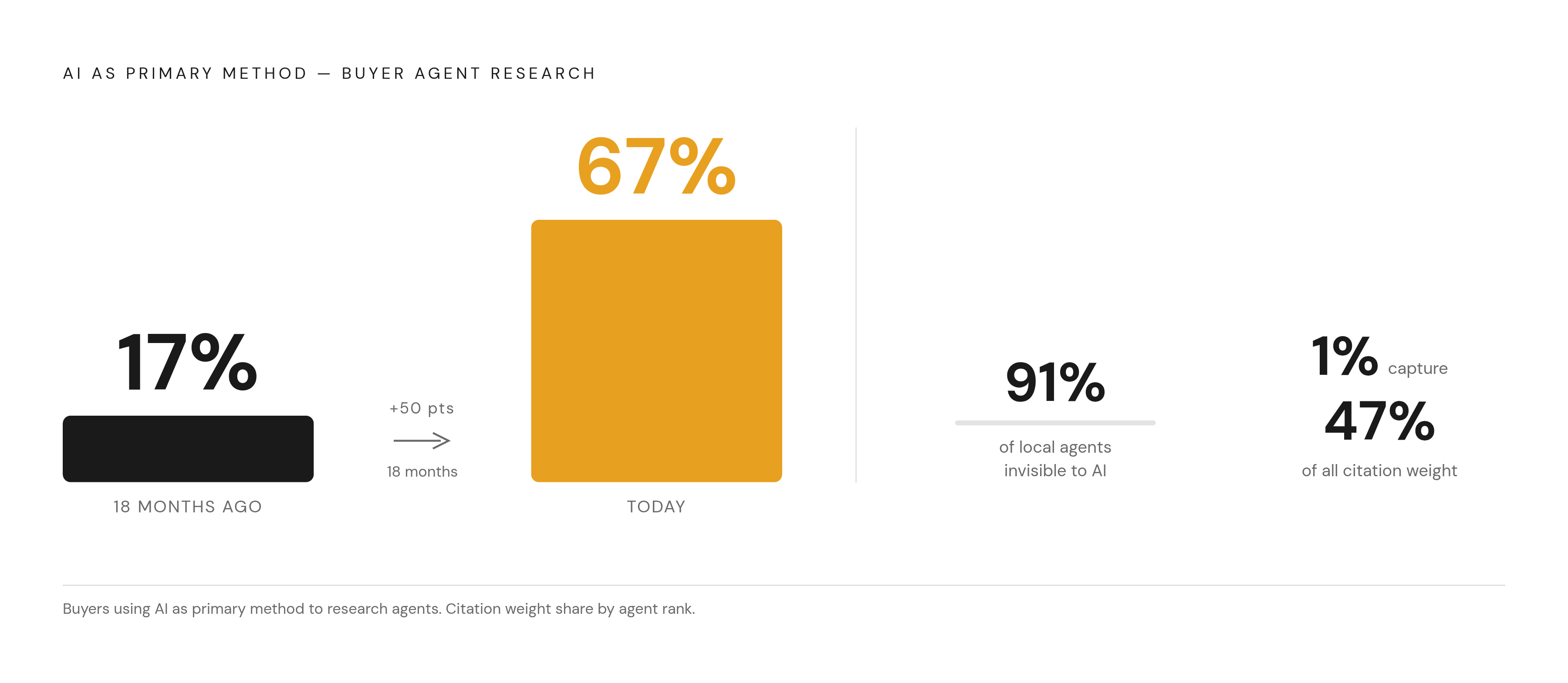
Buyers now find agents at a pace most agents haven't kept up with, and that gap is the real narrative here. A 2026 analysis synthesizing multiple sector surveys shows 67% among home buyers who rely on AI as their main method for researching agents, a sharp rise from only 17% eighteen months prior. It also revealed that 91% of local real estate agents don't show up when buyers use AI. Buyers' search habits shifted faster than the industry kept pace.
These mechanics driving the change are clear. Once Google shows an Overview, searches in 83% of cases stop there with no visit to any outside page. Within Google's dedicated AI Mode, the number climbs to 93%, while Mode itself passed one billion monthly users, according to Google's I/O 2026. AEO Engine reports that 58% of searches for property return AI-powered results today, a reality agents face right now even if they haven't adapted.
Visibility, when it shows up, seems brutally concentrated, since 47% of total citation weight goes to the highest-ranked 1% among agents. This gap in visibility is a straightforward problem, not just an inconvenience, since 70% of AI-sourced prospects sign deals inside 30 days. In Q4 2025, an analysis of 17.2 million citations showed 86% linked to brand-managed material, divided roughly evenly across first-party sites and online profiles. Structured details and controlled pages, rather than organic mentions, shape what those models show; each agent who keeps betting on organic mentions backs the bad approach.
People today check Google AI Overviews, ChatGPT, Claude, Gemini, Perplexity, Grok, YouTube, Apple Maps, Bing, Zillow, Realtor.com, and Homes.com. If it’s not set up for structured machine readability plus local trust signals, a company may lose visibility, though its traditional SEO metrics can still look fine in paper reports, which is exactly the trap: everything's fine, the old scoreboard says, while the other says no. But experts still handle the transaction itself. NAR's 2025 Profile covering Home Buyers and Sellers says 88% of buyers used an agent, as did 91% of sellers. Agents haven't gone anywhere. How buyers find them got rewritten without their noticing.
This approach is known as Generative Optimization for Engine, or Answer Engine Optimization: structuring material so AI-generated search tools quote it with citations, instead of sending clicks to a standard search listing. Running real estate firms in several markets makes this a cross-client and multi-surface problem rather than some one-time review. Platforms like Thrad were built for this, offering cumulative AI visibility analytics per client plus a way to show measurable reach in AI-mediated answers, not guessing.
The common thread: specific friction, not broad disruption
EliseAI focuses on communication automation. REACH for transaction workflows. Cotality and HouseCanary cover valuation. OpenSpace and Procore for coordinating job sites. Though their markets and tools vary, the approach is identical: every firm picked a single operational problem to master rather than working hard to reconstruct the whole real estate transaction.
This round of funding built that shape deliberately, drawn straight from what the previous crash made very clear. In 2021, proptech capital chased big change bets, including iBuying, marketplace disruption, and fractional ownership. That capital has mostly vanished, and so have the businesses it backed. What came next is more contained and, up to now, longer-lasting: startups that see real estate's fragmentation less as a wall in front of some big platform move and more as a guide to focused, ownable issues. No single firm had to solve all of it. It called for a handful of players, each tackling one problem well, and current funding is backing exactly that approach.