Proptech Investment Trends and Where Venture Capital Is Flowing
AI now determines which proptech startups attract capital and which ones don't.

Proptech venture capital reached $16.7 billion worldwide in 2025, a 67.9% year-over-year rise and funding surpassed pre-pandemic 2019 levels, according to CRETI. That figure isn't the point. What counts is that AI now acts as the check investors apply before any money moves, and that check determines which parts of the sector get backing and which get quietly ignored.
CRETI sums up the recovery in a single word: disciplined. That word matters, because this isn't 2021, when capital followed growth metrics first and checked fundamentals later. Large deals and debt or structured financings made up most of the 2025 dollar totals, while seed and Series A rounds stayed steady even as growth-stage valuations reset lower. Investors prioritized capital efficiency, customer retention, and real physical-asset economics over growth at any cost.
M&A followed the same pattern. Qubit Capital tracked about $2.3 billion in growth equity and debt financing across 55 M&A deals in early 2025, meaning consolidation and fresh capital arrived together. It isn't slowing down.
RET Ventures principal Aaron Ru says it straight: the money exists, but backers need to see a product people actually want and customers who stay. Matt Knight of the Foundation for Innovation in Real Estate is even more direct: beyond AI, investors aren't paying inflated prices anymore. Choose your side in this market. You either build on AI that genuinely does the job, or you fight over leftovers. Weak players have been weeded out, and capital is now being deployed with a sharpness it lacked three years ago.
Why AI became the primary filter investors use to allocate proptech capital
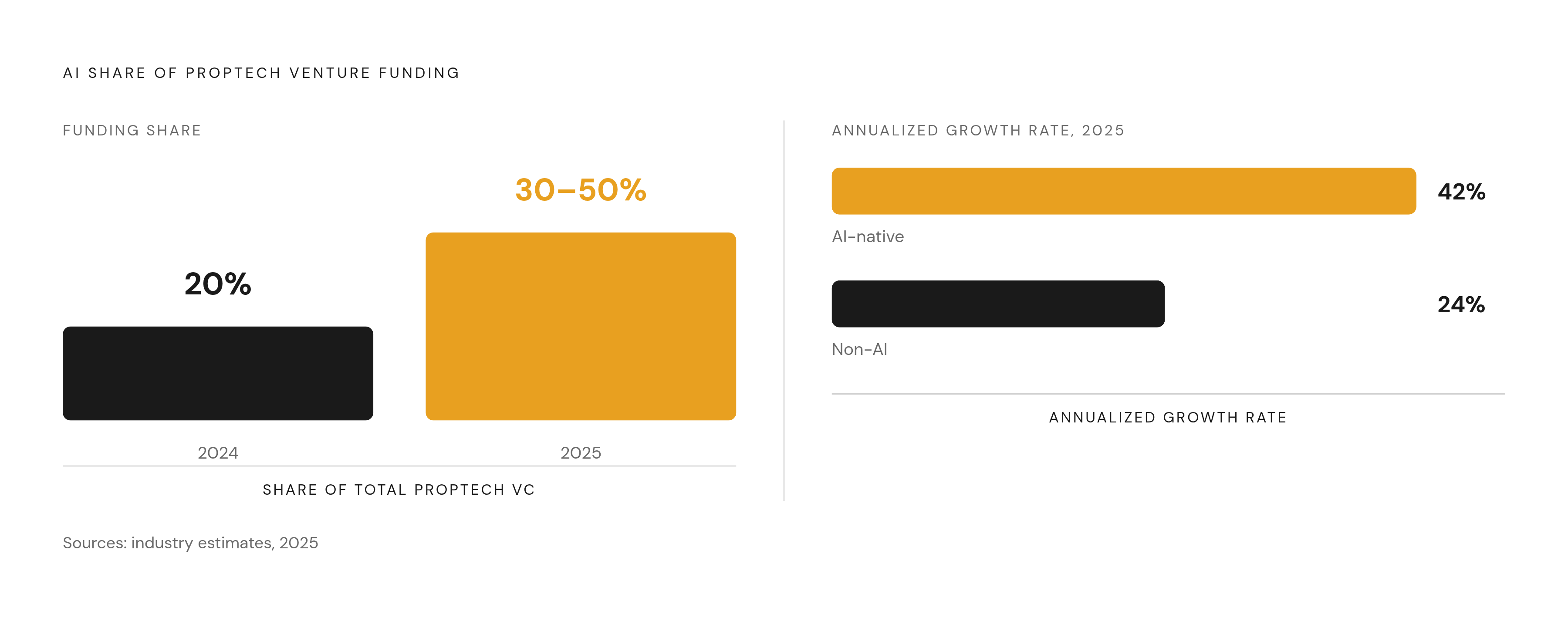
CRETI's finding is stark: AI is no longer one trend among many in commercial real estate venture capital, but the main guide for nearly every allocation decision. In 2024, AI startups took in about 20% of all proptech funding. By 2025 it had climbed to between 30% and 50%, CRETI estimates, according to Commercial Observer.
Growth numbers back the shift up. Proptech companies built around AI expanded at an annualized 42% in 2025, versus 24% for firms without AI. Investors don't see that difference as a short-term advantage. To them, that gap proves AI-native companies are a different category of infrastructure entirely, not an upgrade bolted onto what already existed.
Plenty of outsiders think every AI feature adds to that premium. Not in practice, and that's where the mainstream view of this market is wrong. Investors are backing recurring-revenue software and automation models, while last cycle's marketplace and transaction-fee structures have lost favor. Autonomous execution, where AI completes a task rather than helping a person with it, attracts the aggressive capital. Dashboards that use AI to show a person something they still have to act on face much tougher questions today. Investors want software doing the work, not describing it.
CRETI frames the resulting landscape as two-tiered. AI-native platforms that pair solid data pipelines with solid distribution pull in growth-stage capital pretty easily. Lookalike newcomers have trouble clearing seed. Ru puts it plainly: investors back AI tools rooted in solid data and tied to essential systems, not shallow apps that won't last. The shift away from surface-level AI is clear: buyers now set their own quality bar, with no regulator needed.
That filter appears where the money gathers. Property Management Systems got 60.4% of proptech funding, averaging $45.6 million per round but hitting a median of only $4.0 million. A few big winners lift the average as most companies raise smaller rounds. Leasing Technology accounted for 14.3% of deals and 7.6% of capital. Both fall right along AI's route, prompting the obvious follow-up: precisely where is this money going, subsector by subsector?
Where the money is actually going, the subsectors AI is reshaping fastest
Multifamily and property operations are hands-down the top AI entry point in the sector right now. Leasing bots, rent roll matching software, and delinquency platforms are growing faster than nearly anything else in proptech since they touch daily cash flow directly: payments, occupancy tracking, resident communication, reporting. That closeness is exactly why property management grabs the biggest slice of capital this cycle.
RXR Realty offers the clearest working example: it deployed Vero, an AI platform for fraud screening and leasing. RXR's delinquency rate dropped from 4.16% to 0.02% with Vero, per Qubit Capital. Investors want numbers like that now, not future-efficiency promises, but documented figures sitting inside a rent roll.
Construction tech takes a similar but separate path, focused on lowering risk instead of just streamlining operations. Developers and insurers are working harder to cut risk, so growth money is flowing into predictive analytics and jobsite safety tech. Finance and mortgage infrastructure form a third lane. Investors back AI-driven origination, underwriting, and servicing tools because they shorten cycle times and boost credit performance in directly measurable ways. Real estate fintech valuations at scale are now common, as seen in recent funding rounds once it actually works.
Insurability is becoming a top priority too. Insurers and lenders looking to price risk better are paying attention to underwriting tools that map climate exposure, maintenance history, and tenant risk. Office and retail are turning to space utilization tools, energy optimization software, and tenant-retention analytics, largely because traditional occupancy metrics face real pressure in both sectors. Capital is shifting toward multifamily and real estate fintech, with less emphasis on office and industrial providers.
AI-powered automated valuation models now hit a median error rate of about 2.8%, compared to a historical 10% to 15%. That's why AI underwriting looks like a defensible infrastructure buy, not a speculative bet: one tool helps investors underwrite decisions, the other feels optional. These categories aren't staying separate either. Leasing tech is merging with fintech, and fintech is merging with insurability underwriting.
Four new unicorns that show exactly what winning capital looks like right now
Since 2023, real estate AI startups have pulled in $13.8 billion over 585 deals, per Botmemo's analysis, minting four new unicorns in the past twelve months. Each puts a slightly different spin on what winning capital actually looks like.
In August 2025, EliseAI raised a $250 million Series E, valuing the company at $2.2 billion, over twice its worth from a year before. The company surpassed $100 million in annual recurring revenue and expanded its headcount from 300 employees. EliseAI makes AI tools for leasing and resident communication in multifamily housing and healthcare, and it's the most obvious case of AI woven into a core workflow at genuine scale.
Bedrock Robotics takes a quicker, riskier path. The company was founded in 2024 and raised $270 million in February 2026 at a $1.75 billion valuation, with CapitalG and Valor Atreides AI Fund co-leading and Xora, 8VC, Eclipse, Emergence Capital, and others joining. Former Waymo and Anki executives started Bedrock to make hardware and software kits that turn construction and worksite vehicles into self-driving machines. Becoming a unicorn in less than two years reveals how quickly investors commit when the core problem is huge and largely unsolved.
Juniper Square is arguably the most instructive of the four cases. The company raised $130 million in June 2025 at a $1.1 billion valuation from Ribbit Capital, Fifth Wall, Redpoint Ventures, and others. In October 2025 it launched an AI-driven CRM based on JunieAI, applying large language models to automate investor workflows, improve investor data, and reveal insights, connecting with email and calendar systems. Tishman Speyer, Greystar, and Beacon Capital Partners are among its clients. Juniper Square wasn't AI-native from the start. It became a unicorn by bringing real AI to a capital-markets platform that already worked, a harder and arguably more durable move than starting AI-native.
Vantaca rounds out the list with a $1.25 billion valuation in the narrow, unglamorous field of HOA management. Its takeaway is different from the other three. Even a niche community-association-management category can hit unicorn scale when AI is built into the product from the start instead of added later.
How AI is proving its ROI inside real estate operations, the evidence investors are reading
Backers want hard evidence today, not a sales pitch. Ru himself spells out the standard: immediate, measurable impact, deeply embedded in core workflows, sustainable NOI growth. Those three phrases function much like a checklist separating funded deals from polite passes.
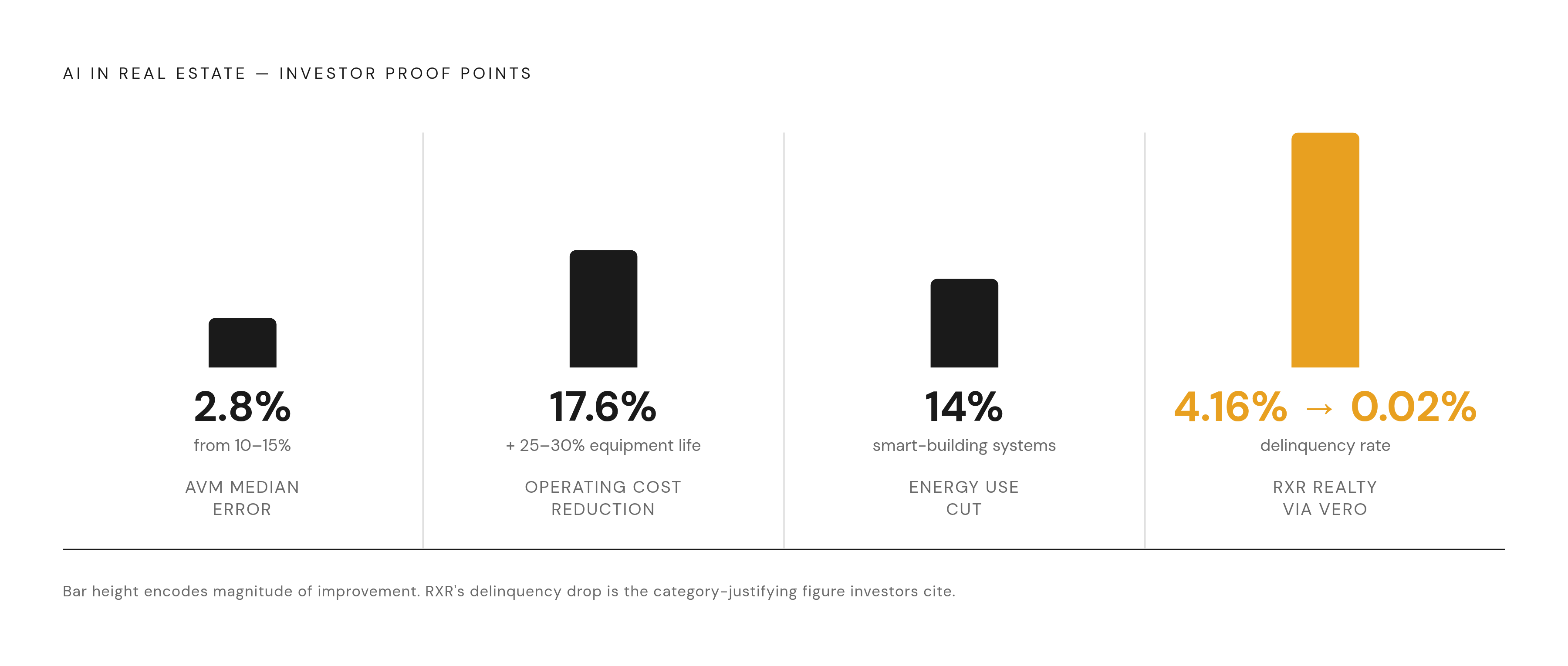
Skip the broad claim and look at the real numbers. AI-based automated valuation models now have a median error of roughly 2.8%, compared with 10% to 15% historically, making underwriting repeatable instead of near guesswork. Property managers squeezed on margins pay attention to these numbers: predictive maintenance tools lower operating costs by about 17.6% and keep equipment running 25% to 30% longer. Smart-building systems cut energy use by an average of 14%. With Vero, RXR Realty drove delinquency from 4.16% down to 0.02%, a result that nearly justifies backing the whole category on its own.
This whole thing isn't about AI as a feature anymore. Investors now want measurable NOI gains and lower costs, full stop, and the figures above are the proof they check before writing anything. The gap between AI that helps and AI that does the work keeps growing too. Tools that fully replace manual tasks, such as rent reconciliation, delinquency screening, or automated valuation, pull in larger checks than ones that only produce a report for someone to handle afterward.
Investors and operators increasingly view AI as necessary, with adoption still in early stages. Adoption has stopped being optional, and nobody in these conversations argues otherwise anymore.
Why proptech companies that aren't visible in AI-generated answers are losing before the sales conversation starts
Proptech buyers increasingly start research with a prompt, not a vendor's homepage. Queries such as "what's the best software for managing a multifamily portfolio" or "what tool helps reduce operational costs in CRE" now go to AI assistants first, per leading proptech AEO agencies. The result is decided before anyone on sales even makes a call.
Discovery now happens across Google AI Overviews, ChatGPT, Claude, Gemini, Perplexity, Grok, and a growing list of vertical platforms. A brand not made for machines to read and cite fades from view there, even when its traditional SEO looks good on paper. People call this generative engine optimization, or GEO: shaping your content and reputation so AI tools pick, quote, and show your brand in their responses. Here, visibility is a mention rate across many prompts rather than one ranking spot on a results page, yet most proptech marketers still treat that difference as an afterthought instead of the whole game.
The real opportunity sits in the gap between awareness and action. More than 92% of marketers report planning to or already optimizing for both traditional and AI-powered search. Right now, a minority are changing their SEO plans for AI search. That gap is a first-mover window, and it's closing fast.
A firm may land venture capital thanks to real AI integration yet still lose buyers who can't find it in the AI answers they're already checking. Agencies running proptech clients need a steady, real way to track and show visibility across AI surfaces, not a yearly content update that's quickly forgotten.
This does not remove the human side of the transaction. NAR's 2025 Profile of Home Buyers and Sellers reports that 88% of buyers and a large majority of sellers still work with an agent. Deals still get done through those relationships. But trust starts forming on the AI discovery path, well before that relationship begins.
What the VC filter and the AI discovery shift mean for proptech brands and their agency partners going forward
Proptech companies now face two filters at the same time, but most only notice one. The first is funding: investors choosing AI-native companies with measurable operational impact and defensible data, a pattern shown in every section above. The second is market: buyers who lean on AI assistants to find and size up products before speaking with any salesperson, a visibility layer that determines if a well-funded company truly reaches its customers.
A business might pass the first test but get rejected by the next. Calling AI visibility a marketing extra rather than the structural threat it really is, that's the error to name outright, and it gets riskier as buyer research moves further toward AI-first discovery. Even after raising $250 million, a startup can lose deals to a rival that just pops up more when buyers ask an AI assistant for suggestions.
Agencies running proptech brands face a similar shift, and those who adapt won't resemble the ones still sending out quarterly SEO reports. Clients now need to show up in AI-generated answers, not only rank well in search. Proving it means tracking mention rates across AI surfaces continuously and reporting them in language clients actually grasp, not filing away a one-time content audit and calling it done. Account teams must be trained to talk about AI visibility in concrete terms, since that missing know-how is precisely what divides the agencies leading this conversation from those lagging behind.
Thrad is designed for that operating reality: an AI visibility platform that enables agencies to launch, monitor, and demonstrate their clients' presence across AI surfaces at portfolio scale, with cumulative analytics running across every client an agency manages.
Sources
- PropTech Investment Trends & Funding Opportunities
- Proptech funding rose to $16.7B in 2025
- VC Is Back in Proptech and Picking Winners Based on AI Integration
- theaiconsultingnetwork.com
- These 4 Newest Proptech Unicorns Show AI's Increasing Role In Commercial Real Estate
- newmarketpitch.com
- botmemo.com
- aiforproptech.com