Property Management Industry Trends Reshaping Operations
Most property management firms plan growth they can't actually execute.

The property management industry hit $139.9 billion in the U.S. in 2026, spread across roughly 340,000 businesses, and almost everyone in that count is trying to grow while costs climb and margins get thinner (IBISWorld, 2026). That's a market big enough to pull in serious capital, but scattered enough that most firms are still running on infrastructure built for a smaller, slower version of this business. So where's the actual gap between ambition and execution, where is the money going, and who's actually closing that gap instead of just talking about it? This piece digs into exactly that.
Why the growth ambitions of most property management firms are outrunning their execution capacity
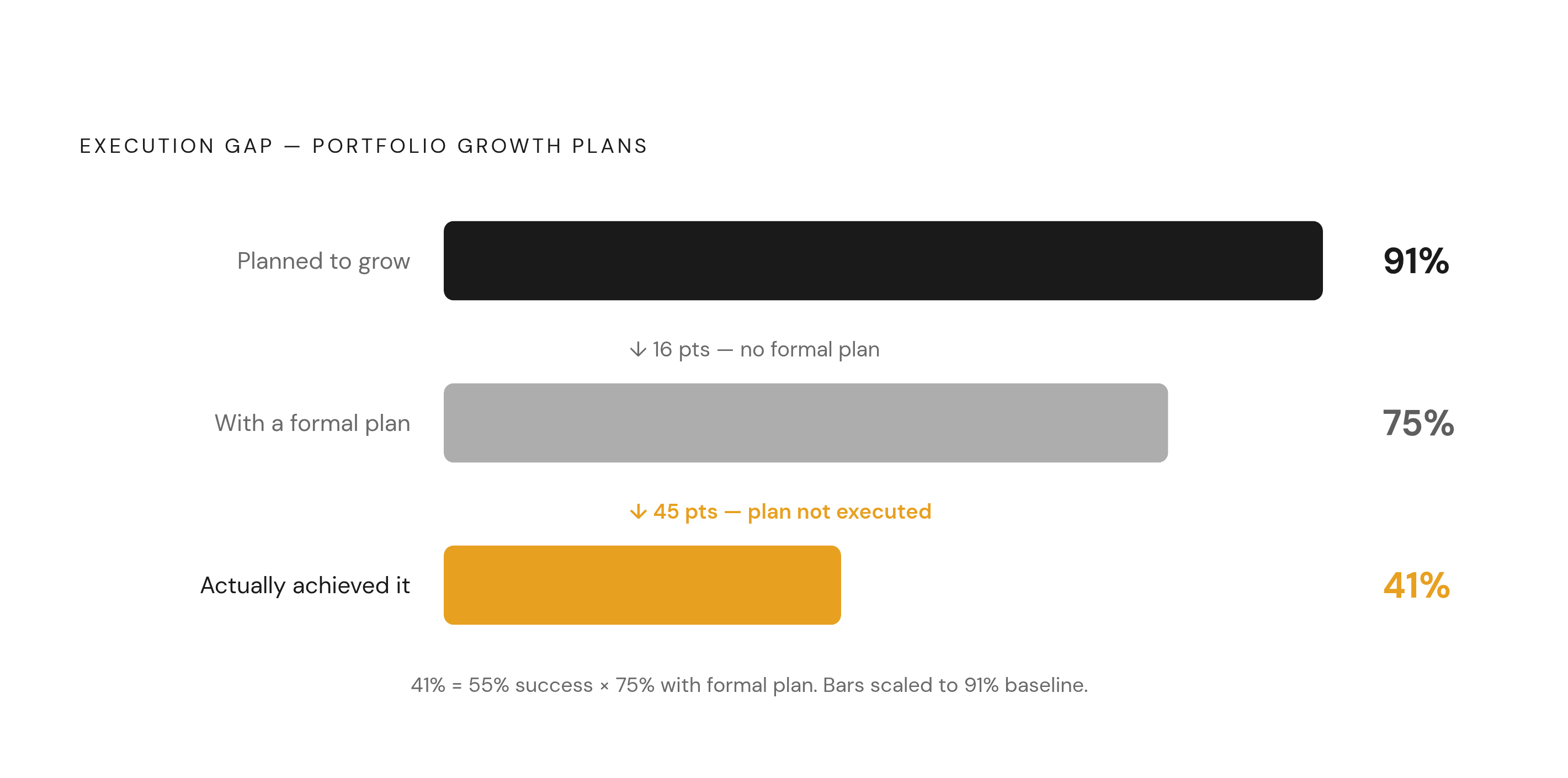
Ask any property management executive about their plans for 2025 and 2026 and you get the same one-word answer: grow. Buildium puts the number at 91% of third-party property management companies planning to expand their portfolios in that window. Everybody wants more doors, which, fine, sure, who doesn't.
Only 55% of the 75% of firms with a stated growth plan actually pulled it off last year, per Buildium's 2026 State of the Property Management Industry Report. Do that math and you get more than four in ten firms with a plan on paper that never showed up in the portfolio.
Part of this is just supply outrunning capacity. The U.S. added over 600,000 new apartment units in 2024, the most in decades, and that sounds great until you remember someone has to actually manage those units: turn them, lease them, answer the 2am pipe-burst call. Add in investors buying up nearly a third of single-family homes in the first half of 2025, and you've got a wave of scattered-site inventory that most firms never built the systems to run at scale. Commercial property management is growing even faster, north of 7% a year through 2033 by some projections, and that side of the business runs on longer lease cycles and compliance rules that look nothing like residential.
The deeper issue is capacity: firms are short on the ability to manage what they already said yes to without the service quality quietly falling apart behind the scenes. A company that adds 500 doors and then can't clear a maintenance ticket queue in a reasonable window is setting up next year's churn number. Everything else in this piece traces back to that one tension: whether growth sticks, or slides right back out the door six months later.
How quickly AI adoption moved from experiment to operational standard
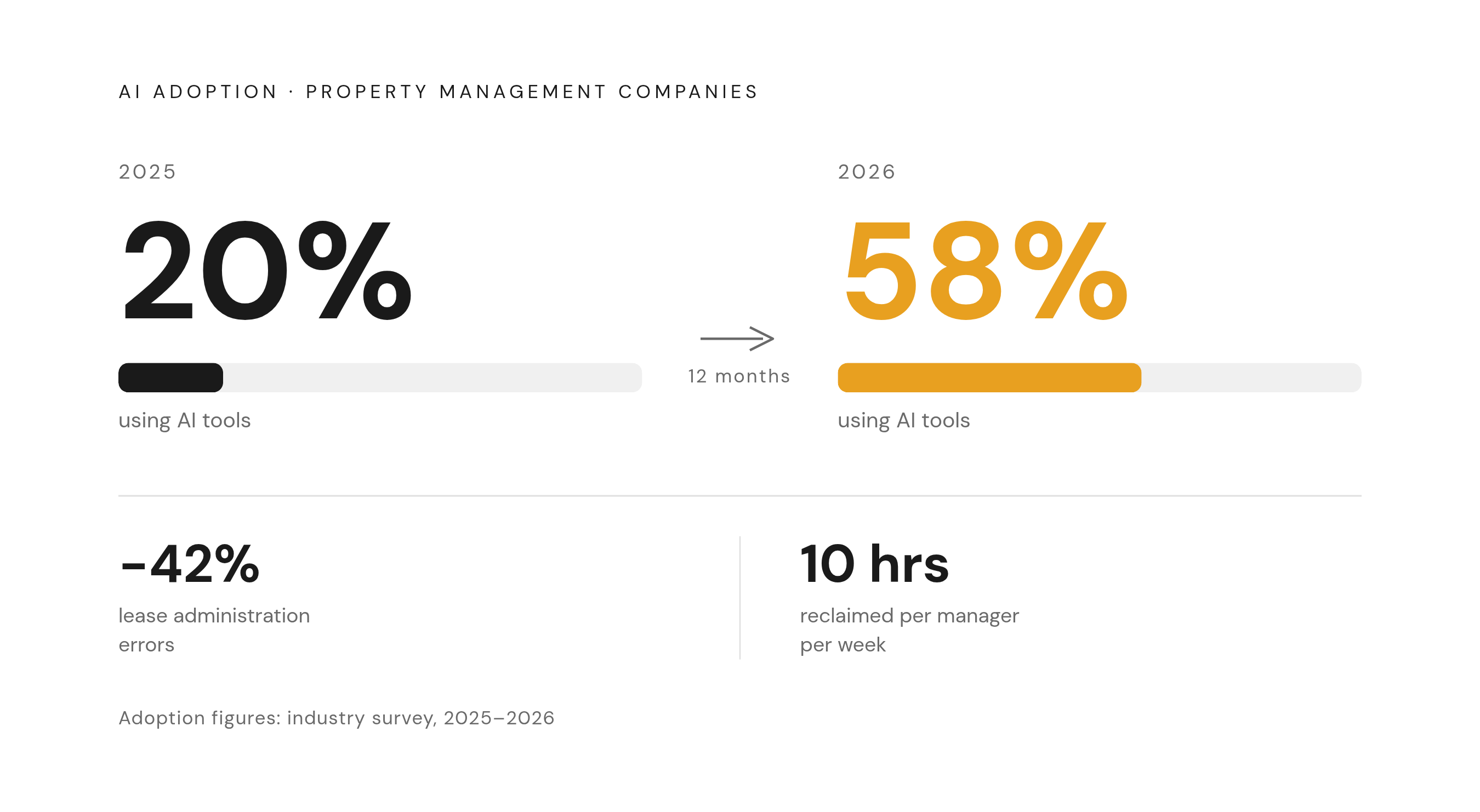
Here's the number that actually stops you: the share of property management companies using AI tools jumped from 20% to 58% in a single year, per Buildium's 2026 Industry Report. Tripling in twelve months isn't how this industry usually moves. Property management has historically been slow to change, the kind of business where "we've always done it this way" carries real weight in a room, and that instinct just got run over.
So where's it actually showing up, day to day, not in a slide deck? Messaging copilots now field the repetitive resident questions, the "when does rent post," the "how do I submit a maintenance request," volume that used to burn staff hours without needing much judgment at all. Maintenance forecasting tools try to flag a likely failure before it happens, so someone schedules a fix instead of taking the emergency call at 11pm on a Friday. Pricing tools pull in demand signals and adjust rents close to real time, instead of waiting for the old quarterly review. Valuation models have quietly gotten sharp too: automated valuation models now land median error rates around 2.8%, down from 10 to 15% just five years back. That's the gap between an educated guess and a number a manager can actually underwrite against.
The efficiency numbers hold up under this. Firms using AI report operational efficiency gains in the 20 to 30% range, some report lease administration error drops as high as 42%, and property managers are clawing back up to 10 hours a week. One multifamily operator that rolled out an AI leasing bot cut inquiry response times by more than half, and tenant satisfaction went up at the same time. Speed and quality usually trade off against each other; here, both moved in the same direction.
Half of property management professionals now name new tools, or getting more out of the ones they already own, as their top cost-cutting move. That connects straight to the margin problem later in this piece: AI has become the main lever left for controlling cost.
Adoption without a plan, though, is its own kind of mess. Many real estate firms increased tech spending after the pandemic, but a much smaller share had a formal technology strategy behind that spending. Buying five tools that don't talk to each other is just a pricier version of the chaos you started with.
Where the investment capital behind proptech is actually going, and what it signals about operational priorities
Investors poured substantial capital into proptech globally in 2025, with figures from multiple trackers showing a sharp year-over-year jump that pushed past pre-pandemic levels. A rebound gets you back to where you were before; this figure clears that bar and keeps accelerating.
Break down what kind of proptech is actually pulling that money, and the pattern gets sharp fast. AI-centered proptech companies attracted investment at a noticeably faster pace than non-AI proptech peers, with the gap between the two cohorts widening through 2025. Investors are sorting hard, and the non-AI half of the field is growing at roughly half speed while everyone watches.
Inside the broader proptech spending breakdown, property management software captured a significant slice of total investment, ahead of real estate marketplaces and newer categories like proptech fintech and smart building tech. That figure deserves a second look on its own: a fifth of all proptech money is going straight to the software running day-to-day management operations, ahead of flashier stuff like virtual staging or blockchain title records.
Two deals from the last year show what this money actually believes. Major acquisitions of AI-powered maintenance platforms in 2025 and 2026 carried valuations that looked more like high-growth software multiples than traditional services businesses. That's a software-company multiple slapped onto a maintenance tool, which tells you the market now prices operational AI the same way it prices any other high-growth software business with a clear return path. Separately, leasing automation platforms raised large funding rounds at valuations that reflected software-company pricing, a real shift from how services businesses in this space used to get priced. Leasing automation gets valued like software now, a real shift from how services businesses in this space used to get priced.
Nobody's slowing down, either. A large majority of real estate decision-makers worldwide plan to increase tech spending over the next several years. Sit this one out and you're not just missing a trend, you're watching the gap between you and your better-funded competitor widen every quarter you wait.
The cost structure squeezing margins even as portfolios grow
The bulk of every rent dollar collected already goes to operating costs, leaving a thin margin that doesn't survive a bad year, a wage bump, an insurance renewal, and a reserve fund all at once. Sit with that for a second: eleven cents of margin doesn't survive a bad year, a wage bump, an insurance renewal, and a reserve fund all at once.
Multifamily operating expenses have climbed steadily, and repairs and maintenance costs have risen sharply since 2021, a steady climb across labor, materials, and everything else it takes to keep a building standing.
Insurance is the sharpest edge in this whole picture. Landlord insurance premiums have surged dramatically in recent years, and a large majority of property management companies reported premium increases in 2025 alone. In coastal markets, or anywhere disaster risk runs high, insurance has stopped being a routine budget line and become the variable that decides whether a deal underwrites at all. The broader landlord picture backs this up: most rental property owners reported cost increases in recent years, with a notable share saying those increases were steep.
Rent, meanwhile, the entire revenue side of this equation, basically sat still. National median rents were essentially flat in late 2025, based on available market research. So firms chasing profitability in 2026 don't have a pricing lever to pull. Efficiency carries the weight now, because revenue growth isn't walking through the door to bail anyone out.
Occupancy anxiety is climbing right alongside all of it. A growing share of property managers in 2025 said they're worried about holding occupancy steady, up noticeably from the prior year. Cost pressure and occupancy pressure compounding at once is a rough combination, and there's no growing your way out of it. Efficiency and retention are the two levers left that actually move margin, and retention is where the next section goes.
Why tenant retention has become a financial metric rather than a service aspiration
Retention used to live in the "nice to have" column, something the leasing team fussed over while the CFO looked the other way. Multifamily retention rates have been declining in recent years, right when costs are climbing everywhere else at once. Bad timing, in other words.
Renter mobility is part of why. Recent renter surveys found a rising share of renters plan to move in the next 12 months compared to the year before. Fewer people are staying put, which shrinks the window an operator has to lock in a renewal before someone starts browsing listings on their phone during lunch.
There's a genuinely cheap fix sitting in the data, though. Research has found a meaningful share of renters say they'd be much more likely to renew if their community ran a rewards program. Weigh the cost of that against a full turnover: lost rent during the vacancy stretch, concessions and marketing spend to land a replacement, make-ready costs between leases, plus the admin load of re-screening a total stranger. In a flat-rent market, one turnover can erase months of net operating income on a single unit. The math changed here, not just the mood around it.
Resident experience programs, digital communication, faster maintenance turnaround, loyalty perks, have quietly stopped being amenity upgrades and started functioning as retention infrastructure. Money spent on resident-facing tech is, functionally, money spent buying renewals at a lower cost per renewal than chasing a new lease would run. Keeping someone has always been cheaper than convincing a stranger to sign; the only thing that's changed is operators are finally pricing it that way instead of just nodding along in theory.
Rental fraud as an operational and financial threat that most firms are still underestimating
Fraud isn't new here. What's new is how sharp it's gotten, and how fast that sharpness scaled across the industry. Rental fraud now covers synthetic identity fraud, fabricated income documents, deepfake-assisted applications, and listing scams that hit applicants and operators both. Rental fraud has become one of the fastest-growing categories of real estate fraud, with combined losses across landlords, managers, and renters running into the hundreds of millions a year.
Fraud gets into operations through a few specific doors, and it's worth naming them plainly. Application fraud looks like falsified pay stubs, fake employment verification, synthetic credit profiles built specifically to slide past a routine screen. The same AI tools helping property managers move faster are helping bad actors forge more convincing paperwork too, an uncomfortable symmetry nobody in this industry likes talking about out loud. Listing scams involve someone re-listing a real property at a below-market rent to collect deposits from applicants who never get an actual lease, and never see that money again. Occupancy fraud shows up as unauthorized subletting, often funneled through short-term rental platforms, creating liability and insurance exposure the property manager never agreed to carry.
The cost of one fraud case rarely ends at the fraud itself. Legal fees to remove a fraudulent occupant, lost rent during proceedings, unit damage, and reputational fallout if the scam touches other applicants in the same market, all of it stacks. Screening tech is catching up: identity verification, bank-direct income checks, AI-assisted document review. These are becoming standard at the better-run operations, but adoption is uneven across the industry, and the gap between firms that screen well and firms that don't is a real exposure gap, not a rounding error.
There's a data-security angle sitting right next to all this too. Property management firms hold a mountain of sensitive tenant financial and personal information, and a breach doesn't just trigger a regulatory headache; it wrecks resident trust at precisely the moment retention is the number that matters most. Fraud risk and retention risk aren't two separate conversations. They're the same conversation, just viewed from different angles.
What separates operators who absorb these pressures from those who get ahead of them
Cost pressure makes retention non-negotiable. Retention requires spending on resident experience. AI is what lets that spending scale without ballooning headcount. Fraud risk turns screening into part of the actual value an operator delivers, not a background compliance box to check. None of this sits in isolation, and that's really the whole point of walking through it section by section instead of as one big blur.
This loops back to the same pattern noted earlier: many real estate firms increased tech spending after the pandemic, but only a fraction had a formal strategy guiding where it went. The operators actually pulling ahead picked specific problems, slow leasing response, maintenance scheduling lag, pricing accuracy, and matched tools to those problems instead of buying broadly and hoping something sticks to the wall.
A few markers show up again and again among the operators doing this well. AI adoption tied to a named workflow bottleneck, not a vague "modernize the business" goal. Retention tracked as a financial KPI next to occupancy and NOI, with actual renewal-timing programs attached to it. Fraud screening run as an ongoing operational layer, not a one-time check at move-in. Communication systems, move-in guides, maintenance updates, community messaging, built to run at scale rather than handled ad hoc by whoever happens to be free that afternoon.
Ninety-four percent of property management companies expect revenue to grow over the next two years, which is a lot of optimism for one room to hold. The operators who actually see that growth land on their books will be the ones who matched ambition to infrastructure before the growth showed up, not the ones scrambling to build the plumbing after the doors were already signed.
Every trend in this piece points the same direction: more automation, tighter margins, harder-won retention, fraud that keeps getting more sophisticated by the quarter. What's still genuinely open, for any one firm reading this, is whether it's building ahead of that curve or just patching holes as they show up, one leak at a time.