Technology Trends in Commercial Real Estate for Asset Managers
AI tools are reshaping underwriting and portfolio analysis with measurable speed and accuracy gains.

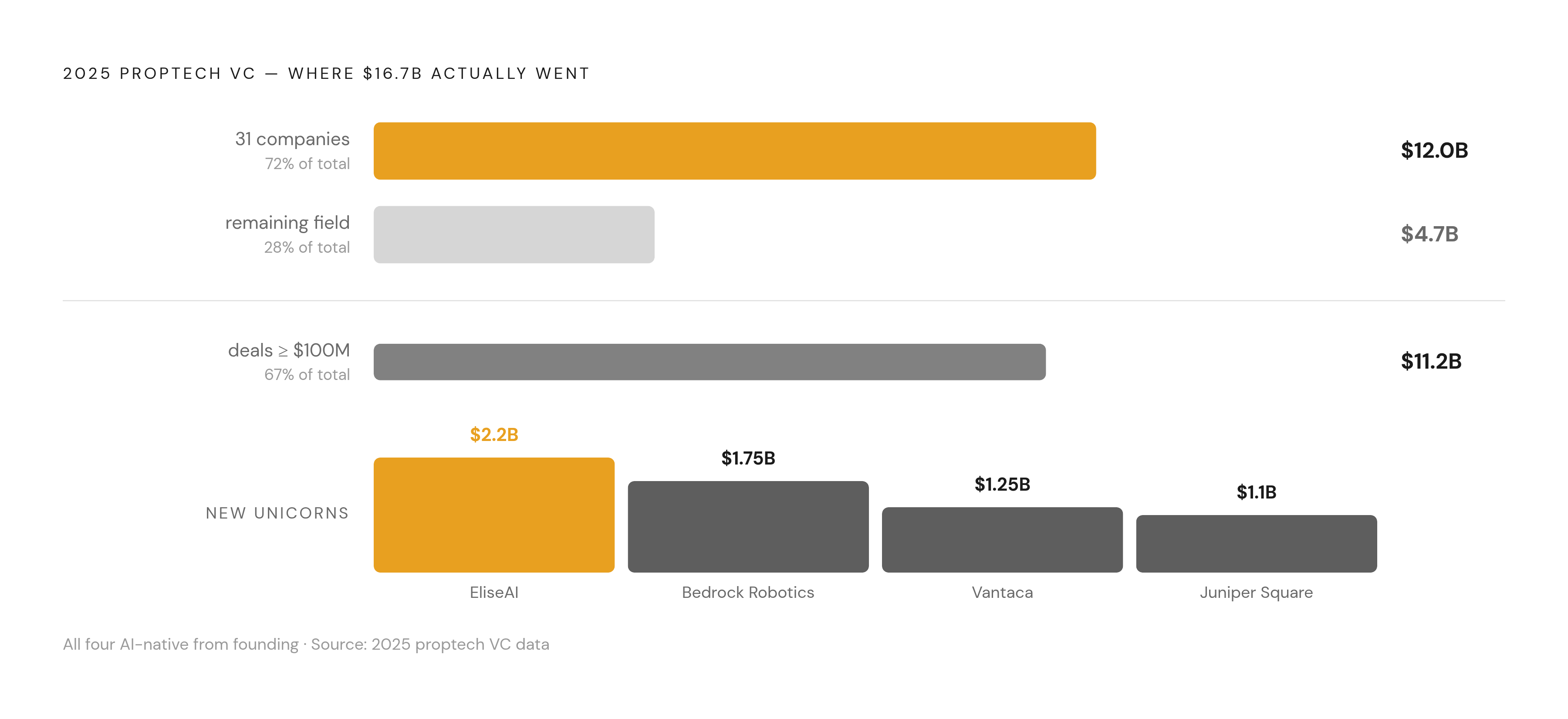
Proptech venture capital hit $16.7 billion in 2025, up 67.9% from the year before, blowing past the old record of $14 billion set back in 2019, per CRETI data. January 2026 alone pulled in roughly $1.7 billion, a 176% jump over January 2025. The headline number tells you almost nothing next to where the money actually landed, and this piece is about the shape of that capital.
For anyone running a portfolio instead of scrolling headlines, the mix matters more than the sum. AI-focused companies took $4.5 billion of the 2025 haul, and their slice grew 42% year over year, nearly double the growth rate of plain SaaS tools. Commercial Observer puts AI's overall share of proptech VC somewhere between 30% and 50% in 2025, up from roughly 20% the year before. Investors are pricing in outcomes they can already see on a spreadsheet.
Meanwhile the market is sorting itself into winners and everyone else, fast enough that mid-tier vendors should be nervous. More than $11.2 billion came from deals over $100 million, and just 31 companies took home over 72% of everything invested. Four new proptech unicorns showed up this cycle, per Bisnow: EliseAI at $2.2 billion, Bedrock Robotics at $1.75 billion, Vantaca at $1.25 billion, and Juniper Square at $1.1 billion. Every one of them built AI into the core from day one. For asset managers, that concentration is the real story hiding inside the funding numbers. Vendors without a genuine data advantage are going to have a hard time surviving the next funding round, and the field of "safe" platforms to bet on is smaller than the topline number suggests.
Where adoption actually stands (and why the gap between expectation and practice defines the moment)
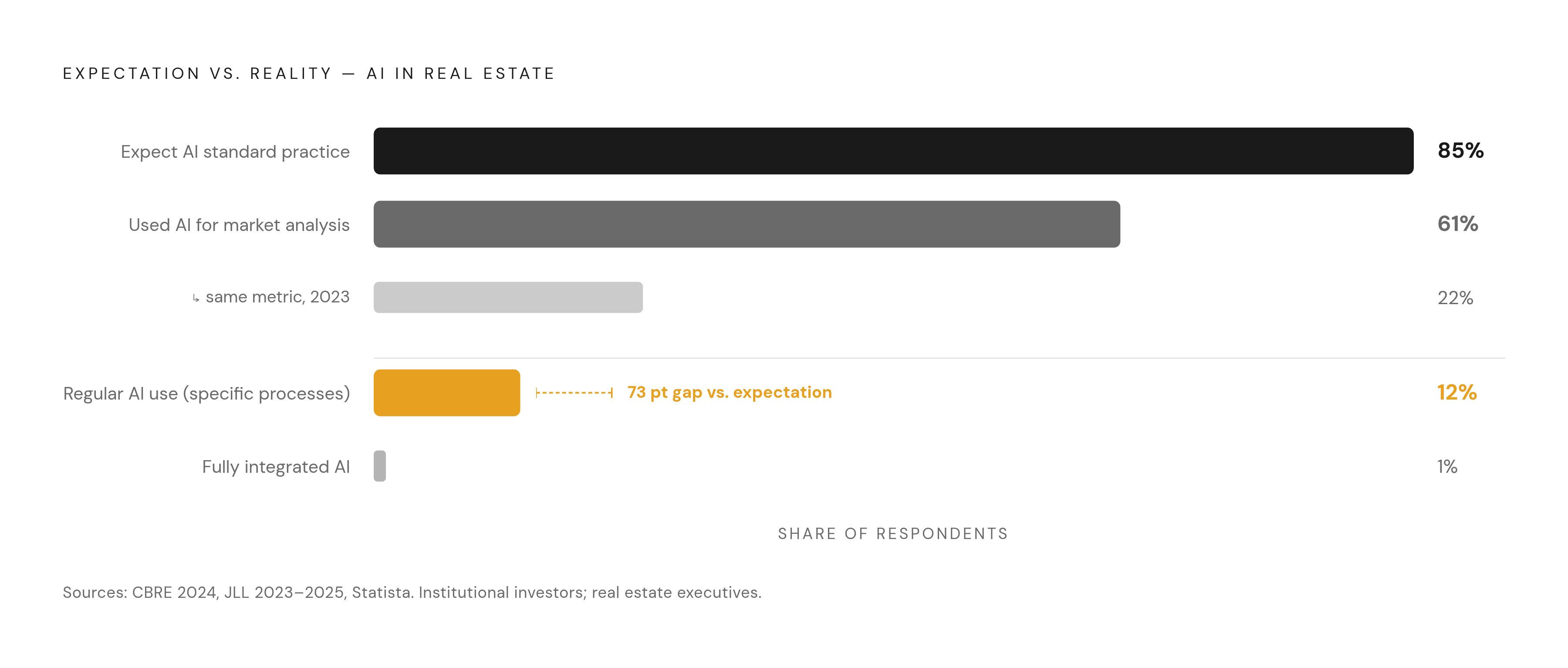
Start with the rosy number. JLL's 2025 Global Real Estate Technology Survey found 61% of institutional investors used AI for market analysis that year, up from 22% in 2023. CBRE's 2024 Global Investor Survey backs this up from another angle: 85% of institutional investors now expect AI tools to be standard practice in due diligence and asset management.
The ground floor looks different, almost stubbornly so. Statista found only 12% of real estate executives report regular AI use in specific processes, and just 1% say they've folded it fully into the organization. Deloitte's Commercial Real Estate Outlook 2024 piles on: 61% of real estate firms are still running on outdated technology. Set that against the 85% expectation figure and you get an odd picture: an industry that's made up its mind about the destination but hasn't packed a bag.
What explains the gap? Most firms have already run a pilot, testing the tool on one asset class, one region, writing an internal memo nobody reads twice. The failure shows up after that memo gets filed, because the tool never gets wired into the workflow where underwriters, asset managers, and portfolio teams actually do their jobs. It sits next to the process instead of inside it.
That gap is also a market of its own. ResearchAndMarkets sizes the AI-in-real-estate market at roughly $303 billion in 2025, projected to approach $989 billion by 2029 (a 34.4% compound annual growth rate). The infrastructure is still getting built even as adoption expectations have already settled around the idea that it's done. Asset managers who treat this as a vendor selection exercise, picking the right logo off a slide, stay stuck exactly where that 12% figure says they are. The firms making real headway treat it as workflow redesign, which is slower and a lot less exciting in a boardroom deck, but it's the thing that actually closes the gap.
Portfolio analytics and underwriting: where AI is delivering measurable speed gains
Underwriting is where the numbers stop being aspirational and start showing up in the P&L. V7 Labs research on banks using AI underwriting found time-to-decision dropped 50% to 75% for commercial loans. One CRE investment fund using AI tools cut acquisition cycles by 40% and got more consistent underwriting output out of it, which let the team chase more deals without adding headcount.
The underlying problem is simple enough to say out loud: CRE finance produces an enormous pile of documentation across origination, underwriting, closing, servicing, and asset management, and that information lives in silos, split across teams and systems that don't talk to each other. Every closed deal adds another file that sits unopened until something breaks. AI-driven automated valuation models have compressed median error down to roughly 2.8%, a sharp drop from the historical 10% to 15% range. That changes how fast a manager can price risk with any real confidence.
The real estate investment software market itself was valued at $5.6 billion in 2025 and is projected to reach $9.8 billion by 2030, per Mordor Intelligence. Deal-cycle tooling is a crowded, growing category, and the real question for asset managers is what to adopt: a standalone dashboard, or a platform that connects underwriting data to servicing data to asset management data. The firms closing the gap fastest picked the platform. Faster underwriting without a consistent framework behind it just produces bad decisions more quickly than before, which is not the win it sounds like on a sales call.
Predictive maintenance and smart buildings as a NOI lever, not just an operational upgrade
Industry research found 40% of CRE firms already using AI for predictive maintenance or tenant engagement, with another 30% planning to roll it out by 2025 per McKinsey. Early adopters report repair costs down as much as 25%, per McKinsey, and maintenance downtime cut by nearly half. Separate industry analysis puts the operating expense reduction from predictive maintenance at roughly 17.6%, with equipment life stretched 25% to 30% longer. These numbers flow straight into net operating income, and NOI happens to be the line every LP reads first, before the footnotes, before the narrative slide, before anything else.
The global smart building market, valued at $139.43 billion in 2025 and projected to hit $309.58 billion by 2030 per Mordor Intelligence, is carried largely by the commercial segment, which accounts for a substantial share of the current market. A growing share of U.S. commercial real estate portfolios have already committed to smart building upgrades, and retrofit projects increasingly include IoT sensor networks and connected building management systems. That's the plumbing that makes any of this work in the first place; skip it, and the rest of the pitch falls apart.
Digital twins deserve a specific mention here. IoT and sensor data now support 3D digital models of a property that can simulate performance under different environmental conditions and help plan operations or emergency response, built from continuous sensor feeds rather than a once-a-year inspection report somebody skims and files away. Integrated building control platforms have documented meaningful energy savings, a decent reference point for what connected systems can deliver once they're installed correctly and left alone to do their job.
Asset managers pitching this to LPs should lead with NOI. The operating expense case is documented well enough now that it doesn't need extra dressing.
ESG reporting requirements are pulling technology adoption faster than strategy is pushing it
Here's a number worth sitting with: ESG risks are now considered critical to investment decisions by a large share of investors, and that's mainstream due diligence now, the kind of line that shows up on every term sheet review. Buildings account for a substantial share of global carbon emissions, which makes the built environment one of the biggest single targets for regulators and institutional investors alike.
Regulation is doing most of the pushing here. The EU's Corporate Sustainability Reporting Directive and California's climate disclosure laws now require continuous, granular energy and emissions reporting, exactly the kind of data IoT-connected buildings generate as a matter of course, and that spreadsheet-managed portfolios struggle to produce on demand. Green certifications like LEED, WELL, ENERGY STAR, and Fitwel have shifted from differentiator to baseline expectation among tenants and LPs. Technology is the layer that keeps those certifications alive at scale, a running commitment rather than a one-time filing that quietly expires three years later.
The practical implication is blunt. Managers without connected data infrastructure face a reporting burden that gets heavier with every new disclosure rule, plus a credibility problem with institutional LPs who increasingly treat ESG data quality as a stand-in for operational rigor generally. If the ESG numbers look sloppy, the assumption is everything else does too, fair or not.
Worth noting: ESG tech runs through the same IoT sensors, building management systems, and portfolio analytics infrastructure covered in the two sections above it. Managers building that infrastructure for NOI reasons get ESG compliance almost for free. Managers who build it only to check a disclosure box tend to end up with something narrower, and a lot less useful a year or two down the road.
How the largest managers are moving from buying proptech to building it
Brookfield committed $500 million to OpenAI's enterprise deployment, and Blackstone partnered with Anthropic to build custom AI-native enterprise services. Both bets aim at the same target: proprietary portfolio intelligence, turning internal data that already exists into a competitive asset no vendor product can replicate, because the vendor simply doesn't have that data sitting in its warehouse.
Blackstone, a $1.35 trillion alternative asset manager, is building AI internally specifically to put its own data to work. The asset was always the data sitting in their systems, and the AI is just what finally unlocks it.
This move toward internal build need not shrink the proptech vendor ecosystem — analogies to other sectors suggest internal enterprise software teams have historically grown the surrounding vendor landscape instead of replacing it. Read that as a sign of a market growing up, a maturing landscape rather than one consolidating into a monopoly.
So what does that mean for a manager who isn't running a trillion-dollar balance sheet? Proprietary AI isn't the realistic path for most of the industry, and it doesn't need to be. The competitive floor now is a third-party platform with real depth of data integration and workflow specificity, a step up from a shallow point solution that does one thing passably and calls it a day. Industry analysis now treats AI and data infrastructure as a primary driver of competitive position, ahead of the support-function label it used to wear. Generative AI and multi-agent workflows are already handling market analysis, lease processing, forecasting, and pieces of the decision chain. The vendor landscape is consolidating, as the funding concentration numbers from the opening section make plain, so the platforms worth evaluating are the ones with durable data moats and real integration depth.
Data centers as the asset class where CRE and AI infrastructure converge
Data centers are where commercial real estate and AI infrastructure converge into a single conversation. Primary market data center supply surged to record levels measured in megawatts in the first half of 2026. Primary market vacancy fell to record lows over the same stretch, and new capacity gets absorbed almost as fast as it's built, unusual for any real estate asset class to sustain for long. Data centers carry a power dependency most commercial asset classes never have to think about.
Net absorption across primary markets rose sharply year over year in the same period, driven by hyperscale and AI occupiers competing for a limited supply of contiguous power blocks. That's the actual physical ceiling on how fast this sector can grow: building capacity means little without the power to run it. Average rental rates for mid-size deployments climbed meaningfully in the first half of 2026, a supply-demand imbalance sharp enough to pull institutional capital in at scale.
The demand side rests on committed capital, not speculation. Major hyperscalers committed substantial capital expenditure in 2025 and have signaled continued aggressive spending into 2026. Blackstone has made high-profile moves into data center investment, about as loud a signal as institutional capital gives that this asset class has arrived and isn't packing up anytime soon.
The underwriting here looks nothing like a standard office or multifamily deal: power infrastructure, hyperscale lease structures, technical specifications, location constraints tied to grid capacity instead of foot traffic. That complexity is exactly where AI-assisted due diligence tools earn their keep, since the volume and technicality of the work outpaces what a manual process can chew through in any reasonable time. Managers who've already built AI-integrated portfolio analytics for their existing asset classes are simply better positioned to move on data center deals than those still running everything by hand. The tooling built for one purpose ends up transferring to the next, which is usually how infrastructure works.
What asset managers should actually do with all of this
Some capabilities have moved from pilot to production faster than others. Predictive maintenance has documented NOI impact, AI-assisted underwriting has real speed and consistency gains behind it, and portfolio-level valuation modeling has an error rate low enough now to act on with confidence. Fully integrated multi-agent workflows, generative AI for lease and document processing at real scale, and digital twin operations across large portfolios are still maturing. They're works in progress, and treating them as finished is how a firm ends up disappointed around month six, wondering why the tool that demoed so well isn't actually saving anyone time.
Where should a manager start? With the workflows where the data already exists: underwriting files, maintenance logs, energy consumption records. AI works on data a firm already has sitting around, rather than data it wishes it had. Treat ESG compliance as the forcing function for building connected data infrastructure in the first place, since the same sensors and systems that satisfy a disclosure requirement also feed predictive analytics on the operations side.
Evaluate platforms rather than point tools. The funding concentration among a small number of scaled vendors with genuine data moats tells you where the durable value actually sits, and a patchwork of five single-purpose tools just creates integration debt somebody has to pay down later, usually at the worst possible moment. Favor platforms that pair strategy-first workflow design with AI output grounded in real portfolio context. That's where speed and quality stop trading off against each other.
The gap flagged at the start of this piece (85% of institutional investors expecting AI as standard practice against just 12% using it regularly) isn't going to hold still forever. Gaps like that tend to close quietly, without a press release, and by the time everyone notices, whoever moved first has already banked the head start.
Every serious manager already knows it needs AI-powered tools; that part isn't in dispute anymore. What actually separates the firms pulling ahead is whether the tools they picked talk to each other, connect to the portfolio's real data, and plug into the decisions that actually move returns.