Proptech Examples Across Residential, Commercial, and Industrial
Three distinct proptech sectors—residential, commercial, industrial—share little beyond a name.

Proptech is one word doing the work of three separate jobs: finding an apartment, running a hundred-story office tower, and routing a pallet through a distribution center all fall under it, even though the software involved has almost nothing in common. The category is worth USD 47.08 billion globally as of 2025, according to Precedence Research, headed toward USD 185.31 billion by 2034. That kind of curve is why pension funds and private equity shops keep writing checks into it.
More than 9,000 proptech firms operate worldwide, and a field that crowded can't be understood as one thing. Residential tools chase consumers by the millions. Commercial tools chase enterprise budgets in the six and seven figures. Industrial tools chase throughput numbers that make a warehouse manager weep or cheer depending on which direction they're moving. Most coverage treats proptech as one industry with one trajectory. The honest read is that it's three industries wearing the same name tag, and knowing which one a tool was built for is the whole ballgame. The feature that delights a homebuyer is dead weight to a logistics VP staring down a conveyor outage.
What residential proptech actually covers, from search to ownership
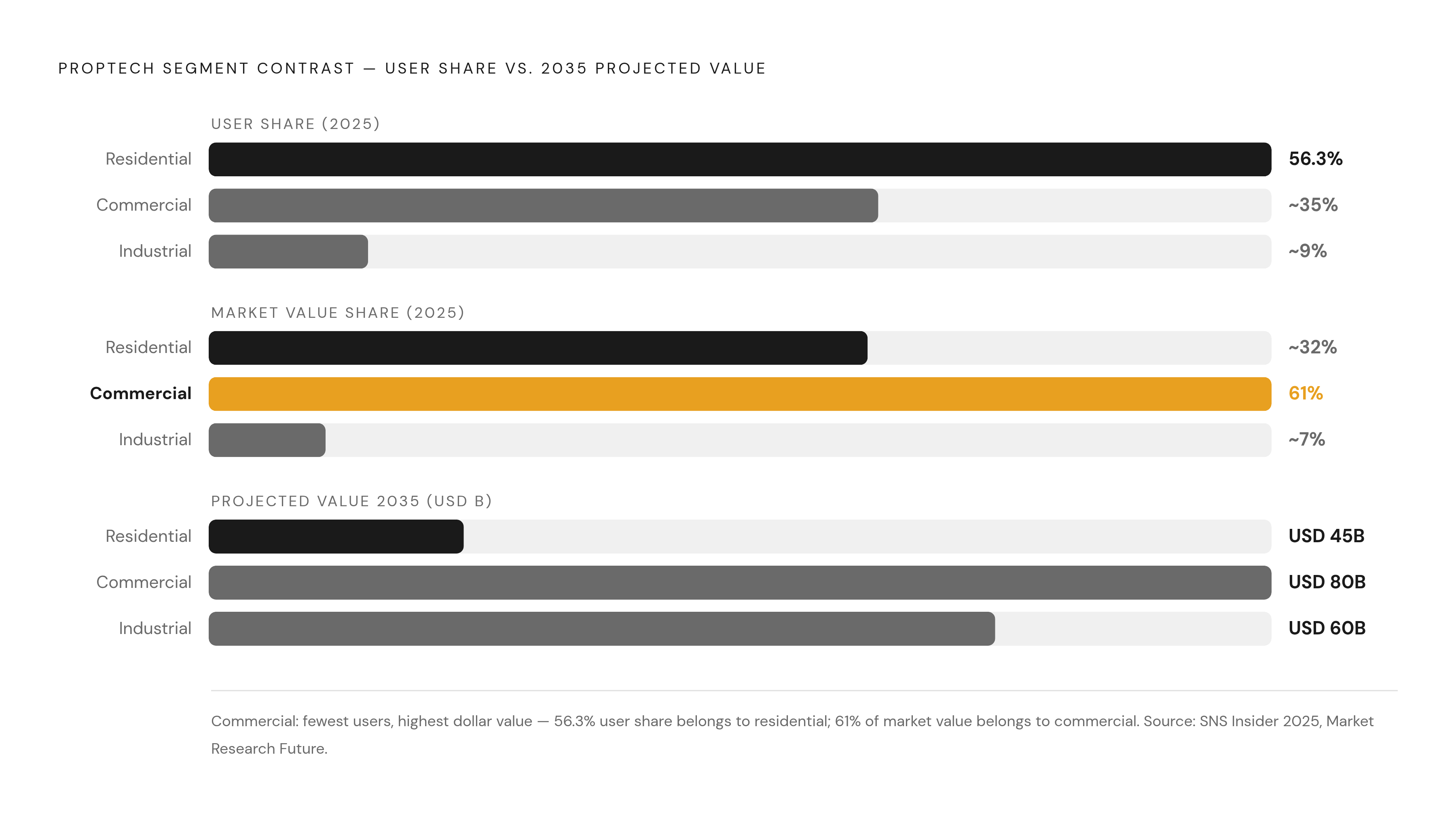
Residential holds the largest share of the proptech market, 56.3% in 2025 according to Grand View Research. The reason is simple arithmetic: everyone needs somewhere to live, so buyers, renters, owners, and small-time investors all show up as users. That's a bigger pool than corporate real estate teams shopping for office space, which is why residential gets treated as the "default" version of proptech in most coverage. Default implies simple, and residential is anything but.
Underneath that umbrella sit four distinct jobs. There's finding a property, which is search and discovery. There's transacting on it: offers, mortgages, closing paperwork. There's living in it: smart home tech and day-to-day upkeep. And there's investing in it without moving in, through fractional ownership or crowdfunding.
A buyer scrolling Zillow on a Tuesday night and a landlord logging into AppFolio the next morning are technically in the same sector. They are not touching the same stack; one is shopping, the other is running a business. That distinction matters more than the market-share numbers suggest, because professionals actually dominate residential proptech's usage even though consumers get the attention. Property managers and agents held a 42% share of the end-user base in 2025, per Precedence Research. Even in the most consumer-facing corner of the industry, the pros outnumber the amateurs at the terminal.
How search and discovery platforms changed residential buying and renting
Zillow, Redfin, and Trulia arrived in the mid-2000s and did something print classifieds never could: put every listing, every price estimate, and every neighborhood data point in one browser tab. That was the entire pitch, and it gutted the newspaper real estate section within a decade.
The next wave is conversational. Instead of checking boxes for three bedrooms and a two-car garage, buyers type things like "three-bedroom within 30 minutes of work, near good schools, with a garden" and let AI-powered search parse the request. Zillow, Homes.com, and Entrata all rolled out major AI search products in early 2026, which tells you the entire first-generation portal layer is upgrading at once. None of them can afford to be the one still running keyword filters while a competitor understands full sentences.
Zillow's Q1 2026 numbers back up the shift: revenue up 18% year-over-year, rentals up 42%, mortgages up 56%. Growth across all three lines at once suggests the moat isn't search traffic anymore. It's how many parts of the home-buying journey one platform can own end to end.
Not every experiment panned out, and here's where most people get the lesson backward. iBuying promised that an algorithm could just buy a house on the spot and flip it, and it ran straight into the limits of automating a transaction that fast and that personal. Zillow shut down Zillow Offers in 2021. Opendoor and Offerpad are still around, but the category remains fragile as of 2026. Discovery turned out to be the easy problem; transaction automation is still the hard one. Anyone pitching an "AI that buys your house" product in 2026 should have to explain why Zillow, sitting on more listing data than anyone alive, walked away from exactly that.
Residential tools that work after the search is over: virtual tours, smart home, and property management
Once someone finds a listing they like, the next question is whether they need to drive across town to see it. Increasingly, no. Matterport, iStaging, and RoOomy generate 360-degree walkthroughs from a smartphone, and Zillow and Redfin now embed those Matterport tours directly into listings. RoOomy pushes further with virtual staging, digitally furnishing an empty room so a buyer can picture a couch where there's currently just carpet. Fewer wasted showings for agents, fewer wasted Saturdays for buyers.
Inside the home, the layer that actually runs the place belongs to the scale players: Alphabet's Nest, Samsung's SmartThings, and Amazon's Alexa handle lighting, temperature, and access control. None of this is new anymore. It's the baseline expectation rather than the novelty, worth noting since "smart home" still gets marketed like it's cutting edge.
Behind the scenes, property management software does the unglamorous work, and this is the part of residential proptech that actually deserves the spotlight it doesn't get. AppFolio, Yardi, and Buildium handle rent collection, maintenance tickets, and lease renewals, the systems that keep a rental portfolio from turning into a spreadsheet nightmare. AppFolio has posted strong revenue growth, making it one of the faster-growing players anywhere in the residential stack. That's the real money in residential proptech: operations, a quieter layer than the search business that gets all the press.
There's a newer category bridging search and investing, too: AI investment assistants, like Alma from DealMachine, built on OpenAI's models, which surface rental income estimates, repair cost projections, and owner outreach for people buying investment property rather than a home to live in. It's the analyst function, automated and handed to anyone with a laptop and a login.
Fractional ownership and digital mortgages: how residential proptech is democratizing access to real estate
Real estate used to require a mortgage or a fortune. Crowdfunding platforms split the difference. Fundrise manages billions of dollars of equity for investors as of 2025. RealtyMogul serves both accredited and non-accredited investors across a range of real estate deals. CrowdStreet skews toward larger commercial deals, a reminder that these platforms don't respect the tidy residential-versus-commercial line this piece otherwise draws.
On the financing side, digital mortgage platforms have compressed closing timelines significantly, using automated verification and e-signatures instead of a loan officer processing paperwork by hand.
Put those two threads together and residential proptech's job gets bigger than helping someone find a house. It's making the house itself a more liquid asset, one a renter with a few hundred dollars can own a slice of, instead of a monolithic thing bought outright or not touched at all. That's a genuine shift in what "owning property" even means, and it's easy to miss because none of it looks dramatic from the outside.
Commercial proptech's different starting point: data and market intelligence first
Flip to commercial real estate and the shape of the problem changes entirely. Office leases, retail site selection, and mixed-use development involve fewer transactions, bigger dollar amounts, and cycles measured in years rather than weekends. Nobody's scrolling a CRE app on a lunch break the way they browse home listings. The information problem here is analytical, not search-and-match.
CoStar and LoopNet built the foundational data layer for that world: inventory, comps, and market trends aggregated at a scale no individual broker could replicate alone. CoStar has continued posting strong revenue growth, which says demand for CRE data infrastructure keeps climbing even when deal volume itself wobbles.
SNS Insider attributes 61% of the 2025 proptech market to commercial, a figure that looks odd next to residential's larger user base until it clicks: enterprise CRE software commands far higher contract values, even with fewer deals closing. The segment is projected to grow from USD 15.0 billion to USD 80.0 billion by 2035, according to Market Research Future, riding digitalization spreading across offices, retail, warehouses, and mixed-use developments alike.
Commercial proptech buyers are almost always professionals: brokers, asset managers, corporate real estate teams. So the tools get built for workflow integration rather than consumer simplicity. Nobody's optimizing a CoStar dashboard for a first-time user experience; they're optimizing it for someone who's logged in eight hours a day for a decade.
How commercial buildings are being managed differently: occupancy analytics, smart offices, and lease tech
Since 2020, one question has haunted every office landlord: how much space does anyone actually need anymore? Occupancy analytics and IoT sensors answer that by tracking real-time desk usage, heat-mapping foot traffic in retail corridors, and feeding data into decisions about lease renewals and space reconfiguration. Hybrid work turned this from a nice-to-have into something close to a core requirement for landlords deciding which floors to keep leasing and which to convert.
Smart building platforms tie HVAC, lighting, access control, and energy management into one dashboard, cutting operating costs while generating the sustainability reporting institutional tenants now expect as a checkbox item. On the paperwork side, lease management platforms digitize the entire CRE lease lifecycle: abstracting clauses, tracking renewal dates, managing hundreds of leases across a portfolio without someone combing through PDFs by hand. CBRE, JLL, and large corporate tenants rely on this layer to keep from losing track of a lease buried in a filing cabinet somewhere.
AI shows up here too, in predictive maintenance that flags a failing chiller before it fails, in automated lease abstraction, in scenario modeling for portfolio optimization. The logic underneath all of it is blunt: shaving a meaningful percentage off operating costs across a large portfolio is worth vastly more than a prettier search interface. Commercial proptech gets measured in basis points and square-foot efficiency, not app store star ratings, and any vendor pitching a slicker UI as the main selling point is pitching to the wrong buyer.
Industrial proptech's distinct logic: where real estate meets supply chain
Warehouses don't get graded on curb appeal. An industrial facility, whether it's a distribution center, a fulfillment hub, or a cold storage plant, gets measured in throughput, pick rates, and dwell time, metrics that would sound alien to a residential agent or an office landlord.
The forcing function is e-commerce and supply chain pressure. A warehouse functions less like a building and more like a node in a logistics network, and the proptech serving it has to keep pace with that network's speed requirements rather than a lease cycle. That's why industrial proptech is projected to grow from tens of billions to nearly sixty billion dollars by 2035 per Market Research Future, the fastest-growing proptech segment in absolute terms.
Here's the number that matters most to a retailer: a distribution center's location, layout, and automation level directly sets the cost of last-mile delivery. Proptech that improves any of those variables shows up on the P&L almost immediately, not eventually. That's also why industrial proptech vendors increasingly sound like supply chain software companies rather than real estate tech firms. The buyer on the other end of the sales call is as likely to hold a logistics title as a real estate one, and pitching them on "property technology" language is a good way to lose the room.
The specific tools reshaping industrial facilities, from site selection to warehouse automation
Before a single pallet moves, there's the question of where to put the building at all. AI-driven site selection tools model transportation costs, labor availability, proximity to population centers, and zoning constraints to find the best warehouse location, work that logistics companies and large retailers use to rationalize sprawling multi-facility networks instead of guessing.
Once the building exists, Warehouse Management Systems become the operational nervous system: orchestrating inventory location, picking routes, inbound receiving, outbound shipping. Modern WMS platforms plug directly into robotics, directing autonomous mobile robots and goods-to-person systems around the floor with constant, precise coordination.
IoT sensor networks fill in the rest. Real-time inventory visibility means knowing exactly where a pallet sits without a human walking the aisles with a scanner. Environmental monitoring keeps cold storage and pharmaceutical warehouses within temperature and humidity thresholds, flagging problems before a shipment spoils. Asset tracking follows forklifts, equipment, and returnable containers so nothing quietly disappears into a corner of a million-square-foot building.
Digital twin technology takes this further: a virtual replica of the warehouse lets operators test layout changes, staffing models, or new automation before touching anything physical. Predictive maintenance platforms flag equipment degradation before failure, which matters enormously when one dead conveyor belt can stall the entire operation. And here's the distinction that separates this sector from commercial real estate entirely: in an industrial building, it's often the tenant deploying the technology, not the landlord. Proptech here lives right at the seam between real estate and operations, and it's not always obvious which side of that seam a given tool belongs to.
The cross-sector forces making proptech more capable in all three segments
Some technologies don't care which sector they land in. AI, big data analytics, and IoT sensors underpin residential search personalization, commercial occupancy analytics, and industrial inventory tracking all at once, the same underlying capability applied across three different contexts.
Blockchain and tokenization show up in residential fractional ownership models like Fundrise, and pilots are testing the same idea for commercial lease and title recording, aiming to cut friction out of processes still shockingly paper-heavy for an industry this large. Smart city investment builds connectivity, sensor networks, and digital permitting infrastructure that residential, commercial, and industrial users all eventually draw from, whether or not any of them asked for it directly.
The money backs this up. Proptech companies raised USD 11.5 billion globally year-to-date in 2025, already ahead of the full-year totals for both 2024 and 2023. Capital is moving faster, and across all three sectors rather than piling into one.
The pattern worth noticing: technologies tend to mature first in residential, simply because that's where the volume is, then get adapted for commercial and industrial contexts where each deployment carries higher stakes. Search personalization got good on Zillow before it showed up anywhere else. Digital twins are following the reverse path, industrial first, everyone else later, which suggests the direction of technology transfer isn't fixed. It follows whichever sector has the most urgent, expensive problem at a given moment.
What the sector differences reveal about where proptech is actually heading
Residential's frontier isn't discovery anymore. That part is largely solved, and any startup pitching "better home search" in 2026 is competing for scraps Zillow and Redfin left behind. The real frontier is personalization and transaction automation: making the offer, financing, and closing stages as frictionless as scrolling listings already is.
Commercial's frontier is portfolio intelligence. Individual buildings are getting digitized well; modeling decisions across a hundred heterogeneous assets in real time is still the harder, unsolved problem, and it's the one worth watching, because whoever cracks it owns the enterprise relationship, not just a building's worth of data.
Industrial's frontier is physical automation integration: software and robotics converging until the building stops being a passive container and starts acting like a programmable system. That's the most mechanically interesting of the three, if only because it's the one where the technology has somewhere obvious left to go.
None of these tracks are running on the same clock, and that's the whole point. A platform tuned for residential agents will not serve a logistics operator staring at pick-rate data, and pretending otherwise is how proptech vendors waste a sales cycle chasing a buyer who was never going to convert. The same goes for anyone marketing into this space: sector-specific positioning beats generic proptech messaging, because the buyer in each sector is solving a genuinely different problem.
Which is why the 9,000-plus proptech firms competing globally aren't likely to consolidate into one unified stack anytime soon. The underlying technologies, AI, IoT, blockchain, keep converging and getting shared across sectors. But the sectors themselves keep pulling apart in what they actually need, and that divergence, not the size of the market, is the more interesting story here.