Fractional Real Estate Ownership Platforms Explained
How LLCs and regulatory exemptions determine who can invest and what you actually own.

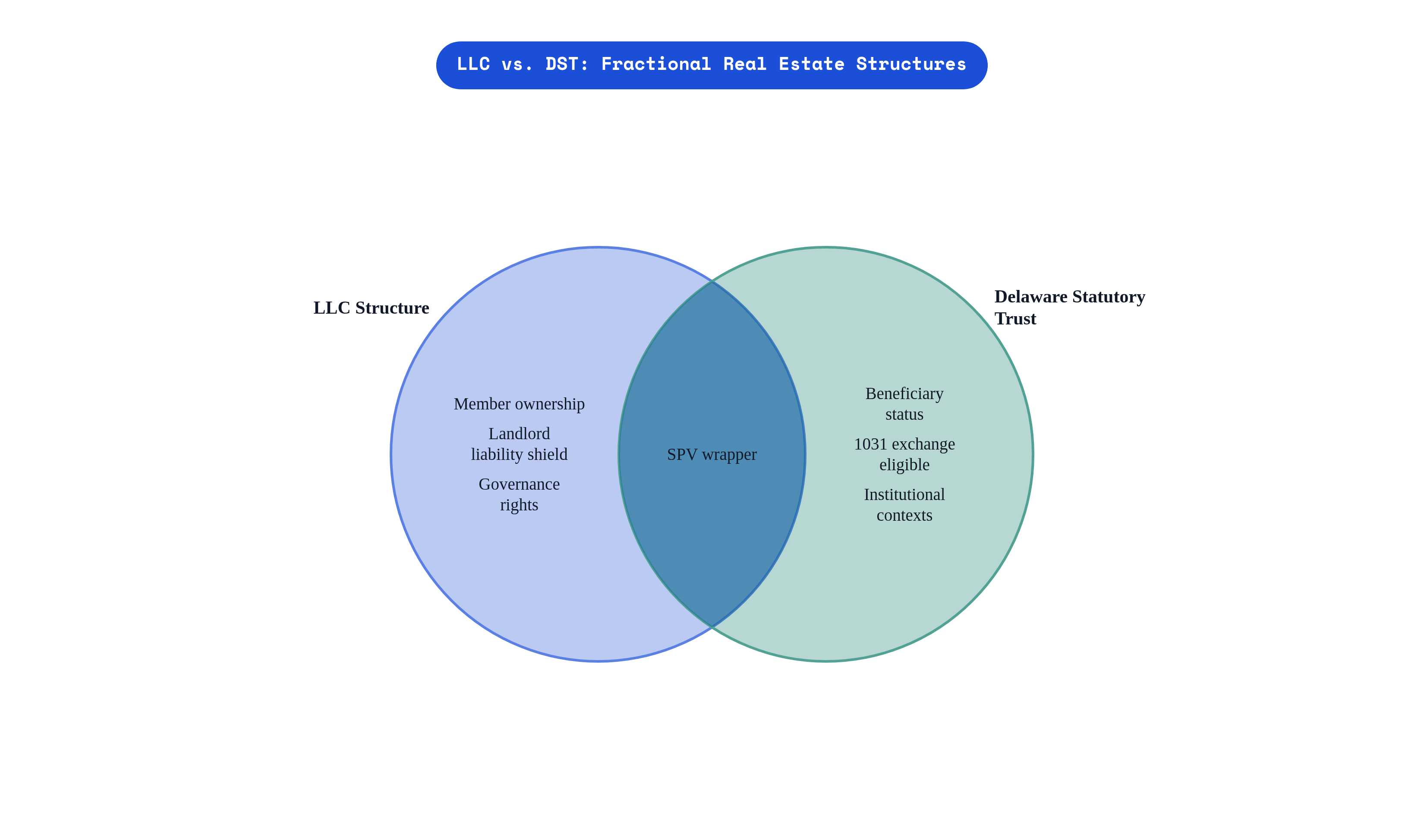
The special-purpose vehicle, almost always a limited liability company, is what stands between you and the property you think you own. A platform creates an LLC, that LLC takes title to the property, and then the platform sells you a membership interest in the LLC. Your name never appears on the deed. The LLC's name does.
This is not misdirection. The LLC isolates operational liability, removes investors from landlord obligations entirely, and simplifies day-to-day management in ways that make passive ownership workable at scale.
A less common but important alternative is the Delaware Statutory Trust, which you encounter most often when investors need 1031 exchange eligibility. DSTs let investors roll proceeds from a prior property sale into a new qualified investment and defer capital gains taxes in the process. Investors become beneficiaries of the trust rather than LLC members, and the tax pass-through treatment follows them through. These show up far more in institutional contexts than on consumer-facing platforms, but they are worth knowing about if 1031 eligibility is part of your situation.
Securities law is where retail access actually gets determined. Membership interests in these LLCs are investment contracts, which makes them securities, which means platforms either register offerings with the SEC or qualify under a recognized exemption. Regulation CF opened the market to ordinary retail participants by allowing platforms to raise up to $5 million per year from non-accredited investors. Regulation D can accommodate much larger raises with fewer disclosure requirements, but it is largely restricted to accredited investors, those who clear defined net worth or income thresholds. Whether you qualify for Reg D or are limited to Reg CF offerings is a binary question worth settling before anything else.
The operating agreement is the actual governing document of your investment, not the platform's landing page. Income distributions, appreciation upon sale, and transaction proceeds all flow through the LLC before reaching you. Governance rights, any meaningful say in management or disposition decisions, are limited and vary considerably by platform. Read it.
How a Property Moves from Platform Sourcing to Investor Ownership
Asset selection is where platforms differentiate most visibly, and it is the most consequential variable in the whole chain. A platform underwrites potential acquisitions against internal criteria: rental yield potential, local market conditions, property condition, projected appreciation. Some platforms focus exclusively on single-family residential. Others pursue commercial assets, short-term vacation rentals, or mixed portfolios. The sourcing and underwriting function is, in practical terms, the core of what you are paying for.
Once a property clears underwriting, the platform establishes the LLC, takes title, and prepares the offering documents. Depending on the regulatory exemption used, this is either a Private Placement Memorandum for Reg D offerings or an SEC-filed circular for Reg CF. Investors then access the offering through the platform's interface, review the disclosures, and fund their allocation. Minimum investments across major platforms currently range from $10 at Fundrise to a low minimum at Ark7, $50 at Lofty, and $100 at Arrived.
After funding closes, the platform or a contracted third-party manager assumes full operational responsibility: leasing, maintenance, tenant relations, financial reporting. Investors have no operational role. This is a passive ownership model by design.
Rental income, net of fees and operating expenses, is distributed to investors in proportion to their ownership share. Some platforms pay monthly, others quarterly. Exit occurs either through a planned property sale at the end of a defined hold period or through a secondary market transaction if the platform offers one.
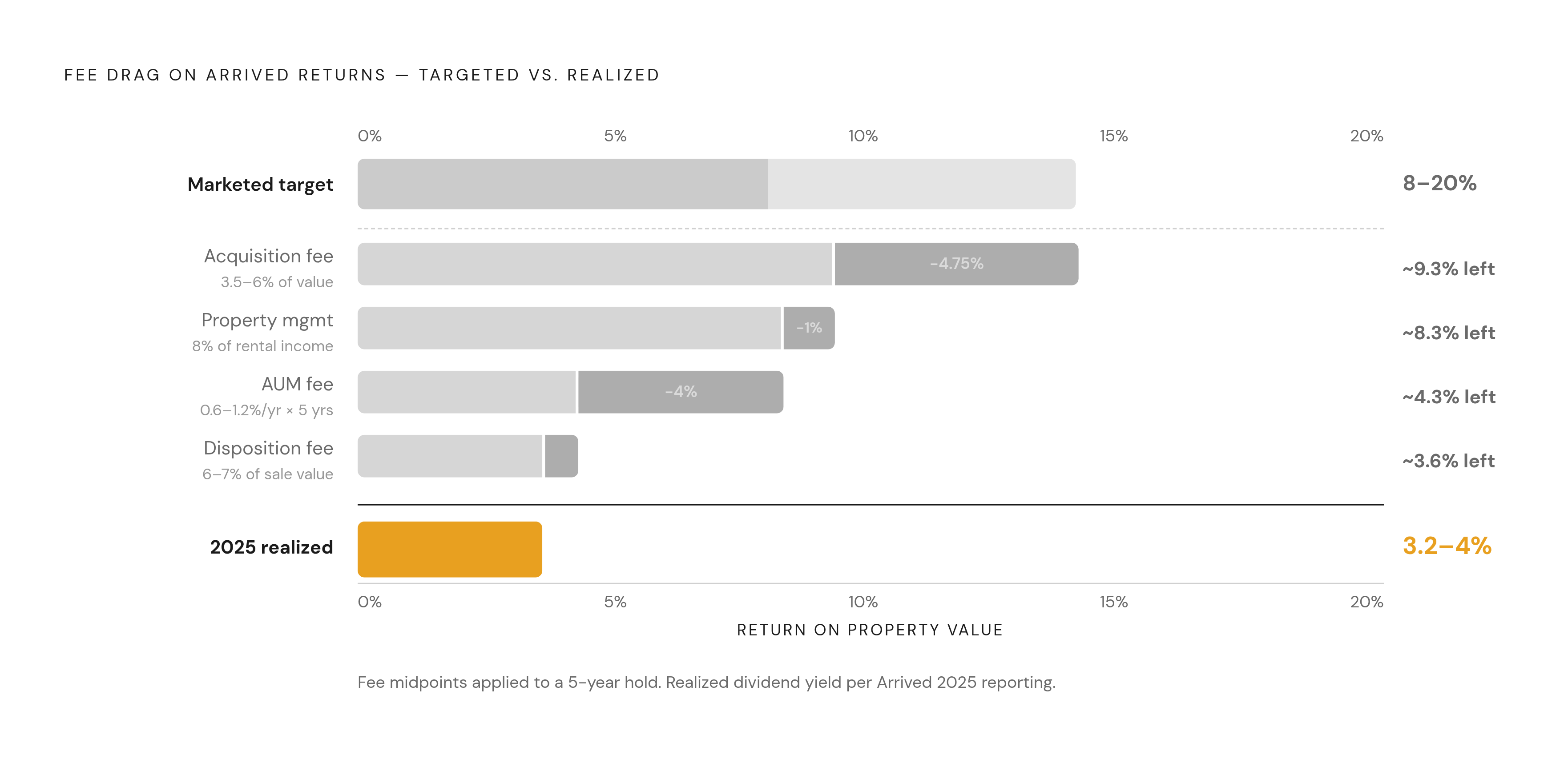
Arrived's fee structure illustrates how cumulative drag works in practice. A 3.5 to 6 percent sourcing fee at acquisition, 8 percent property management fee on gross rental income, 6 to 7 percent disposition fee at sale, and an annual AUM fee of 0.6 to 1.2 percent. Across a typical multi-year hold, those fees collectively consume roughly 10 to 13 percent of property value. Sit with that number when evaluating the 3.2 to 4.0 percent realized dividends Arrived investors received in 2025, particularly against the platform's own historical marketing language around 8 to 20 percent target returns.
The Major Platforms and How Their Models Differ in Practice
The platforms worth examining compare most usefully across five dimensions: asset type, minimum investment, fee structure, investor eligibility, and liquidity pathway. Those are the variables that actually affect outcomes.
Fundrise, founded in 2012, pioneered the eREIT structure for non-accredited investors and currently manages approximately $2.87 billion in assets. The minimum is $10. The all-in annual fee is 1.0 percent, transparent and comparatively low. Rather than offering single-property selections, Fundrise takes a diversified portfolio approach, and its Income Real Estate Fund posted a 7.81 percent annualized net return from April 2022 through December 2025, per KPMG-audited financials.
That record needs context. Fundrise posted a negative 7.45 percent return in 2023 and suspended redemptions that same year. Investors who entered expecting stock-like flexibility discovered that liquidity policies can shift under market stress, entirely outside investor control.
Arrived Homes, founded in 2019 with backing from Jeff Bezos, has attracted more than 906,000 registered investors and deployed over $350 million across its single-family residential portfolio. The $100 minimum and no accreditation requirement make it genuinely accessible. The fee structure is what demands careful attention before committing. In 2024, Arrived received a consent order from Washington State regulators for failing to notice-file securities offerings in six affiliated entities. That is a compliance flag, not an operational collapse, but it is a reason to verify a platform's regulatory standing rather than assume it.
Lofty AI occupies a distinct position because it uses blockchain technology, specifically the Algorand network, to encode ownership interests as digital tokens. The $50 minimum is among the lowest in the market, and the platform operates a secondary marketplace where tokens can be listed for sale. With more than 150 U.S. rental properties available, Lofty has one of the more developed secondary liquidity mechanisms of any consumer-facing fractional platform. Liquidity depth, the actual number of willing buyers at any given moment, is not guaranteed, but the infrastructure for it exists in a way it simply does not on most competing platforms.
RealtyMogul, founded in 2012, has served more than 300,000 members and facilitated over $1.2 billion in capital invested across more than $8 billion in property value offered. It targets primarily accredited investors and focuses on commercial real estate. Its recent history is worth examining without flattering it: its Income REIT cut distributions from 6 percent to 3 percent, experienced significant NAV decline, MogulREIT II was paused to new investors, and in November 2025 the company was acquired by The Wideman Company. That sequence is a complete illustration of what platform continuity risk and fund-structure deterioration look like when they arrive together.
Ark7, founded in 2018, has built a community of a large community of active investors with a $20 minimum and a direct fractional ownership model focused on cash-flowing rentals. Its documented weakness is capitalization. Ark7 remains at seed stage, operates with a small team, and is currently unprofitable. Platform survival risk here is meaningfully higher than at larger peers, and that belongs in any honest evaluation.
Mogul, built by Goldman Sachs alumni, targets 15 to 20 percent annual IRR through institutional-grade underwriting of single-family rentals. With a smaller asset base and a more limited investor count, it is smaller by AUM than the platforms above. Its stated differentiator is underwriting rigor, and it occupies a useful position for investors who prioritize analytical depth over platform scale.
How Tokenization Changes the Ownership and Trading Layer
Tokenization, at its most mechanical, encodes ownership interests as digital tokens on a distributed ledger. Title transfer becomes a token transfer, which removes much of the friction and cost associated with traditional deed-based conveyance. Transaction cost reductions relative to conventional property transfers are estimated at 30 to 40 percent, a meaningful efficiency gain when secondary market viability is the goal.
The tokenized real estate market was estimated at approximately $3.5 billion in 2024, with projections suggesting growth toward $19.4 billion by 2033. Treat those projections as directional.
Lofty AI is the clearest consumer-facing example of what tokenized fractional ownership looks like today: Algorand-based tokens, a functional secondary marketplace, $50 entry. The experience is meaningfully different from non-tokenized platforms because the exit mechanism is designed around token trading rather than a platform-managed property sale. If liquidity matters to you, that distinction matters.
What tokenization leaves unresolved is the thing that actually governs your rights. Legal enforceability still depends entirely on the underlying SPV structure. A token representing an LLC membership interest is only as good as the operating agreement and legal entity behind it. Regulatory treatment of security tokens is still evolving, and the gap between what the technology can theoretically enable and what the current legal framework clearly supports is precisely where the risk lives.
Liquidity: What Exit Options Actually Exist and What They Cost
Fractional shares are not publicly traded securities. Selling requires either a platform-operated secondary market, a platform-managed property sale, or locating a willing buyer on your own. That structural reality should sit at the front of every investor's thinking before capital is committed.
Three exit pathways exist in practice. The most common is the planned property sale at the end of a defined hold period, typically multiple years, after which the platform liquidates the asset and distributes net proceeds proportionally. The investor has no meaningful control over timing beyond whatever the operating agreement establishes, and most operating agreements give platforms considerable discretion.
Secondary markets are available on some platforms, most notably Lofty's token marketplace and Arrived's more limited secondary facility. Liquidity on these platforms is thin. Some Arrived investors report having been able to sell only a portion of their holdings over several months of active attempts.
Redemption programs, available on fund-structured platforms like Fundrise, offer periodic windows during which investors can request liquidity. These are not on-demand. Fundrise suspended its redemption program entirely in 2023 under market stress. Periodic redemption access is a policy, not a guarantee, and that distinction becomes operationally significant precisely when you most need liquidity.
Taking a price discount to exit quickly is a real and quantifiable cost in this market. Tokenization reduces the mechanical friction of a sale, but market depth, the number of buyers willing to transact at a reasonable price, is the binding constraint. Treat fractional real estate as a medium-to-long-term illiquid commitment on most platforms for most assets, and size allocations accordingly.
The Fee Structures That Sit Between Gross Returns and What Investors Actually Receive
Four fee categories appear across fractional platforms, each operating at a different point in the investment lifecycle.
Acquisition or sourcing fees are charged at purchase, before any income is earned. Arrived charges 3.5 to 6 percent of property value at this stage. Property management fees are ongoing charges on gross rental income; Arrived charges 8 percent. Disposition fees are assessed at sale; Arrived charges 6 to 7 percent. Annual AUM or advisory fees are charged on assets under management; Arrived charges 0.6 to 1.2 percent annually, while Fundrise charges 1.0 percent all-in with no separate sourcing or disposition charges.
The cumulative drag is what actually matters. Arrived's fee stack, taken together, consumes roughly 10 to 13 percent of property value across a typical hold period. That is the denominator you need when evaluating the 3.2 to 4.0 percent realized dividends investors received in 2025, and when comparing those figures against the platform's historical target marketing ranges.
Fundrise's fund structure handles transaction costs differently. Because it operates a diversified pooled vehicle rather than individual property offerings, sourcing and disposition costs are absorbed into the fund's operating economics rather than itemized as investor-facing charges. The 1.0 percent all-in annual fee is a cleaner comparison for investors who value cost transparency above most other variables.
When reviewing any platform's fee disclosure, check whether all fees appear in one place or whether sourcing and disposition charges are buried in the offering document while the marketing summary shows only the annual management fee. Total cost of ownership across the projected hold period is what matters, not any single line item read in isolation.
The Risks That Are Specific to the Platform Layer, Not Just the Property
Property-level risk is universal across real estate investing: vacancy, deferred maintenance, local market deterioration, interest rate sensitivity. These apply equally to fractional and direct ownership. The platform layer introduces a separate set of exposures with no equivalent in direct property ownership, and those deserve their own accounting.
Platform insolvency is the most severe. If a platform operator fails, the SPV holding the property will be wound down on terms that are unfavorable, rushed, or disputed. Ark7's current profile, seed-stage capitalization, a small team, an unprofitable operating structure, represents an elevated version of this risk in the live market right now. That does not mean Ark7 will fail. But investors should price that possibility into their allocation decision rather than assume operational continuity.
Regulatory non-compliance creates uncertainty even at well-funded platforms. Arrived's 2024 consent order for securities notice-filing failures in six affiliated entities demonstrates that enforcement actions can emerge from operational oversights at platforms that are otherwise prominent and well-capitalized. The practical implication is not necessarily that assets are at immediate risk; regulatory proceedings introduce timing and process uncertainty into an investment that is already illiquid.
Distribution cuts and NAV erosion can revise investor economics mid-hold without triggering any formal default. RealtyMogul's Income REIT cut its distribution from 6 percent to 3 percent and experienced significant NAV decline before the platform was acquired in November 2025. That sequence illustrates how fund-structured products can move materially against investor expectations while providing no contractual recourse.
Redemption suspension, as Fundrise demonstrated in 2023, means that liquidity access promised by a platform's operating policy can be withdrawn under adverse market conditions. This is not fraud. It is a known risk, worth naming plainly.
Before committing capital to any platform, get clear answers to five questions: What is the platform's capitalization and operating history? What is its SEC filing status and enforcement history? Are all fees disclosed in a single document? What are the specific mechanics of the exit mechanism, beyond a general reference to a secondary market? And what happens to the SPV if the platform closes?
How to Evaluate Whether a Specific Platform Fits a Specific Investment Goal
Start with investor eligibility, because it is binary. Non-accredited investors can access Fundrise, Arrived, Lofty, and Ark7. Accredited investors can access the full field, including RealtyMogul and Mogul. Confirm your status before anything else.
From there, match asset type to investment thesis. Single-family residential, the focus of Arrived, Ark7, and Mogul, delivers income through rental yield with appreciation driven by residential market dynamics. Commercial real estate, the primary domain of RealtyMogul, carries different vacancy and lease structure dynamics. Diversified fund exposure, Fundrise's model, reduces single-asset concentration risk but removes you from any specific property selection. Vacation rentals carry higher yield potential alongside higher occupancy volatility. Each fits a different objective and a different investor disposition toward uncertainty.
Run the fee comparison before you evaluate any return projection. Compute total cost of ownership across the projected hold period for the specific offering under consideration, not the platform's average or marketing summary. A platform with a 1.0 percent annual fee and no disposition charge and a platform with a 1.0 percent annual fee plus a 6 percent disposition fee are structurally different investments, even if their gross return projections look identical on paper.
Liquidity need and time horizon are where personal circumstances override everything else. An investor who needs capital access within two years should not be in a multi-year hold with no functioning secondary market. An investor who can commit capital for five or more years has materially more platform options and should use that flexibility to select on other dimensions.
Weight platform risk by capitalization and regulatory record. The difference between a well-capitalized platform with an established compliance history and a seed-stage operator with regulatory flags is not a marginal distinction; it is a different risk class. For smaller exploratory allocations, higher-risk platforms are reasonable. For larger allocations, platform survival is not a tail risk you can dismiss.
Last: read the offering document. Every fee, risk, and governance right that matters to your investment is disclosed there, by legal requirement. The marketing page is the platform's best case. The offering document is the full case. Any material gap between the two tells you something important about how that platform communicates with its investors.