Real Estate Crowdfunding Platforms for Accredited Investors
How accredited platforms differ on deal type, minimums, fees, and liquidity.

Real estate crowdfunding pools capital from multiple investors into a single property or portfolio through an online platform. It is not a REIT ETF you can sell on Tuesday afternoon. Direct ownership with your name on the deed is an entirely separate thing. It sits in a distinct middle lane, regulated primarily under Reg D Rule 506(c), which imposes no cap on raise size but restricts participation to accredited investors only. That structural distinction is why deal quality, minimums, and access look so different from what you find on mass-market platforms operating under Reg CF or Reg A+.
The market's growth has been substantial, and the range of estimates is itself instructive. Depending on methodology, the global real estate crowdfunding market was somewhere between $10.5 billion and $20.3 billion in 2024. Both figures come from credible research sources with different counting conventions. One number is not more honest than the other; they reflect different definitions of what gets counted. What matters is that the market is large, growing fast, and attracting serious capital. North America accounts for roughly 40% of global volume, which means more deal flow, more platform competition, and more historical data to evaluate than anywhere else on the planet.
Two structural facts about the current market shape the investor experience in ways that don't always make the brochure. First, deal-by-deal investing accounted for roughly two-thirds of the real estate crowdfunding market in 2025. That is why most accredited platforms are built around individual deal selection rather than fund-only access. Second, institutional investors, including family offices, endowments, and smaller pension allocators, are the fastest-growing participant type, projected to grow at a 22.57% compound annual rate through the early 2030s. They are moving into the same platforms that high-net-worth individuals use. More players chasing fewer deals tightens spreads. That affects you, even if you are not a family office.
For investors evaluating platforms today, the practical implication is this: more options exist than at any prior point, which sounds like good news, and it mostly is, but it also raises the stakes for platform selection. More platforms means more variation in underwriting rigor, and the marketing quality of a pitch deck has never been a reliable proxy for the quality of sponsor relationships.
One more piece of context before the platform analysis. The accredited investor threshold, net worth over $1 million excluding a primary residence, or income over $200,000 individually, has not been revised since it was set in 1982. Adjusted for inflation, that $1 million threshold would be roughly $3.42 million today. The SEC has not moved it, which is why approximately 18.5% of U.S. households now qualify, compared to 1.8% in 1983. Legislation passed the House in 2025 that would extend eligibility to individuals with demonstrable education or relevant professional experience, and it was pending Senate consideration as of June 2025. Investors who currently sit just outside the threshold should be paying attention.
The four variables that actually differentiate platforms: deal type, minimum, fees, and liquidity
Every platform comparison eventually reduces to four variables. Once you understand what each one means in practice, the field narrows quickly, and the rest is just reading documents carefully.
Deal type determines how you get paid and when. Equity positions generate quarterly distributions from rental income plus a back-end payout at sale; you participate in upside but accept a longer horizon. Debt and preferred equity structures sit higher in the capital stack, generate more predictable interest-like payments, and cap your return in exchange for reduced risk. Short-term fixed-rate notes, which some platforms now offer, provide yield without property-level exposure and, in some cases, without a multi-year lockup. These are not interchangeable products. Treating them as versions of the same thing is where investors make the first mistake.
Minimum investment is the single variable that narrows the field fastest. Entry points range from a few thousand dollars on accessible note products to $200,000 at institutional-grade platforms. Know your number before you evaluate any platform's deal mix or fee structure, because a compelling deal at a minimum you cannot meet is not a deal.
Fees require careful reading, more careful than most investors bother with. Most accredited platforms embed sponsor-level costs into deal economics rather than charging investors a visible direct fee. The stated management fee rate understates total cost. Direct management fees across accredited platforms generally run from roughly half a percent to over one percent annually, but sponsor profit-share arrangements layer on top. The question to ask is not what the platform charges; it is what the deal-level economics look like after all fees are extracted. Those are different questions with different answers.
Liquidity is the central tradeoff, and it is not negotiable after you wire the money. Most deal-by-deal platforms lock capital until the deal exits, typically over a three-to-seven-year hold. Some platforms offer secondary markets; most do not. In 2025, one of the best-known open-access platforms suspended its quarterly redemption windows entirely when rate pressure moved against real estate valuations. That was not an aberration or a platform-specific failure. It was a preview of what illiquidity looks like when the macro environment turns. Every investor on every platform should plan from the start as though redemption is unavailable until the stated hold period ends, because that assumption is usually correct.
A fifth factor worth naming: how platforms verify accredited status. A March 2025 SEC no-action letter clarified that a written representation combined with a minimum investment of at least $200,000 satisfies the "reasonable steps" standard under Rule 506(c). Platforms below that threshold use third-party verification services or document review. The process varies, and it affects friction at onboarding.
These variables interact in ways that matter. A high-minimum platform with selective underwriting and low fees represents meaningfully better value than a low-minimum platform with opaque sponsor costs. The investor who evaluates platforms on headline return projections alone is solving the wrong problem.
CrowdStreet: large commercial deals and high realized returns, with litigation history to weigh
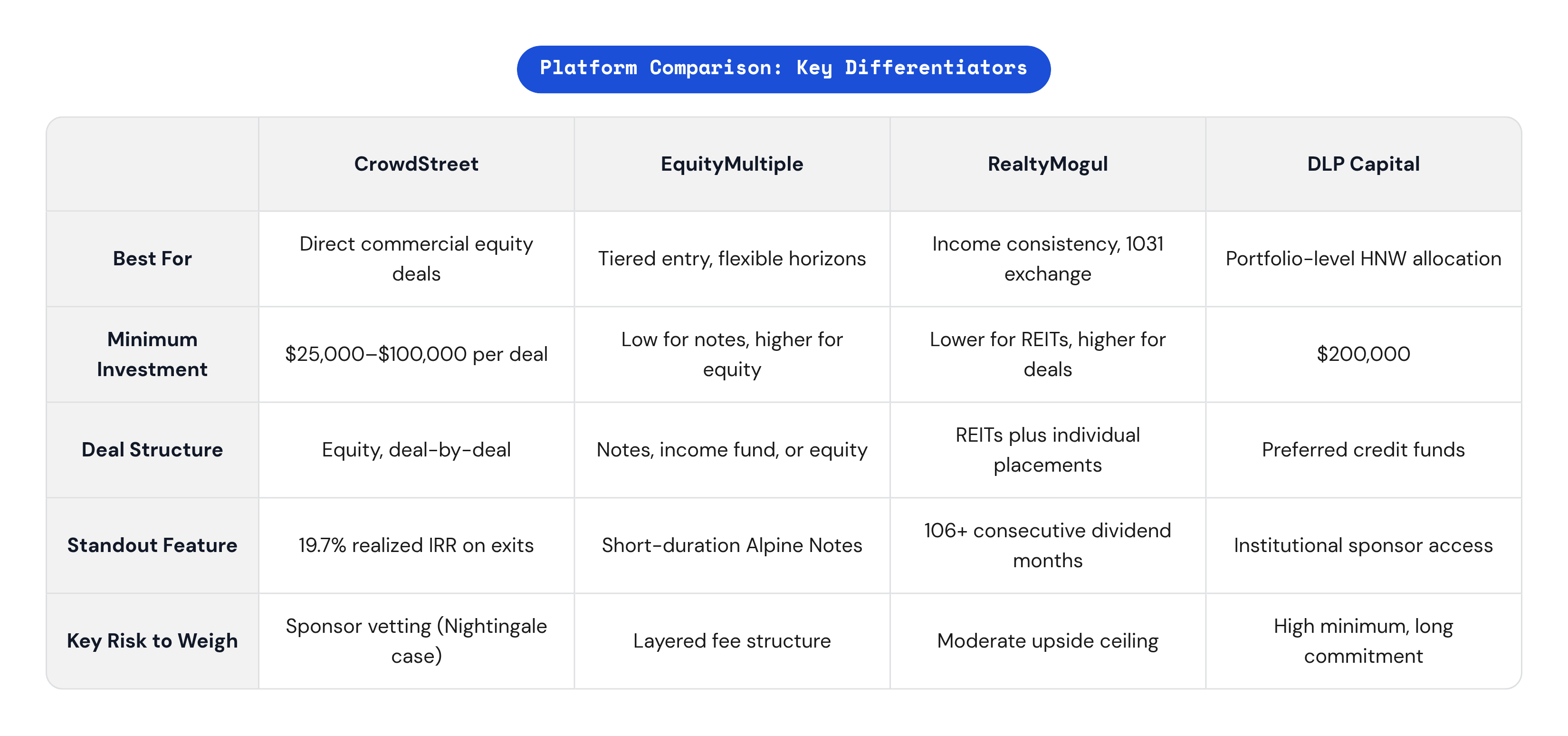
CrowdStreet operates at scale. More than $4.5 billion deployed across 800 deals, with more than 300,000 registered members. The platform focuses exclusively on commercial real estate, exclusively for accredited investors: office, multifamily, industrial, mixed-use. The standard deal minimum is $25,000, with some offerings requiring $50,000 to $100,000.
The track record on completed deals is a 19.7% realized IRR. That is a meaningful number with an important caveat: realized IRR reflects only exited deals. It does not represent the full portfolio, and it does not tell you how unrealized positions are currently marked. Read it as a signal about deal selection quality, not as a projection for what your deal will return.
CrowdStreet charges no direct investor fees. Sponsors embed annual management fees plus profit share into deal-level economics. The investor pays indirectly. This is standard practice in the accredited commercial real estate space; it is not a red flag, but it does require investors to read offering documents carefully rather than assuming the platform's fee-free positioning means the economics are frictionless.
The risk context that belongs in any honest assessment of CrowdStreet is the litigation involving a sponsor called Nightingale Properties, which diverted investor funds. The platform has publicly addressed the incident and revised its sponsor vetting process. Prospective investors should read CrowdStreet's current underwriting documentation to evaluate the changes. The incident is not disqualifying, but it is instructive in a way that scale alone cannot resolve: platform volume does not eliminate sponsor-level risk. It can, if anything, obscure it, because the sheer number of deals makes any single sponsor relationship harder to monitor continuously.
CrowdStreet is the right fit for investors with $25,000 or more per deal to commit, real tolerance for three-to-seven-year lockups, and a genuine interest in direct access to institutional-grade commercial assets without a fund wrapper. Investors who want someone else to manage diversification across the portfolio should look elsewhere.
EquityMultiple: tiered products from short-term notes to direct deals, aimed at yield-seeking accredited investors
EquityMultiple is structured around three distinct investor pathways, which is a more deliberate product architecture than most competitors offer, and it is worth understanding why that matters before evaluating the individual tiers.
The Keep Plan centers on Alpine Notes: fixed-APY, real estate-backed notes with short durations and low minimums. The Earn Plan is a commercial real estate income fund, diversified, with moderate minimums. The Grow Plan offers deal-by-deal equity and preferred equity with higher per-deal commitments. Each tier maps to a different time horizon and return objective, and an investor can move between them as their allocation strategy evolves.
The Alpine Notes product occupies a genuine gap in the accredited platform landscape. Most commercial real estate platforms require multi-year commitments. For accredited investors who want meaningful yield without that lockup, a short-duration note backed by real estate collateral is a structurally different offer. It is not a substitute for equity participation, but it serves a distinct purpose in a portfolio and should be evaluated on those terms.
The selectivity metric EquityMultiple publishes is worth taking seriously: the team approves only a small fraction of deals evaluated. That filter matters more than headline return projections, because it tells you something about the quality of the pipeline relative to what is rejected. Management fees run roughly half a percent to one and a half percent annually depending on the product, making EquityMultiple among the more transparent direct-fee structures in the accredited space.
For accredited investors who want a tiered entry point into commercial real estate, with the flexibility to start in a shorter-duration product and move toward direct deal exposure over time, EquityMultiple offers a more modular structure than its peers. That modularity is genuinely useful if you are still calibrating how much illiquidity you can actually tolerate, as opposed to how much you think you can tolerate on paper.
RealtyMogul: the most defensible choice for conservative accredited investors prioritizing income consistency
RealtyMogul serves a wider investor base than most accredited platforms. Its two REIT funds are available to non-accredited investors; individual deal placements require accreditation and carry a higher minimum. Management fees on the REIT products run roughly around one percent or slightly above.
The differentiating fact for income-oriented investors is this: more than 106 consecutive months of dividends paid. That is the clearest proof point in the platform's positioning, and it is genuinely rare. Most platforms can show you projected yields and historical IRRs on completed deals. Very few can show you an unbroken dividend track record across multiple market cycles, including the rate stress of 2022 through 2024. That kind of history takes actual discipline to build; it does not emerge from good marketing.
RealtyMogul also offers 1031 exchange capability for accredited investors. For an investor rolling proceeds from a property sale, the ability to defer capital gains taxes by moving into a real estate investment through a qualified intermediary process is a meaningful structural advantage, not a cosmetic feature. Most platforms in this category do not offer it, and the after-tax return differential can be significant depending on the investor's basis and gain.
The platform's deal mix spans a wider risk spectrum than CrowdStreet, ranging from conservative income-oriented yields on the REIT side to higher-return equity deals on individual placements. That breadth makes it appropriate for investors who are not trying to maximize upside but who need their real estate allocation to generate consistent income and, ideally, offer a tax-efficient entry point.
For conservative accredited investors, particularly those with a 1031 exchange need or a strong preference for income over appreciation, RealtyMogul is the most defensible choice in the current platform landscape. The dividend history is not a marketing claim. It is a verifiable operating record, and in a space where projections are abundant and track records are thin, that distinction matters.
DLP Capital and other institutional-minimum platforms worth knowing for high-net-worth allocators
DLP Capital manages several billion dollars in assets and focuses on preferred credit funds with a $200,000 minimum investment. That minimum places it in a categorically different tier from the platforms discussed above. This is not a starter position. It is designed for high-net-worth investors and family offices treating real estate as a meaningful portfolio allocation, not a trial.
The $200,000 threshold is also procedurally significant in a way that often goes unmentioned. It aligns with the SEC's 2025 no-action letter standard, under which a written representation plus an investment at or above that threshold satisfies the "reasonable steps" requirement for accredited investor verification under Rule 506(c). For sophisticated investors writing large checks, the compliance friction is reduced.
The tradeoff at this tier is predictable: less liquidity optionality, longer commitments, and a higher barrier to entry. In exchange, investors typically gain more direct access to deal economics, tighter sponsor relationships, and structures that are designed for portfolio-level capital rather than retail participation. Other platforms in this range, including Origin Investments and comparable preferred credit vehicles, operate on similar logic. The investor is making a meaningful portfolio commitment, not a trial allocation, and the platform structures reflect that assumption.
This is also where the institutional CAGR story becomes most relevant. Family offices and smaller endowments moving into real estate crowdfunding are not doing so through $10,000 Alpine Notes. They are allocating at the DLP Capital tier, competing for the same deals, and driving the pricing dynamics that filter down and affect returns at every level of the market. If you are investing at a lower minimum and wondering why spreads feel compressed, this is part of the explanation.
Fundrise and Arrived: what open-access platforms reveal about the accredited-only tradeoffs
Fundrise is one of the largest real estate private equity platforms by deployment volume globally. Its minimum investment starts at a few dollars. It has introduced more investors to private real estate than any platform in history, and that is genuinely significant. The all-in fee structure, once management and advisory fees are combined, runs roughly comparable to accredited platforms. Accessibility does not mean cheap.
In October 2025, Fundrise suspended its quarterly redemption windows. They remained suspended through at least Q1 2026. This is the concrete, recent case study for what liquidity risk looks like in a real estate fund structure when rate pressure moves against property valuations. It is not a Fundrise-specific failure; it is a market-wide dynamic that surfaces wherever real estate funds offer redemption optionality during a rate cycle that moves against them. Open platforms cannot guarantee liquidity any more than closed ones can. The rate environment matters more than the structure.
Arrived Homes focuses on single-family and vacation rental properties, with low per-share minimums and property-level transparency. It paid dividends across hundreds of properties in 2025 and is accessible to all investors, not just accredited ones.
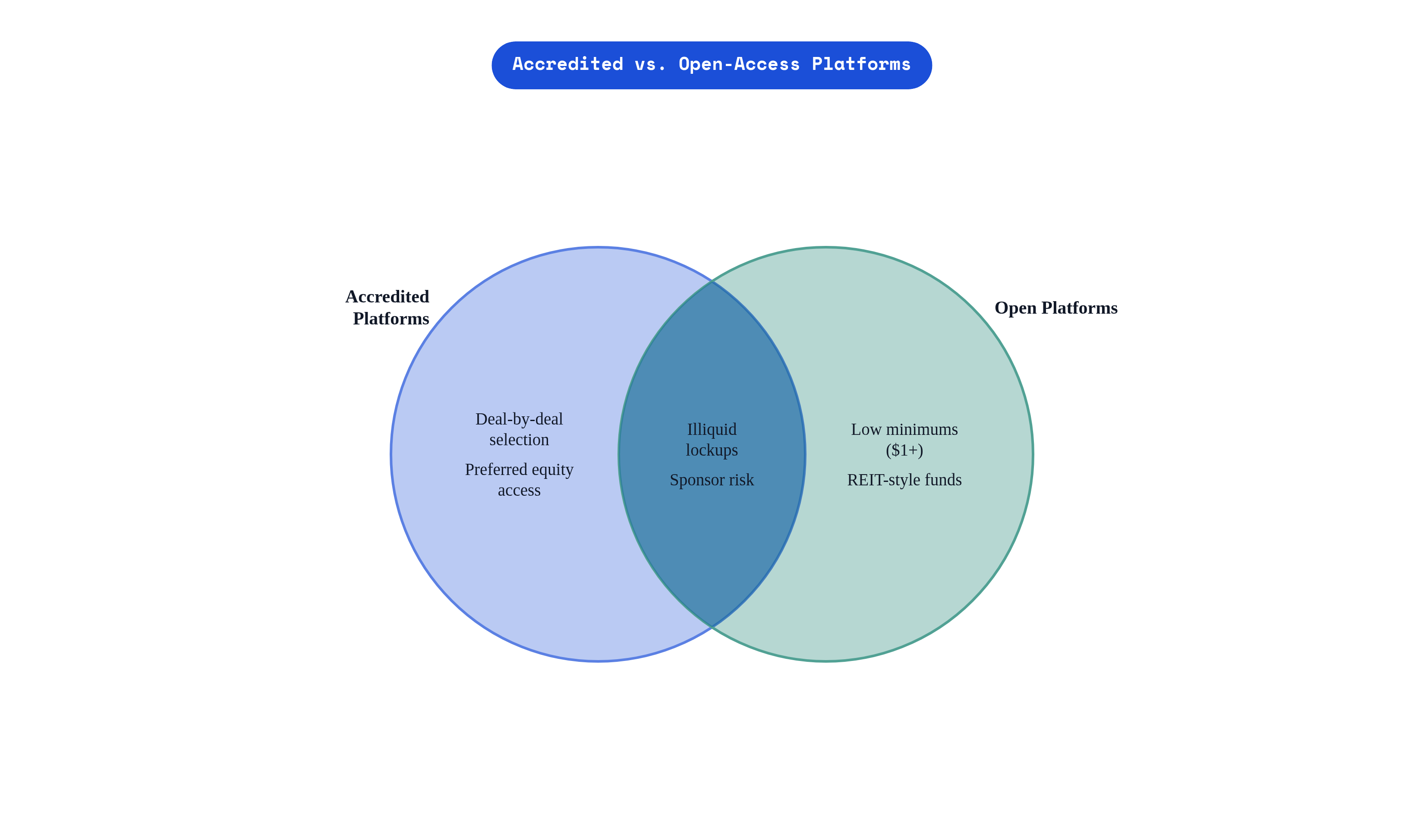
What these two platforms clarify is the actual nature of the accredited advantage, which is less about exclusivity and more about what the structure unlocks. Open platforms offer diversification and low minimums, but they generally cannot provide access to large commercial transactions, deal-by-deal selection, preferred equity structures, or the more yield-intensive debt products that accredited-only platforms offer. An accredited investor who defaults to an open platform because it is familiar is trading real structural advantages for the comfort of familiarity. That is a legitimate choice, but it should be a deliberate one.
How to match a platform to an investor's actual goals and constraints
The central question is not which platform has the highest stated return. It is which deal structure, minimum, lockup, and tax treatment fits the way your capital actually needs to work over the next three to seven years. That question sounds simple. Most investors skip it anyway and end up evaluating platforms on the wrong criteria.
Start with liquidity. Not preferred liquidity, actual liquidity. If there is any scenario over the next five years where you might need the capital you are considering committing, do not commit it. Accredited real estate crowdfunding is not a place to park money you might need. It is a place to put money you genuinely will not need for the duration.
From there, the platform match follows from goal. Yield-first investors with a shorter horizon who cannot stomach a multi-year commitment should start with short-term note products. EquityMultiple's Alpine Notes structure was built for exactly this use case: meaningful yield with real estate backing, without locking into a full deal cycle. It is a reasonable on-ramp.
Income-oriented, conservative investors, particularly those with a 1031 exchange need or a strong preference for dividend consistency over appreciation, should look at RealtyMogul. The 106-month dividend track record is not just a number; it reflects a disciplined operational posture across market cycles that most platforms have not demonstrated.
Investors who want direct access to institutional-grade commercial equity deals, and who have $25,000 or more per deal to commit with genuine tolerance for multi-year lockups, should evaluate CrowdStreet's deal mix and realized IRR history, with the understanding that sponsor-level due diligence is the investor's responsibility, not the platform's guarantee.
High-net-worth allocators treating real estate as a portfolio-level commitment rather than a position should be looking at DLP Capital and comparable preferred credit funds at the $200,000 threshold. The structure, the sponsor access, and the compliance framework are all calibrated for that use case.
Tax treatment is not a footnote and should not be treated as one. REIT investments generate pass-through income with specific tax characteristics. Deal-by-deal equity investments typically produce K-1s. RealtyMogul's 1031 exchange capability is a genuine differentiator for investors with embedded gains from a prior property sale. These distinctions can affect after-tax returns more than the difference in gross yields between platforms, and most investors do not model this until after the fact.
Finally, due diligence on platforms should extend beyond deals to sponsors. The CrowdStreet litigation episode is a useful reminder that platform scale does not eliminate sponsor-level fraud risk. Ask each platform how it vets sponsors, what happens when a sponsor defaults, and what recourse investors have. The answers vary more than you would expect, and they matter more than most marketing materials acknowledge.
The risks that apply across platforms regardless of which one an investor chooses
Illiquidity is structural, not incidental. Three-to-seven-year hold periods are the norm across the accredited platform landscape, and most platforms do not offer functional secondary markets. This is not a caveat in fine print; it is the defining characteristic of the asset class. Investors who understand this going in, and size their positions accordingly, are the ones who do not end up in a bind when the macro environment shifts.
Real estate crowdfunding investments are sensitive to interest rate cycles in ways that public REIT investors have seen but private investors sometimes underestimate until it happens to them. Rising rates compress valuations on commercial properties, stress debt-service coverage ratios on deals using leverage, and can trigger redemption gates even on fund structures marketed as more liquid. The 2022 through 2024 rate environment demonstrated this across the industry, not just at individual platforms.
Sponsor risk is distinct from platform risk and does not disappear because a platform has rigorous underwriting standards. Platforms vet sponsors at the point of onboarding. They do not continuously monitor every capital decision a sponsor makes with investor funds. The investor bears residual sponsor risk, and no platform has eliminated it. The Nightingale Properties situation at CrowdStreet is the clearest recent example of what that looks like when it surfaces.
Platform counterparty risk is also real, even if it is less frequently discussed. If a platform closes, is acquired, or restructures, the operational infrastructure managing your investment changes. This is not a common outcome, but it is not theoretical either. Investors should understand what happens to their deal-level assets if the platform itself ceases to operate, because that question has a different answer depending on how the deals are structured and where the assets are held.
Concentration risk is the final consideration worth naming plainly. Accredited real estate crowdfunding, even across multiple platforms, represents a single asset class with correlated exposure to real estate cycles, credit availability, and interest rates. The access is real. The returns can be compelling. But these allocations belong as one component of a diversified portfolio, not as a replacement for direct property ownership, publicly traded REITs, or other income-generating assets. The risks are proportionate to the opportunity, and they deserve the same rigorous assessment as the return projections on any given deal, probably more.