REIT Investing Platforms for Non-Accredited Investors
These platforms democratized real estate investing for everyday Americans.

Non-accredited investors, meaning approximately 87% of American households according to CrowdfundedWealth, now have real access to REIT investing through a handful of platforms that didn't exist fifteen years ago. That access comes with real tradeoffs: minimums, fee structures, and liquidity terms that vary wildly and matter more than the marketing copy suggests. This piece walks through why these platforms exist at all, what happened when several of them hit a wall in 2025 and 2026, and how to actually compare them before wiring money anywhere.
Quick definitions first, because the whole story hinges on them. An accredited investor is someone with income above $200,000 individually (or $300,000 joint) in each of the past two years, or a net worth over $1 million excluding the primary residence, or someone holding a Series 7, 65, or 82 license. Those thresholds haven't moved in decades — not for inflation, not for anything. Incomes have climbed for four decades while the bar sat still, which is part of why the INVEST Act (H.R. 3383) passed the House 302-123 in December 2025 and is now sitting in the Senate, proposing exam-based pathways to accredited status and, finally, inflation indexing. It isn't law yet. Until it is, or until it isn't, non-accredited investors need platforms built for the rules as they exist today. That's what this piece covers.
The three regulatory exemptions that made non-accredited REIT platforms possible
None of this happens without the JOBS Act of 2012. Before that law, private real estate deals, the syndications and non-traded funds that institutions and wealthy individuals used to build portfolios, were locked behind accreditation. The JOBS Act cracked that door open, and two exemptions in particular are worth knowing by name because you'll see them in every platform's fine print.
Regulation A+ comes in two tiers. Tier 1 caps a raise at $20 million and only needs state-level qualification, with no ongoing SEC reporting. Tier 2 goes up to $75 million, requires SEC qualification, audited financials, and ongoing reporting, and it's the tier most real estate platforms actually use. Under Reg A+, non-accredited investors are capped at 10% of the greater of their annual income or net worth, per year. In practice, this is how a company sells shares in a diversified property fund directly to the public: institutional-style portfolios, low minimums, no country club required.
Regulation Crowdfunding, or Reg CF, works a bit differently. It caps raises at $5 million annually and requires an SEC-registered funding portal or broker-dealer to run the offering. Non-accredited investors face a 10% cap on the greater of income or net worth if both exceed $124,000, and an aggregate cap of $124,000 per twelve-month period no matter what.
Here's the part that doesn't get mentioned in the pitch decks: both exemptions carry a structural warning sign. Reg A filings fell 67% from their peak by 2024, and Reg CF filings dropped by more than a third over the same stretch. The crowdfunding boom that followed the JOBS Act has cooled considerably. And only 4% of Reg A issuers ever list on a national exchange, which means secondary market liquidity is thin by design, not by accident. The legal wrapper on a platform, Reg A+ versus Reg CF versus something else, tells you as much about your investor protections and exit options as the brand name does.
The liquidity crisis of 2025–2026 and what it revealed about how these platforms actually work
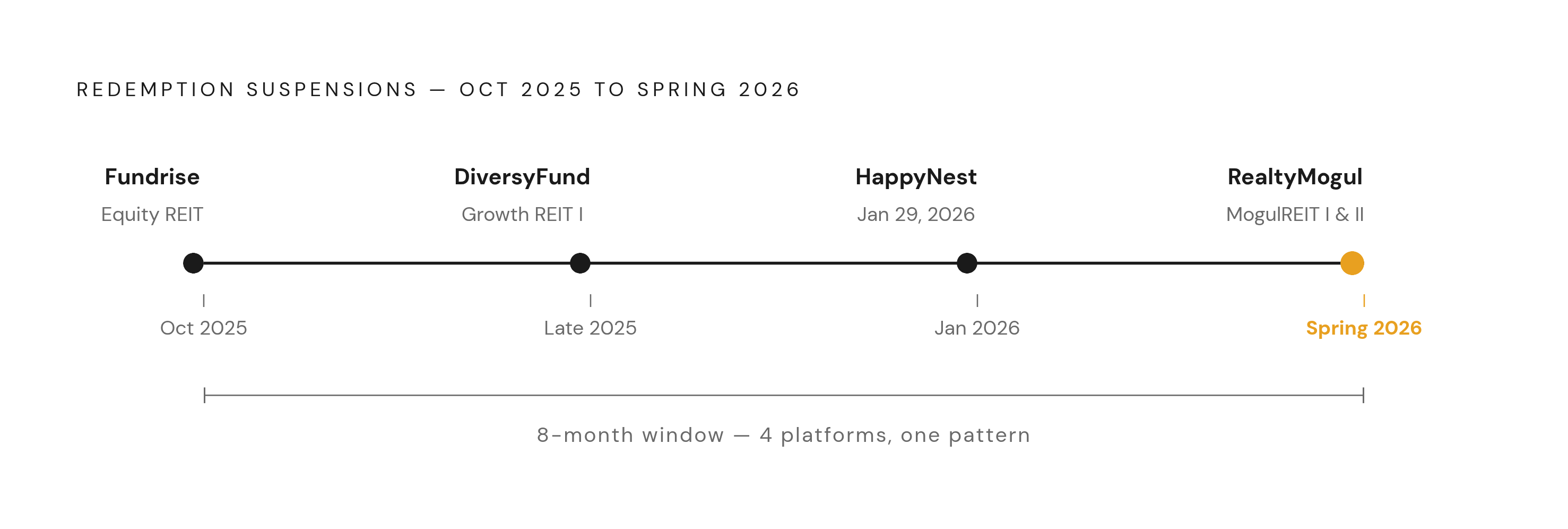
Between October 2025 and April 2026, four major platforms restricted or suspended redemptions. Fundrise's Equity REIT suspended in late 2025. DiversyFund's Growth REIT I followed before year's end. HappyNest suspended in early 2026. RealtyMogul's MogulREIT I and II suspended in spring 2026. Four platforms, eight months, one pattern.
The underlying properties didn't fail. They kept collecting rent, kept generating income, kept being buildings that people live and work in. The problem was a mismatch between how these platforms market withdrawal flexibility and how illiquid the actual holdings are underneath. Every non-traded REIT and eREIT prospectus discloses, usually in a paragraph nobody reads twice, that redemptions can be suspended at the manager's discretion. The 2025-2026 cycle is the moment that clause stopped being boilerplate and started being operational.
So what does an investor do with that information? Treat every advertised redemption window as a best-case scenario, not an expected one. The actual liquidity of a platform comes down to its structure, whether it's an interval fund with mandatory quarterly repurchases, a discretionary non-traded REIT, or something claiming a secondary market, far more than it comes down to whatever's printed on the landing page. Which platforms suspended and which didn't (or offered a real alternative) is now a legitimate, maybe primary, way to sort these options. That framing carries through every platform discussed below.
How to compare platforms before committing capital: the five dimensions that matter
Five things actually move the needle here, and none of them is "how good does the app look."
Minimum investment decides who can start at all. Across the platforms in this piece, minimums range from $10 to over $1,000, which is a wide enough spread that it functions almost like a separate market segment.
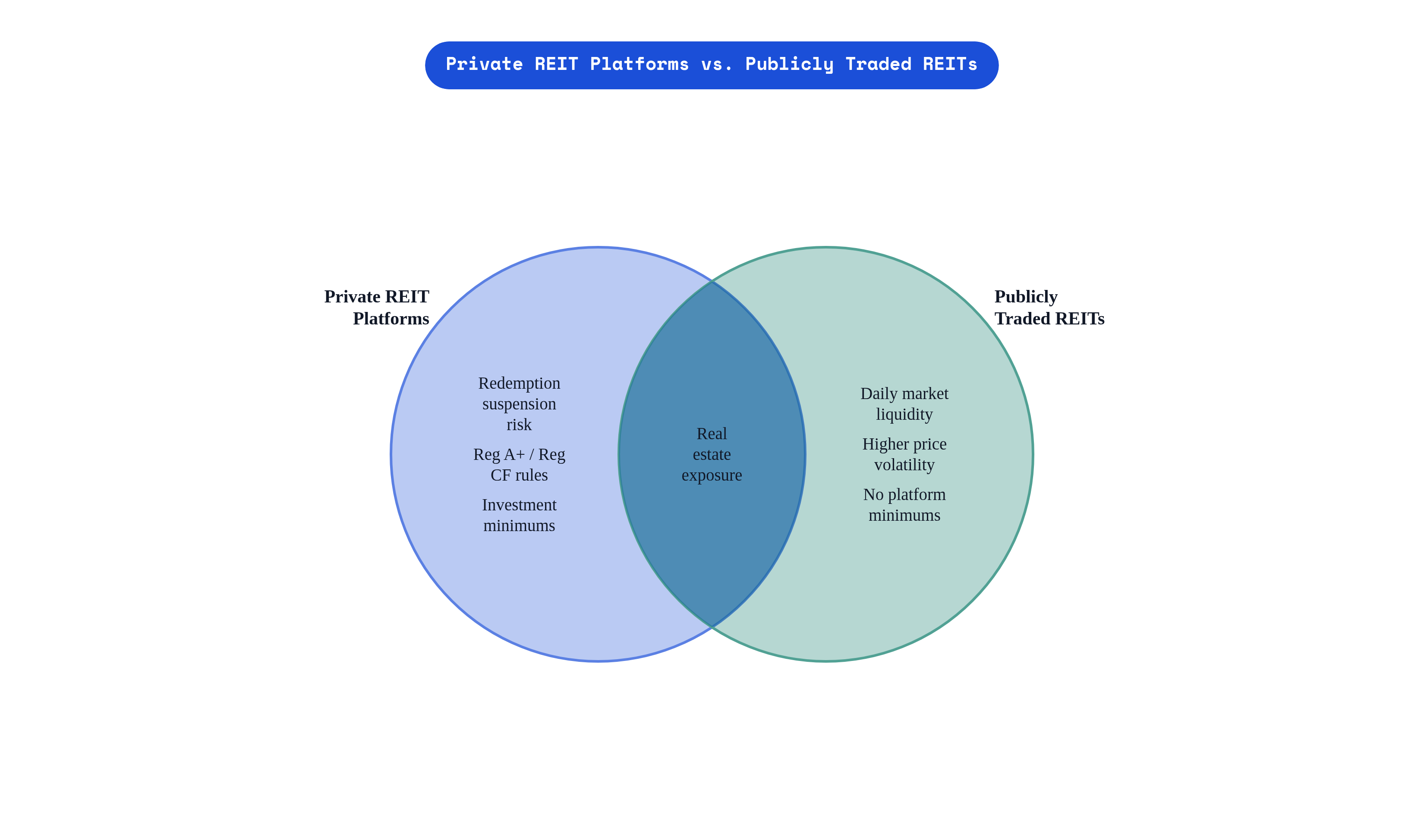
Liquidity structure is the one people get wrong most often. The real question isn't "can I withdraw." It's "under what conditions, how often, and what actually happened the last time markets got stressed." Interval funds under Rule 23c-3 are required to make quarterly repurchase offers for at least 5% of outstanding shares, a defined but limited window. Non-traded REITs redeem at manager discretion, full stop, as 2025-2026 made clear. Fractional share platforms with secondary markets look more liquid on paper, but actual trading volume on those secondary markets tends to be thin.
Fees matter beyond the headline number. Add up the management fee, the advisory fee, and the expense ratio, because that combined drag is what actually eats your return, not whatever number is in bold on the homepage.
Asset type and strategy separate these platforms more than people assume. Single-family rentals, commercial buildings, diversified funds, debt-focused portfolios: these aren't flavors of the same thing, they're different risk and return profiles entirely.
Regulatory wrapper decides your reporting standards, your investor protections, and your hard investment caps if you're non-accredited. And a couple of secondary things are worth checking before you commit: IRA compatibility, whether you get a 1099-DIV or a K-1 at tax time, and whether the platform even operates in your state.
Fundrise: the largest platform, meaningful returns, and a suspended redemption program
Fundrise runs about $3.3 billion in assets under management, which makes it the largest real estate crowdfunding platform by that measure, across its eREIT and eFund products. It's open to any U.S. investor with $10, and it was the platform that pioneered Reg A+ for non-accredited investors (it also uses Reg D for accredited ones). Its eREITs and eFunds hold diversified portfolios mixing debt and equity positions across many properties.
The returns tell an interesting, slightly bumpy story. Overall client return came in at 6.24% in 2025, 5.75% in 2024, and negative 7.45% in 2023. Inside 2025 alone, the spread was wide: the Income Real Estate Fund returned 8.27% while the Flagship Real Estate Fund returned just 1.33%, two products on the same platform, pointed in very different directions. The eight-year annualized net return from 2018 through 2025 comes out to 5.7%.
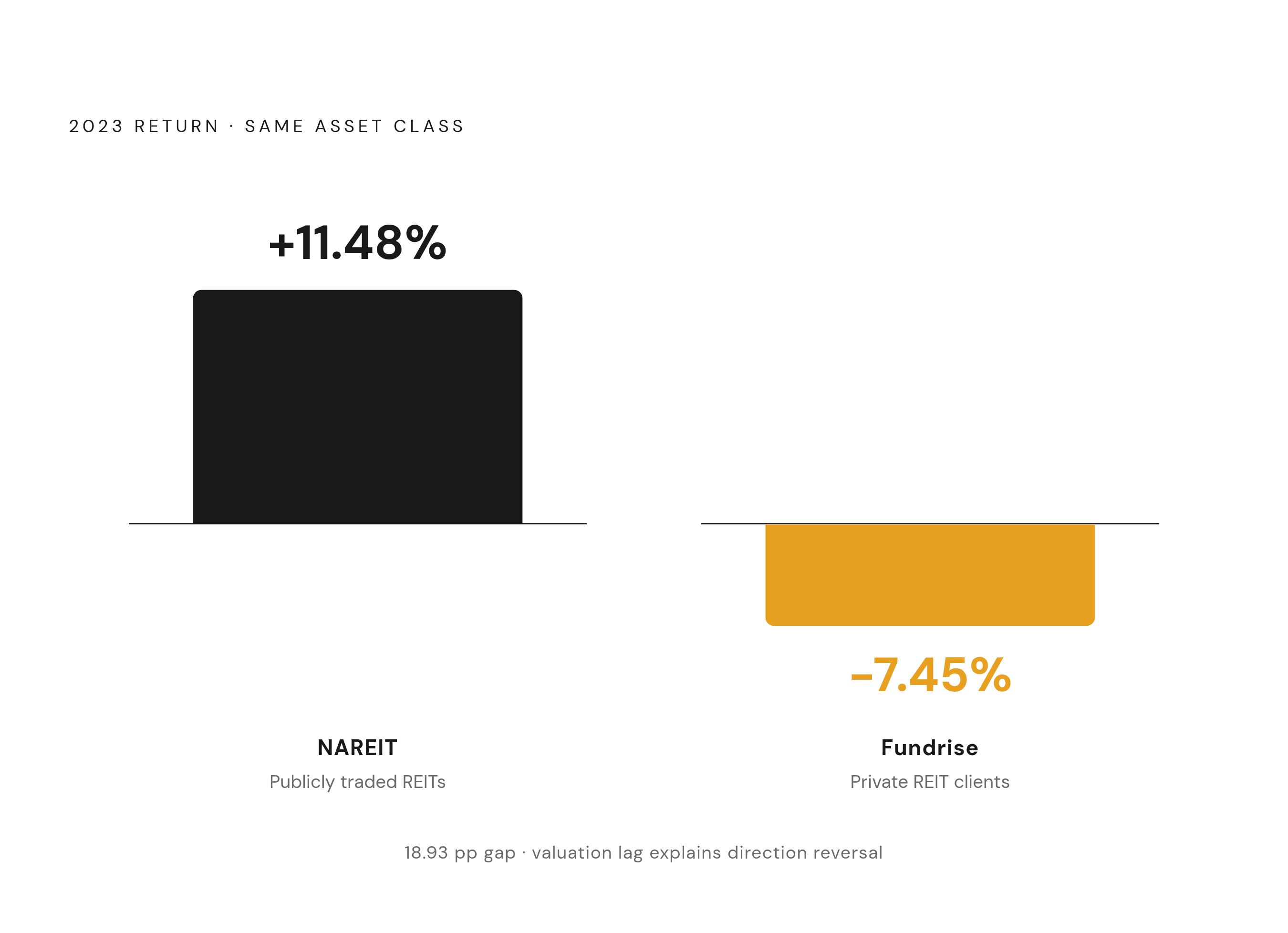
That 2023 number deserves a second look, because it's genuinely instructive. Fundrise investors lost 7.45% in a year when publicly traded REITs, tracked by NAREIT, returned positive 11.48%. That's not a small gap, and it's not because Fundrise's buildings suddenly got worse. It's valuation lag: private portfolios get appraised infrequently, so their reported values move slower and smoother than a stock price does, for better and for worse.
Fees run 0.85% management plus 0.15% advisory, roughly 1% all in, though the Income Real Estate Fund carries a heavier 1.96% total expense ratio. That fund holds $631 million in net assets, is structured as an interval fund under Rule 23c-3 with quarterly repurchase offers covering a minimum 5% of outstanding shares, and asks for a $1,000 minimum per the prospectus. Meanwhile, the Equity REIT's redemption suspension from October 2025 hadn't been lifted as of mid-2026, meaning the largest, most widely recommended platform in this category pulled the discretionary lever in the same window it was topping "best of" lists.
One footnote worth flagging so nobody gets confused: Fundrise's Innovation Fund posted a striking 68.39% NAV return for the year ended March 31, 2026. That's a private tech venture fund, not real estate; Anthropic, Databricks, and OpenAI Group make up 66.9% of its net assets. It has nothing to do with the REIT products this piece is evaluating, and it shouldn't be mistaken for one.
Fundrise fits investors who want a low entry point, broad diversification across many properties, and who can genuinely leave the money alone for five years or more without needing it back on a schedule.
Arrived Homes: single-family and vacation rental exposure with a $100 entry point
Arrived Homes offers a low entry point, requires no accreditation, and has attracted notable venture backing. The platform has reported growth in total capital deployed and investor participation since launch.
Structurally, this is a different animal from Fundrise. Instead of buying into a pooled fund, investors buy fractional shares of individual properties, single-family rentals and vacation rentals, each one held in its own dedicated legal entity. Rental income gets distributed as dividends along the way, but appreciation only gets realized when the underlying property actually sells, and that timeline isn't up to the investor.
Liquidity here is a real question mark. There's no guaranteed secondary market for shares; if a property doesn't sell and no buyer shows up on the platform's internal marketplace, that capital just sits there. The tradeoff versus Fundrise is concentration: Arrived investors know exactly which house or cabin they own a piece of, which some people prefer, but there's no pooling of risk across dozens of assets to smooth out one bad year for one property. Best fit is an investor who wants to pick specific markets or property types directly and is fine with a longer, less predictable hold.
RealtyMogul: a broader product menu, higher minimums, and a mid-2026 redemption suspension
For non-accredited investors, RealtyMogul's relevant products were MogulREIT I and MogulREIT II, with minimums that sit noticeably higher than entry-level platforms like Fundrise.
And then came spring 2026, when both MogulREIT I and II suspended redemptions. It's the fourth data point in the 2025-2026 pattern, and it confirms this wasn't a Fundrise problem or a small-platform problem. It's a structural issue across the category.
RealtyMogul also offers additional products beyond the two REITs, but those are restricted to accredited investors; non-accredited investors are limited to the two REIT products. The platform tends to suit investors with more capital to put to work who want a longer operating track record and who might value having a broader menu available if they eventually cross into accredited status.
Ark7 and fractional share platforms offering more granular property-level investing
Ark7 takes the fractional-share idea and applies it property by property, with a secondary marketplace for reselling shares that, in theory, beats the liquidity profile of a non-traded REIT.
In theory being the operative phrase. Secondary market liquidity depends entirely on there being a buyer on the other side, and demand on smaller, niche platforms tends to run thin. Advertised secondary trading is a feature, not a promise of an exit whenever you want one.
The argument this whole category makes is a fair one: by skipping the pooled non-traded REIT structure entirely, they sidestep the exact mechanism, discretionary redemption suspension, that caused the 2025-2026 pileup. But the tradeoff cuts the other way too. Individual property exposure means no diversification cushion; a bad tenant or a bad local market hits that one asset directly, with nothing else in the portfolio to offset it. Minimums are low and accreditation isn't required, so this cohort fits investors who'd rather take on concentration risk and platform-level secondary market uncertainty than sign up for a fund structure with a discretionary suspension clause built in.
DiversyFund and HappyNest: the smaller platforms that also suspended and what that signals
DiversyFund's Growth REIT I, marketed as a long-term wealth-building vehicle, suspended redemptions in late 2025. HappyNest, positioned as the friendly, low-minimum, beginner's-first-REIT option, suspended on January 29, 2026.
Both had disclosed the right to suspend redemptions in their offering documents from day one. The 2025-2026 stretch just required actually using that right.
Here's the signal worth sitting with: size didn't protect anyone. Being the biggest platform (Fundrise) didn't prevent a suspension, and being small didn't either. Marketing language like "beginner-friendly" or "wealth-building" turned out to have zero predictive value for redemption risk. What separated the platforms that suspended from ones that held steady likely wasn't superior property performance so much as structural differences: interval fund rules, lower redemption volume relative to fund size, or an investor base that behaved differently under stress. The practical lesson: small platforms with thin secondary trading and no mandatory repurchase obligation carry the highest liquidity risk exactly when investors most want their money back.
Publicly traded REITs as the benchmark non-accredited investors always had access to
It's worth remembering that non-accredited investors were never actually locked out of REITs entirely. Publicly traded REITs have been sitting there the whole time, on regular stock exchanges, requiring nothing more than a brokerage account. No accreditation, no platform minimum beyond whatever it costs to buy one share, and critically, no redemption suspension risk, because shares trade at market price every trading day.
The 2023 comparison makes the strongest case for this option in recent memory: publicly traded REITs, per NAREIT, returned positive 11.48% in the same year Fundrise clients lost 7.45%. Same asset class, wildly different outcomes, largely explained by how each is priced.
That said, public REITs aren't free of tradeoffs. Because they're marked to market daily, price swings are more visible and often sharper than a private fund's quarterly NAV update, even when the underlying real estate isn't moving nearly as much. What you gain in liquidity, you sometimes pay for in volatility you actually have to watch happen. On the upside, the public REIT universe covers plenty of ground: industrial, healthcare, data centers, residential, office, all accessible through sector ETFs or individual names if an investor wants targeted exposure rather than a diversified fund.
The honest way to frame it: for anyone who needs liquidity on their own timeline, or who just isn't comfortable locking money up for years with a suspension clause lurking in the fine print, publicly traded REITs remain the option that was there all along, and the one against which every platform in this piece ought to be measured.