Commercial Real Estate Management Software Selection
Start by matching your property types to platform capabilities, not brand reputation.
Property type is the first filter. Not brand recognition, not market share, not which platform your peers swear by over drinks at a conference. Start here, because getting this wrong poisons everything that follows.
Office portfolios need real space utilization tracking and genuine flex-space management. Those stopped being nice-to-haves the moment occupancy patterns started shifting and never shifted back. Any platform that can't handle sophisticated expense pass-through calculations and surface them cleanly for tenants will leave you doing that work in spreadsheets, regardless of what the software costs you annually.
Retail is where things get genuinely messy. Percentage-rent clauses require the platform to collect and validate sales reporting from tenants and calculate overage rent accordingly. Tenant mix management and co-tenancy tracking are retail-specific requirements that most platforms handle poorly, or simply don't handle. If your portfolio carries co-tenancy clauses that trigger rent abatements when anchor tenants vacate, a platform that can't model those scenarios creates real financial exposure. I've watched operators discover this six months post-implementation, when a major anchor gave notice and nobody could quickly model what the cascade meant for the rent roll. That's a bad day.
Industrial portfolios have simpler individual lease structures, but the volume of square footage and the complexity of preventative maintenance scheduling at that scale demand serious operational tooling. Logistics coordination features matter here in ways they genuinely don't for office.
Mixed portfolios are where buyers hit the deepest frustration. The pattern is consistent: someone selects a system claiming dual capability, gets into implementation, and discovers the commercial side is essentially a residential logic layer wearing different labels. The workarounds accumulate quietly. The team loses confidence in the data. The platform gets blamed, but the real failure happened weeks before any contract was signed.
Before opening a single demo, map your top three asset classes and the three most operationally painful workflows within each. That list is your filter. Everything else is noise.
Matching platform tier to portfolio size before evaluating features
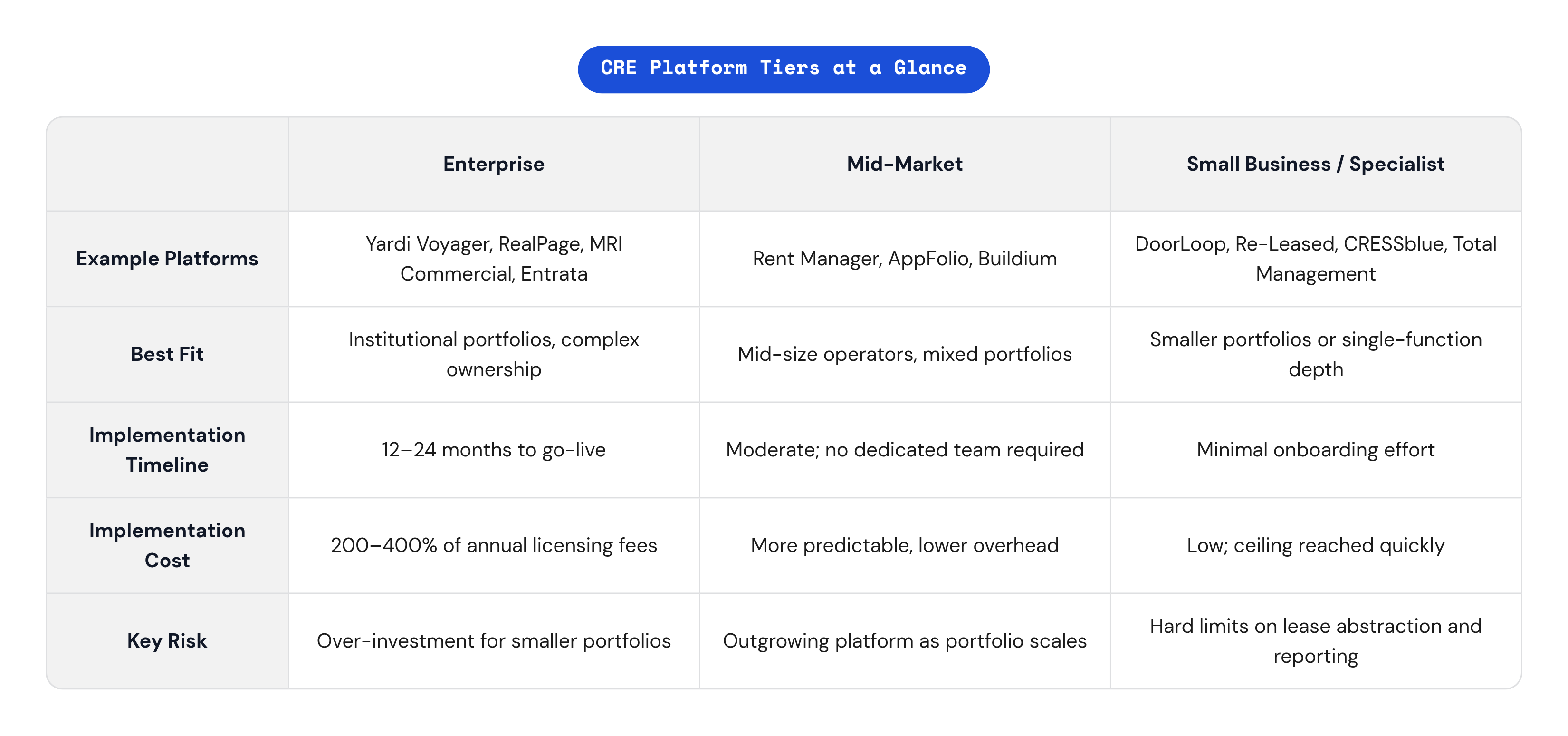
Three tiers have solidified in this market, each carrying meaningfully different capability depth, configuration burden, and cost structure. Knowing which tier fits your organization before entering vendor conversations is one of the most consequential decisions in the entire process, and it's consistently the one buyers skip.
Enterprise platforms like Yardi Voyager, RealPage Commercial, MRI Commercial, and Entrata are built for institutional portfolios. Maximum customization, complex integration environments, the works. They also carry implementation timelines of twelve to twenty-four months from contract to go-live, and implementation costs that regularly run two hundred to four hundred percent of annual licensing fees, according to Intellectual Market Insights. For a large institutional operator, that math makes sense. For a three-hundred-unit portfolio, it's a slow-motion mistake that takes about eighteen months to become obvious.
Mid-market solutions like Rent Manager, AppFolio, and Buildium occupy the range where functionality and usability are more deliberately balanced. These platforms are designed for organizations that need genuine commercial capability without a dedicated implementation team and a multi-year onboarding project absorbing everyone's time.
Small business and specialized tools, including DoorLoop, Re-Leased, CRESSblue, and Total Management, serve as entry points for smaller portfolios or as deep specialists in a single function, like CAM reconciliation. The ceiling on these platforms is real. You will eventually feel it.
Portfolio composition matters beyond raw unit count. Portfolios that are seventy percent or more commercial warrant purpose-built commercial platforms. Mixed-use portfolios need systems with genuine dual capability, not a residential platform with commercial features bolted on afterward. Buying above your tier means paying for implementation complexity your organization cannot absorb. Buying below it means hitting hard limits on lease abstraction, multi-entity accounting, and reporting customization precisely when your portfolio's growth is demanding more from the software.
Know which tier applies to you before the first vendor call. It changes what you ask, what you hear, and, critically, what you let yourself believe.
The core features that nearly every CRE buyer needs to evaluate first
Software Advice data from nearly thirty-five hundred conversations with property management buyers found that ninety-eight percent identified tenant and lease management as a required feature. That's the floor. Where the real evaluation begins is in the depth of a platform's execution in that area, because the floor is easy to clear and the gap above it is enormous.
Lease administration capability should be stress-tested across four dimensions: automated rent escalation calculations, CAM reconciliation workflows, critical date tracking, and lease abstraction. On escalations, can the platform handle both CPI-indexed and fixed step-ups without anyone touching it manually? On CAM reconciliation, can it calculate, bill, and audit charges without exporting to a spreadsheet at any point in the cycle? That last part is where many platforms quietly fail, and vendors are rarely forthcoming about it during demos. Ask directly. On critical dates, the alerts covering expiration dates, renewal options, and ROFO and ROFR deadlines need to be native and reliable. Missing a renewal option isn't an administrative error. It's a financial event.
Financial reporting depth is where the gap between platforms becomes most visible at scale. Multi-entity and multi-currency support matter for any organization with a complex ownership structure. General ledger, accounts payable, and accounts receivable should either live natively in the platform or connect through a documented, stable integration. Budget versus actual variance reporting at both property and portfolio level is essential for asset management conversations. Fund managers on legacy systems have reported spending up to three weeks generating reports that modern software produces in under two hours, according to Kolena. Three weeks, every quarter. The compounding cost of that is significant.
Tenant management encompasses online payment portals with ACH support, maintenance request intake and work order routing, and communication logs that create an auditable record. That last item is chronically underappreciated until a lease dispute or compliance review suddenly makes it the most important thing in the system.
Commercial buyers show above-average interest in building maintenance tools and budgeting and forecasting applications relative to the broader buyer population, according to Software Advice. Both are consistently under-weighted in initial demos. Push vendors hard on both, and do it early before the sales conversation gets comfortable.
Specialized capabilities that matter depending on how you operate
Not every platform needs to do everything, and treating specialized capabilities as universal requirements is one of the more expensive evaluation errors you can make. The real question is which of these categories actually maps to how your organization generates value or manages risk.
Deal pipeline and leasing velocity
For portfolios with high lease turnover or active acquisition and disposition activity, deal pipeline tooling is a meaningful differentiator. VTS is purpose-built for this function, with deal pipeline management, tenant retention workflows, and market intelligence used by some of the largest operators in the industry. VTS AI's Proposal AI agent has been reported to automate proposal entry by ninety-three percent, saving more than twenty-five thousand hours of manual work annually across its user base, according to Propmodo.
The limitation matters as much as the capability. VTS doesn't handle accounting, rent collection, or daily operations. Organizations that rely on it for leasing run a second platform alongside it for operational functions. That's a deliberate architectural choice, not a product gap, but it demands honest accounting of integration complexity and total cost before you commit. Two platforms means two vendor relationships, two renewal cycles, and two sets of things that can break.
Building operations for office and mixed-use
Building Engines was built specifically for preventative maintenance scheduling, compliance tracking, and work order prioritization across office, retail, and industrial assets. For portfolios where deferred maintenance creates measurable liability, or where institutional investors require compliance documentation, this kind of specialization matters in ways a general-purpose platform won't replicate. General-purpose tools spread their development resources across too many functions to go deep on any single one.
ESG and sustainability reporting
Institutional capital increasingly requires this, and regulatory frameworks are accelerating the timeline faster than most buyers expect. Measurabl tracks sustainability performance across more than twenty-one billion square feet of commercial real estate globally and automates submissions for frameworks like GRESB and ENERGY STAR benchmarking. For portfolios seeking institutional debt or equity, ESG data management is moving from a reporting convenience to an underwriting requirement. Treating it as a future-state concern is a timing error with concrete consequences.
Analytics and comparative reporting
Larger platforms offer sophisticated analytics, but buyers should understand the full context. RealPage's comparative reporting capabilities suit REITs and large asset managers well. The company's November 2025 Department of Justice settlement, which restricts how its pricing recommendations use nonpublic competitor data and imposes a court-appointed monitor with code-level access for seven years, is a compliance consideration institutional buyers should evaluate directly with legal counsel before signing anything.
In every demo, ask one specific question: does this capability live natively in the platform, or does it require a third-party module with a separate contract, a separate implementation, and a separate renewal cycle? The answer tells you what the platform actually is versus what it's being marketed as.
Integration requirements and the open-platform question
CRE operations don't run on one platform. A typical stack includes some combination of accounting or ERP, CRM, construction and project management, investor portals, and market data feeds. The integration architecture of whatever platform you select will determine how much of that existing stack you can preserve, and how much you'll be forced to replace or manually reconcile at the end of every reporting cycle.
The open versus closed platform question isn't philosophical. It's about which approach matches your existing infrastructure investment. MRI Commercial Suite is built on an open platform architecture designed explicitly for integration with established workflow tools. If your organization has a significant ERP investment, that openness has real value. Yardi Voyager integrates accounting, leasing, and operations natively, which reduces integration complexity but increases dependency on a single vendor's product roadmap and pricing decisions. You're trading one kind of risk for another. AppFolio's Realm-X platform, launched in 2024, embeds AI-driven workflow automation within its environment, which reduces the need for certain external point solutions depending on which workflows it actually covers.
Integration cost is one of the most consequential hidden drivers of total cost of ownership. Per-user-per-month pricing for mid-market platforms can look manageable in a proposal, but that number excludes integration development, implementation fees, and third-party data subscriptions. The full cost picture only emerges when those components are assembled together, usually after you've already signed.
Before signing any contract, resolve four specific questions. Does the platform offer a documented API, or does data leave the system only through flat-file exports? Which integrations are pre-built and which require custom development? What data formats does the platform accept for migration from your current system? Who owns the integration maintenance relationship over time? This last question gets deferred constantly and creates significant problems eighteen months later when something breaks and nobody is sure whose problem it is. Sixty percent of real estate companies experience serious complications during platform migrations, and thirty percent require manual data correction after migration, according to Kolena. Budget for that reality from the start, not after you've encountered it.
Understanding what CRE software actually costs beyond the subscription line
Nearly half of commercial real estate software buyers who spoke with Software Advice advisors are budgeting more than one hundred fifty dollars per month. Whatever that number is for your organization, it is the smallest component of what you will actually spend over the life of a mid-market or enterprise implementation. The subscription line in a vendor proposal is a starting point for the budget conversation, nothing more.
Five-year total cost of ownership regularly exceeds subscription costs by two hundred to three hundred percent when implementation services, training, customization, integration development, and internal IT support are fully accounted for, according to Leasey.AI. I've seen buyers go into a selection process with a clear subscription budget and come out of year one having spent three times that number. Not because they were deceived, exactly. Because they didn't ask the right questions and the vendor didn't volunteer the uncomfortable answers.
Training investment scales with platform complexity in ways that are predictable and consistently underestimated. Simple platforms require roughly ten to twenty hours per user to reach operational proficiency. Enterprise solutions require eighty to one hundred twenty hours per user. Only nine percent of real estate companies have dedicated IT departments, according to Verified Market Reports, which means most buyers are relying on vendor implementation teams or external consultants. Those fees are rarely visible in initial pricing proposals and rarely fixed-price in the contracts that follow.
The cost of a failed selection is concrete. Choosing the wrong platform costs one hundred thousand dollars or more in implementation expenses, lost productivity, and switching costs when the platform fails to meet operational requirements within eighteen to thirty-six months of go-live, according to Leasey.AI. That figure doesn't include the organizational disruption of running a second implementation while the first one is still being unwound, which is a genuinely unpleasant operational state to be in.
Treat customization and integration maintenance as ongoing operational line items, not one-time implementation events. The platform will evolve. Your portfolio will evolve. The integrations that work today will require maintenance as both sides of the connection change. This belongs in every year of your budget model, not just year one.
Implementation risks that derail selections that looked right on paper
Fifty-five to seventy-five percent of ERP implementations fail to meet original expectations due to extended timelines, budget overruns, or unmet requirements, according to Kolena. Commercial real estate platforms at the enterprise tier operate in that same risk category. The specific failure patterns are identifiable in advance, which means they're also at least partially preventable.
Data migration underestimation
Sixty percent of real estate companies experience serious complications during migration, and thirty percent require manual property-level data correction after the fact. Here's the thing most buyers discover too late: the condition of your current data determines the complexity of your migration more than the platform you're moving to. A clean, well-maintained data set moves relatively smoothly. Years of inconsistent entry, duplicate records, and undocumented exceptions do not. Budget for a dedicated data audit before go-live. Not during implementation. Before, when you still have time to do something about what you find.
Change management
Nearly forty percent of companies report employee resistance as a significant factor in delayed implementations, and only twenty-five percent enter a migration with a well-defined data strategy, according to Kolena. The organizational adoption plan is as important as the technical implementation plan, and it is almost always less resourced. The teams that navigate this well treat change management as a parallel workstream with its own budget and its own accountable owner, not as something that will sort itself out once the software is live.
Over-configuration at launch
This is the most common implementation failure pattern and the least discussed. Organizations select a platform with extensive capabilities and then attempt to configure all of them simultaneously during the initial rollout. The team can't absorb that volume of change at once. The platform goes live in a partially functional state, adoption suffers, and the perceived failure gets attributed to the software when the rollout strategy is the actual culprit.
Phased deployment is the practical fix. Begin with a pilot group focused on the two or three manual processes causing the most operational pain. Resolve problems in that controlled environment before broader deployment. Incremental rollout spreads cost, builds organizational competency, and surfaces integration problems at a scale that is still manageable rather than catastrophic.
Before any enterprise deployment, verify the platform's security posture: role-based access controls, encryption at rest and in transit, audit logs, and SOC 2 Type II compliance. Institutional investor reporting obligations make these requirements, not preferences.
How to structure the final vendor comparison and make the selection decision
The final comparison should be structured as a weighted scorecard. Without explicit weighting, different stakeholders weight different criteria differently, and the process drifts toward whoever argues most forcefully rather than whoever has the best information. That's a bad way to spend a hundred thousand dollars.
A functional weighting that holds up in practice: features at thirty percent, assessing whether the platform handles actual workflows rather than demo scenarios; ease of use at twenty-five percent, because capable software that doesn't get adopted delivers no operational value regardless of its capability ceiling; support at twenty percent, covering response SLAs, onboarding quality, and access to implementation resources; pricing and total cost of ownership at fifteen percent, meaning the full five-year cost rather than the subscription rate; scalability at ten percent, specifically whether the platform can grow with the portfolio without requiring a full reimplementation. This framework is adapted from Buildium's published evaluation structure.
The demo protocol matters as much as the scorecard. Bring two or three actual leases from your current portfolio into every vendor demo and ask the vendor to demonstrate CAM reconciliation and critical date tracking against your leases specifically. Not a generic example, your leases. Ask explicitly how the platform handles the edge cases in your asset class: percentage rent for retail, flex-space utilization for office, preventative maintenance volume for industrial. A vendor who can only demo clean, uncomplicated scenarios during the sales process will not perform better after the contract is signed.
Request a data migration scoping call before the contract, not after. A vendor willing to scope migration complexity before closing has confidence in what they're selling. One who defers that conversation until post-signature is hoping you don't look closely enough before committing.
The selection decision, once the scorecard is complete, should be made by the people who will live with the platform daily, weighted by the input of the people accountable for the financial outcomes. That combination produces decisions the organization can actually execute on, which is the only kind that matters.