Blockchain Applications in Real Estate Title and Escrow
Blockchain eliminates the fragmented record-keeping that slows closings and enables wire fraud.
Real estate closings in the U.S. still take an average of 50 days, and the delay has nothing to do with any single slow step. It comes from six or seven parties working off six or seven different ledgers, none of which update each other automatically. Blockchain's entire pitch to this industry is fixing that architecture problem, the gap between six or seven ledgers that don't talk to each other. This piece walks through what blockchain actually does in a title and escrow context, where it's already running in production, and where it still runs headlong into county paperwork and state law.
Brokers, title companies, escrow officers, notaries, lenders, and county recorders each keep their own version of the truth. None of those versions talks to the others. That's a design flaw built into how the industry keeps records, and every handoff between those parties is a place where information gets re-entered, re-verified, or faxed (yes, still faxed) from one system into the next. Each handoff adds days.
Three failure modes live inside that structure, and blockchain addresses each one differently, so they're worth pulling apart instead of lumping together. Fragmentation means there's no single source of truth for who owns a property, so title searches mean digging through records that might be incomplete or simply wrong. Fraud vulnerability means wire instructions and title documents travel through email and phone calls, both interceptable by someone with zero legitimate claim to either. Closing delay means every condition, an inspection, a lender sign-off, a regulatory clearance, gets checked by a person instead of a system, one email at a time.
Fraud is the sharpest of the three. FBI data shows real estate fraud losses jumped from $173 million in 2024 to $275.1 million in 2025, on 12,368 complaints versus 9,359 the year before. The FBI also estimates only 15% of incidents ever get reported, which means the real total almost certainly dwarfs what shows up in the complaint data. Six-figure transactions get routed through phone calls, email threads, and PDFs that anyone with the right access can quietly edit mid-transit. That mechanism drives the losses, and it's worth holding onto that distinction going into the next section, because a structural vulnerability calls for a very different fix than bad luck would.
What a blockchain actually provides in a title and escrow context
Two things matter here, and conflating them is where most explanations of this technology go wrong. The first is an immutable shared ledger: every ownership record, lien, and transfer written once, visible to everyone with permission to see it, and unalterable after the fact. The second is the smart contract: self-executing code that holds funds and releases them automatically once pre-set conditions are met, with no escrow officer manually pushing a wire through.
The ledger goes straight at fragmentation. Instead of the county recorder holding one version of ownership history, the title company another, and the lender working off a third, everyone reads from the same record. The tamper-resistance goes straight at fraud. A buyer's wire instructions, once written into a smart contract, can't be swapped mid-transaction the way an emailed PDF can be intercepted and edited by whoever's sitting quietly in that thread.
Here's roughly how the mechanics play out. A buyer deposits funds on-chain into the contract. Title data gets digitized and recorded. The contract then watches for conditions: inspection completion, regulatory clearance, lender approval. Once those are satisfied, it releases funds to the seller and transfers title to the buyer on its own, with no human required to push a button at any point in that sequence.
Worth being precise about what this doesn't do: blockchain doesn't replace due diligence. Someone still inspects the house. A lender still underwrites the loan. What the smart contract automates is the release of funds once that due diligence is confirmed, which happens to be exactly where most of today's delay and error already sits. That's a fix aimed squarely at the paperwork bottleneck, and the judgment calls stay exactly where they were.
How blockchain title registries address the ownership-record problem
Title searches today mean tracing ownership through paper records that are sometimes incomplete, sometimes misfiled, and occasionally falsified outright. Title insurance exists specifically because that search can't be trusted to be airtight, which is a fairly damning admission about how shaky the underlying system already is. An entire insurance product exists to cover for the fact that nobody's fully sure who owns what.
Put every ownership event, purchase, transfer, lien, release, on a blockchain, and the result is a chain of custody that's auditable without a title company doing the manual legwork. Verification that used to take weeks can drop to hours, cutting out the longest manual step in the whole search process.
Some governments have already moved past the pilot stage. Georgia (the country, not the state) has been cited as an early national adopter of blockchain-based land registration, recording property titles with cryptographic proof of ownership. Sweden's land registry ran a blockchain pilot for recording property transactions, exploring how a private blockchain with a smart contract layer could replace paper-based transfer records. Dubai's Land Department has moved to register property deeds on a blockchain ledger, with official titles recorded as digital tokens. In the U.S., several jurisdictions have explored pilots to move land records onto blockchain platforms.
What these pilots really prove is that the technology works. Nobody's still debugging the cryptography. The friction left over is legal recognition and getting new systems to talk to county infrastructure that in some cases predates the fax machine, and that's a much slower fight than writing code.
How smart contract escrow removes the wire fraud attack surface
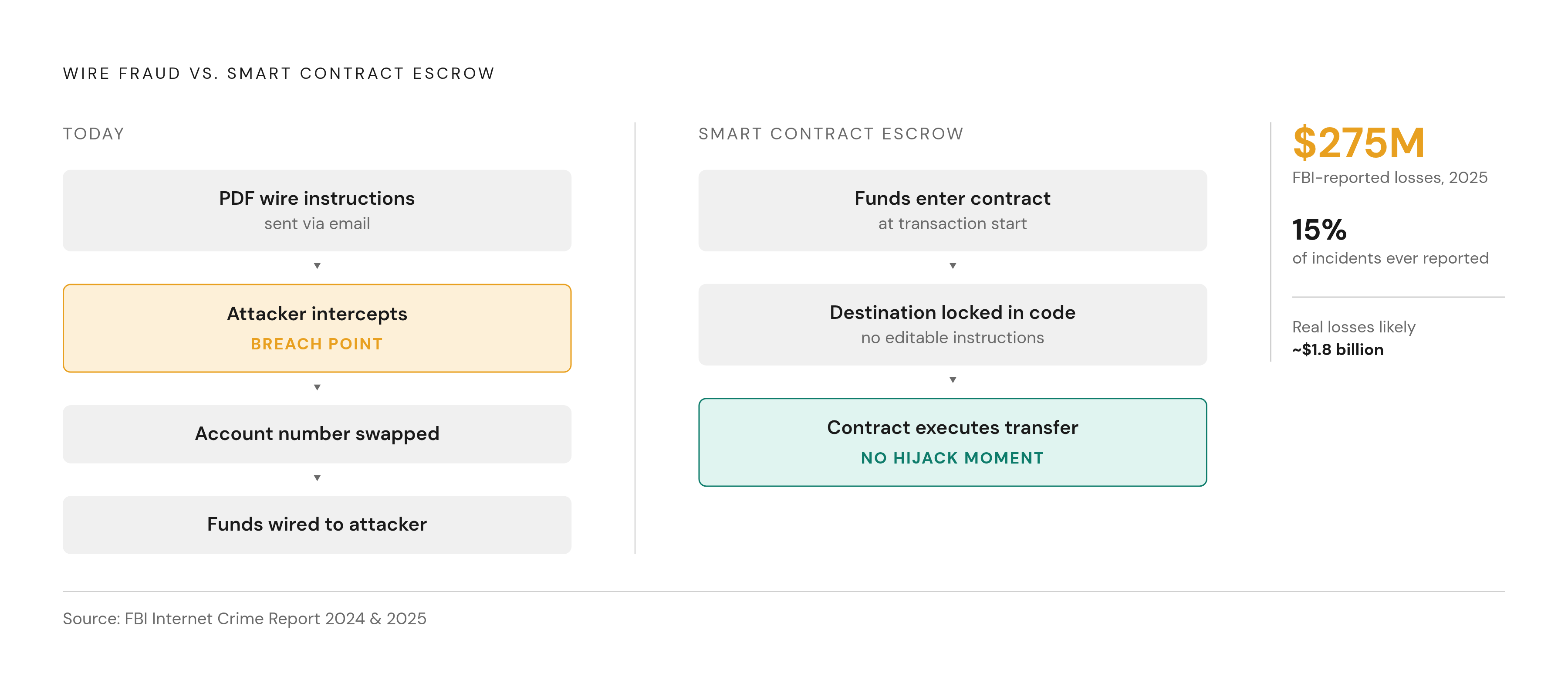
Business email compromise is the mechanism behind most real estate wire fraud, and the pattern is dull once you see it laid out. An attacker gets into an email thread, swaps the legitimate wire instructions for their own account number, and the buyer wires six figures straight to a stranger who's never set foot near the property. The attack works because wire instructions travel as an editable document through a channel nobody's actually verifying.
BEC accounted for $2.77 billion in losses in 2024, with real estate wire fraud making up an estimated $500 million of the broader $12.5 billion in losses reported to the FBI's Internet Crime Complaint Center that year. Smart contract escrow shuts down the exact channel this fraud depends on. Funds go into the contract at the start of the transaction instead of getting wired at closing off an emailed instruction sheet. The destination, the seller's wallet or account, is written into the contract's code itself, not sent as a document someone can quietly retype. The contract executes the transfer directly instead of a person following instructions from an inbox, closing off the one moment, "send the wire to this account," that an attacker needs to hijack the whole deal.
There's a quieter benefit sitting next to the headline one: every party can check escrow status on-chain in real time, which cuts down on the phone tag of confirming with an escrow officer whether a wire actually cleared. Wire fraud doesn't become impossible under this model; the door it usually walks through simply closes.
What smart contracts do to closing timelines and transaction costs
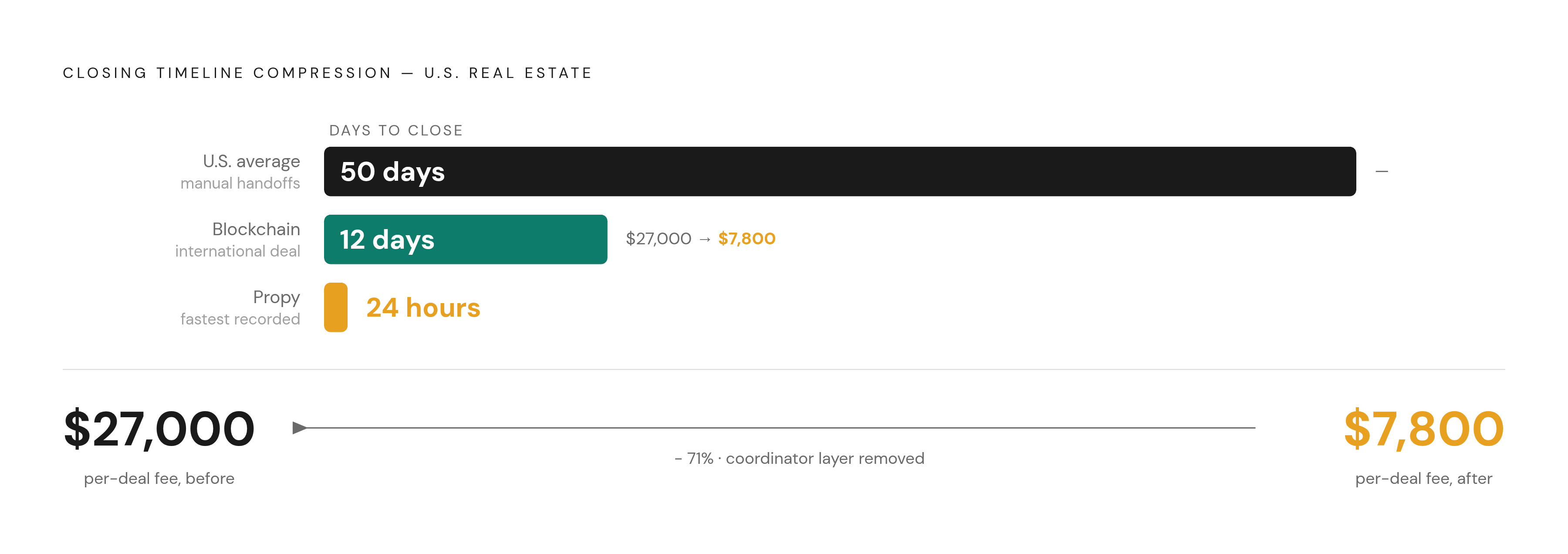
That 50-day average is stacked with manual steps at every handoff: document requests, title searches, escrow coordination, lender confirmations. Most of those steps don't need a human's judgment. They need a human's time, which is a different problem with a different fix.
Smart contracts turn each condition, inspection, regulatory approval, lender sign-off, into something the contract itself monitors. Once a condition is met, the deal moves forward without a coordinator checking a box and calling someone to relay the news. One documented blockchain implementation cut international deal timelines from the usual 45 to 60 days down to 12, with per-deal transaction fees dropping from $27,000 to $7,800. That's what happens when the layer of people whose entire job is coordinating other people gets removed from the critical path.
Propy has pushed this to its logical extreme, closing a home purchase in as little as 24 hours using smart contracts. That's less a typical outcome than a proof that the ceiling sits a lot higher than 50 days.
Here's the caveat worth sitting with, though: the speed gains show up in coordination and verification, not in the parts of the process that genuinely need a lawyer or a regulator to look at them. Those steps don't vanish just because a smart contract is running underneath them. They just stop being the bottleneck, a real improvement on its own terms, well short of a system with no lawyers left in it.
Where blockchain title and escrow is operating today
As of 2024, 20% of real estate firms were adopting blockchain in some form, 12% had implemented tokenization specifically, and 46% were running pilots. That's early-mover territory, further along than most emerging technologies get before the trade press starts calling them "emerging," but still well short of the mainstream.
Propy is the most documented U.S. example, and by a wide margin. It built the first blockchain-enabled title and escrow service operating in the country, running in Arizona, Colorado, and Florida. It records title both on-chain and with the county registrar, a hybrid setup that satisfies existing legal requirements while still building the blockchain record underneath. It supports traditional, crypto, and NFT closings, with crypto escrow through Coinbase Prime. As of mid-2024, Propy had supported more than $4 billion in real estate transactions, and that year it paired AI with blockchain to cut 40% of the manual labor that title and escrow work traditionally demands. Its Propy Keys platform has minted more than 285,000 property addresses as NFTs, tied to over $10 billion in real estate value worldwide, and it has closed property sales entirely on-chain in international markets.
Other players are circling the same problem from different angles. Other players are circling the same problem from different angles, with firms across Europe and the Middle East running pilots in smart escrow and property tokenization for fractional investment.
In a Deloitte survey, 86% of commercial real estate CEOs said they expect blockchain to change the market fundamentally in the near term, which sits well ahead of where actual implementation is today. Executives are betting on a curve steeper than the current adoption numbers justify, and that gap between belief and deployment is itself worth watching over the next few years.
Property tokenization as the next layer on top of blockchain title
Once a title exists as a verified on-chain record, the ownership it represents can be split into digital tokens: fractional slices of a property that get issued, moved, or traded through code rather than paperwork. That's tokenization, a layer that depends entirely on the title infrastructure covered above rather than a standalone product bolted onto real estate. Tokenize ownership without a reliable on-chain title record underneath it, and what you've built is a database with extra steps and a marketing budget.
Deloitte's 2025 forecast puts the global tokenized real estate market at $4 trillion by 2035, growing around 27% a year from a base well under $300 billion today. That's not a rounding error of a forecast; it implies tokenization stops being a side experiment and starts being how a meaningful share of property actually changes hands.
What changes for title and escrow specifically once tokenization shows up? A single property could end up with dozens, even hundreds, of token holders, something no paper-based recording system could handle without collapsing under its own filing cabinets, but that a blockchain manages without much strain. Selling a tokenized share on a secondary market doesn't require a fresh title search or a new escrow process; the smart contract just handles the transfer. Cross-border deals, get far more workable once ownership is a blockchain record instead of a document chained to one country's paper system.
Everything covered so far, the shared ledger, the smart contract escrow, the faster closings, adds up to more than a pile of incremental fixes. It's the foundation a tokenized market needs before it can start behaving more like a securities exchange than a 50-day closing marathon with a fax machine wedged in the middle of it.
What is not yet resolved and where real friction remains
Legal recognition is the biggest gap, and it's not a small one. A blockchain title record only carries as much weight as the jurisdiction that recognizes it, and most U.S. counties still require recording in legacy systems that have no idea what a smart contract even is. That's exactly why Propy records on-chain and with the county registrar simultaneously: the old system hasn't gone anywhere, and pretending otherwise doesn't close a single deal faster.
Interoperability is its own separate headache. Blockchain platforms for title and escrow haven't standardized, so a record on one chain isn't automatically readable on another. That builds a new kind of fragmentation directly on top of the paper-based fragmentation the technology was supposed to eliminate.
Regulation is still catching up, too. Crypto-denominated escrow and NFT-based title transfer sit inside a legal environment that shifts from state to state and country to country, and that compliance overhead eats into some of the speed gains described earlier. Adoption also needs multiple parties to change behavior at the same time: title companies, lenders, county recorders, regulators. If even one of them holds out, the manual steps creep right back into the transaction.
The underreporting problem cuts in an odd direction here. If only 15% of wire fraud actually gets reported, every fraud figure cited earlier in this piece is a floor, not a ceiling, and the real scale of the problem is almost certainly worse than the industry currently assumes. That should sharpen the case for structural fixes rather than soften it.
Georgia and Sweden already proved the technology works; what's gating adoption now is legal infrastructure and getting a dozen institutions to agree on a format at the same time. That's a slower fight than writing the code ever was, and it's the fight that actually decides whether any of this reaches the average homebuyer instead of staying a pilot program in a press release.