Buy Now Pay Later Models Applied to Real Estate Closing Costs
Closing costs are too big and too rigid for checkout-aisle payment plans.
BNPL is migrating from checkout screens to closing tables. The same installment logic that lets someone split a $200 jacket into four payments is now getting tested against a bill that averages $4,661 and can run past $17,000, and the fit is nowhere near as clean as the marketing suggests.
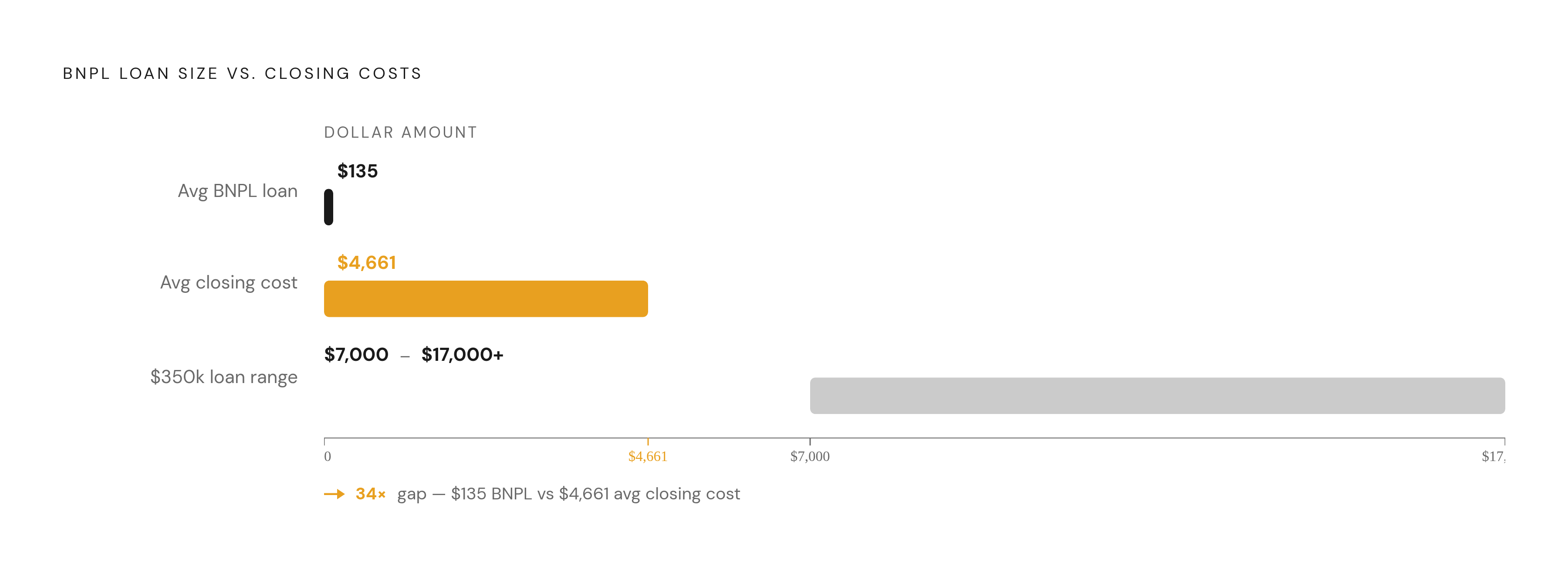
Per LodeStar's 2025 report, the average closing cost on a single-family purchase sits around 1.6% of the average $438,236 sale price. That number flattens a range that isn't flat at all. On a $350,000 loan, closing costs typically run 2% to 5%, meaning buyers can owe anywhere from $7,000 to more than $17,000. Location does a lot of the work too: state-level costs range from under 1% of sale price to nearly 3%, with Washington, D.C. at the expensive end and South Dakota at the cheap one.
What's actually inside that number isn't mysterious. Credit checks, title search, title insurance, appraisal, attorney fees, an origination fee, an application fee, an underwriting fee, transfer taxes; most of these are set by the lender or by state law, not negotiable line items a buyer can talk down. First-time buyers feel this hardest, since there's no prior home sale kicking equity back into the pot. The down payment and the closing costs draw from the same shrinking pool of savings. That's a cash-timing problem, not a question of whether someone can afford the monthly mortgage payment going forward, and it's exactly the gap BNPL-style products are angling to fill.
How BNPL actually works, mechanically, before anyone bolts it onto a mortgage
The retail version everyone's used at least once follows a simple pattern: four equal payments, the first due right at purchase, the other three spaced about two weeks apart, usually interest-free if paid on schedule. That's "pay-in-four," and it's the version most people picture when they hear the term BNPL. It is also, and this matters more than it sounds like it should, built for purchases under a few hundred dollars.
It isn't the only format. Longer-term installment loans stretch payments over months or years and usually carry interest, functioning like a traditional loan wearing a friendlier interface. Deferred payment, sometimes marketed as "pay in 30," pushes the entire balance out by a grace period with no installments at all: you either pay the whole thing at day 30 or you don't.
The category has grown past the point where anyone can call it a fringe habit. In 2023, BNPL lenders originated 335.8 million loans totaling $45.2 billion, up 23% in volume and 26% in dollar value from the year before. A Richmond Fed model projects real origination values climbing to $65.31 billion in 2025. Credit performance backs up the growth story too: the 2023 charge-off rate for BNPL loans was 1.83%, down from 2.63% in 2022, against 4.19% for credit cards over the same stretch. Small-dollar underwriting, it turns out, isn't the reckless experiment skeptics assumed it would be.
None of that changes the arithmetic sitting underneath this whole conversation. The average BNPL loan size is $135, against an average closing cost of $4,661. That's roughly a 34x gap, and no amount of interface polish closes a 34x gap on its own. Anyone pitching "BNPL for closing costs" as a drop-in swap for the pay-in-four model is either misunderstanding the math or hoping the buyer won't check it.
The three BNPL formats and how each would actually behave at the closing table
No dominant, purpose-built "BNPL for closing costs" product exists as of mid-2026, so this isn't a product review. It's a mechanical walkthrough of how each retail format would behave if bolted onto a real closing, based on the adjacent products that already exist, and a fairly firm opinion on which of the three deserves the most skepticism.
Split-pay first, and it's the weakest fit of the three. A buyer covers a fraction of costs at closing, the rest splits across two or three follow-up payments. That works fine for a smaller service fee, the appraisal or the credit check, and fails outright against transfer taxes or prepaid escrow, the fixed obligations that have to clear in full on closing day no matter what. The two-week payment cadence built for a small online order doesn't scale to a many-thousands-of-dollars obligation without stretching the intervals so far that it stops resembling split-pay at all.
Longer-term installment loans map more cleanly, if less excitingly. A lender or third-party fintech covers the closing costs upfront, the buyer repays monthly over a set term, usually with interest attached. Functionally, this sits close to rolling costs into the mortgage, except it runs as a separate loan parallel to the mortgage rather than folded into the principal. It resembles a personal loan taken out to cover closing costs, a practice that already exists under heavier lender scrutiny than most buyers expect.
Then there's the deferred, event-triggered model, and this is the one worth paying attention to. Costs get covered at closing, and repayment doesn't happen on a calendar date; it triggers when the home sells, refinances, or the mortgage gets paid off. Iowa Finance Authority's 2nd Loan Program is a working example: assistance due at sale or refinance, structured so repayment triggers on a life event rather than a calendar date. Government-backed, but structurally it's BNPL with a life event standing in for a due date, and it carries the lightest monthly pressure of the three, often paired with shared-appreciation terms or interest that accrues quietly and shows up later.
Worth naming too: the "Sign Now, Pay Later" model surfacing in commercial real estate, through providers like Duckfund, which lets an investor lock down a property with a signature instead of a soft deposit. That's deferred capital commitment, not deferred payment, and a residential version, one that removes closing-day cash entirely, would be the most aggressive version of this idea currently on the table.
Strip the branding off any of these three, and the question for a buyer doesn't change: does this defer the cash problem, or just relocate it to a different date with a price tag stapled to it?
What the market already offers, and why it makes BNPL look late to its own party
BNPL isn't walking into an empty room, and this is the section most people skip past too fast. Rolling closing costs into the mortgage is already the most common workaround: it cuts the day-of cash requirement while adding to the principal and compounding interest for as long as the loan runs, sometimes 30 years.
Seller concessions show up more often than most buyers assume. Seller concessions are more common than most buyers assume, with a meaningful share of accepted offers including partial or full seller coverage of closing costs. That's a negotiated outcome, not a financial product, so it lives and dies by how hot or cold the local market happens to be.
Lender grants sit beside this, and they don't require repayment at all. Bank of America offers up to $7,500 toward non-recurring closing costs. Chase's Homebuyer Grant tops out at $5,000, and Wells Fargo's Dream. Plan. Home.® program offers a closing cost credit up to $5,000. Income and geography limits apply, so none of these are universal, but their existence signals that lenders already treat upfront cash friction as a problem worth subsidizing rather than financing.
The biggest pool by far is state and local down payment assistance. Down Payment Resource's Q4 2025 index counted 2,619 active programs nationwide, up from 2,466 a year earlier. The average benefit is about $18,000, with an average loan-to-value reduction of 8.8%, and many of these programs cover closing costs alongside the down payment itself. CalHFA helped more than 6,800 California families buy homes in fiscal year 2024–25, beating its annual target by 20%.
Here's the part that should reframe how BNPL gets pitched: many existing DPA programs already run on deferred-payment mechanics, repayment due at sale or refinance, the exact structure BNPL is being credited with inventing. The label is new; the mechanism has been sitting in government housing finance for a while. What's actually left over for BNPL to serve is the buyer who falls outside every one of these nets: over the income cap, outside the geographic footprint, not a first-time buyer, or simply too late, since CalHFA's programs have historically seen demand that outpaces available funding cycles. That's a real gap. It's also a much narrower gap than the marketing implies.
Why DTI is the part of this story that actually determines whether it works
Here's where the concept runs into friction retail BNPL never has to deal with. A new payment obligation taken on right before or at closing can push up a borrower's debt-to-income ratio, and DTI is the single most common reason mortgage applications get denied. DTI is widely cited as the single most common reason mortgage applications get denied, making any new payment obligation taken on near closing a genuine underwriting risk.
BNPL has a visibility problem baked into how it reports. These obligations frequently don't show up on a standard credit report, so a lender's automated DTI calculation can miss them entirely. Bank statements tell a different story, though; underwriters reviewing statements spot recurring BNPL payments and start asking questions, credit report or no credit report. A buyer who takes out a BNPL loan to cover closing costs and then applies for a mortgage is walking into more scrutiny than a buyer who takes the same loan out after closing wraps.
One structural carve-out is worth understanding in detail, because it's the design constraint any legitimate product in this space has to work inside. FHA underwriting guidance includes provisions around how short-term closed-end debts are treated, and any legitimate product in this space would need to be structured to fit within those existing policy boundaries. In plain terms: a BNPL product built to cover closing costs and fully retire inside that 10-month window could, under current FHA policy, avoid inflating DTI at all. That's not a loophole so much as the entire blueprint for how a compliant product would need to be built.
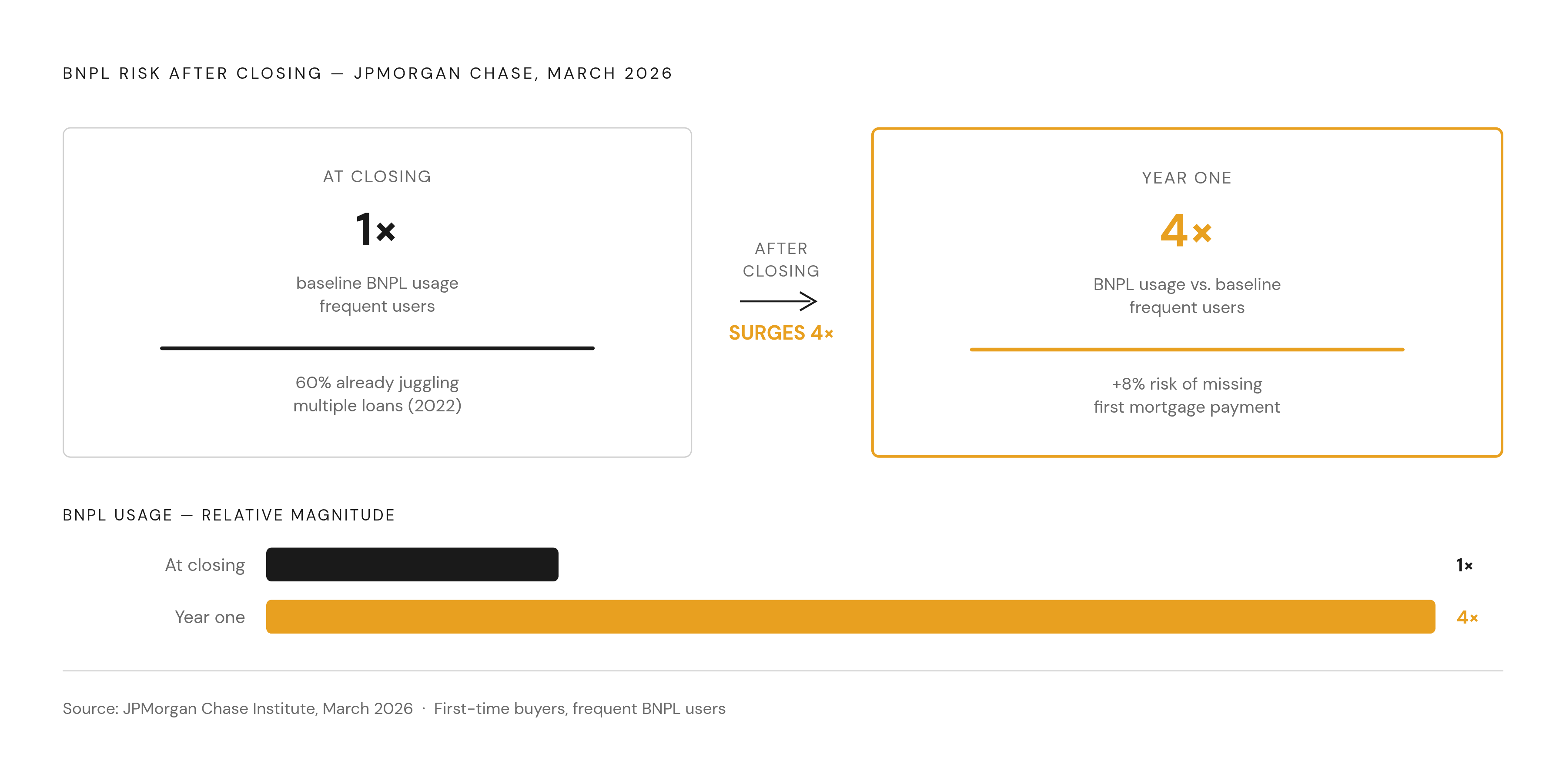
Post-closing behavior adds a second layer of risk underwriting doesn't catch, because it happens after the file is already approved. Research from JPMorgan Chase, published in March 2026, found frequent BNPL users increase usage nearly fourfold after closing on a home, and first-time buyers leaning heavily on BNPL face an 8% higher risk of missing a mortgage payment in year one. The risk isn't confined to the underwriting desk; it's behavioral, and it shows up after the keys change hands. A buyer stretched thin to make closing happen doesn't stop being stretched thin once the moving truck pulls away, and BNPL becomes the tool that covers the couch, the movers, the first surprise repair bill.
HUD has signaled active interest in how BNPL affects FHA underwriting, and formal guidance on the question appears to be in motion. Until it lands, buyers and lenders are operating in a gray zone with more assumptions than rules, and that gray zone should make anyone cautious, not curious.
What to actually check before signing up for one of these
Start with timing, because it decides almost everything else. Any obligation taken on before the mortgage closes has to be disclosed, and its position relative to the loan application date changes how a lender treats it entirely. An obligation opened after closing is a different animal than one opened the week before, even if the dollar amount is identical.
Then run the real cost of capital side by side, without letting the marketing do the math. Rolling costs into the mortgage means less cash due today, but interest compounds over 30 years, sometimes turning thousands of dollars in closing costs into a much larger number over the life of the loan. An interest-bearing installment loan gives a known total cost and a shorter horizon, but adds a visible monthly obligation an underwriter will factor in. A deferred or event-triggered product removes monthly payment pressure, but the bill comes due at the moment of maximum liquidity need, when the home sells or refinances, which isn't always a moment the buyer gets to choose. Zero-interest deferred options, meaning grants and DPA, cost nothing if the buyer qualifies, so eligibility should get checked before anyone signs onto a fee-bearing alternative. That order matters: check free money first, and treat anything with an interest rate as the fallback, not the default.
The FHA's 10-month rule is a useful gut check even outside FHA loans specifically. A product that fully retires in under 10 months, with payments under 5% of gross monthly income, likely dodges DTI impact under current FHA policy, though a loan officer should confirm that directly rather than a buyer assuming it.
A short set of questions does most of the evaluation work. Will this debt show up on a credit report before the mortgage closes? Is the repayment date fixed, or tied to a sale or refinance that might not happen on schedule? What's the full repayment cost, fees included, next to the grants and DPA already sitting in the market unclaimed?
The buyers this genuinely helps are a narrow group: people who don't qualify for grants or DPA, buying where sellers aren't offering concessions, with stable income but not enough liquid cash sitting around specifically for closing day. It is not built for buyers who are broadly over-leveraged, and the stacking data is the clearest warning sign in the whole piece. In 2022, 21% of consumers with a credit record used BNPL from a major provider, and 60% of those had multiple BNPL loans running at the same time. Stack that habit onto a closing cost product and the timing problem it was meant to solve turns into a second, bigger one, arriving later and compounding.
BNPL mechanics can genuinely shrink a real cash-timing gap in homebuying, but the evaluation has to start with total cost and underwriting exposure, not with how much smaller the number looks on closing day. Smaller today doesn't mean smaller, period; it usually just means later, with interest attached.