Commercial Real Estate Fintech Startups Reshaping Lending
Banks are pulling back from a $4 trillion refinancing wave, and fintech is racing to fill the void.

More than $4 trillion in commercial real estate loans come due between 2025 and 2029, and the banks that wrote a lot of that debt are in no hurry to refinance it. This piece looks at the fintech companies stepping into that gap, the marketplaces, the AI underwriting shops, the alternative capital vehicles, the tokenization bets, and asks a plain question: are they solving the problem, or just repackaging the same scarcity with a nicer interface? Some of this technology is real infrastructure, and some is just a faster horse, as we'll see below. Worth figuring out which is which before anyone's maturity date arrives.
Start with scale, because the number sounds abstract until you sit with it for a second. The Mortgage Bankers Association estimates that 2025 maturities will hit around $957 billion, nearly 20% of existing commercial mortgages. Another $875 billion matures in 2026. This is not a one-year hiccup that resolves itself once rates settle. It's a rolling wave, and the boats meant to carry borrowers across it, banks, have been pulling back rather than rowing harder. Sponsors who financed at 2021 rates are staring at a refinancing environment that's slower, pickier, and in a lot of cases just not interested. The whole point of what comes next is this gap between strong demand and shrinking traditional capital.
How large the gap actually is between available bank capital and what borrowers need
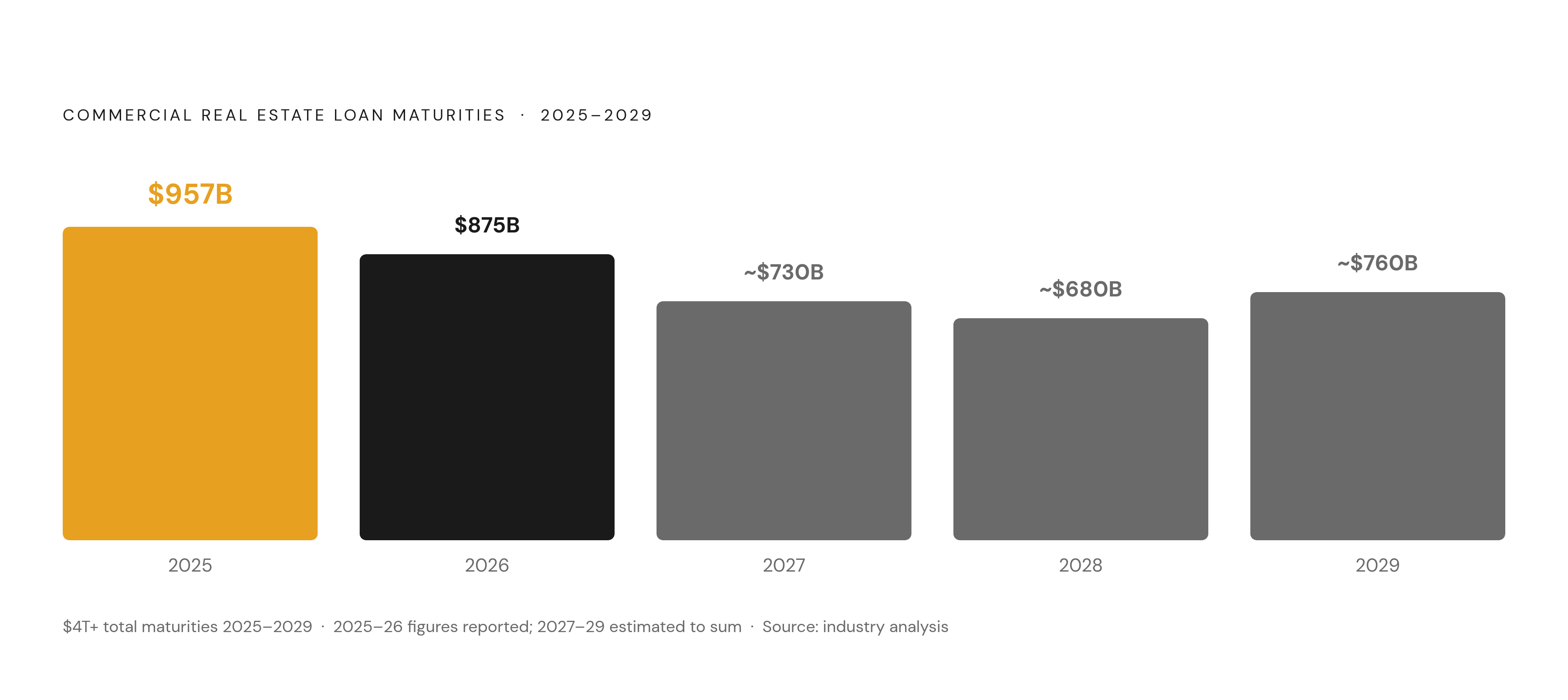
Commercial banks still hold close to $3 trillion in commercial real estate loans. That sounds like dominance, and it's tempting to read it that way. But dominance and direction are different things, and the direction here points down: The private debt market is forecast to reach $2.3 trillion by 2027, a growth curve that doesn't reverse because of one Fed meeting.
The 2025 closings data makes the handoff concrete rather than theoretical. Alternative lenders, meaning debt funds and mortgage REITs, captured 37% of non-agency closings, ahead of banks at 31% and life companies at 16%, according to Agora Real. Banks are no longer the default answer to "who's financing this deal." They're one option among several, and increasingly not the fastest one.
So the real question isn't whether alternative capital fills the gap left by retreating banks. It already is. The real issue is figuring out which companies and tech actually do a good job filling the gap, not just quickly. They’re different, and mixing them up is why so much hope in this sector is misplaced. That's where the fintech layer stops being a footnote and starts being the actual infrastructure of the market.
What makes CRE lending genuinely hard to digitize, and why that is changing now
No two commercial real estate loans look alike, and that's by design, not accident. A loan on a mid-size medical office building in Tucson is vastly different from a construction loan for a mixed-use tower in Brooklyn, with different lease structures, local comps, capital stacks, and tenants with very different credit profiles. Try building one underwriting model for both, and you'll understand pretty quickly why residential mortgage tech, standardized and largely automated a decade ago, never quite translated over to commercial.
Traditional underwriting reflected that complexity by being slow on purpose. Manual reviews took weeks: hand-checking financials, scheduling site visits, waiting for appraisals, and gathering comparable sales one by one. No step moved forward without someone approving it first. That wasn't inefficiency for its own sake. It was built for a world where the underlying data simply didn't exist in a form software could touch.
That's the part that's changed. AI can now parse lease abstracts, pull comparables, and model valuations at a speed that would have sounded like science fiction five years ago, and a U.S. The CRE mortgage market, which saw $498 billion in borrowing in 2024 (↑16% YoY, per the MBA), is big enough to make the R&D cost of these tools worthwhile.
Then there's the forcing function nobody asked for but everybody's dealing with: the maturity wall itself. A sponsor with a loan due in 90 days doesn't have patience for a six-week underwriting cycle. They need an answer in days. Urgency turns out to be a pretty effective sales pitch for automation.
How AI underwriting is compressing the time between application and decision
Blooma's pitch is that its platform lets underwriters handle more deals with the same staff. Research from V7 Labs supports this trend, showing banks using AI underwriting cut decision times on commercial loans by half or more. According to the research, Speed isn't a nice-to-have when the borrower on the other end has a maturity date circled in red marker. Speed isn't a nice-to-have when the borrower on the other end has a maturity date circled in red marker.
What is the AI actually doing, mechanically? Parsing lease abstracts. Evaluating property performance metrics. Assessing borrower creditworthiness. Estimating values by considering climate risks, neighborhood trends, and industry changes like how e-commerce wiped out many retail sectors. Blooma uses data from Moody's Analytics REIS Network and local crime stats to create a property profile before human review.
None of this replaces underwriting judgment, and that's worth sitting with, because it's the claim most likely to get overstated in a pitch deck. AI cuts out the manual tasks, collecting and reshaping data, that once took up most of an underwriter’s week, freeing them to focus fully on the risk decision, the part that relies on years of experience, rather than just the scraps of energy left after admin work.
But how much should anyone trust a model trained mostly on pre-2020 cycles? Office and retail didn't just wobble after the pandemic, they got structurally rewired, and a model that learned its instincts from the old normal may not fully price the new one. Human oversight isn't a compliance checkbox here. It's the thing catching what the training data never saw, and any lender treating it as optional is skipping the one step that actually matters.
The startups building marketplace infrastructure: CommLoan, Lev, and LOANtuitive
CRE borrowing has historically run on relationships, not price discovery. A sponsor contacted their go-to broker from three prior deals, who then reached out to three familiar lenders, and the "market rate" resulted from this small circle. Nobody was shopping the whole field, because there was no efficient way to.
CommLoan calls itself the operating system for CRE lending, connecting borrowers, brokers, and lenders through AI-powered matching, and claims to run the first true commercial mortgage lending marketplace.
Lev has raised $100 million in venture capital and financed more than $2 billion in deals in 2024 alone, pairing real-time lender data with CRM and workflow tools built for sponsors and brokers. It has a network of over 4,000 lenders, including regional banks, national shops, and specialty finance firms.
LOANtuitive, based in Seattle, focuses on one thing: helping commercial mortgage brokers do their jobs better without replacing them. Since its April 2021 launch, the platform's brokers have originated over $2 billion in commercial loan requests. The company closed a $1.1 million pre-seed round backed by Ascend.vc, with founders out of DocuSign and LegalZoom. Early stage, sure, but that's a pedigree that knows something about building trust-based infrastructure.
What ties these three together matters more than what separates them: none of them try to cut the broker or sponsor out of the loop. They boost the human connection rather than removing it, which differs from most consumer fintech. In consumer lending, the app often is the relationship. In CRE, the relationship is still the product. The software just makes it move faster, and any founder pitching otherwise probably hasn't closed a large deal.
The startups embedding AI into the lender's own workflow: Blooma and Roc Capital
Different playbook here. These companies don’t redirect borrowers away from traditional lenders, they sell speed and accuracy to those same lenders instead.
Blooma is a cloud-based platform that automates the manual chunks of the lending workflow and stitches together data sources that used to sit in separate silos. Regions Bank adopted it and reported that workflow steps once measured in days now take hours, a real shift for developer and investor clients who'd rather not wait. Blooma gathers data from Moody's Analytics REIS Network and web sources such as local crime stats and building records, then applies machine learning to create property profiles linked to loan applications. The point is clear: underwriters manage more deals with the same staff, and that’s the kind of math a bank's CFO likes without any presentation.
Roc Capital takes a third approach entirely, one that doesn't fit neatly into "marketplace" or "software vendor." It's a fintech-native private lender blending human underwriting with AI-driven data intelligence to speed approvals and sharpen risk modeling, while trying to keep the borrower experience from feeling like a black box. Technology isn't the product Roc sells to a lender. It's the edge a lender uses to originate and underwrite faster than the shop across the street.
Regions Bank running Blooma internally complicates the tidy "fintech disrupts bank" story people like to tell. This isn't a bypass narrative where startups route around slow incumbents. Banks are absorbing this technology directly, under competitive pressure, which suggests the endgame isn't fintechs replacing banks. It's the whole category adopting the same tools at different speeds, with the slow adopters simply losing deal flow to the fast ones.
Alternative capital structures: how GPARENCY, Fundrise, and EquityMultiple are changing who can lend and invest
GPARENCY runs a membership-based commercial mortgage brokerage on a flat-fee model, which sounds boring until it clicks how disruptive transparent pricing actually is in an industry built on commission incentives that don't always point the same direction as the borrower's interest. The "Shop My Deal" service costs $4,500 and finds loan options with term sheets. "Broker My Deal" covers full transaction management for half a point, capped at $100,000. The pricing structure is the innovation here, not some new algorithm. It commoditizes access to broker expertise and removes the commission-driven conflict of interest from the room entirely.
Fundrise introduced eREITs, or Electronic Real Estate Investment Funds, opening CRE to retail investors with a low minimum investment. That's not a borrower-side fix. It's a supply-side one: if the pool of capital available to lend against or invest in CRE grows because retail money can finally participate, the refinancing crunch eases a little from the other direction.
EquityMultiple lets accredited investors join CRE deals that once required big institutional money, joining a larger trend of capital flowing into real estate fintech.
Put those three together and the argument gets clear fast: the refinancing gap isn't only a lending problem, it's a capital supply problem, and fintech widens the funnel by making CRE investable for people who were locked out entirely a decade ago. The lending-side fixes get more headlines, but the supply-side ones may matter more over a full cycle, since they change who's allowed to show up with money in the first place.
Tokenization as the longer-term structural bet on CRE capital markets
Tokenization takes an ownership stake in a physical property and turns it into a blockchain-based digital token that can be issued, transferred, and traded with a lot less friction than a deed-based transaction requires. Odd idea, until you remember a building is just a very illiquid financial asset wearing a roof, and tokens are one way to make illiquid things trade more like liquid ones.
Tokenization could transform real estate into a more liquid asset class over the next decade, though regulatory frameworks remain a hurdle. That's not a rounding error. That's a bet that tokenized property becomes a mainstream capital markets instrument within a decade, with commercial and industrial assets leading the charge, likely because institutional owners already have cleaner title and insurance structures to build on top of.
Some firms are targeting title, the toughest bottleneck in scaling tokenized real estate, as the first priority to fix. Once title is fixed, much else begins to seem solvable.
Worth saying plainly: the regulatory frameworks aren't there yet. For tokenization to work at scale, it's necessary to have clear laws on owning tokenized assets, rules for secondary markets, and a way for lenders to underwrite them, but all that's still lacking. Backing tokenization today means hoping regulators speed up beyond their usual pace. If Deloitte's timeline proves right, the next maturity wall, and it's coming, will hit a market armed with far more capital tools than borrowers have today.
What the investment flowing into CRE fintech signals about where the market is heading
Money talks, and in 2025 it said quite a lot. Global real estate startups pulled in around $10.5 billion in seed-to-growth funding, Crunchbase reports, a 17% jump from 2024’s $9 billion, even as overall venture investment grew more conservative. Of the 2024 total, $3.2 billion went specifically to AI-powered PropTech, meaning the underwriting and data-intelligence layer pulls in dedicated capital rather than just riding general proptech enthusiasm.
The MBA’s forecast shows commercial mortgage originations hitting $806 billion in 2026, a jump from $633.7 billion in 2025. More volume flowing through the system raises the stakes for whoever ends up controlling the infrastructure that volume runs through.
What does that investment pattern actually say? Investors are favoring platforms that manage workflow and data, rather than those solely focused on loan origination. The long-run value looks like it's accruing to whoever becomes the operating system underneath the transaction, not necessarily whoever's name sits on the loan document.
Worth not glossing over: most of these platforms are still young. CommLoan's SPAC path, Lev's $100 million raise, and LOANtuitive's $1.1 million pre-seed sit at wildly different points on the maturity curve, and consolidation looks likely from here. Five years out, some of these names probably won't exist independently. That's not pessimism. It's just how young markets tend to shake out, the way every gold rush ends with three surviving hardware stores and a lot of empty storefronts.
What borrowers and lending teams should actually do with this shift
When facing a maturity date, sponsors can access a much larger lender network through platforms like Lev or CommLoan compared to the limited connections a traditional broker accumulates over their career. But that network only helps if it gets engaged early. Arriving at a marketplace platform after the loan has matured is like calling firefighters once the house is already gone.
For lending institutions watching from the sidelines, the Regions Bank and Blooma pairing makes one point worth taking seriously: adopting AI workflow tools doesn't mean abandoning underwriting discipline or acting like a scrappy startup that just raised a seed round. A bank can compete on speed while keeping its judgment layer fully intact, and those two goals aren't actually in tension the way they might look at first glance.
For capital allocators, a private debt market forecast to reach $2.3 trillion by 2027 isn't a speculative side bet anymore. It's turning into a structural feature of how commercial real estate gets financed, and the fintech layer covered here, marketplaces, embedded AI, alternative capital, tokenization, is the plumbing that decides how efficiently that capital reaches the deals that actually need it. The maturity wall isn't going anywhere before 2029. Whether the system meeting it looks anything like the one that created it is an open question worth watching, not a verdict anyone can responsibly hand down today.