Digital Mortgage Platforms versus Traditional Lender Underwriting
Digital lenders dominate by volume, but traditional underwriting still wins with messier files.
Digital mortgage platforms have won the volume war. Traditional underwriting is fighting on narrower ground than the industry likes to admit, and that narrowing is the actual story here. Both models are trying to answer one question: will this borrower pay the money back? They just trust different evidence to get there, and they are built for different edge cases. This piece maps where each one actually wins, using the numbers instead of whichever one sounds more modern on a homepage.
How big the digital mortgage market has grown and why banks are paying attention
The digital mortgage platform market was valued at $7.19 billion in 2024, on track for $8.28 billion in 2025. That is 15.2% growth in a single year, against 4.8% annual growth projected for the broader mortgage lender market through 2034. The digital segment is expanding roughly three times faster than the industry that contains it, and banks noticed: U.S. banks and mortgage lenders put more than $1.2 billion into digital mortgage platforms in 2025 alone.
Consumers noticed too, or at least said they did. Fannie Mae found that 90% of 2024 homebuyers wanted a process that was at least partly digital, if not entirely.
None of that tells you whether digital borrowers end up with better loans, faster closings that actually hold up, or fewer surprises at the closing table. Adoption measures appetite, not outcome. Wanting a digital process and being well served by one are two different claims, and the rest of this piece is about the gap between them.
Who is actually originating the most loans right now
By loan count, Rocket Mortgage led the country in 2025 with 429,332 loans, according to HMDA data. By dollar volume, United Wholesale Mortgage led with $164.3 billion. Both are digital-first, and that alone should tell you something about where origination volume has actually gone.
Zoom out to the top three by loan volume, Rocket, UWM, and CrossCountry, all online-first, together accounting for more than 14% of all origination volume in 2025. Of the ten largest originators that year, only four were full-service banks offering checking accounts, credit cards, and wealth management alongside a mortgage. Nonbank loan counts grew 15% in 2025; bank loan counts grew 5%, roughly a third of that pace.
So here is the position worth stating plainly: digital-first lenders have already won on scale, and treating that as an open question is just outdated. What is not settled, and what the rest of this piece actually argues about, is whether winning on scale means winning on service for every borrower, or just the easy ones. Those are different claims, and conflating them is the single most common mistake in how this industry gets covered.
How a mortgage application actually moves through an automated underwriting system
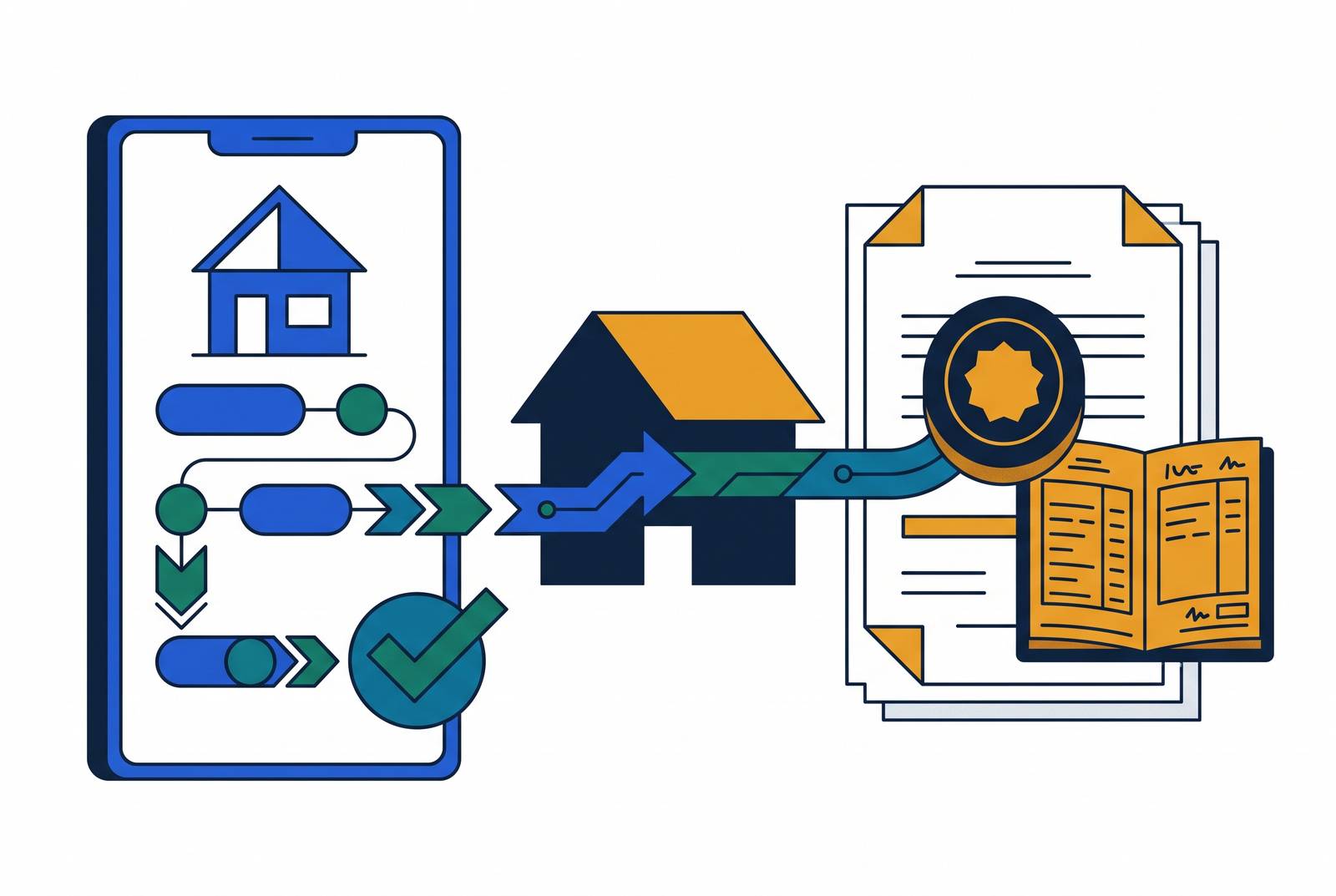
Here is the mechanical reality most borrowers never see. The moment an application goes in, it runs through an automated underwriting system, or AUS, before a human looks at anything. The two systems that dominate this space are Fannie Mae's Desktop Underwriter (DU) and Freddie Mac's Loan Product Advisor (LPA). Both run continuously, without breaks, fatigue, or carryover from a previous file.
The AUS pulls credit score, debt-to-income ratio, work history, and asset data, then returns an approve, refer, or deny, usually within minutes. A large share of applications get handled by AUS alone, start to finish. The rest get kicked to a human, and those files are where the interesting decisions actually happen; it is also, not coincidentally, where most of this article's tension lives.
Layered on top of that is AI and machine learning, and the growth curve here is steep enough to raise eyebrows. Stratmor Group's 2025 survey found 38% of lenders using AI somewhere in underwriting, up from 15% in 2023. That is a jump compliance departments are not thrilled about, and Fannie Mae projects adoption will reach 55% of lenders by the end of 2025.
Worth separating clearly: AUS is rules-based, meaning the logic is fixed and, in principle, auditable. Someone can point to the line of code that triggered a denial. AI layers add pattern recognition on top, which catches things rules miss, but it also adds a layer nobody outside the model can fully see into. That distinction matters later, when the conversation turns to bias and who can actually explain a denial to the person who received it.
Where digital platforms genuinely outperform on speed
The numbers make the speed case without much help. ICE Mortgage Technology tracked the average purchase loan closing at 36.8 days in March 2026, the fastest in the company's records. Back in 2021, that average sat between 49 and 58 days. That is roughly two weeks shaved off, industry-wide, in under five years, and some specialized digital lenders have pushed their timelines further still for qualified borrowers with clean files.
That kind of speed comes from optical character recognition handling document intake, income verification running automatically against payroll and bank data, and compliance checks happening in real time instead of sitting in a queue until Monday morning. Traditional manual underwriting, by contrast, still burns a lot of human hours on tasks that have nothing to do with judgment: sorting PDFs, keying numbers into fields, chasing a borrower for the third version of the same pay stub. Automation mostly removes busywork that was never adding insight to begin with, and speeds up the parts of the process that judgment never touched anyway.
But the speed advantage comes with a condition, and it is the condition that decides everything downstream. It applies most cleanly to borrowers the algorithm can read easily: stable W-2 paycheck, conventional credit history, a standard single-family home. Feed the system a clean file and it moves quickly and predictably. Feed it something messier, and progress stalls, which is exactly where the next section picks up.
The borrower profiles that automated systems handle poorly
An AUS produces a binary answer. It cannot pause and weigh the fact that a borrower's income looks unstable on paper but they have paid rent on time for six years and just took a new job that pays more. A human underwriter can hold that kind of context in mind; a rules engine was never built to.
Regulation forces the issue in some cases, no discretion involved. FHA guidelines include specific credit and risk thresholds that require manual review, regardless of how a file scores in AUS. Certain borrower profiles — those falling outside standard credit and risk thresholds — can trigger that mandatory human review.
Beyond the mandated cases sits a whole population of borrowers automated scoring was never designed to read well. Freelancers, contractors, and self-employed people whose income swings month to month do not fit a W-2 template. Borrowers with no traditional credit file, who nonetheless pay rent, utilities, and tuition on time every month, do not generate the kind of history an AUS is trained to score. Borrowers recovering from one isolated financial hit, a medical bill, a layoff, a divorce, but with an otherwise solid repayment record, look worse on paper than they are in practice.
FHA manual underwriting guidelines permit consideration of compensating factors documented on the file, a flexibility no automated model currently replicates on its own. None of this means manual review is more accurate across the board; plenty of AUS decisions are perfectly sound. It means manual underwriting covers terrain the algorithm was never sent to map, and pretending otherwise is how a good borrower gets a bad answer.
How risk assessment depth differs between the two models
Automated systems assess risk consistently and at enormous scale, and that consistency removes some categories of human bias almost by accident, simply by applying the same rules regardless of circumstance. But a model can only weigh what it was fed and trained to notice. If a form of creditworthiness never made it into the training data, the model has no opinion on it at all; it is simply blind to it.
That blindness has a paper trail. Research into fintech mortgage lending has found that racial and ethnic pricing disparities do not disappear simply because a human loan officer is removed from the decision. Removing a human loan officer from the decision does not automatically remove discriminatory outcomes. It just relocates where the discrimination comes from and makes it harder to point at, which is arguably worse.
That is the explainability problem in a sentence: plenty of AI and machine learning models function as black boxes, and even the lenders using them, let alone the regulators auditing them, cannot always trace which inputs produced a given decision. A human's reasoning is generally traceable after the fact, which gives traditional underwriting a real edge here. But it introduces its own risk, individual error, inconsistency between underwriters on similar files, a biased judgment call that never gets flagged because nobody was watching that particular underwriter that particular day.
Neither model has solved the bigger issue sitting underneath both of them. Mortgage rejection rates have remained meaningfully elevated in recent years. That is not a rounding error, and it means borrowers on the margin face real friction no matter which system reviews their file.
Some AI vendors have pointed to examples where algorithmic tools improved approval rates for underserved borrowers without measurably increasing portfolio risk. So the technical capability to do better clearly exists somewhere. What remains genuinely open is whether a model trained on decades of lending data shaped by decades of lending bias can ever fully separate itself from the patterns baked into that history. Nobody has answered that definitively, in either direction, and it is worth saying so plainly instead of pretending this piece just did.
Where the two models are converging rather than competing
The clean digital-versus-traditional split is dissolving, which is probably good news for borrowers even if it ruins a tidy headline. Big banks are deploying AUS tools and AI layers of their own. Digital-first lenders still employ human underwriters, because someone has to review the significant share of files the AUS kicks back.
Traditional lenders investing in automation are narrowing the speed gap, though the numbers say they have not closed it. Nonbank loan counts grew 15% in 2025 against 5% for banks; the investment gap is shrinking in percentage terms, market share is not shrinking nearly as fast.
What is emerging as the practical default is a hybrid workflow, and it is a sensible one once you say it out loud. The algorithm handles standard files at scale, because that is what it is good at. Edge cases route to a human underwriter, because that is what humans are good at. It is a division of labor that plays to each side's strengths, and asking which one is more important misses the point of the arrangement.
Borrower-facing experience is converging too, for a simpler reason: expectations set by fully digital lenders are pressuring community banks and credit unions to build better online portals, even when the underwriting behind that portal is still entirely manual. A bank's marketing identity, digital-first disruptor or friendly neighborhood branch, is becoming a weaker signal of what its underwriting actually looks like. Asking directly beats reading the homepage every time.
When each model is likely the better fit for a specific borrower
A digital platform fits best when the borrower has stable W-2 income, a conventional credit history, and a standard property type. It also fits when speed matters, a competing offer, a rate-lock deadline, a tight closing window, and when the borrower is comfortable running most of the process through a screen with limited back-and-forth.
Traditional or manual underwriting fits a different set of cases: irregular income, self-employment, a thin or non-traditional credit file; a recent financial event, a missed payment, a short sale, a bankruptcy, that makes the file look worse on paper than the reality on the ground; a loan type where regulation mandates manual review, like an FHA loan with a credit score under 620; or a borrower who simply wants a person who can advocate for their file in front of whoever makes the call.
A few questions cut through the marketing regardless of which lender is on the other end of the phone. What share of loans go through automated versus manual underwriting? If a file gets referred out of AUS, who reviews it, and what is the realistic timeline from there? How is non-traditional income or a limited credit history actually evaluated, not just theoretically accommodated?
The principle running under all of this: the right model is whichever one gives the reviewer, human or system, enough legible signal to make a confident approval. Speed is real. Judgment is real. Neither is the universal answer, and picking one because it sounds more modern, or more human, is how a solid borrower ends up filed under the wrong process for their own life.