Fintech Platforms Changing Residential Real Estate Transactions
Software is finally automating the dozen handoffs that have slowed real estate closings for decades.

Residential real estate has spent decades running on a chain of separate silos, buyer, seller, agent, lender, title company, escrow, notary, each with its own paperwork, its own timeline, and its own reasons not to talk to the others. Fintech platforms are now digitizing and reconnecting that chain stage by stage, and the result is a transaction that moves faster, costs differently, and hides less than it used to. This piece walks through where that's actually happened, where it's still mostly a pitch deck, and what it means for anyone trying to plan around this shift instead of just reading about it after the fact.
Start with the timeline. A closing measured in weeks to months isn't a law of physics; it's a byproduct of a dozen handoff points where a deal can stall, die, or just sit while someone waits on someone else's next move. Buyers couldn't see real underwriting criteria, and sellers had no reliable read on true market liquidity. Neither side had real-time visibility into where things actually stood, which is a strange thing to accept given that people can track a $12 pizza order down to the minute but not a six-figure asset. The cost stack, origination fees, title insurance, notary fees, agent commissions, reflects intermediaries whose function was often partly administrative, which raises an obvious question: administrative work is exactly what software is good at. So why did it take this long? Regulation, local recording requirements, and decades of incumbents building moats around each individual stage explain much of the delay. Each layer had to be cracked separately, one slow and expensive negotiation at a time.
The scale of capital and company formation now targeting every stage of that chain
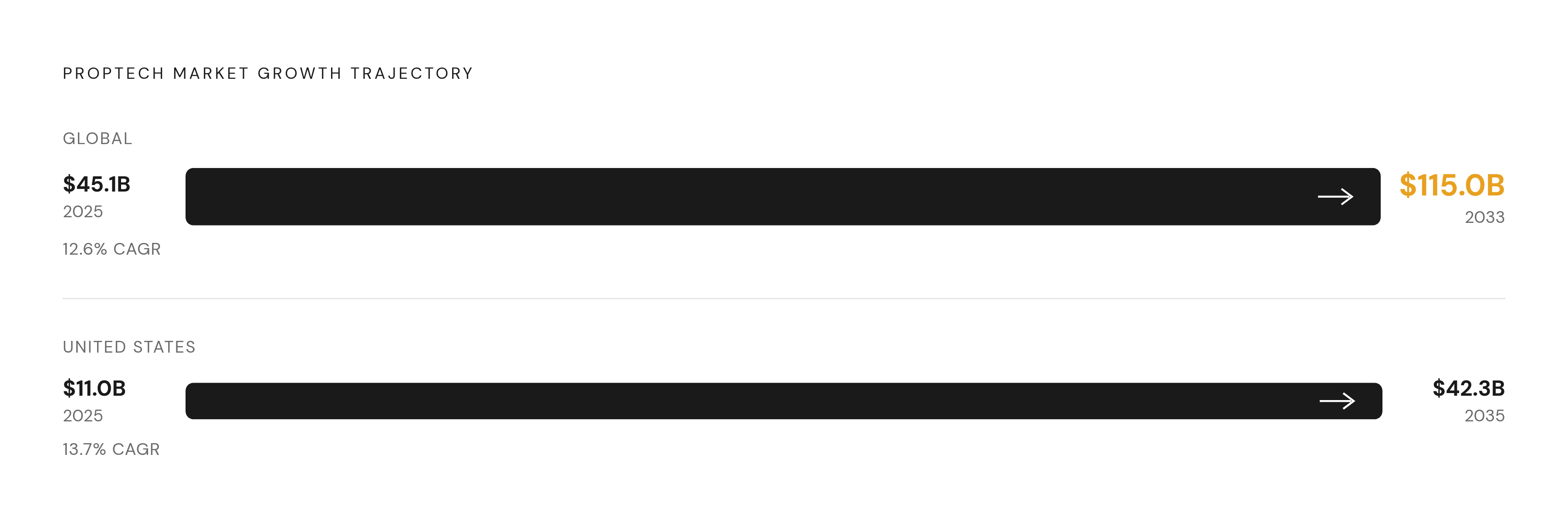
The numbers make clear this isn't a niche experiment anymore. Grand View Research put the global PropTech market at $45.1 billion in 2025, projecting growth to $115.0 billion by 2033 at a 12.6% compound annual rate. North America holds a 55.5% revenue share of that market in 2025, and the residential segment alone accounts for 56.3% of global PropTech revenue, meaning most of this capital is landing exactly where this article is pointed.
More than 9,000 PropTech companies now operate worldwide as of 2025, backed by venture funding that's crossed $12 billion globally. SNS Insider pegs the U.S. market specifically at $11.0 billion in 2025, on track for $42.3 billion by 2035 at a 13.7% CAGR. Digital mortgage platforms, one sub-segment among several, grew from $7.19 billion in 2024 to $8.28 billion in 2025, a 15.2% growth rate in a single year. That's one slice of the pie, and it's already moving faster than most industries move in total.
So the question isn't whether fintech reshapes residential transactions. Which layers are furthest along, and which are still mostly promise, is the real question, and that's the map the rest of this piece draws.
What AI-powered mortgage origination and underwriting actually changed about speed and access
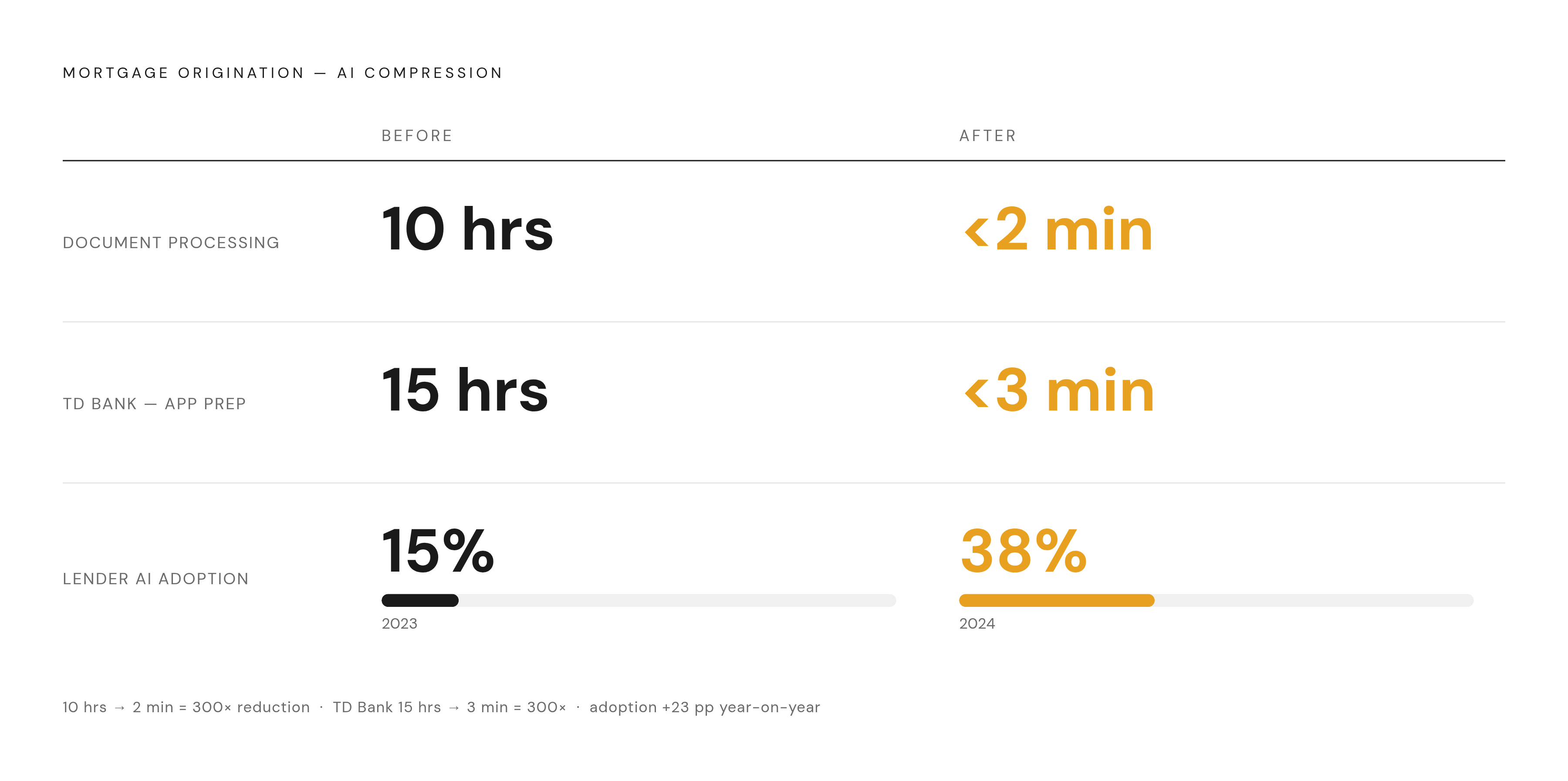
Mortgage origination is where the AI story is least theoretical. A 2025 Stratmor Group survey found AI adoption among lenders jumped from 15% in 2023 to 38% in 2024. Robotic process automation, the less glamorous cousin of generative AI, went from use by 30% of lenders in 2020 to 48% in 2024. That's not a pilot program trend; that's a majority behavior forming in plain sight.
The speed compression is the part that gets the headlines, and for good reason. AI agents now process mortgage documents in under two minutes, a task that used to take roughly ten hours by hand. TD Bank's agentic AI system reportedly cut application prep time from about 15 hours to under three minutes. Some lenders now advertise approval decisions in as little as 47 seconds, though that figure is worth pausing on: it reflects automated pre-qualification more than a full underwriting decision. Still, it tells you how far the front-end experience has shifted, even if the fine print underneath hasn't caught up to the marketing copy.
Rocket Mortgage processes over 1.5 million documents monthly using generative AI, automatically extracting more than 90% of the data it needs. Better.com's AI agent, nicknamed Betsy, handles nearly 100,000 mortgage-related calls a month and resolved 35.5% of borrower inquiries in 2025 without a human ever picking up. Freddie Mac's Loan Product Advisor updates, released in May 2025, automated income, asset, and employment verification, saving originators up to $1,500 per loan and shaving five days off the production cycle.
Here's the part that should get more attention than it does: Freddie Mac's machine learning improvements to LPA reportedly qualified an additional 18,000 borrowers who wouldn't have passed under the old model. That raises a real question worth sitting with, about whether speed gains and access gains are actually happening together, or whether we're just assuming they are because they show up in the same press release.
The GreenState Credit Union case, using underwriting technology from Zest AI, is the strongest evidence available that they can move together. GreenState saw its general approval rate rise 26%, its approval rate for women and Hispanic applicants rise 32%, with no added credit risk, and a $132 million increase in annual revenue attached to the change — a genuinely rare combination of outcomes in a single dataset. That's a genuinely rare result: expanded access and better economics in the same dataset. Algorithmic bias risk cuts both ways, though, since models trained on historical lending data can just as easily encode the discrimination baked into that history, dressed up as objectivity. GreenState's result is real, but it isn't universal, and treating it as proof that AI underwriting solves bias by default would be its own kind of bias.
How iBuyer platforms converted home sale liquidity from a negotiation into a product
Opendoor launched in 2014 and introduced the iBuyer model to U.S. residential real estate, still the largest platform running that playbook today. The pitch is simple: get an offer in minutes, close in days. The sale stops being a negotiation with a stranger and starts looking like a liquidity event.
How big did this actually get, though? In 2022, combined iBuyer share of U.S. single-family home sales hit a small fraction of a percent, with Opendoor responsible for roughly two-thirds of that volume. Even at its peak, the model captured a small sliver of total transactions, which is a useful ceiling to keep in mind before anyone declares the traditional home sale dead. Zillow and Redfin have both exited the iBuyer business entirely, leaving Opendoor and Offerpad as the two large survivors. That attrition matters, since it suggests the unit economics are harder than the original pitch implied, not that the concept was wrong, but that running it profitably at scale is its own unsolved problem.
There's also a real cost to the convenience. An analysis of properties bought and resold by these platforms between March 2023 and June 2025 found Opendoor purchasing homes at roughly 9% below eventual open-market resale price, and Offerpad at roughly 10% below. Sellers are paying for certainty and speed, and that payment is not small. Opendoor's multimillion-dollar FTC fine in August 2022, for misleading customers about pricing relative to the open market, is now a permanent part of the iBuyer origin story, whether the company likes it or not.
The honest read: iBuyers solve a real problem, certainty, speed, no strangers walking through your kitchen, for a specific seller who values those things more than maximum price. Framing them as a universal better deal overstates what the data shows. What survives, regardless of any single company's fortunes, is the proof of concept: the sell side of residential real estate can be productized end to end. That idea outlives whichever platform is currently winning.
Digital closing platforms and what eClosing did to the last mile of the transaction
If iBuyers reinvented the front of the transaction, eClosing platforms reinvented the very back of it, the part that used to involve a notary, a conference table, and a thick stack of paper. Digital closing platforms bundle document management, identity verification, e-signature, and loan processing into one digital workflow. Borrowers review, sign, and submit closing documents electronically, and the courier-delivered document package, once a fixture of every closing, is quietly becoming a relic.
The speed numbers here are just as sharp as the ones in origination. Real-time risk assessment on property-backed loans has reportedly compressed underwriter review time significantly on digital platforms. That compression isn't just about convenience; it's about deal certainty, since every extra day a deal sits open is another day it can fall apart. Broader survey data shows a large share of property lenders increased their technology budgets in recent years, with automation and predictive analytics as the focus, which tells you eClosing has moved from edge case to mainstream lender priority.
What's still holding this back isn't the software; it's the law. State-by-state variation in remote online notarization rules means a fully digital closing isn't available everywhere yet, and that patchwork, not the technology, is the real bottleneck. Worth noting too: eClosing platforms only deliver their full value when they're wired into digital origination systems upstream. A signing tool that stands alone is a nice feature. A signing tool connected to origination and recording is a different product entirely, and that distinction is going to matter a lot in the next section.
Blockchain and smart contracts at the title and escrow layer — what's real now versus what's still being built
Smart contracts promise to do at the title and escrow layer what AI did at origination: automate escrow initialization, title verification, payment settlement, and deed recording, cutting out the title company as a manual intermediary. In pilot deployments, that's reportedly compressed closing timelines significantly compared to traditional processes. That's the pitch, anyway.
A small number of U.S. platforms have put this into actual practice, running property closing workflows through smart contracts end to end. These are working deployments with real transactions behind them, not whitepapers gathering dust. On the fractional side, platforms enabling tokenized ownership of property have emerged, and the tokenized real estate space has attracted growing interest, though estimates of its scale vary widely across research firms and should be read as directional rather than precise.
Here's where it's worth slowing down, because the honest answer is: the barrier isn't technical, it's legal. Enforceability of smart contracts, the legal status of a digital signature on an actual deed, and how disputes get resolved when code executes incorrectly, all of that remains unresolved in most U.S. jurisdictions. Some jurisdictions have explored blockchain-based property records pilots, but full state-level implementation is nowhere close to complete. That gap between a pilot in one county and infrastructure across fifty states is wide, and it's not closing on a software development timeline; it's closing on a legislative one, which moves at an entirely different speed.
For now, blockchain's most credible use is at the margins: fractional ownership, cross-border deals, investor-grade assets, rather than the mainstream residential closing that most buyers and sellers actually experience. That ceiling could rise as remote notarization law and smart contract law start to converge, but "could" is doing real work in that sentence.
Fractional ownership and crowdfunding platforms opening residential real estate to non-traditional buyers
Real estate crowdfunding is growing fast, and estimates of exactly how fast vary a lot depending on which research firm you ask, a gap worth naming rather than smoothing over. Estimates of the fractional real estate platform market vary across research firms, and the segment is widely described as growing rapidly, though figures differ enough that any single number should be treated as directional. In the U.S., a handful of platforms account for much of the activity in this segment.
What's genuinely interesting isn't the dollar figure; it's who's showing up. Available reporting suggests a substantial share of new users on these platforms are first-time alternative asset investors, meaning these platforms aren't just pulling capital from people who already owned rental property. They're creating a category of participant that didn't really exist before: someone who owns a sliver of a duplex in Ohio without ever setting foot in Ohio.
Online platforms are increasingly accounting for a growing majority of fractional ownership transaction volume, a share expected to keep climbing, which marks a structural shift from private placement toward digital platform as the default channel. Within that volume, the mix of equity and debt crowdfunding shapes both investor risk profile and how regulators end up treating the platforms.
One distinction is worth making bluntly, because it's the one most likely to get blurred in marketing copy: these platforms expand investment access, not homeownership access. Owning a fractional share of a rental property is not the same as owning a home to live in, and conflating the two overstates how democratized any of this actually is.
How the most competitive fintech platforms are winning by connecting stages rather than digitizing them individually
Look across every stage covered so far, mortgage origination, iBuying, eClosing, blockchain title work, fractional ownership, and a pattern shows up that's easy to miss if you study each one in isolation: the platforms pulling ahead are the ones connecting two or more stages, not the ones perfecting a single one. Origination plus closing. Offer plus settlement. Valuation plus underwriting. Integration, not isolated digitization, is where retention and unit economics both improve.
Rocket Mortgage's 1.5 million monthly documents only matter because that pipeline feeds underwriting, which feeds closing. The volume is impressive on its own, but the advantage compounds because the stages talk to each other. Look at which iBuyers survived: Opendoor and Offerpad, and notice what they added rather than what they kept doing. Title services, mortgage products, moving logistics, ancillary services that made up an increasing share of Opendoor's gross profit in 2025. The instant offer alone wasn't the business. It was the entry point into a longer relationship.
Same logic applies to eClosing. The platforms pulling ahead are integrating upstream with origination systems and downstream with recording, while standalone e-signature tools are commoditizing fast, becoming a feature rather than a product. For incumbents, that's the uncomfortable implication buried in all of this: a lender, title company, or brokerage that digitizes its own single stage without connecting to the stages next to it doesn't disappear overnight. It just becomes a slow, legible handoff point for whichever platform did connect the stages. Nobody has to beat you head to head. They just have to make you the weak link in someone else's faster chain.
The forcing function underneath all of it is consumer expectation. Buyers and sellers now expect the same status visibility and self-service they get from any other digital financial product, a bank app, a delivery tracker, a stock trading platform. Whoever delivers that across the full transaction arc, not just one stage of it, sets the new baseline everyone else gets measured against.
What real estate and marketing leaders should read in these shifts before their next planning cycle
Step back and the transaction itself starts to look less like a legal process and more like a data product. Every digitized stage, origination, underwriting, closing, generates structured data on buyer behavior, property valuation, and risk. Organizations capturing and using that data are building an advantage that compounds; organizations treating it as a byproduct of doing business are leaving it on the table, probably without realizing it.
Speed has quietly become table stakes rather than a premium feature. A 47-second approval decision and a same-day cash offer reset buyer expectations even among people who never use those specific products, much the way overnight shipping reset expectations for everything else. Marketing content that still frames "quick approval" as a differentiator is describing yesterday's baseline as tomorrow's edge.
Access expansion is genuinely happening, and it's worth taking seriously without overselling it. The GreenState result, 26% higher approvals with no added credit risk, and the fractional ownership data showing a large majority of users are first-time alternative investors, both point toward real expansion of who gets to participate. These are platform-specific results, not a sector-wide guarantee, though, and the gap between "this happened at GreenState" and "this happens everywhere" is exactly the gap a careful reader should watch.
For marketing leaders specifically, the opportunity sitting in plain sight is helping buyers and sellers understand a transaction that no longer matches the mental model most people are still carrying around. Explainer content, comparison frameworks, decision tools, these carry real search intent because the confusion is real. Strategy here means mapping the actual decision journey through the connected stack, mortgage, offer, closing, as one experience, rather than writing about each platform as its own island. That's the same lesson the platforms themselves learned first: remove friction at every handoff, use data to anticipate the next question before it's asked, and own the relationship across the whole journey instead of a single moment in it. The industry didn't change because someone digitized a form. It changed because someone finally connected the forms to each other.