Cloud-Based Brokerage Platforms for Independent Brokerages
How independents can evaluate cloud platforms to compete with franchise brokerages.

This piece is about cloud-based brokerage platforms, the software infrastructure letting independent real estate brokerages run CRM, compliance, agent management, and marketing without owning servers or a back office. The point is practical: what these platforms actually offer, and how an independent broker figures out whether one fits their shop before signing anything.
The category covers two different things that get talked about like they're one thing. First, there's the independent brokerage that keeps its own brand and license but runs operations through a platform instead of duct-taping together five separate tools. Second, there's the cloud-native brokerage model itself, virtual or hybrid, no physical office required, where the platform isn't something you buy, it's the thing you join. Both matter to this conversation, and confusing them is where a lot of independents waste six months and a chunk of their tech budget.
The pressure behind all this is straightforward. Big franchise brands have had enterprise-grade CRM, transaction management, and marketing automation for years, funded by scale the independent shop doesn't have. Meanwhile independents are competing for the same listings, the same buyer leads, the same MLS data, often the same agents who are deciding where to hang their license. Grand View Research put cloud-based deployment at 51.0% of the PropTech market in 2025. That's not an early-adopter number anymore; that's a majority, meaning the independents still running everything off a server in a closet are now the outliers. One quick scope note before we go further: this is about real estate and adjacent brokerage models, not financial trading platforms. Different industry, different regulators, different everything.
Why cloud infrastructure has become structurally advantageous for capital-constrained independents
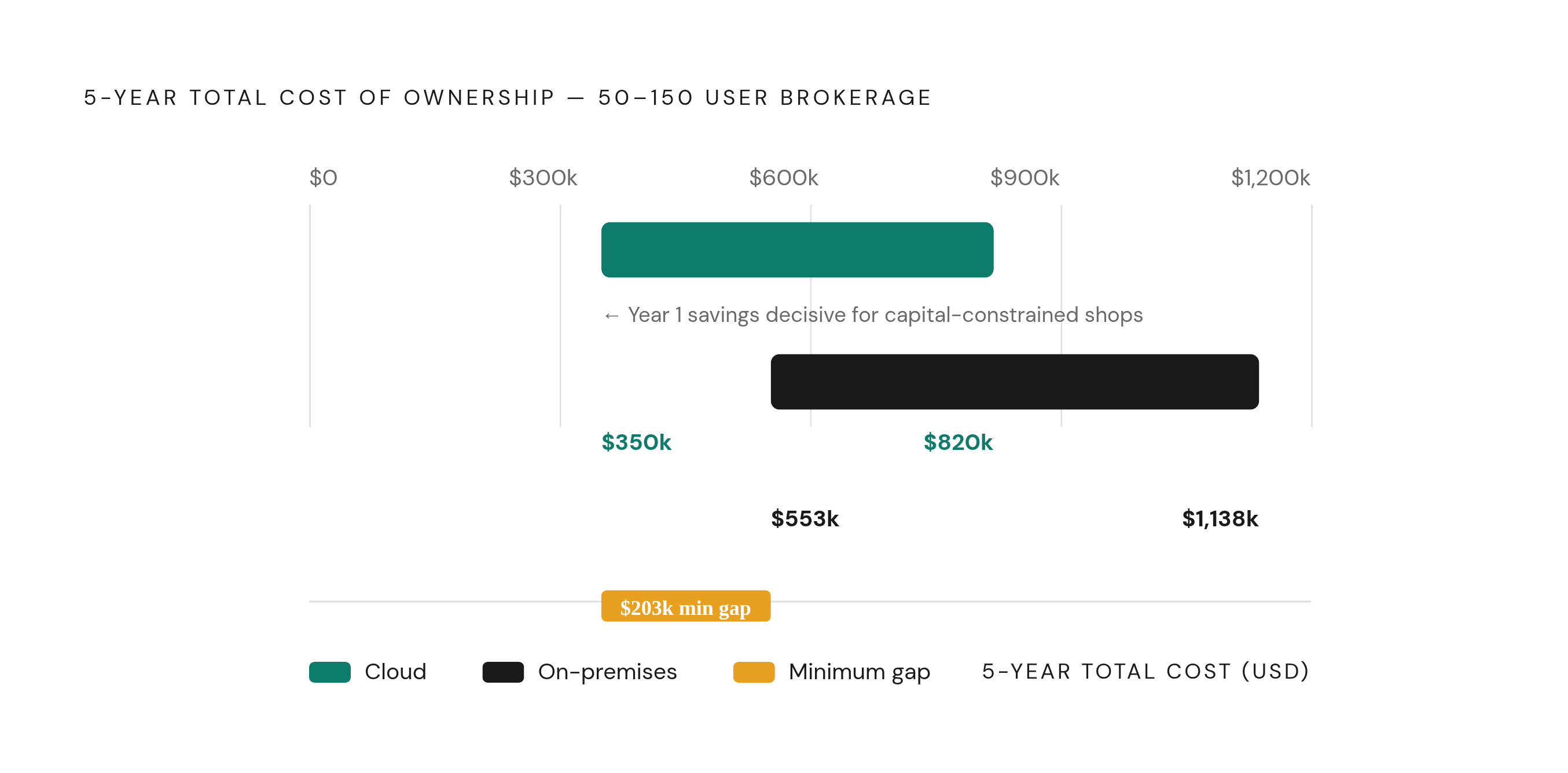
Here's the blunt version: cloud computing turns a big upfront bill into a smaller monthly one, and for a brokerage that doesn't have a war chest, that difference matters a great deal.
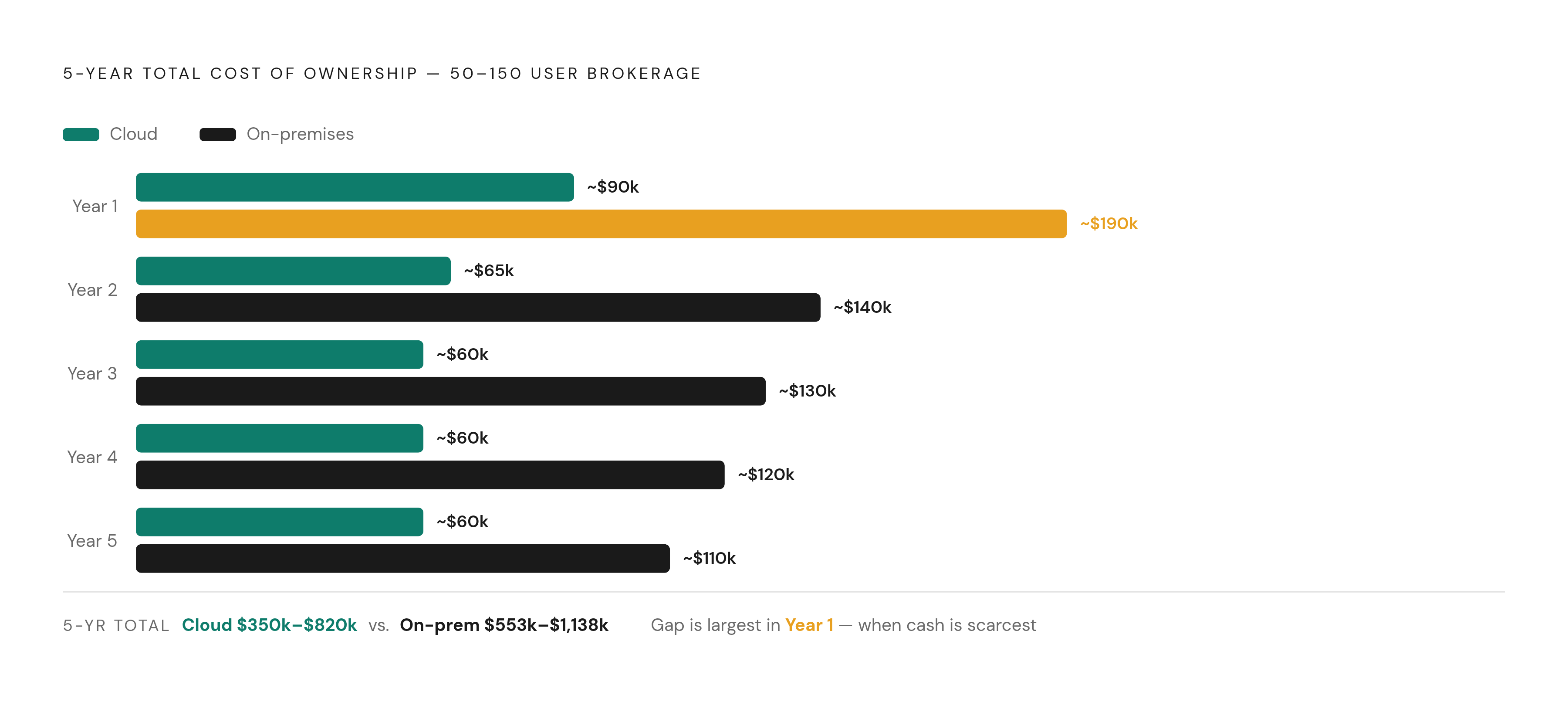
Running your own servers means buying hardware, housing it, cooling it, patching it, and eventually replacing it, all before a single agent closes a deal. Cloud infrastructure swaps that capital expense for an operating expense, paid monthly, scaled to how many seats or agents you actually have. For a realistic independent brokerage running 50 to 150 users over five years, total cost of ownership on cloud lands somewhere around $350,000 to $820,000. Fully loaded on-premises infrastructure for the same brokerage runs about $553,000 to $1,138,000. The gap isn't evenly spread across those five years; it's front-loaded, which matters because Year 1 is exactly when a growing independent has the least cash to spare and the most reason to conserve it.
Speed is part of the case too, and it's underrated. Mordor Intelligence found cloud solutions captured 55.92% of real estate IT spending in 2025, and part of the reason is rollout times under 45 days. Compare that to standing up on-premises infrastructure, which can eat months before anyone's even logged in. A brokerage that can go live in six weeks instead of six months isn't just saving money, it's preserving the runway that a new office needs to start generating revenue instead of consuming it.
Then there's the part that has nothing to do with spreadsheets: where the work actually happens. Agents and brokers now expect to pull up a listing, sign a document, or check a client's file from a car, a coffee shop, or a kitchen table at 10pm, and cloud platforms are built for exactly that. Remote work stopped being optional after 2020, and the limitations of a site-bound server became obvious once it did; a file that lives on one machine can't be reached from anywhere else. Multi-tenant cloud architecture also means feature updates roll out automatically across every brokerage on the platform, so an independent with no in-house IT staff still gets the same software improvements as a firm with a whole tech department.
The SME segment is growing faster than the market overall, at an 8.66% compound annual rate according to Mordor Intelligence, and a lot of that is because entry-level SaaS tiers are priced at a per-door monthly cost low enough that a five-agent shop can justify it. Still, don't take the cost advantage as gospel before you've run your own numbers. Model your actual Year 1 cash position and your actual five-year total cost. The averages above are a starting point, not a guarantee that cloud wins for your specific brokerage.
The core capabilities any independent brokerage should expect from a cloud platform
Think of this section as a checklist. Not every platform nails every item, and that gap is exactly what separates a good fit from an expensive mistake.
CRM and lead management sits at the center. You want contact and pipeline tools built around the actual real estate transaction cycle, not a generic sales funnel borrowed from software companies selling subscriptions. Lead routing, automated follow-up, and behavioral tracking (who opened what, who visited which listing twice) should come standard. Inside Real Estate has reported that brokerages using more advanced CRM tools see a meaningful bump in lead conversion. Worth noting, worth flagging, but treat it as a directional signal rather than a controlled experiment; your mileage depends heavily on how your agents actually use the tool.
Transaction and compliance management is where an independent without a compliance department either sleeps well or doesn't. Document storage, e-signature integration, audit trails, and state-specific compliance workflows aren't nice-to-haves, they're the thing standing between you and a regulatory headache. Agent management and recruiting tools matter just as much: commission tracking, split calculations, cap management, onboarding workflows, and training libraries that don't require you to personally walk every new hire through the paperwork.
Communication tools (internal messaging, virtual meeting rooms, sometimes full digital campus environments) and client-facing portals with co-branding options round out the collaboration side. Marketing and content tools cover listing promotion, social automation, email campaigns, and IDX/MLS integration for property data, and increasingly, AI-assisted content generation for listing descriptions and outreach copy. That last one is a real gap between platforms right now; some vendors have shipped it, some are still promising it, and the difference is worth asking about directly during any demo.
Reporting and analytics (agent performance dashboards, transaction volume, lead source attribution) tell you what's actually working. And an open API with native integrations to your existing accounting software, showing software, and MLS feed determines whether the platform fits into your current stack or forces you to rebuild it from scratch. This list is a benchmark for the conversation you should be having with a vendor, not a promise any single platform will check every box.
How the cloud-native brokerage model works in practice, using eXp Realty as the clearest example
eXp Realty is the largest independent brokerage in the world, and it's the cleanest example of what the cloud-native model looks like when you take it all the way.
The centerpiece is eXp World, an immersive virtual campus where agents attend training, meet with brokers, and handle admin issues, all through digital avatars walking around a virtual space. Agents log in, their avatar walks into a meeting room, and business happens. CRM comes bundled into the monthly fee, and as of July 2025 agents can pick from BoldTrail (the rebuilt kvCORE), Cloze, or Lofty. The monthly cloud brokerage fee runs at a modest flat rate and covers the virtual campus plus the included CRM tools; there's no office rent line item because there's no office.
The scale is the part that makes this more than a curiosity. eXp reported 83,060 agents, 440,163 transactions, and $194.0 billion in transaction volume in 2025, with $4.77 billion in full-year revenue. That's one of the largest brokerage operations in the country, running on a model with zero traditional office footprint.
What agents give up is real: no physical office to walk into, no in-person culture built around a break room and a bullpen, no broker sitting down the hall to answer a quick question in person. What they get in exchange is the technology stack, the built-in CRM, a revenue share program, and agent stock pathways, funded in part by the overhead a traditional office would have absorbed instead. The lesson for an independent who isn't joining eXp but is trying to build something similar is to look at the stack itself: CRM, virtual collaboration, compliance tools, marketing support. That's the bundle worth replicating or sourcing, piece by piece, through whatever platform you choose.
One more data point worth sitting with: AGNT Inc., eXp's parent company after its 2026 rebrand, posted $1.4 billion in Q2 2026 revenue, up 11% year over year. The growth is coming from agent productivity and transaction volume, not just from adding more agents to the roster, which suggests the model is maturing rather than just getting bigger.
Other cloud brokerage platforms and models worth evaluating
eXp isn't the only option, and the alternatives show how differently this model can be priced and structured.
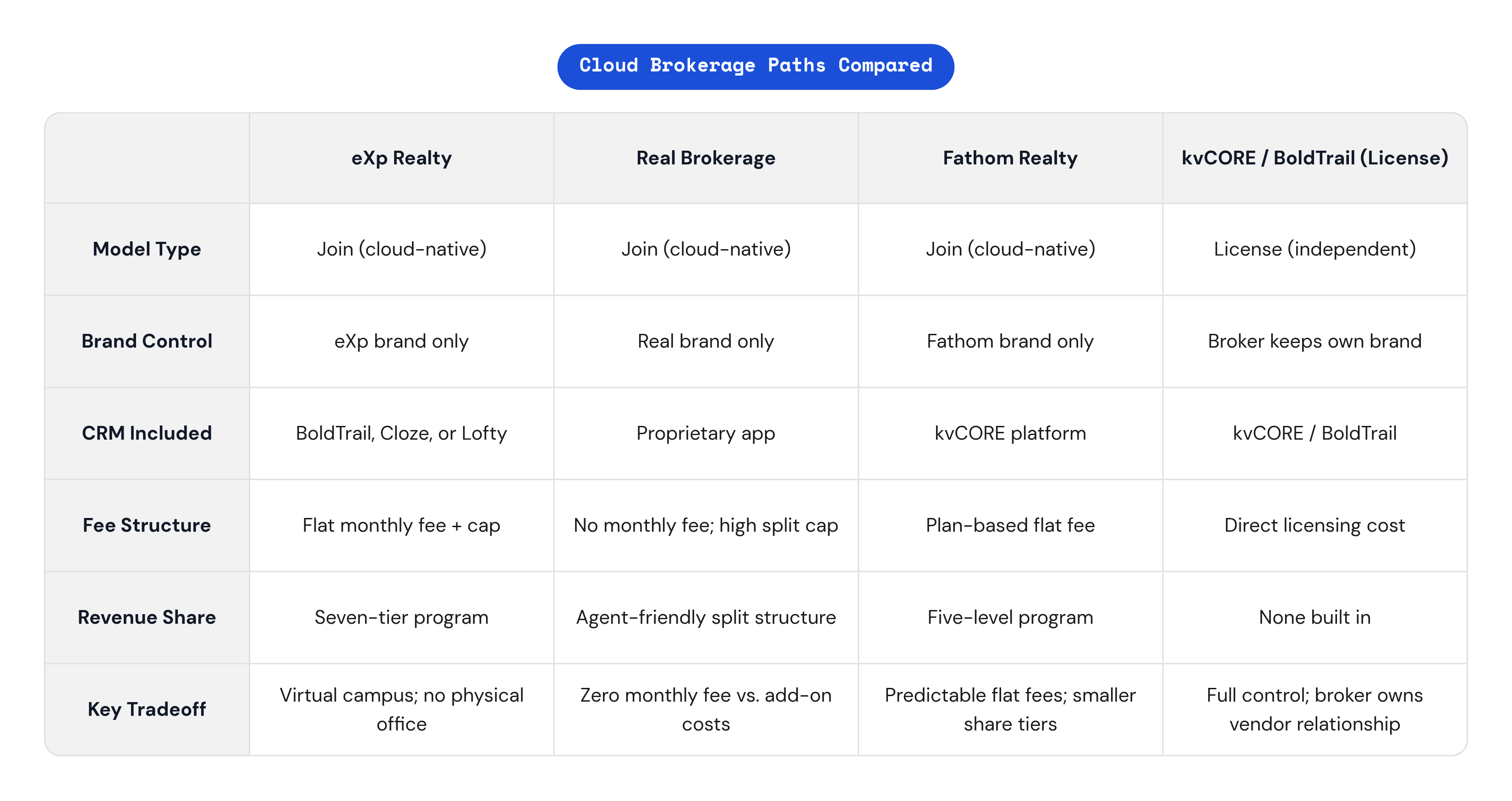
Real Brokerage is the fastest-growing challenger, publicly traded, operating in all 50 states and Canada. Agent count grew sharply in 2025 to 31,739, which is a growth rate that tells you something about agent appetite for this model beyond eXp specifically. The financial structure is competitive: a high base split, a low annual cap, and a modest post-cap fee, among the more agent-friendly setups in the market as of 2026. The differentiator is the zero monthly fee, no equivalent to eXp's $85. The tradeoff for an independent studying this model is figuring out what that $0 actually includes versus what gets tacked on as an add-on later. Lower headline cost isn't the same as lower total cost.
Fathom Realty runs a cloud-native, plan-based structure instead of a straight percentage split. It's publicly traded, full-service, and offers commission structures through its Edge and Elevate plans, each with its own fee schedule, appealing to agents who'd rather know their number up front than do split math every closing. Fathom runs a five-level revenue share program, smaller than eXp's seven-tier structure, which distributed hundreds of millions of dollars in 2024. Fathom also runs on the kvCORE platform, meaning agents there get a similar underlying CRM technology to eXp's BoldTrail, just wrapped in a different economic model.
Then there's the platform layer sitting underneath several of these brands: kvCORE, now rebranded BoldTrail under Inside Real Estate. It's positioned as a single platform for brokers, teams, and agents to run an entire business, and it's the engine powering eXp's CRM offering, Fathom, and plenty of independents who bought it directly rather than through a brokerage relationship. The October 2023 acquisition of BoomTown consolidated Inside Real Estate's position in a meaningful way, and any independent evaluating kvCORE now should understand they're looking at a bigger, more consolidated company than they might have been a few years back. Inside Real Estate has claimed brokerages switching to kvCORE can cut technology costs by 35%. Treat that as a vendor-reported figure, directional rather than independently audited, and ask for specifics before you bank on it.
The real fork in the road for an independent is this: joining a cloud brokerage like eXp, Real, or Fathom trades your brand for a bundled tech and economics package, while licensing a platform like kvCORE/BoldTrail lets you keep your name on the sign but puts you in charge of managing the vendor relationship yourself.
How to evaluate platforms against the actual structure of an independent brokerage
Start with the join-versus-license question, because everything else downstream depends on the answer. Joining a cloud brokerage means giving up brand independence in exchange for bundled technology and built-in economic incentives like revenue share. Licensing a platform keeps your brand and your control, but you own the vendor relationship, the configuration headaches, and the renewal negotiations. Neither choice is objectively better; it depends on whether your brand actually means something to buyers and sellers in your market, or whether it's mostly just a name on a yard sign.
Size changes the math. A solo broker or a three-person team has completely different CRM and compliance needs than a brokerage running 20 to 50 agents across multiple splits and caps. Platforms priced per seat scale predictably as you grow or shrink; flat-fee platforms can leave you overpaying at five agents and underserved at fifty.
Commission structure compatibility is where a lot of platform evaluations quietly fail. Does the tool's payment logic actually handle your cap structure, your tiers, your team splits, your referral fees? A platform that can't model how you actually pay agents isn't saving you time, it's creating a second spreadsheet you now maintain by hand.
Integration is next, and it's less glamorous but just as important. Does the platform talk to your local MLS directly, or does that require a third-party bridge that adds cost and another point of failure? Map your current showing software, transaction management tool, and accounting system against the platform's actual integration list before you assume compatibility; assuming it and finding out later is how six-figure software decisions go sideways.
Compliance deserves its own look, separate from the general capability list above, because independents carry that liability directly with no corporate compliance department to catch mistakes. A platform without state-specific document workflows for your state adds real regulatory risk.
Vendor stability matters more than it used to, given how much consolidation is happening. Inside Real Estate's BoomTown acquisition is one example of a platform market that's actively reshaping itself. Ask whether the vendor you're considering is likely to get acquired, or is doing the acquiring, and what either scenario would mean for your pricing and roadmap two years from now.
Last, look honestly at the content and marketing gap. A lot of platforms hand you basic marketing tools and then leave you to actually write the listing descriptions, the market reports, the agent bios, the email campaigns. That's a real gap, and it's worth asking upfront whether the platform's marketing features connect to any structured content workflow, or whether that's a hole you'll be filling yourself, one blog post at a time.
What the growth of the real estate software market signals about where platforms are heading
The real estate brokerage software market was valued at $1,759.79 million in 2025 and is projected to top $4,000 million by 2033, a 9.33% compound annual growth rate according to Market Report Analytics. A market growing that fast pulls in new entrants and acquirers at the same time, which is exactly the mix independents are navigating right now.
What does that growth actually mean if you're the one signing the contract? More options in the near term, which sounds good until you remember that more options also means more vendor churn, more acquisition activity, and pricing that can shift under you mid-contract. Feature parity across platforms is also going to compress. What counts as a differentiator today, AI-assisted tools, predictive analytics, automated compliance flagging, is on track to become the baseline expectation within a few years, the way e-signature integration went from novelty to non-negotiable.
AI is the frontier worth watching most closely. Platforms are folding AI into CRM through predictive lead scoring, into compliance through document review flags, and into marketing through content generation for listings and campaigns. The honest question to ask a vendor isn't whether they have an AI roadmap; everyone has a roadmap. Ask what's actually live today, and ask for evidence they've shipped roadmap commitments before, not just announced them.
The virtual brokerage model is also starting to expand in a direction worth noting: AGNT's 2026 acquisition of NextHome, a franchise brokerage with an actual physical footprint, suggests cloud-native companies are starting to absorb traditional brokerage models rather than simply competing against them from the outside. That's a shift in strategy, not just growth for growth's sake.
Zoom out further and the pattern holds. Grand View Research projects the global PropTech market growing from $50.1 billion in 2026 to $115.0 billion by 2033, a 12.6% compound annual rate. Real estate brokerage software is one slice of that larger transformation, and it's going to keep raising what agents and clients expect a platform to do. The practical takeaway: pick a vendor with an active development roadmap and a demonstrated ability to ship, not the vendor with the flashiest current feature list. Feature lists age fast in a market moving this quickly.
Making the final call: what an independent brokerage should do before signing a platform contract
Run your own five-year total cost of ownership before you believe anyone's marketing deck, including this one. The cloud-versus-on-premises numbers earlier in this piece are averages pulled from a mid-sized brokerage; your actual agent count, your actual growth rate, and your actual state's compliance requirements will move those numbers in ways only your own math can capture.
Decide the join-versus-license question first, deliberately, not by default. If your brand carries real weight with buyers and sellers in your market, licensing a platform like kvCORE/BoldTrail preserves that while giving you enterprise-level tools. If your brand is mostly a logo on a sign and what agents actually want is infrastructure, revenue share, and lower overhead, a cloud brokerage model like eXp, Real, or Fathom might do more for recruiting and retention than staying fully independent ever would.
Then get specific with any vendor you're seriously considering. Ask for a live demo of the commission and cap logic against your actual split structure, not a generic walkthrough. Ask what AI features are live today versus promised for next year. Ask about the parent company's acquisition history and what happened to pricing after their last one. And ask, bluntly, what happens to your data and your workflow if you decide to leave in eighteen months, because a platform that makes migration painful is quietly betting you'll stay out of inertia rather than satisfaction.
None of this guarantees the right choice. But it turns the decision from a leap of faith into something you can actually defend to your agents, your accountant, and, eventually, yourself, six months after the ink dries.