Residential versus Commercial Real Estate Investment Returns Compared
Real estate, residential or commercial, is about separate issues, and most folks weighing them lean on the off number. By cap rates, commercial properties typically yield around 7%, while residential properties average about 5%. In 2024, residential real estate had an average ROI of 10.6%, while commercial real estate averaged 9.5%. Over time they end up close: From January 1978 to December 2022, commercial real estate averaged an annual return of 9.03%, according to the National Council of Real Estate Investment Fiduciaries. Yield handles one task, while total return covers a different one. Collapsing both into a number is why contradictory headlines on this subject are still circulating, and people quoting one stat to crown a victor have not got the comparison right.
What each property type actually is, and where the lines blur
Residential means houses, plus two-unit, three-unit and four-unit buildings: fewer than 5 units. Go past that point and this property is commercial on paper, however much it still resembles housing from outside. Business also covers offices, stores, plants, hotels, storage units, and server farms, a much broader range of purposes than housing ever reaches.
That five-unit mark is no accident. Commercial loan underwriting gets triggered, with separate tax treatment and obligations someone with a triplex does not face. Go over it by just one door, and how you borrow, how properties get valued, and your risk all change at once, sometimes before the buyer has even clocked leaving residential behind.
Mixed-use spots complicate matters: retail sits below, homes stacked on top, one place straddling the two classifications together. This setup appears more in urban areas as remote life reshapes the expectations tenants have for a spot. But Residential dominates in size, and the usual framing has it wrong. Commercial is seen as the higher-return play, with residential framed as the basic asset, though housing drives the real business. Housing has more volume and trades easier, so any comparison that ignores this size misses the point.
The income advantage commercial leases provide, and what it actually costs to access
Commercial properties usually yield an average rental return of 7%, while cash flow returns can reach between 7% and 12%. Residential properties typically deliver cash flow returns in the 5% to 8% range, with an average rental return of about 5%. The gap traces back to lease length: commercial tenants sign for three to ten years, while residential tenants often sign month-to-month leases. So commercial landlords secure steady income while cutting turnover expenses, which residential landlords never achieve.
The gap grows because of Lease structure. Certain lease agreements shift some expenses to the tenant, an income edge residential landlords typically lack. Commercial tenants usually fix problems themselves per the contract, while their residential landlord counterparts are stuck fielding a heater breakdown at night.
That added income doesn’t come cheaply, and the comparison often breaks down here: the 7% yield gets cited without pricing the work and money needed to reach it. You typically put down 20% to 40% on Commercial properties, while residential needs just 3% to 5%. Financing differs too: business-property notes mature in 5 to 10 and finish with a big payoff, requiring fresh borrowing each time, while the typical home note stretches to 30. Buying commercial property means paying higher closing costs for appraisals, site checks, lawyer bills, and the origination charge. That premium yield comes gated by an entry cost that excludes most investors who'd sail through a residential mortgage but wouldn't pass commercial underwriting.
How risk is distributed across the two asset types
One tenant leaving a modest commercial building wipes out its total income. One vacancy within a ten-unit residential property takes only a fraction from total rent. That gap is what the argument over residential versus commercial assets hinges on, yet it seldom gets weighed against comparing returns.
Residential demand stays inelastic: everyone requires a home regardless of economic conditions. When a recession arrives, firms shut or downsize quickly, so Commercial demand drops and office plus retail units sit vacant in ways residential occupancy never sees. Liquidity works much the same way. Residential properties typically close in a few months when things are steady, but commercial ones might wait six or more, facing fewer and highly selective people looking to buy.
Multifamily properties may offer a return premium, but it typically appears only among investors able to stay in through an entire cycle and avoid being forced out during a downturn. Commercial real estate holds one systemic risk residential avoids: when certain CRE trusts take hits, the damage can spread to larger investment vehicles, potentially triggering redemptions and fire-sale pricing that may affect sector-wide valuations. Commercial returns may offer diversification, though again only investors with deep pockets and staying power can typically realize it. Retail investor's money still drives Residential. Nearly 73% of single-home landlord holdings belong to private owners. This market runs on smaller, less sophisticated capital instead of institutional money, which is why it stays stronger when pressure hits.
The current commercial sector landscape, broken down by property type
The sector is still feeling the effects of COVID. National vacancy rates for commercial real estate showed signs of stabilization in 2025, with early-year peaks easing by the third quarter. Delinquency rates for commercial real estate loans rose to 7.2% by the second quarter of 2025. It's stabilization, early-stage at best, far from fixed, and don't view lower vacancy as any turnaround.
By mid-2025, industrial real estate saw increased vacancy rates and softened demand, with asking prices adjusting to new supply. But demand stayed put, with e-commerce leasing making up 35% of every industrial square foot leased.
Retail properties maintained relatively low vacancy rates in 2025, with steady demand compared to other commercial sectors. Foot traffic sits only 3% below pre-pandemic levels, so consumer demand for physical retail has mostly come back.
Multifamily properties, classified as commercial once they have at least 5 units, continued to perform strongly in 2025, with stable demand and controlled vacancy rates. Deal activity increased from a year earlier as big investors returned, and apartments have outperformed offices, shops, and storage buildings on safer gains over the last ten years. Any investor hunting that commercial yield premium faces totally distinct risk based on putting funds toward struggling office properties, oversupplied industrial zones, or a multifamily asset in a good spot. A property type's sector matters more than its name. Anyone treating "commercial" as one bet is missing where the actual risk sits.
The debt maturity pressure weighing on commercial real estate right now
Nearly $1.8 trillion of commercial real estate loans are set to mature before 2026 ends, creating a significant refinancing challenge. Many refinancing now see their loan payments jump by 75% to 100%, a shock for anyone who locked in when rates were still low.
Delinquency on CRE loans stood at 1.57% in a recent quarter according to Federal Reserve figures, while commercial mortgage-backed debt ran much higher at 7.29%. To delay things, Lenders kept modifying loans, yet that chance keeps narrowing while maturities pile up. In 2023, commercial properties faced a correction after years of growth driven by low rates. Situations this stressed can create chances for investors sitting on cash to put money to work. Seeing a discounted office property as a bargain and skipping that refinancing wall hurts investors: this asset holds risk old return numbers hadn't priced.
How residential returns hold up when measured on the same total-return basis
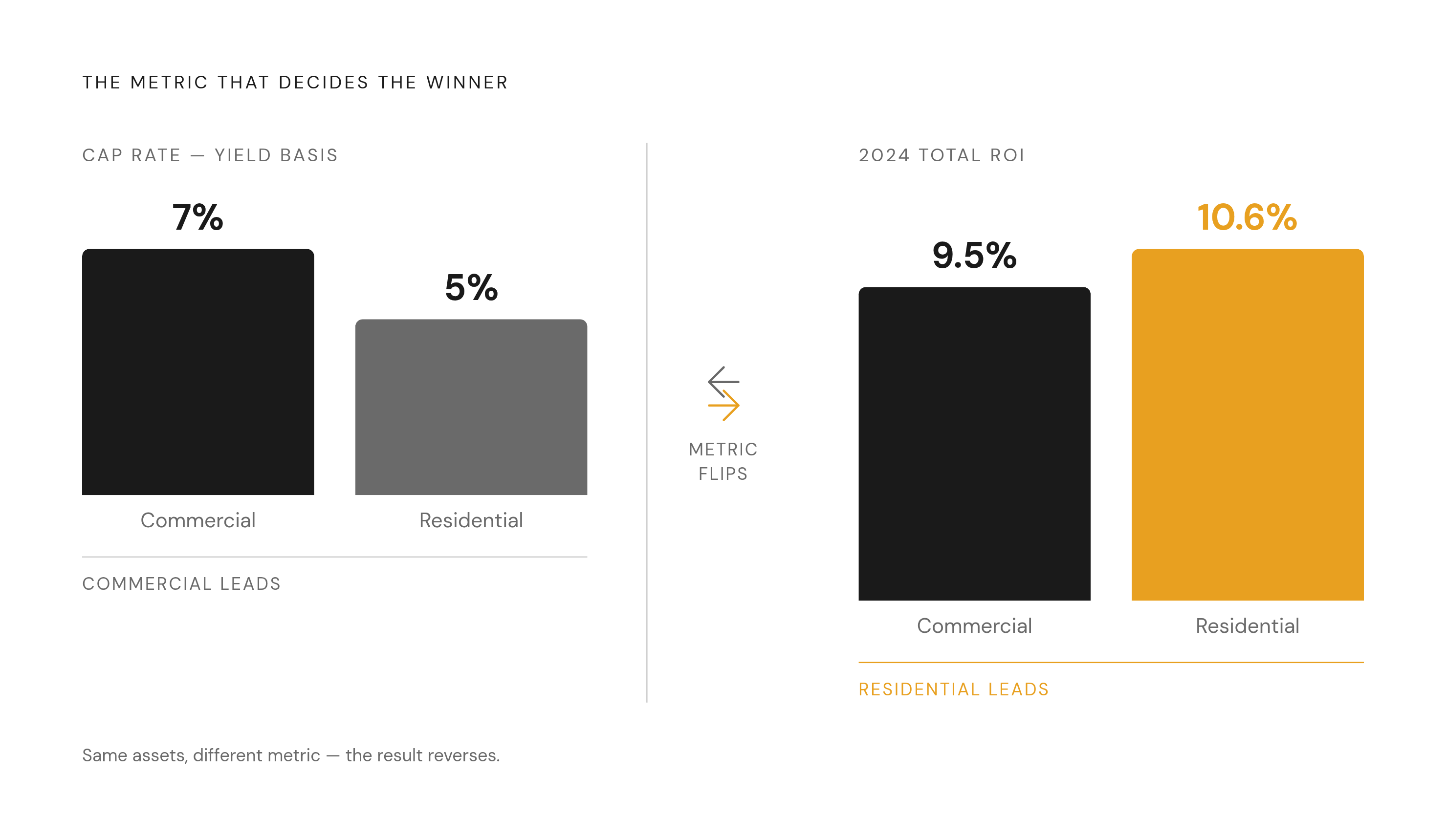
In 2024, homes had 10.6% total ROI and beat business space at 9.5%, mainly because price growth is included in the homes figure in a way yield measures miss alone. Measured on a total-return level, the gap is far tighter than yield figures imply, and here's the key: someone quoting cap rates alone and calling commercial the stronger asset ignores the number that settled 2024.
Demand durability is obvious from occupancy figures. Nationally, rental occupancy climbed to 95.7% in 2025's second quarter, a level last seen in 2022's third quarter. Still, yield numbers can tend, wrongly, to flatter residential: $21,000 goes from single-family homeowners toward upkeep, and that cost eats away at net returns, yet is routinely underestimated when modeling from only the top-line figure.
Picking the right sub-type matters every bit as much as the residential-versus-commercial decision. Residential sub-types show varying returns, with some properties outperforming others based on market conditions. That number alone shows "residential" isn't one single play. Short-term rentals can provide higher revenue potential than traditional residential leases, though they come with additional risks and operational demands.
Tax structure and valuation method differences that affect realized returns
Commercial depreciation follows a faster timeline than residential. Commercial properties often allow for accelerated depreciation through cost segregation, potentially offering tax advantages in the early years of ownership. With cost segregation, you're assigning every part of a property its own faster depreciation timeline, and commercial properties see bigger gains here, since they hold more complicated machinery and gear than a house.
Valuation approaches split far more clearly, and that gap is the one that truly counts for someone running the property instead of just sitting on it. Residential prices come from matching past deals: any property gets priced roughly like close homes that just changed hands, and a single holder can barely raise the number with operating decisions. Commercial price works off the income method: a capitalization number linked to net operating income tells you what it appraises for, so higher rents or smaller operating costs make the asset worth more. That gives commercial managers a level of say over the asset that residential buyers simply don't get. For the investor who's hands-on with managing a property, that's a real edge, but a real pitfall for a passive commercial buyer who doesn't see how NOI sets value. Tax treatment brings another factor that is different by state: in some places, commercial property tax is limited upon reassessment, which can meaningfully alter the ROI comparison for people weighing options.
Where REITs sit relative to direct ownership in both categories
In 2023, REITs saw an average return of 8.2%. Listed REITs delivered 11% in returns in 2023, with fluctuations reaching as high as 15% in mid-September 2024. REITs have shown strong performance, with an average return of 11.8%, compared to direct residential and commercial real estate returns. That comparison alone gives you the best reason here to skip purchasing real estate altogether.
The spread of REIT sectors tracks what's going on across direct commercial holdings. In 2024, specialty REITs were among the top-performing subsectors, reflecting broader trends in commercial real estate. REITs fix liquidity outright, buying and selling as equities do, so an investor skips loan origination plus property work. Active management strategies may enhance REIT returns, with projections suggesting continued growth in the coming years.
REITs don't take the place of direct ownership, and you see that trade-off through returns. People holding REITs lose say over which buildings are bought and how they're run, while gaining a link to stocks that building owners mostly avoid. REITs let an investor chasing commercial-level returns yet shut out of direct ownership by its entry cost tap that return profile, skipping the underwriting hurdles a property purchase requires.
Matching the investment type to the investor's actual situation
How much an asset class returns, in some theoretical way, isn't the actual issue. Which asset performs best comes down to the investor's money, investment period, risk level, plus appetite to do hands-on work. Framed that way, the comparison stops being a contest and starts being a fit exercise, and most of the "commercial beats residential" arguments floating around simply skip this step.
Residential suits investors who haven't yet put together much wealth, because putting down just 3% up to 5% gets you started, while commercial demands 20% to 40%. It suits people who need liquidity, with 30 to 90-day sales instead of six months to a full twelve or more in commercial, plus those fine managing or outsourcing regular upkeep without experts on standby. Residential works for people wanting to prioritize demand durability across a whole cycle rather than squeezing every bit of extra yield, taking 5% to 8% cash-flow returns because appreciation brings total gains close to 10.6%.
Commercial suits investors with enough money to meet the cost up front and stay across one refinancing cycle, without having to sell too soon. It's right for people ready to take on tenant mix risk, type by type, because a prime apartment complex and an office tower in trouble share next to nothing even in the same bucket. It also suits investors drawn to the income premium net-lease deals and extended leases carry, if they have staying power and patience commercial's slower liquidity requires. On its own, each asset class falls short. Each wins when matched to its investor, and you can't read those returns until you separate them first.