Proptech Company Reviews Aggregated by User Segment
Different user segments rate the same proptech platforms in fundamentally incompatible ways.
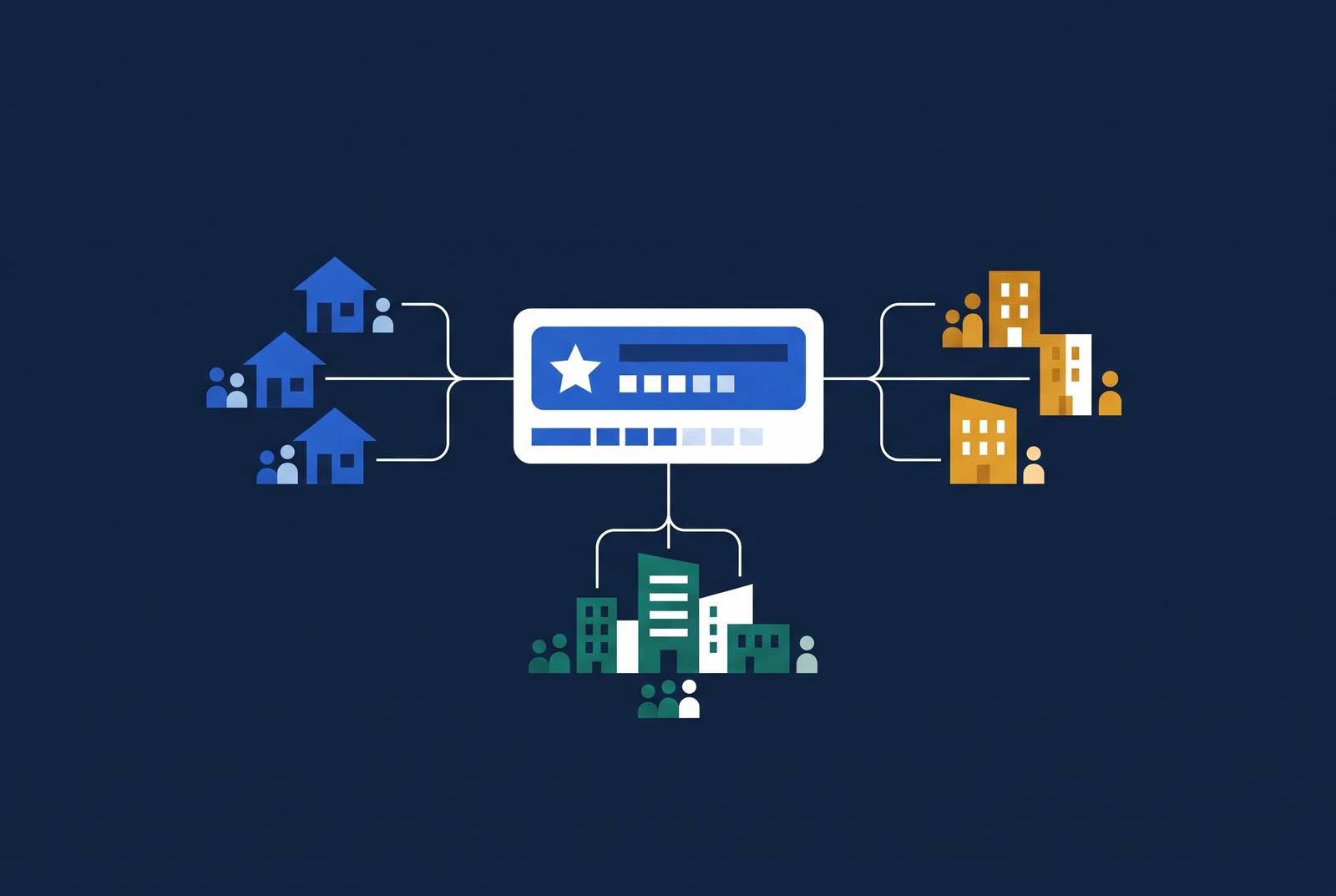
A proptech review is only as useful as the user segment it comes from, and that single fact explains most of the confusing star-rating spreads buyers encounter when shopping for property management software⟦c1⟧. The market itself has grown large enough to make this a real problem rather than a philosophical one: more than 2,000 proptech companies now operate in the U.S. alone, and that volume of choice means review signals carry more weight in a buyer's decision than they used to⟦c2⟧. But an aggregate star rating flattens every one of those choices into a single number, and that number often hides two reviewers describing entirely different products in practice, even when they used the same software ⟦c29⟧.
Consider a contrast drawn straight from Capterra's own review threads ⟦c3⟧. A self-employed landlord complains that a platform's premium tier "doesn't add up to the value," a complaint rooted entirely in price sensitivity and unit count⟦c3⟧. An enterprise buyer, reviewing the same category of software but a different tier of product, complains instead about UX complexity and disconnected systems, a complaint rooted in integration depth and procurement friction⟦c3⟧. Both reviewers are right. Neither review is comparable to the other, and averaging them into one score produces a number that describes neither experience accurately.
The rest of this piece works through why that happens structurally and shows what a segment-literate reading of proptech reviews actually looks like.
How the proptech market is structured by user segment
Industry classification splits proptech's end-user base into four groups: housing associations, property managers and agents, property investors, and a catch-all "others" category that includes tenants⟦c4⟧. Each group operates under a different mandate, which means each group walks into a software evaluation with a different definition of success already baked in.
Precedence Research puts property managers and agents as the largest single cohort by end-user market share, holding 42% in 2025⟦c5⟧. Housing associations are expected to account for 35.88% of end-user share in 2026⟦c5⟧. Property investors, meanwhile, are growing faster than either of those cohorts on a compound annual basis, which matters less for their current size than for where review volume is headed⟦c6⟧. As investor adoption accelerates, investor-authored reviews will make up a larger share of what buyers read, and those reviews test entirely different criteria than the ones property managers apply.
Layered onto this is a targeting problem on the vendor side. PwC and MetaProp's Global PropTech Confidence Index found that 76% of proptech startups build specifically for multifamily assets⟦c7⟧. That means most of the software under review was never designed to serve the whole market in the first place, it was designed for one slice of it, and reviews from outside that slice are reviews of a mismatch as much as a product. A platform built around regulatory compliance and statutory resident-satisfaction reporting for housing associations is being evaluated on different success criteria than one optimised for a private investor, which is judged on AI-based valuation and return forecasting⟦c8⟧. Neither buyer is wrong to apply their own criteria. But their scores are not measuring the same thing.
Property type adds another axis of complexity. Property manager" covers people who manage 20-unit residential buildings and people who manage 2,000-unit commercial portfolios, and no single review score can represent both ⟦c51⟧.
Proptech review locations and segment filtering by platform
Structured proptech reviews mostly live in three environments, and each offers a different level of segment granularity⟦c10⟧. G2's property management category surfaces verified reviews broken out by company size tier, from SMB through mid-market to enterprise, and that structure is increasingly treated as genuine diligence data rather than marketing collateral⟦c11⟧.
Capterra operates at greater scale, having verified more than 2.5 million reviews across software categories using a combination of human moderators and automated text-quality analysis⟦c12⟧. Its reach is Capterra's advantage ⟦c3⟧. Its segment labeling is coarser than G2's formal tiers, which means a reader has to do more inference work to figure out whether a five-star review came from a ten-unit landlord or a two-hundred-unit portfolio manager ⟦c16⟧⟦c33⟧⟦c56⟧.
A third tier exists in specialist outlets. PropTech Reviews, based in Lincoln in the United Kingdom and founded in 2017, operates specifically as an online review platform for property tech companies, staffed by 1–10 employees as of December 2024 and unfunded⟦c13⟧. What it lacks in scale, it makes up for in domain focus, though a small operation covering a fast-moving market inevitably has coverage gaps that a two-million-review platform does not ⟦c29⟧.
Segment filtering, where it exists at all, is approximate. And the review volume itself is not a clean proxy for genuine adoption. A 2025 UK survey of 411 estate and letting agents found that awareness of a given platform correlates with actual usage only 43% of the time⟦c15⟧: a sizable share of the people who could plausibly leave a review know a product by reputation, not by daily use. That inflates apparent review activity without necessarily reflecting lived experience with the software. None of these platforms was designed around the four industry-standard end-user segments (housing associations, property managers, investors, and others), leaving segment filtering approximate at best ⟦c14⟧.
Independent landlord and small-portfolio operator reviews of proptech
Independent landlords and small operators, typically managing under roughly ten units on their own with no dedicated IT staff, evaluate software against a narrow and consistent set of criteria⟦c16⟧. They want simplicity, they want a flat or free pricing structure, and they want rent collection and screening to work from a phone without friction. For this cohort, more features are not a selling point. Feature depth is often read as complexity they will never use and never wanted to pay for.
The praise patterns in their Capterra reviews are notably consistent ⟦c3⟧. Automation, integrated payments, and reachable human support come up repeatedly, with one reviewer specifically praising having "one place to track all my accounting and expenses" and the ability to reach "an actual human when you have a question, not a bot"⟦c17⟧. A support bot that cannot resolve a payment dispute affects the entire vendor relationship for a landlord managing a handful of units alone. For a landlord managing a handful of units alone, a support bot that cannot resolve a payment dispute is not a minor inconvenience, it is the whole relationship with the vendor breaking down at the exact moment it is needed.
The pain points are equally consistent. Per-unit pricing minimums that price out small operators entirely are a repeated source of frustration, and the absence of SMS/text notifications for tenants is another, with one reviewer noting flatly that a product offers "no text message notification to Tenant, does not allow reminders via text"⟦c18⟧. Legacy platforms built around per-unit minimums tend to score poorly with this segment for a reason that has nothing to do with product quality: the pricing model itself assumes a scale this buyer does not have.
Software built specifically for this cohort tends to compete on flat-rate or free pricing structures, mobile-first design, and low setup friction. RentRedi, for instance, was named a Capterra "Established Player" in 2023 based on user ratings and popularity, built around a flat-rate, mobile-first approach aimed squarely at this segment⟦c19⟧. What stands out across this cohort's reviews is how homogeneous the evaluation criteria are. When an independent landlord's review diverges sharply from a platform's aggregate score, the divergence is almost never about product quality. It is almost always about whether the pricing structure fits a portfolio this small.
SMB property manager reviews of residential portfolio tools
SMB property managers occupy the middle tier, typically overseeing somewhere between 10 and 200-plus residential units in a professional management context that requires tenant screening, lease management, maintenance workflows, and reporting, but that has not yet grown into the multi-entity accounting complexity enterprise operators deal with⟦c20⟧. Their reviews track a different set of concerns than the independent landlord's: implementation ease, tenant communication tools, screening workflow quality, onboarding speed, and how responsive support is once the account is live.
AppFolio Property Manager is instructive here because its own reviewer base skews heavily toward this segment: 81% of its G2 reviewers identify as SMB⟦c21⟧. The praise pattern follows from that fact. Reviewers consistently cite ease of use and implementation, and an onboarding window of 30 to 45 days appears repeatedly in reviews as a positive rather than a complaint⟦c21⟧. The criticism that recurs just as consistently is limited depth on commercial lease handling, a gap that matters little to a residential-only SMB manager but matters a great deal to a buyer cross-shopping for mixed-use portfolios⟦c21⟧.
Buildium tells a similar story from a different angle. It carries a 4.5 rating from more than 2,150 reviews on Capterra, the largest review count of any real estate property management software on that platform, and a 4.4 from over 220 reviews on G2, where it has been recognized as a category "Leader"⟦c22⟧. Pricing transparency itself shows up as a review factor for this segment: published tiers run $62 a month for Essential, $192 for Growth, and $400 for Premium⟦c23⟧. That transparency matters to a segment that is often comparing three or four vendors on a spreadsheet before ever booking a demo ⟦c4⟧⟦c10⟧.
One Capterra review from this cohort captures the workflow logic behind the scores well, describing how "the tenant screening process is also fantastic, it handles credit and background checks securely, and having the applicants pay the fee directly simplifies the entire workflow"⟦c24⟧. This is a review about a specific administrative task getting easier, not features in the abstract. It is a review about a specific administrative task getting easier, which is the actual currency SMB managers are trading in ⟦c11⟧. They are not buying software so much as buying a workflow, and a review from this segment is most useful when it describes the day-90 experience rather than what the sales demo promised⟦c25⟧.
That distinction sets up a real tension one tier up. SMB managers prize ease of use above almost everything else, while enterprise managers treat the same "easy to use" praise as a signal to look closer, because simplicity at scale often means a platform has not been built to handle the complexity enterprise portfolios actually carry⟦c26⟧.
Enterprise and Institutional Property Managers on Platforms for Large, Complex Portfolios
What this segment measures in a review bears little resemblance to what an SMB manager measures ⟦c11⟧, though G2's property management category surfaces verified reviews with segment-level breakdowns, including SMB versus mid-market versus enterprise ⟦c11⟧. Compliance depth, multi-entity accounting capability, the breadth of a partner integration ecosystem, and raw scalability all outrank UX simplicity, which barely registers as a criterion once functional completeness is on the table⟦c28⟧.
At this scale, the practical decision usually narrows to two names: Yardi Voyager and MRI Software, both enterprise-grade property management and accounting systems built for exactly this kind of operational weight⟦c29⟧. SelectHub's analyst ratings put Yardi Voyager at 91 against MRI Software's 86⟦c30⟧. Yardi draws consistent praise in enterprise reviews for commercial depth and scalability that few competitors can match. That same depth produces the platform's most persistent criticism: decades of layered functionality have left it with a reputation for UX complexity that enterprise reviewers raise constantly⟦c31⟧. Yardi's partner ecosystem, which runs past 450 integrations, is a specific and recurring positive in enterprise reviews, while AppFolio's comparatively thin commercial lease depth is a specific negative whenever it appears in cross-shopping reviews⟦c32⟧.
Rent Manager occupies a notable position in this tier, holding a 4.6 out of 5 rating on Capterra across 587 reviews, with customer support singled out repeatedly as "top notch, available, knowledgeable, effective and friendly"⟦c33⟧. Its integration program covers more than 200 proptech solution providers, a detail that matters specifically to operators running mixed portfolios that need to talk to several other systems at once⟦c33⟧.
Build-to-Rent operators represent, according to WorkLab's analysis, the most sophisticated buyer segment in the entire market ⟦c9⟧. They ask about adoption rates at day 90, they ask for a named customer support contact rather than a generic help desk, and they ask what the vendor's process looks like for users who resist the new system⟦c34⟧. The leading operators in this segment measure a platform's success by resident NPS and team efficiency scores, not by login counts or feature-usage dashboards⟦c34⟧. Defining characteristics of these portfolios include large commercial or mixed-use holdings, multi-entity accounting, compliance requirements, multiple procurement stakeholders, and an average of 12–15 disconnected software systems per firm (WorkLab 2026) ⟦c27⟧. Enterprise reviews are only interpretable in context, since a 3-star rating for "ease of use" from a Yardi Voyager user and a 3-star rating for "ease of use" from a TurboTenant user describe entirely different failure modes ⟦c35⟧.
Real estate investor and housing association priorities not typically flagged by landlords or managers
Investors and funds bring a set of demands to proptech reviews that barely overlaps with anything a landlord or manager cares about. Their reviews focus on AI-based valuation modeling, verified financial data, rent roll transparency, return forecasting tools, and, increasingly, fractional ownership or crowdfunding functionality⟦c36⟧. Fortune Business Insights projects this cohort to grow faster than any other end-user segment over the forecast period, which means investor-authored reviews are set to make up a growing share of what buyers encounter⟦c37⟧. The direction of vendor investment backs this up: between 30% and 50% of proptech venture funding in 2025 went to AI-focused companies, up from roughly 20% in 2024, and that shift is visible directly in what investor reviews now test for⟦c38⟧. A platform earning glowing reviews from a property manager over its tenant communication tools is not, by that fact, earning anything from an investor evaluating the same software for its valuation accuracy. These are separate report cards on the same product.
Housing associations sit on the opposite end of the visibility spectrum. Projected to hold 35.88% of end-user market share by 2026, they represent one of the largest cohorts in the entire market and one of the least documented in mainstream review databases⟦c39⟧. In the UK, resident satisfaction has become a statutory measure within social housing, which layers a regulatory compliance requirement onto software evaluation that simply does not exist for an SMB manager or a private investor assessing the identical platform⟦c40⟧. What a housing association actually measures, accordingly, includes compliance tooling, resident engagement features, audit trail integrity, and data governance, criteria almost entirely absent from a landlord's or investor's review of the same product. A platform an independent landlord dings for "feature bloat" may be the exact same platform a housing association praises for the audit and compliance depth that bloat represents.
Both of these segments are underrepresented in the public review record, and both apply criteria specific enough that generic star ratings offer buyers in these categories almost no signal at all⟦c41⟧. Anyone buying on behalf of an investor or a housing association needs to go looking for segment-filtered evidence directly, because the aggregate score was never built with their evaluation criteria in mind.
Tenants and residents as an emerging distinct review cohort operators cannot ignore
Tenants have never counted as proptech "buyers" in any formal sense, yet their satisfaction with a platform increasingly determines whether the operator who bought it keeps paying for it. WorkLab's 2026 analysis captures the mechanism cleanly: the maintenance app that earns four stars on the App Store gets used, while the CRM the operator mandated from the top down gets quietly worked around⟦c42⟧. App Store ratings, in other words, function as a leading indicator of whether a piece of software actually gets adopted in practice, regardless of what the procurement team decided ⟦c42⟧.
What tenants review tracks closely to daily lived experience rather than back-office capability: how fast a maintenance request gets a response, how smooth rent payment feels, whether communication tools work, and whether community features exist. Platforms that consolidate these functions into one interface consistently score highest in tenant-facing reviews⟦c43⟧. The same 2025 UK survey of 411 estate and letting agents that found only 43% awareness-to-usage correlation also captured agents saying, in effect, that proptech needs to stop dazzling and start delivering, a sentiment that reflects tenant-side pressure filtering upward through the agent layer rather than agents inventing the complaint on their own⟦c44⟧.
Social housing tenants form a particularly distinct and regulated sub-segment within this cohort. Because resident satisfaction is a statutory measure in the UK, tenant reviews in that context function as a compliance artifact that feeds directly into vendor assessments, not merely as a consumer preference signal that operators can weigh or ignore at will⟦c45⟧. WorkLab's analysis finds that Build-to-Rent operators already measure technology performance by resident NPS rather than by internal usage metrics, and that approach looks like where the broader market is heading⟦c46⟧. Ignoring tenant-side review signals when evaluating a platform amounts to judging a restaurant by asking only the chef: the diner's experience is what determines whether anyone comes back, and in proptech, the resident's experience is what determines whether the software gets used at all, which is what determines the return on the investment⟦c47⟧.
The cross-segment evidence on how to read proptech reviews more accurately
The clearest finding across every segment examined here is that satisfaction does not track awareness. The 43% correlation between knowing a platform and actually using it, drawn from the 2025 UK survey of 411 agents, means that a platform's public visibility can reflect brand recognition as easily as it reflects genuine operational experience⟦c48⟧. A high review count is not proof of broad, satisfied adoption. It can just as easily be proof that a lot of people have heard of something.
That finding points toward a small set of questions to apply to any proptech review before trusting it. What segment does the reviewer actually operate in, independent landlord, SMB manager, enterprise operator, investor, housing association, or tenant⟦c50⟧? What portfolio size and property type is the review actually describing, since a Yardi review from a manager running 20 residential units and a Yardi review from an operator running 2,000 commercial units are not measuring the same product experience⟦c51⟧? Is the reviewer the buyer, the operator, or the end-user, given that WorkLab's 2026 analysis identifies the buyer as almost always the landlord or operator while the user is the manager, negotiator, or tenant, different parties with different incentives⟦c52⟧? And where in the adoption cycle was the review written, at the demo stage, during onboarding, or after the platform had settled into daily use, given that AppFolio's 30-to-45-day onboarding window itself shapes how early reviewers describe the product compared to reviewers writing months later⟦c53⟧?
Until then, reading proptech reviews accurately means identifying who wrote the review, what they were actually trying to accomplish, and whether their definition of success has anything to do with the reader's own. A star rating without that context is an average of several different questions, none of which the reader actually asked. It is an average of several different questions, none of which the reader actually asked. Five diagnostic questions apply to any proptech review ⟦c49⟧.