AI in Real Estate Development Project Planning
Success depends on organizational discipline, not the AI tools themselves.

AI for real estate development isn't a single tool. It runs as a stack of narrow functions, covering site selection, entitlement, estimation, and schedule, but most firms mess up the sequencing. Over 60% of developers say an AI tool already sits somewhere in the workflow. The tools are out there, and they deliver. The firms capturing real value stand out through internal discipline built around their purchased tools. Whether they built the internal discipline to operate them.
The most striking numbers here come from the 2026 edition of Deloitte's CRE Outlook, which surveyed 850 C-suite leaders in 13 nations. Operators calling AI's effect on their company "transformative" dropped to 1% from 12%, a fall Deloitte's analysis attributes to organizational failure, not any problem in the underlying technology. This isn't a plateau. Deloitte's says organizational failure was to blame, rather than a problem in the underlying technology: firms launched these tools without structured data, defined goals, or the internal capability to run them later. In real estate, only 21% of AI efforts ever left the prototype.
The models aren't the problem here. It indicts how firms have forced advanced tools into work routines that weren’t built for such use. That gap between an organizational issue and a technology problem shows up in every development step ahead.
The development stack's difference from every other AI use case in real estate
Most AI coverage in real estate is about brokerage and asset operations: CRM tools for deals, descriptions, scoring prospects. That stuff doesn't apply to building from the ground up, and acting like it does explains why pilots stall out so often.
A ground-up development depends on documents that have little in common with what a leasing office handles. At once, a project carries offering memoranda, hundred-page agreements, Phase I environmental reviews, utility feasibility checks, geotechnical work, commitments plus construction budgets, schedules, and multi-party stacks. A system built to summarize listings or rate inbound leads won't parse a PSA looking for indemnification triggers, nor reconcile a draw schedule against construction costs. They are structurally different issues, and tools for one rarely handle another.
Tools aren't what's holding things back here. The slowdown comes after all that excess: pairing each slim tool with its slim job, across a workflow packed with dozens.
Development also faces a consequence problem most of the field does not. These choices happen rarely, cost a fortune, and once money goes out they're mostly irreversible, unlike day-to-day calls. A rent comp mistake gets fixed by the market come lease renewal. A bad site selection means the error compounds over the property's entire multi-decade life. That asymmetry explains why getting AI adoption right piece by piece helps site-selection outcomes more in built places than most others: the site-selection error compounds for the asset’s entire multi-decade life.
Site selection: where AI's leverage is highest and adoption is moving fastest
Site selection starts at the funnel's front, and it's long been one of development's most time-intensive, data-hungry jobs. While one team cross-references zoning maps by hand against traffic counts, another developer could be closing on the parcel. AI's leverage is strongest here, cutting time spent manually cross-referencing zoning maps with traffic counts.
These platforms aggregate: geospatial data, zoning rules, utility maps, traffic flow, demographic shifts, past planning approvals, and rival developer moves, folded into one score per parcel. Calling it a marginal productivity gain undersells how a land team now spends its time.
A few well-known platforms lead this category today, each taking a different angle. Deepblocks handles site selection, feasibility, zoning analysis, and 3D massing. TestFit claims site planning happens "5x faster" with "$4,000+ saved". Buildora IQ targets AI pre-construction work, and ArchiWise handles AI-powered site reviews plus zoning analysis. GrowthFactor built a retail-specific "glass-box" system, revealing every factor behind a site's score instead of hiding the logic and just spitting out a result. A GrowthFactor customer, Cavender's, drew on its platform's transparency, tripling openings to 27 locations in 2025. The return on a site-selection tool is measured here as a concrete, countable business outcome.
Entitlement and permitting risk: the stage where AI is creating the largest time savings for developers
Permitting drags out development timelines, and AI's time savings there are the most obvious and easiest to count. Before a developer closes on a site, analysis tools can verify permitted project fit, identify zoning constraints limiting what gets built, quantify buildable size under zoning, gauge if a variance or permit is needed, and compare nearby properties by the parcel's zoning. Land-use attorneys and planners used to spend weeks on that diligence, yet it's been compressed into a background workflow during underwriting.
The financial stakes of faster approvals are concrete. Research in the Journal of Urban Economics on Los Angeles multifamily housing production found that 25% faster approvals could raise housing production by almost 24%. It's nearly one-to-one between permitting pace and housing output, giving real weight to what often gets dismissed as a soft bureaucratic complaint.
Clariti Software folded in CivCheck, which already serves over 20 cities at stages from pilots to live rollouts. Cutting 3, 4, or 5 rounds of review-and-feedback by compressing them into one cycle is when permit turnaround really begins to shift. The mechanism is straightforward: AI catches mistakes early, cutting the back-and-forth before a reviewer sees the submission.
Seattle is showing how this plays out at the city scale. Bruce Harrell signed a mandate in 2025 to drive citywide permitting changes, and Permitting plus Customer Trust workers are piloting AI tools to pre-screen filings, spot usual mistakes, clarify hard rules, and teach employees, with rollout set for 2026. Local governments are testing this as civic infrastructure.
Financial underwriting and pro forma automation: the numbers AI accelerates and the judgment it still cannot replace
Feasibility analysis, which once took a couple of weeks for research and financial modeling, can now be wrapped up in a few days with AI-assisted tools. It's not that the output beats what a skilled analyst could put together by hand. The tools absorb the grinding work: they pull comparable transaction data, start populating the first-pass pro forma, and create sensitivity tables, freeing the analyst's time for judgment, not data.
Northspyre targets development and capital project oversight, applying AI to handle invoice processing, draw management, cost forecasting, and predictive modeling of total project spend. Kolena is built for a different angle, with AI-native agents handling document-heavy real estate: discounted cash flow modeling and pro forma, lease abstraction, and rent analysis. Both reflect the same underlying trend. Software is taking over the repetitive, structured pieces of underwriting so analysts can focus their time on what truly needs judgment.
AI handles specific tasks here: drafting income forecasts, using comparable sites and rent rolls to benchmark a thesis, testing sensitivity scenarios, and estimating stabilization timing plus IRR. From a site's raw capacity, it creates cash flow a developer can show decision-makers up front. It won't make the final judgment in that room, deciding if the risk pays off against what the model fails to quantify. Automation delivers the figures sooner. It won't make the final call.
Generative design in early-stage planning: options at speed, with a selection problem attached
Firms run AI to churn out design iterations at a pace that would be time-prohibitive if architects did it themselves, yielding layouts tuned by data-driven insight to what the end-user wants.
It fits early-stage planning, along with the schematic design phase, when teams are generating and comparing alternatives before finalizing any design. But that qualifier shifts what the tools can actually be trusted to handle. Generative tools generate options faster than any individual could, but someone still needs to evaluate them against the site's requirements, and that selection challenge won't shrink just because there are more options to consider. More volume without judgment only leaves a longer list to sort through, not a stronger choice.
Platforms used for site-selection regularly flow right through to early massing. Deepblocks, TestFit, and ArchiWise pop up here in addition to the funnel's leading edge. That overlap is no coincidence: early massing and site feasibility sit close together, use the same geospatial data and zoning, so a tool built for one extends to the other.
The sector supporting this is growing quickly. Generative AI in architecture is projected to jump from $1.47 billion during 2025 up to $2.07 billion by 2026, then hit $8 billion in 2030 at a 40.2% compound yearly pace. When the curve is that steep, investment comes in faster than a disciplined workflow, with that mismatch showing in the sector's pilot-to-production data.
Construction monitoring and cost management: where AI connects the plan to what is happening on site
Computer vision platforms process 360° site captures or drone imagery against project plans to produce progress reports, detecting schedule slippage, identifying safety hazards, and flagging work that does not match approved plans before it requires demolition or remediation. The real value lies there. Catching a deviation early, before demolition is required, creates a fundamentally different cost result than finding it later.
The data underline how early this remains. Construction AI is projected to hit $24,696.92 million by 2035, up from $1,211.90 million in 2025, a twentyfold jump that marks a category still early next to site selection or underwriting, even with money pouring in behind it.
Survey data supports the sequencing. The AGC/Sage 2026 Construction Outlook reported 61% of respondents already working with AI or planning to invest more in it, versus 44% a year earlier. But firms mostly pointed to administrative work, preconstruction, and estimating. More people want it, but Construction monitoring trails the lifecycle's front end in actual adoption.
The same gap shows up in other areas of the industry too. KPMG's Global Construction Survey says just 24% of global engineering and construction firms use AI across their business. ServiceTitan's data points to a brighter pattern among contractors, with 38% of specialty firms seeing measurable AI gains versus 17% previously. The trend looks good. That underlying pattern of fast-growing curiosity paired with far fewer firms converting it into real outcomes holds everywhere else.
Why most AI pilots fail to reach production
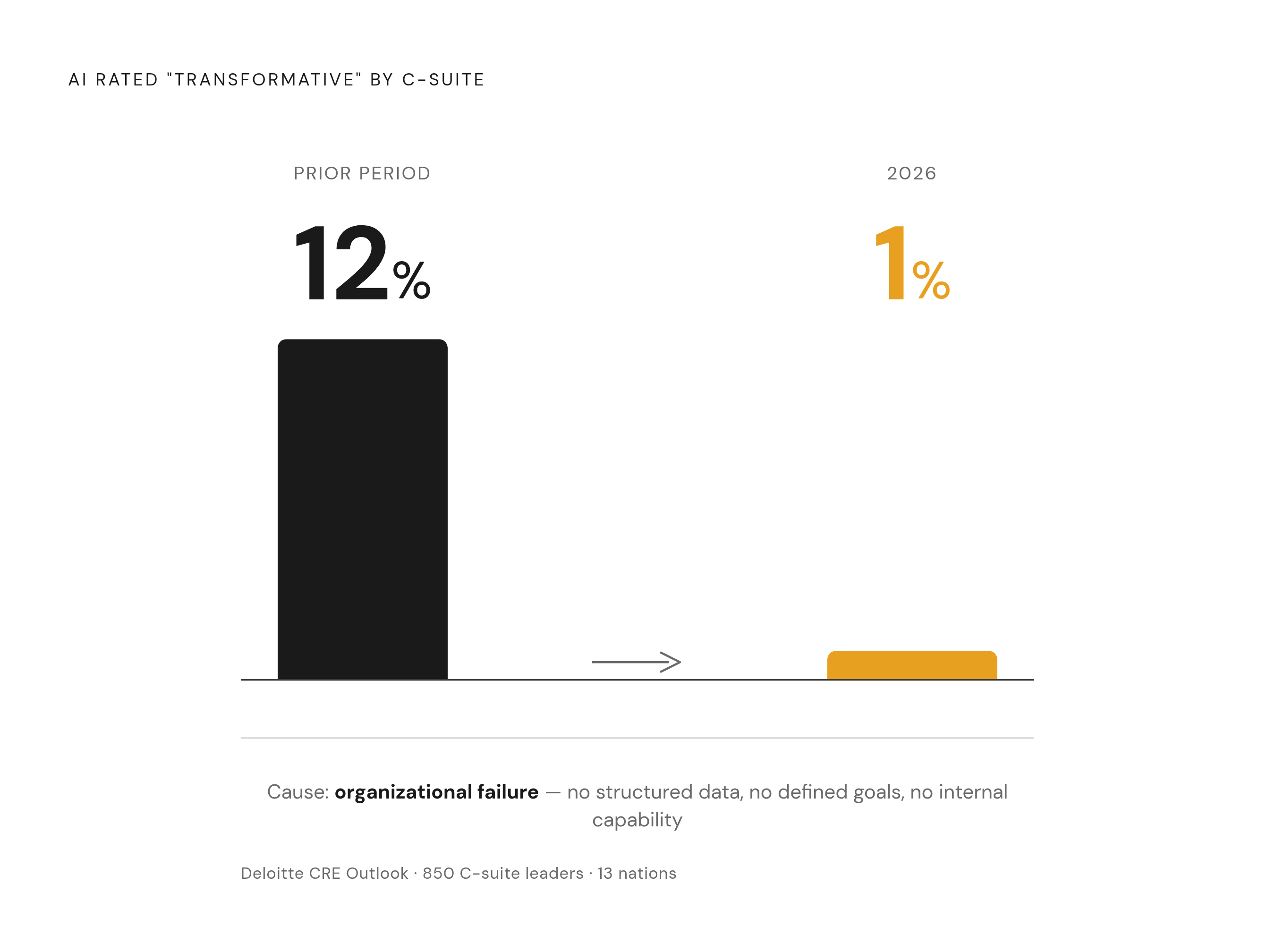
Look at Deloitte’s diagnostic, the clearest clue here: operators’ transformative results dropped from 12% to 1% after organizations launched without structured data, defined objectives, or internal capability for execution. This restates the piece's thesis at the organizational scale.
The surveys point to three distinct roadblocks. Deloitte respondents said complicated systems and missing in-house skills derailed their rollout in 27% of cases. Privacy and data-protection worries are climbing as a reported barrier, jumping from 22% to 30% in RICS's 2026 survey. Workflow resistance drives both obstacles: adopting AI means more than dropping a tool into the current routine, it demands rethinking how tasks get reviewed and approved. Firms underrate that barrier most because organizational change sits outside the technical features on a vendor's list.
FOCAL's take on sequencing sharpens the point. For development work, document tools deliver the clearest ROI fastest, yet this underused category is still overlooked. Demo-friendly tools like generative design and chatbots get piloted early, while higher-value tools go unused. The failure lies in sequencing, not technology, and it can be fixed. Firms that mess this up are out of excuses.
RICS's 2026 data shows that commercial property has been more successful converting pilots into regular use, with 29% regular use, than construction, at 19%. Moving from pilot to production goes smoother when workflows are process-driven and standardized. Firms that get their workflows in order before bringing AI in are pulling ahead of those who slap AI onto undisciplined routines, and that lead will only grow wider.