For Sale by Owner Listing Platforms Compared
These platforms differ sharply on MLS access and hidden closing fees.
FSBO made up 5% of U.S. deals in 2025, compared with 1985’s 21%. Sellers who skip an agent give one answer: 61% say it's to keep the fee. The math partly supports them (2025 FSBO sale price was $360,000 versus agent-assisted at $425,000), but a seller reaches a buyer only after one earlier choice: which platform they use. FSBO platforms come in a couple of types depending on if a listing reaches MLS, and sellers checking costs before deciding that are solving things out of order.
What the 2024 NAR settlement means for the FSBO calculation
The National Association of Realtors settled a $418 million antitrust lawsuit, and new policies went live on 2024's August 17. Buyer-agent pay can't show up in MLS listings, and sellers don't have to offer it. This part of the settlement directly shapes what a FSBO seller chooses.
FSBO sellers didn't have to follow NAR's requirements in the first place because they skip using a broker. But the buyers they want to contact usually use agents, who follow new pay terms. A FSBO seller now has to negotiate and disclose these terms early, instead of keeping them unstated like sellers once did.
In Q1 2025, Redfin reported the average buyer-agent commission was 2.4% in Q1 2025, down slightly from 2.43% in Q1 2024. The deal affected both the paperwork and negotiating posture. Buyer-side commissions held roughly steady. Someone choosing FSBO because they think the settlement killed those fees is betting on an idea the data doesn't back, and that error comes up during talks, when the other side requests the 2.4% they thought was gone.
How MLS access splits FSBO platforms into separate offerings
Around 88% of buyers use a real estate agent, and those agents look at the MLS ahead of Zillow, Facebook, or any other site. A listing that doesn’t make it to the MLS stays hidden from all those buyers, no matter how good the photos look or how many scroll by elsewhere.
FSBO sellers can't put their homes on the MLS themselves. Only brokers get that access, and that restriction leaves the market gap that flat-fee MLS companies handle: they serve as broker so the listing reaches agents. The seller skips the standard 2.5% to 3% share of the sale price, opting for a flat fee upfront with possibly a lower charge at closing.
Those no-cost sites don't offer that trade-off either. A seller putting Facebook Marketplace or Zillow's FSBO tier on par with a flat-fee MLS listing is not choosing a small tradeoff, but confusing two different products. Craigslist, Facebook Marketplace, Zillow, and ForSaleByOwner.com's entry-level tier each put a listing in front of whoever's browsing those platforms, yet not one of them will syndicate to the MLS. If buyers' agents can access listing 88%, it isn't the same as a listing structurally kept from them, and no photo closes that gap.
No-cost FSBO platforms: their offer and where they end
Zillow's FSBO option is free, has no fixed time limit, and takes any number of pictures. No MLS inclusion, but Zillow did shift how it deals with these postings: Zillow displays FSBO properties alongside agent listings. Zillow draws about 220 million people each month, making it the largest platform in residential real estate and a practical option for a seller with a buyer already in mind, or anyone checking a price before paying for MLS access. But since Zillow directs inquiries to local agents unless the seller adjusts their settings.
ForSaleByOwner.com offers tiered pricing, with no closing fees and photo flexibility. At the free tier it's a web-only listing, no MLS. An MLS add-on exists, but when a seller buys it, the listing becomes paid flat-fee and is no longer free.
Facebook Marketplace and Craigslist each cost nothing, neither is on the MLS, and neither ends. Craigslist allows multiple photos; Facebook Marketplace allows photos without a stated limit. Sellers get no built-in offer-management tools, no disclosure handling, and no showing coordination, handling each step over text. Both shine in smaller or specialized areas: 10% FSBO in farming regions, 9% in vacation towns, far past the 5% national figure, so owners there get more from a nearby marketplace than someone outside a big city would.
Every no-cost platform lacks offer management, digital contracts, showing coordination, and a dashboard for any of it. The real cost is that all those tasks end up on the seller's desk. Every one of those tasks ends up back on the seller to handle.
Paid flat-fee MLS platforms compared across pricing, reach, and tools
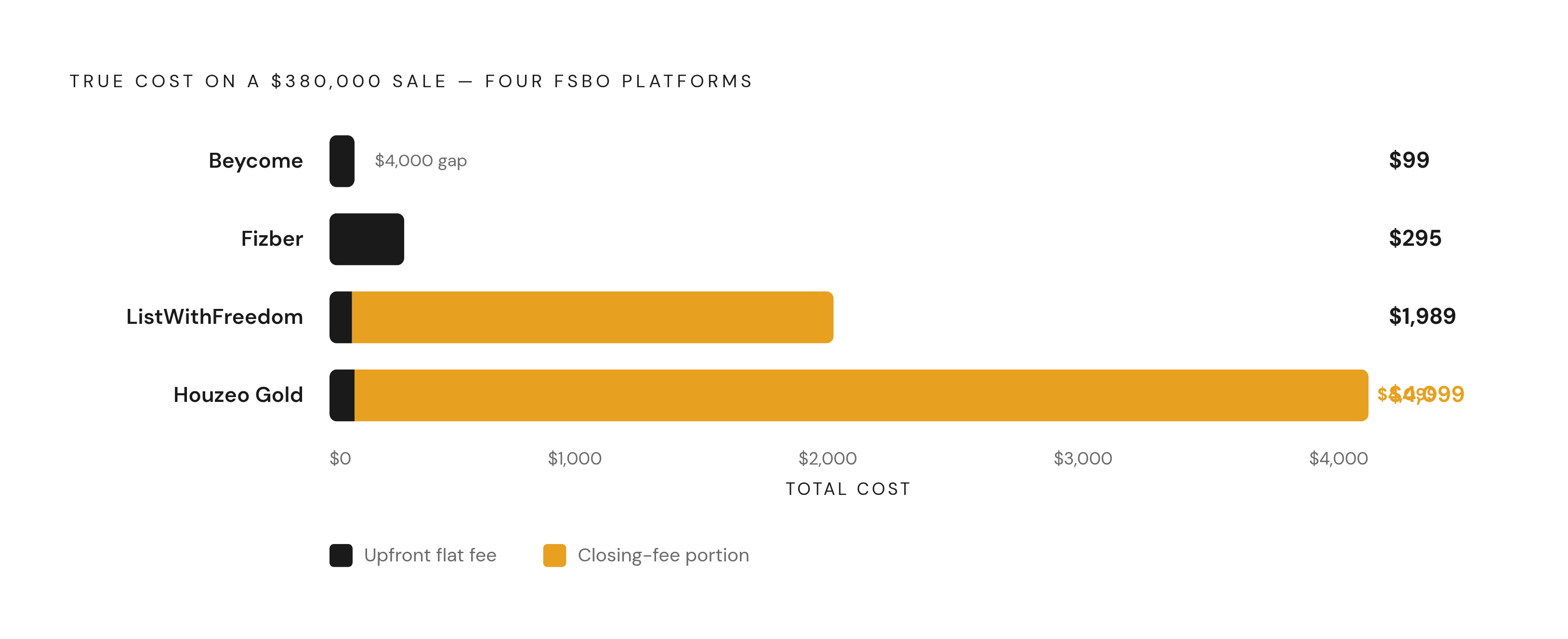
Beycome charges $99, with MLS access included, and charges no extra at closing: no admin fee, no percentage of sale price, and no E&O fee tacked on later. Beycome's listing stays active for 24 months, outlasting every other platform covered, with unlimited photos bound only by the MLS's own upload cap. Tools cover disclosure handling, offer management, talks with buyer or buyer-agent, a seller dashboard, plus unlimited edits to showing or listing. Operates in roughly 14 or 15 states, not the full 50, so access hinges on the home's location. It holds a 4.6 weighted score out of 5 stars across review platforms. Beycome stands out among these platforms for its genuinely flat fee without hidden charges, making it the default choice for sellers seeking the most affordable total cost and no closing-fee surprises.
Houzeo serves all 50 states, along with Puerto Rico and Washington, DC, and in June 2026 rolled out $399 Bronze, with no payment at closing, although Bronze has limited availability. Bronze includes one six-month MLS listing, 24 photos, syndication on Zillow, Trulia, Redfin, Realtor.com, plus over 100 other platforms, 10 listing edits, and 3 open-house postings, while a lawn marker costs $49 more. Silver, Gold, Platinum tiers each tack on a closing fee of 0.5% to 1.25% against the sale price, never less than $999 minimum, so selling a standard $380,000 Tennessee house through Gold totals around $4,099. Just output the sentence.Here's what homeowners should weigh: Houzeo splits its charges, a flat amount first and, except on Bronze, a share of the sale due at settlement. Mix them up and a seller believes they picked a flat fee but really purchased a flat-fee-plus-percentage plan with more paperwork. Houzeo provides tools to assist with listing descriptions, holds a 4.9-star rating from over 11,000 Google entries, yet some users have noted challenges with listing accuracy and support. Houzeo works for a seller who wants maximum syndication and will actually do the tier math, and nobody else.
Fizber's flat fee is $295, with MLS listing for 12 months and no photo cap. No percentage fee anywhere in the pricing. That price stays genuinely flat, so a seller after unlimited photos and MLS access won't see unexpected charges when they reach the closing table.
ListWithFreedom's upfront cost is $89, the least of the set, with MLS, though it charges 0.25% to 0.5% when the sale closes, runs for half a year, and has photo allowance is limited. The closing percentage pushes total cost up as the sale price rises, so a lower-priced listing works best, where that percentage comes to little in actual money. Houzeo's national MLS lists and some New York city-level lists, Rochester included, carry it, though Houzeo's main statewide New York list does not.
What sets platforms apart after MLS access is in place
With MLS access in place, the real test is if pricing stays flat or adds a percentage, yet most sellers never ask. Beycome asks $99, Fizber wants $295, and Houzeo's Bronze is $399, all upfront, so a seller sees the total cost right away. ListWithFreedom's 0.25% to 0.5%, Houzeo's Silver to Platinum with a $999 floor at 0.5% to 1.25%, and HomeZu's 0.1% charge a closing percentage, so total cost tracks the sale price. On a $380,000 property, a flat-fee listing versus a 1% closing-side fee leaves a difference topping $3,000. A gap this big isn't just rounding, and a seller should run the math before looking at sticker costs, not after joining up and learning the total at closing.
Listing duration is another lever, and it doesn't get the focus it needs. Beycome's 24 months beats every other offer, Fizber offers a 12-month listing, while most competitors cap at half a year. In a slower area, or with a higher-priced home that often takes more time, a seller should treat duration heavier than the upfront price, since a listing expiring mid-negotiation can lose far more than the upfront savings were worth.
Photo caps seem small until a seller is limited to ten images for a home with a basement that's already done up and a scene hidden from the road. Beycome and Fizber allow unlimited photos. Homecoin allows multiple photos, while FSBO.com offers about 10 and ISoldMyHouse.com allows up to 10 photos on its basic plan. The MLS itself can set its own upper limit, but the cap the platform enforces is usually what actually binds things day to day, and photos are among the earliest pieces a buyer takes in, long before any listing text gets to them.
The remaining piece is the toolset that comes with the MLS listing: showing coordination, disclosure handling, digital contracts, offer management. These are the jobs once handled only by a listing agent. The real gap between platforms that cost the same is how much of that work a platform replaces, and how much the seller has to run alone by phone and spreadsheet.