Essay Brokerage Platforms
AI Chatbots for Multifamily Leasing Teams
Round-the-clock AI leasing works only with clean data, handoffs, and fair housing guardrails.
AI chatbots help multifamily leasing teams stay responsive during the hours renters are actively searching but leasing offices are closed. The core problem they solve is structural: a renter who discovers a property at 10PM on a Saturday will not wait till Monday morning for a response. AI leasing assistants handle that gap by fielding questions, qualifying prospects, and scheduling tours around the clock, across channels including web chat, SMS, email, and voice. They work as genuine operating infrastructure only when human staff are properly briefed, property data is current, and fair housing rules govern every automated response. This post covers how these tools actually function in multifamily settings, where current adoption stands, where the technology breaks down, and what a well-designed pilot looks like.
AI solves a structural coverage problem
Renters keep looking even after the leasing office shuts down for the night. Messages come in on evenings and weekends while the team is away, leaving prospects waiting as other properties compete for their attention. A fully covered weekday roster will not catch prospects during the moments they are actually apartment hunting.
Even when the office is staffed, the window to respond is unforgiving. A lead left waiting over five minutes may move to a competing property, yet agents cannot always answer that fast while giving tours. By 2026, leases are also taking longer to close on average, which raises the stakes: when leasing cycles drag, an inquiry that goes unanswered overnight can translate directly into additional vacant days and lost revenue.
AI leasing tools vs. basic scripted chatbots
Scripted chatbots operate by pairing inquiries with predetermined response routes. If a prospect asks something those paths do not cover, the conversation stops with a fallback message or a form. Scripts confined to the website also cannot handle phone calls, text messages, and emails, leaving entire inbound channels unmanaged.
EliseAI's 2026 comparison frames the contrast this way: one tool answers, the other converts. A scripted chatbot passes along basic details, while an AI leasing assistant works toward a specific outcome, such as getting a tour booked, by drawing replies from current property data. When the assistant encounters a question it cannot answer, the missing knowledge can be flagged and routed into a guided improvement process, where a draft knowledge article is created for staff review rather than allowing the gap to persist.
According to MRI Software's 2026 overview, the core functions are fielding questions at all hours, scheduling calendar-based tours, qualifying leads, and writing data back to property management systems. These tools manage email, voice, SMS, and web chat, capturing inquiries originating from Zillow and Apartments.com. Because they share context across channels, a prospect can start on web chat and switch to texting via a yard sign without needing to reintroduce themselves.
Live availability and pricing data alone is not enough when the tool cannot send leads, tour bookings, and notes back into the property management system. With only one-way data access, staff must manually reconcile what the assistant gathered. Native integration removes that burden, while open-platform connections provide flexibility across systems like Yardi, AppFolio, Buildium, and RealPage.
From first inquiry to booked tour
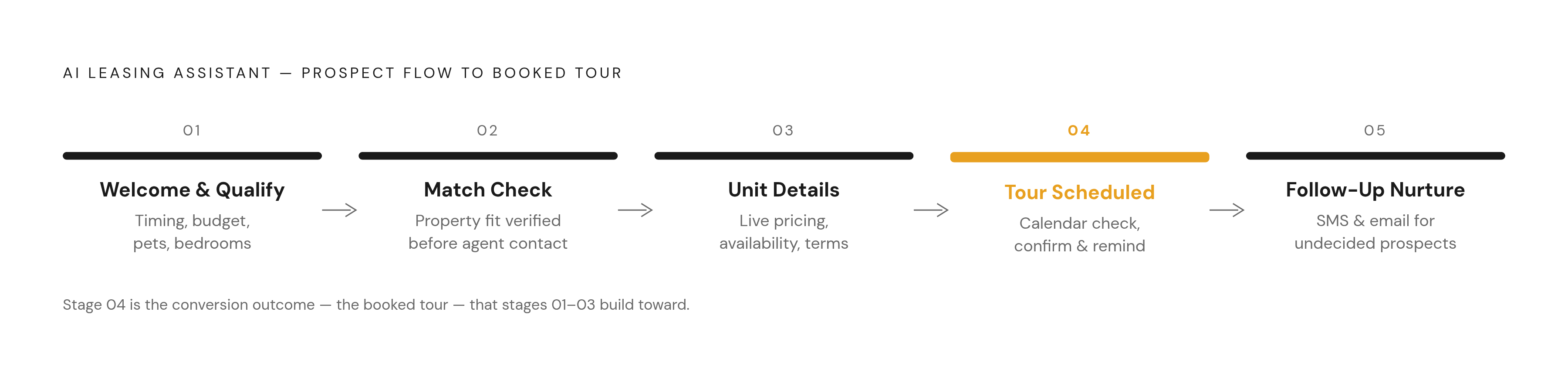
The assistant collects move-in timing, pet status, budget, and bedroom count during the first exchange. Those answers establish whether the property is a reasonable match before a human agent needs to get involved. From there, the assistant pulls current unit data, including pricing, availability, features, lease terms, and property documents, so the prospect has what they need to evaluate the property.
When a prospect wants to visit, the assistant checks agent availability and arranges either a guided tour or a self-guided walkthrough. Confirmations and reminders go out automatically, eliminating back-and-forth email and phone tag. The prospect leaves the conversation with a confirmed appointment rather than a task to complete later.
When a prospect is still deciding, they enter a follow-up sequence. Tailored SMS and email messages go out on a flexible schedule, keeping the lead engaged until they book a visit or opt out. This workflow allows an interested renter to re-engage without requiring an agent to initiate each individual contact.
Where adoption stands across the industry
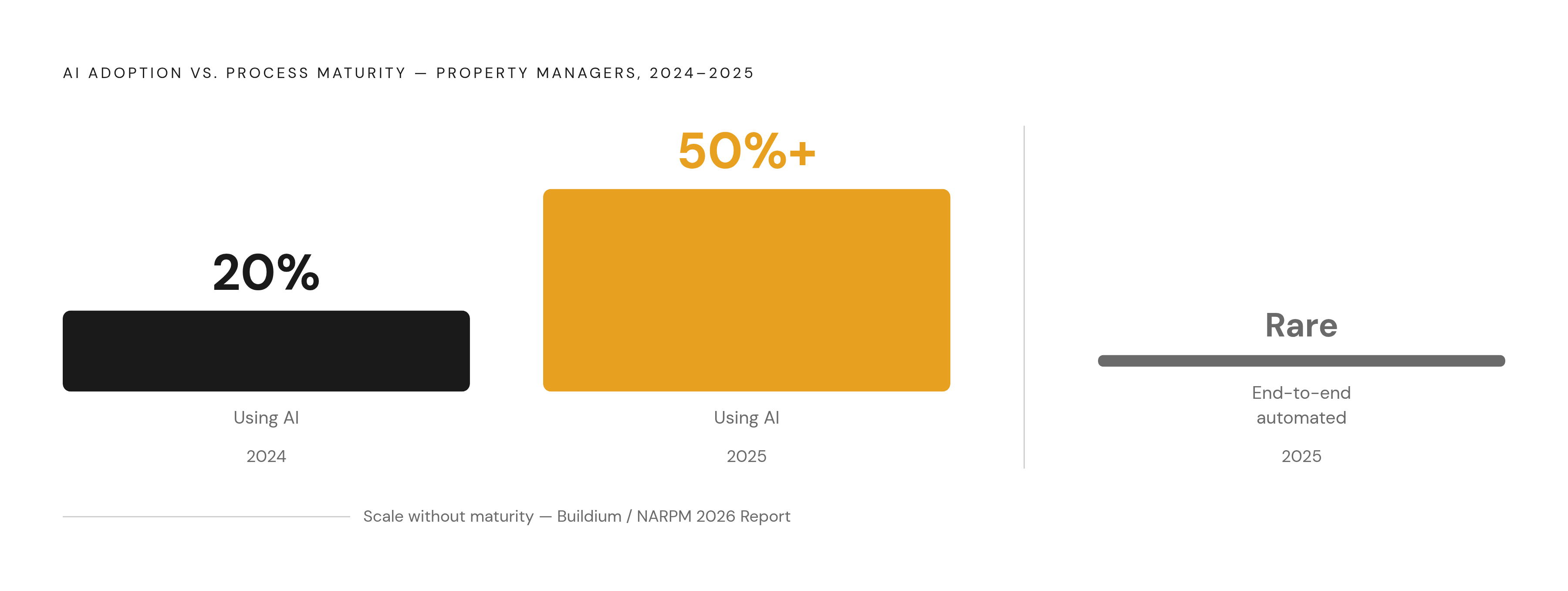
Buildium's 2026 Report for the Property Management Industry, developed alongside NARPM, found that property managers' AI use climbed from 20% in 2024 to more than half of operators by 2025. That same report found fully automated end-to-end processes remained rare. Widespread use and operational maturity are not the same thing: even when adoption is broad, many operators have not completed the data, integration, and governance work required to let AI support a leasing workflow from intake to signed lease.
Teams typically start with leasing intake and tour scheduling because those tasks follow predictable, high-volume patterns. Deployment is uneven across operator size and portfolio type. Smaller operators without dedicated technology budgets rarely adopt AI tools. Larger firms are now extending automation to maintenance request triage, past-due outreach, lease renewals, and reputation management, with several portfolios running these workflows in 2026.
Even when the office is staffed, the window to respond is unforgiving.
Where AI-assisted leasing breaks down
The handoff from the AI assistant to a human agent is often the toughest operational hurdle. A prospect may have already shared their budget, timeline, and unit requirements during the automated conversation, then reach a leasing agent who asks for all of it again. This redundancy reveals a data integration failure: the assistant gathered useful qualification information, but that information was never delivered to the staff member who needed it.
When a handoff works correctly, the agent sees the full conversation history and qualification summary before they say a word. Without integration that pushes data into the property management system, agents must start from scratch and lose everything gathered during intake. Voice calls and email are harder to hand off cleanly than chat, because those channels do not produce organized dialogue records that transfer automatically.
The operational fix is better integration, tested before launch. During pilots, teams should simulate a mid-conversation handoff and verify exactly what the receiving agent can see. That check matters because lost context at the handoff point directly undermines conversion rates.
Fair housing liability in automated leasing
An automated reply can create legal exposure. Under 24 CFR section 100.7, a landlord may face liability when an agent or employee commits discrimination while acting for the operator. HUD guidance issued in 2024 on AI addresses algorithmic screening of applicants and ad targeting, making clear that fair housing obligations survive automation even when no individual human makes a biased decision.
Personalization becomes especially risky when it alters the units or prices shown to prospects based on inferred characteristics. This conduct can constitute illegal steering. A six-month investigation by a fair housing nonprofit found that one major real estate company's AI leasing chatbot was configured to reject subsidized housing applicants across its portfolio, particularly in neighborhoods where voucher recipients were disproportionately members of a protected class.
HUD proposed in January 2026 to rescind its disparate impact regulations, leaving courts to determine the applicable legal standards going forward. Fair housing organizations can test leasing bots remotely, without identifying themselves, and at scale. State-level disclosure requirements deserve separate attention. In California and Colorado, operators need to examine their tools' disclosure practices before deployment. New York's existing AI disclosure law covers companion chatbots but does not currently apply to bots used for leasing or general customer service.
When the assistant cannot respond equitably to every type of inquiry, those questions should route to qualified staff. Periodic audits must verify how the system handles voucher acceptance, unit availability, and move-in requirements regardless of how questions are worded. Vendor contract language is not a substitute for that internal oversight.
What human agents do that AI cannot
Human leasing work begins where repeatable intake ends and judgment under ambiguity takes over. An agent can detect hesitation in a prospect's tone, probe an unspoken objection, or shift strategy when a conversation turns on lease flexibility or a difficult personal situation. Tours, objection handling, and closing negotiations depend on interpersonal skills that current AI tools cannot replicate.
Skilled staff are also required for regulatory judgment. Deciding when to escalate a situation to management, issue a reasonable accommodation notice, or grant a policy exception involves legal and contextual reasoning that cannot be reduced to a scripted response.
Concerns about job displacement are legitimate and results vary across operators. Equity Residential cut staffing significantly between 2020 and 2025 as AI tools and centralized operations absorbed work previously done by on-site leasing staff. That case does not prove industry-wide replacement. In many deployments, automation allows an unchanged team to manage a larger pipeline of qualified prospects by handling screening and initial outreach. Roles are evolving, and that trend does not make staff concerns about layoffs any less valid.
Running a pilot that produces real answers
A useful pilot follows the full renter journey. Teams should attempt to book a tour outside business hours, ask an unscripted question, check how the assistant responds to voucher inquiries, and route a conversation to a live agent. The pilot must include a check on what the receiving agent can actually see at the moment of handoff. Those steps together reveal whether the assistant can maintain momentum without losing the information and guardrails the team requires.
Confirm that lead records, scheduled tours, and conversation notes are written back automatically into the property management platform. Read access alone leaves the workflow incomplete. Channel coverage should reflect how prospects actually reach the property, particularly when ILS email or inbound phone calls dominate the mix.
Vendors typically bill monthly per unit or per qualified lead, with setup fees charged for individual property configurations. At current pricing, one filled vacancy can offset the cost of AI tooling for a full year, but that potential gain only justifies adoption if the pilot tracks actual conversion and vacancy outcomes rather than activity metrics alone.
MRI builds leasing AI capabilities directly into its property management platform, with ILS syndication keeping unit pricing and availability current across listing feeds and the property website. MRI Agora drafts and sends leasing responses automatically, schedules tours, and surfaces recommended next steps for leasing staff. MRI's open platform also connects to On-Site, Realync, Knock, and Funnel.
Governance should be established before launch. Staff need to identify which inquiry types require human handling, including fair housing questions, accommodation requests, and policy exceptions. A specific person should be assigned to audit response patterns on a regular schedule. Where local rules require it, disclosure practices must be verified before the tool goes live.