Predictive Maintenance Software for Multifamily Properties
Sensors and machine learning catch equipment failures before they become expensive emergencies.
When a pipe bursts at 3 in the morning or an HVAC compressor dies during an August heat wave, neither one waits for the office to open. Every property manager knows that call, and paying for it reactively means bringing in an emergency technician, covering a repair bill much higher than what that identical work would have run on a Tuesday afternoon, and dealing with a resident left inconvenienced. Most multifamily portfolios can no longer absorb that hit without feeling it. The industry still defaults to fixing things after they break, yet three forces now drive up the price of that approach beyond what it was five years ago. Expenses for labor, insurance premiums, power, and supplies have all climbed. With fewer qualified technicians available, urgent fixes require more time to crew and carry a steeper price tag. At the same time, renters show little tolerance when cooling fails for three days or a service ticket sits ignored for a week.
PointCentral's 2025 year-in-review highlights this pairing explicitly: with economic headwinds and rapidly shifting resident expectations in play, the climate shaping every property management decision has fundamentally changed. Water damage offers a revealing window onto what is at risk, and the route it travels toward becoming costly almost always follows the same track. A slow leak can persist for weeks or even months, quietly soaking insulation and framing, escalating a minor $200 fitting replacement into remediation work that runs five figures and demands structural drying, displaced residents, and complete unit turnover. HVAC networks, plumbing lines, and electrical panels show the identical drift from inexpensive, easily missed faults to costly, large-scale failures. Doing nothing about that pattern is no longer a neutral choice. The expense builds over time when the pattern is left alone. The reason to rethink maintenance is not chasing tools for their own appeal. The case is about preserving margins and safeguarding the assets that underpin portfolio worth, now that delay has become more expensive.
Predictive Maintenance Software and Preventive Schedules
Predictive maintenance has a precise strategy and mechanism, but treating it as just "maintenance done ahead of time" causes operators to purchase tools that fail to meet their actual needs. Reactive maintenance responds only after failure occurs. Preventive maintenance instead sets service by the calendar, so a filter gets swapped every ninety days or a boiler gets checked each spring whether or not its condition warrants it. Scheduling by the calendar lowers emergency costs relative to pure reaction, yet two flaws remain: labor and parts go to machines that needed nothing yet, and breakdowns still slip through between visits.
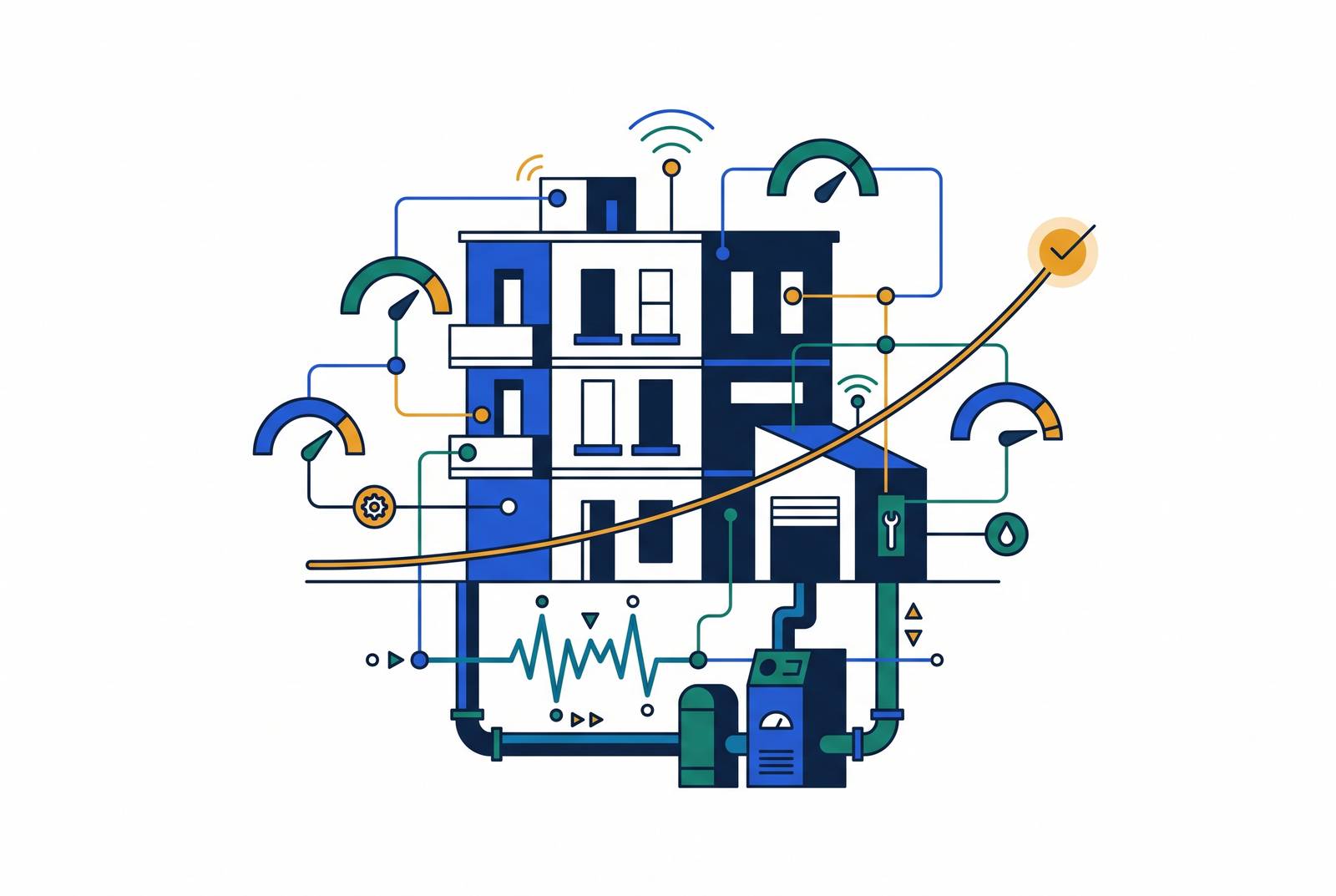
The trigger for intervention shifts under predictive maintenance. Neither scheduled dates nor tenant reports dictate when action is needed anymore. Instead, projections derived from continuous readings and past breakdown trends alert crews that particular machinery is about to fail. This predictive engine merges real-time IoT readings from HVAC units, plumbing, and additional facility hardware with archived maintenance logs, using machine learning to spot departures from typical performance. Should a compressor draw excess amperage relative to its norm, or plumbing throughput deviate from expected patterns, the platform flags the anomaly before any occupant detects trouble.
This difference matters most when buying the software. Scheduling routine upkeep automatically makes a system preventive, which still delivers genuine benefits. Yet tools consuming real-time telemetry to generate breakdown likelihoods belong to the predictive class, performing a fundamentally distinct function. Buyers should demand clarity on which category a vendor is actually pitching, since marketing copy deliberately obscures that boundary.
The sensor and data layer that makes failure forecasting possible
Predictive software only works as well as the data going into it, and understanding this foundation lets an operator distinguish a genuinely predictive platform from one merely using the label. IoT sensors work like the building's sensory organs, with networked hardware attached to HVAC equipment, plumbing arteries, heating vessels, lift systems, and power distribution boards continuously reporting on thermal conditions, force levels, circulation speed, oscillation, and electricity consumption. The software then processes those raw readings to generate a condition indicator for every asset, functioning like a perpetual patient monitor tracking the building's equipment.
Water sensors show the level of detail these systems can achieve. Current devices can spot even sub-gallon hourly seepage. A slow leak inside the wall can trigger an alert well before any apartment floods. Those readings can then be analyzed to identify the likely source right away, so maintenance can tell whether plumbing has split or the toilet flapper is jammed instead of dispatching someone with only a vague ticket.
Sensor data on its own only goes so far. A second essential source is the work-order archive: earlier failure notes, the repairs performed, how old the asset was, and the cost of each job. Without that backlog, the machine learning model cannot build a baseline for that specific asset or flag a live reading as an early warning of failure. Teams with messy maintenance histories struggle at launch when adopting predictive tools, since the model begins with no useful record to study. Using the sensor feed and work-order archive together, AI and machine learning translate the evidence as failure-probability scores, ranked alerts, and suggested next steps. At that point, raw monitoring becomes practical guidance for the maintenance team.
Many multifamily assets in the Class B and C segment lack a building management system, so adding sensors to HVAC equipment, plumbing lines, and power panels creates a real hardware cost. That cost should be part of the budget conversation at the start, not found only after the software contract has been signed. Data quality should be addressed just as soon. If the records do not reliably capture recurring fixes, asset-level costs, and past failures, the model has too little to learn from and will forecast poorly even with strong sensor coverage.
Where predictive maintenance delivers its clearest returns in multifamily
Predictive maintenance pays off fastest in a few categories, and operators that begin there reach payback sooner than operators that try to put sensors across a whole property in one push. HVAC should come first on volume, since in multifamily it breaks often, creates the biggest resident disruption, and sits among the costliest assets to replace. Keeping one large HVAC unit in service several extra years can spare operators more in capital expense than they spend on a predictive platform during that period. Elie Rieder, founder and CEO of Lanterra, says the 2026 playbook starts with roofs and plumbing alongside HVAC, moving those assets from reactive fixes to predictive upkeep because breakdowns and emergency replacements cost so much.
Water risk gives the most direct path to the fastest return, partly because insurers are beginning to price it in. Across multifamily portfolios, no cause drives more insurance claims than water, and underwriters now consider documented leak detection systems when they set premiums. So water monitoring pays back in two ways at once, with fewer remediation events and a stronger standing when policies come up for renewal.
A further compounding benefit comes from energy savings. Smart climate control, including HVAC, and broader energy-management platforms can make utility spend noticeably cheaper, with the resulting savings trimming operating expenses and resonating with residents focused on their own bills. Retention supplies the final piece of the case, a subtler benefit than the others but just as real. When building systems operate dependably, residents tend to be happier, and every renewal prevents the vacancy loss, turnover work, and re-leasing spend tied to a move-out. PointCentral’s citation of Parks Associates research shows renters’ appetite for connected-home and security technology, with over one in three willing to add a meaningful premium to their monthly rent, linking the technology investment with revenue as well as cost avoidance.
How Large Operators Are Using the Technology Today
Understanding current adoption requires recognizing the divide between firms running early tests and those operating full-scale solutions, since that distance reveals the true schedule facing newcomers. CAPREIT is examining whether feeding AI imagery gathered from standard walkthroughs could confirm equipment longevity, monitor guarantees alongside repair tickets, and guide smarter budgeting for future replacements. Such aspirations remain theoretical rather than representing an active, fielded platform. RPM Living is evaluating tools to enhance reporting and provide executives with live insight into upkeep operations throughout its holdings, though no specific solution has been chosen or put into practice.
Those two cases involve major firms with deep pockets, yet neither has moved past the exploratory phase, which should reassure any mid-tier company worried about falling behind. Even well-funded organizations with ample staff have yet to determine how a complete rollout should function. Multifamily operators still have time to bring predictive maintenance into their portfolios. Firms acting during this period of evolving standards can design custom approaches instead of adopting another company's framework.
The Real Barriers to Implementation
An operator trying to get predictive maintenance running will run into barriers, yet proven solutions exist for every obstacle. Treating those barriers as a reason to wait is a choice with its own cost, because each delayed month adds more undetected leaks and reactive repair bills.
The most frequent hurdle is budget and ROI justification. Without a clear path showing how spending translates into savings, maintenance and operations leaders struggle to win internal sign-off. To get past this, start where the financial link is clearest, namely HVAC and water systems, since weighing what a predictive platform costs against emergency repair bills and insurance risks yields figures any CFO can evaluate. Because cloud-hosted, subscription models reduce initial investment, operators can test across several locations without hardware expenses rising proportionally with each added door.
Staffing comes next as a real barrier. A predictive system only works well when the people using it bring data skills that property maintenance staff have not yet developed, and the skilled-trades shortage already driving emergency repair costs higher also leaves fewer people available to respond when the system flags a problem. Platforms that manage the full lifecycle of a job, from intake and prioritization through assignment and completion, rather than merely flagging an issue and leaving a person to determine the next step, lower the skill barrier considerably, because the platform takes on logistical work that staff would otherwise perform manually. Lula's AI coordination system, LuMi, demonstrates this approach in action: from the moment a resident submits an issue, LuMi diagnoses the problem, determines urgency, dispatches a qualified technician, and monitors the job until resolution, thereby reducing the burden on property staff instead of adding another tool requiring their attention.
In buildings categorized as Class B or C that lack monitoring devices or centralized building controls, retrofit hardware can be a major cost barrier, but the upgrade does not have to roll out across the property on the first day. Focusing first on high-risk assets, such as HVAC units and main water lines, limits upfront hardware spending while still producing first-year savings operators can verify. Treat data quality as a separate workstream, not as part of platform selection. If an operator lacks reliable records on past repairs, asset-level costs, and repeat failure patterns, even strong sensor coverage will leave a predictive model with too little to learn from. The sensible place to begin is by reviewing current work-order records, filling missing information, and resolving those issues before a platform is onboarded, instead of discovering incomplete files after launch. Adding sensors and building controls to the IT environment increases risk, so vendors need to provide documented security architecture, not just verbal assurance, although most multifamily operators still see budget and staffing as bigger adoption hurdles.
What to Look for in a Predictive Maintenance Platform
In a demo, a real predictive platform should show concrete capabilities that distinguish it from calendar-based maintenance software dressed in predictive wording, so a prepared operator is not buying sales copy. It needs to turn real-time sensor readings into scored failure risks, not merely issue a filter-replacement reminder when service is scheduled. It should learn from earlier maintenance tickets too, because predictions about what may fail next depend on knowing what failed before. It should also carry each job from request capture through triage, technician dispatch, and closeout tracking instead of handing off after an alert for someone else to coordinate. A platform should state at the outset what equipment a building must install for the software to function, instead of hiding that expense until the deal closes. And it must show clearly how it protects the link from building systems to the internet, because that link is essential to the whole approach, not an extra feature. Someone weighing tools with this checklist is weighing what predictive maintenance really means, not how a sales deck presents it.