Top Proptech Companies in the World for Enterprise Real Estate Teams
Data unification now determines which proptech platforms will win enterprise deals.

What enterprise real estate teams lack is not another application. The tools entered the stack one by one to solve narrow problems, but in doing so they walled off portions of portfolio data from the rest. A smaller regional player with a single property type and only several hundred units may be able to live with that fragmentation. At scale, however, where holdings may include office buildings, logistics campuses, and apartment communities spread over twelve states, every isolated platform adds friction to effective oversight as the portfolio and its mix of asset classes expand. Bringing in another tool before deciding how its data will be governed and reconciled does not simplify portfolio operations. The technology stack becomes its own managerial problem, growing less scalable in step with the company it is supposed to support.
From pilots to production: how the market arrived at this moment
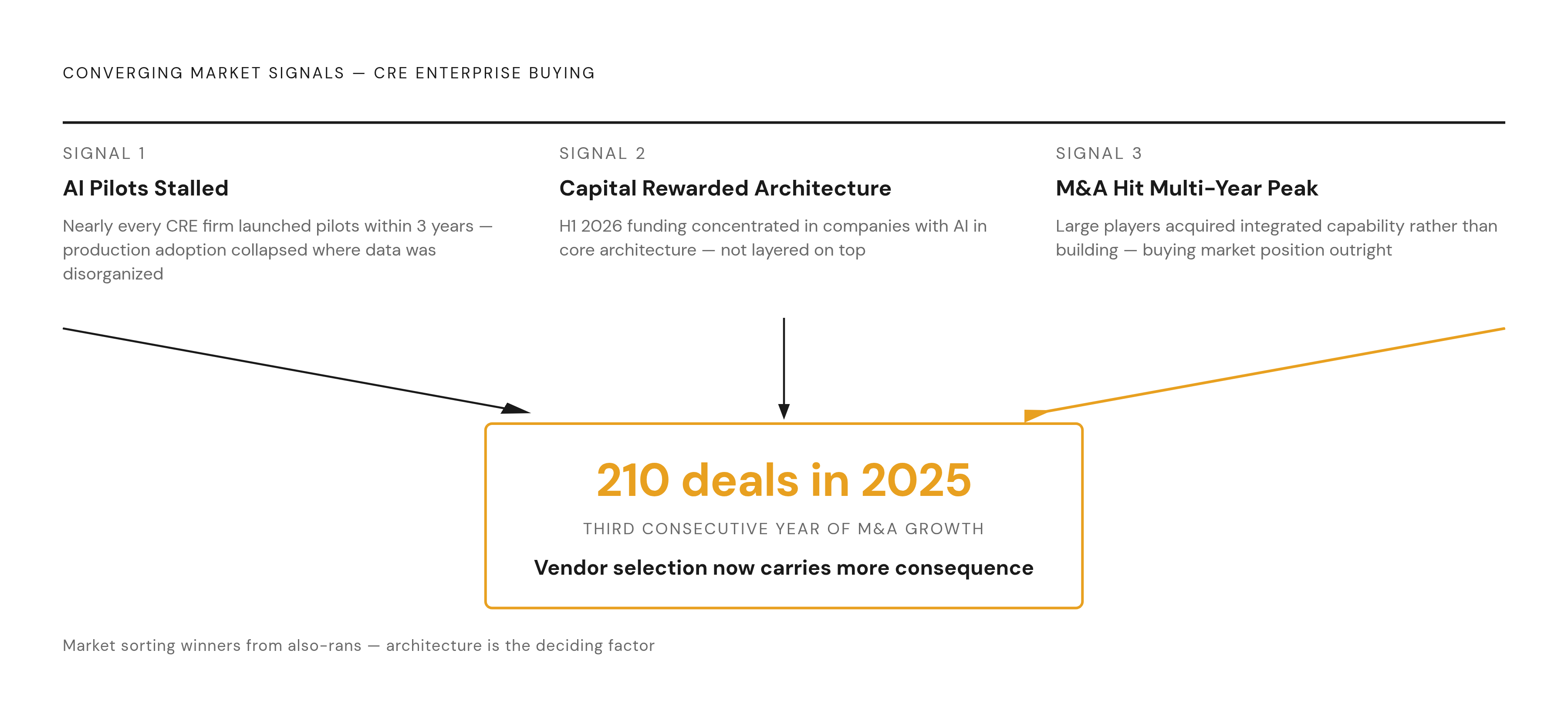
Property technology firms have moved past experimentation and into deployment. This transition was rapid, with nearly every corporate real estate company launching AI pilots within three years, yet production adoption lagged far behind that surge. A 2026 evaluation of how prepared CRE organizations are for AI reveals why: companies purchase licenses and publicize the effort internally, only to see usage collapse within months when disorganized data and unchanged workflows block progress. Such evidence redefines the true purpose of choosing a platform. Rather than something a platform bolts on later, clean and unified data governance is the foundation teams must establish so AI layers can deliver real value.
Capital markets have already drawn that conclusion. In the first half of 2026, investors concentrated funding in companies that built AI into the foundational architecture of their products rather than layering it on top as a feature, and they did it at lower valuation multiples, with far more scrutiny applied to actual return on investment. Acquisitions tell the same story from a different angle. M&A activity hit its highest multi-year trajectory in 2025, with 210 deals marking the third consecutive year of growth, a pace that has continued into 2026. Large players are buying integrated capability rather than building it in-house, and that behavior is consolidating the market around platforms that already unify data rather than around point solutions that promise to unify it eventually. For an enterprise buyer, the lesson from all three data points, pilots that stall, capital that rewards foundational AI, and acquirers chasing integration, is the same: vendor selection now carries more consequence than it did two years ago, because the market has already started sorting winners from also-rans on exactly this basis.
The evaluation framework: what integration means at enterprise scale
An enterprise buyer ultimately needs to know whether the platform can bring data together across asset classes, automate workflows without continual manual fixes, and stay auditable while it does that. That test points to three checks: whether portfolio records are unified rather than walled off again; whether parts can be replaced without severing data continuity rather than making tight integration a trap; and whether the team can inspect, justify, and stand behind AI decisions, which matters because government agencies are now examining algorithmic pricing closely.
Auditability, that third criterion, has turned into a selection test on its own rather than an afterthought for compliance, which the RealPage example below illustrates. By framing software as a Property Operating System, or PropOS, the evaluation shifts: enterprise teams now seek a self-governing layer in which AI agents independently manage invoices, abstract leases, dispatch maintenance, and recommend prices. Viewing software through the PropOS lens rather than as a database with an attached workflow tool means feature tallies no longer set vendors apart. The real test is whether that autonomous layer can reliably operate independently across the portfolio's required scale.
Yardi Systems: the institutional backbone for mixed-asset portfolios
Yardi became the standard for REITs and institutional capital by merging CAM reconciliation, ledger operations, plus fund-level investment oversight into one platform. During June 2026, Yardi introduced AI agents handling leasing alongside resident services, maintenance, plus accounting, deliberately steering its suite into the PropOS framework outlined earlier.
Where a group runs holdings spanning multiple property types and regions, that depth pays off directly: there is less need to reconcile separate platforms against one another, since Yardi already handles most of what another tool would have to cover. But the trade-off points the other way. That same depth, by cutting the number of platforms involved, locks the stack together, and such coupling typically brings real implementation complexity while making it harder to replace individual pieces down the line. For holdings that truly span multiple asset types under institutional management, the exchange usually justifies itself. Where a group focuses on just one or two property types, the setup can deliver more framework than those holdings require.
MRI Software: the open-ecosystem alternative for commercial-heavy owners
MRI Software chooses an architecture that runs counter to Yardi’s. Rather than seek control of every layer, it serves as an open, modular hub where commercial-heavy owners can connect the outside tools they prefer while keeping authority over their underlying data. This approach is well suited to owners focused on industrial, office, and retail properties, where intricate leases and tenant relationships call for configurability that platforms tuned for multifamily cannot provide.
MRI's move toward autonomous operation came on June 25, 2026, when the company announced two new solutions inside MRI Agora, its AI-powered real estate platform: MRI Agora Intelligence and MRI Agora Orchestrator. Orchestrator is the more consequential of the two for enterprise evaluation, since it targets agentic workflow automation directly, pushing MRI from a workflow tool into PropOS territory in the same way Yardi's Virtuoso expansion did. The open-ecosystem bet appears to be paying off commercially: MRI reported 37% revenue growth from 2022 to 2025, growth that suggests commercial operators underserved by multifamily-first platforms are finding what they need in MRI's architecture. For teams that want to connect MRI to third-party valuation tools, CRMs, or construction management platforms, that open architecture makes the connection easier to build and maintain, and it cuts the lock-in risk that enterprise procurement teams are now trained to evaluate explicitly before signing.
RealPage: the multifamily depth question and the regulatory constraint enterprise teams must weigh
No rival matches RealPage's breadth of multifamily capabilities, yet the consent decree that the Department of Justice issued in November 2025 forces enterprise teams assessing its pricing software to reassess their exposure. Major operators already know the company's end-to-end resident platform, engineered for scale to manage leases, renewals, income optimization, and analytics. That November 2025 DOJ settlement now mandates the following operational limits:
It keeps other firms' live, private information out of suggested prices.
- Only data over a year old can train models.
- It calls for auto-accept redesign to stop what the settlement labels one-way ratchets.
- It assigns code-level rights to the court-appointed monitor, three years plus an eighteen-month add-on if needed.
RealPage can still remain under consideration as a platform. What is off the table is the release of the revenue management offering many large operators had treated as its core draw. For enterprise buyers looking at RealPage now, the assessment is of a supervised, limited form of the product, not the one that made its name. It shows most clearly that AI pricing systems sold as optimization can trigger oversight capable of stripping away the product's main commercial value. That is why every enterprise vendor checklist needs auditability.
VTS: the system of record for institutional landlords on the commercial leasing side
VTS takes on the work Yardi and MRI only partly cover, from leasing-pipeline management to following tenants and coordinating deals across institutional commercial portfolios running to millions of square feet. In brokerage teams representing landlords whose portfolios are substantial, VTS often serves as the system of record, not a supplementary tool kept apart from the main process. With VTS 4, AI-powered demand forecasts help landlords anticipate tenant interest and leasing momentum portfolio-wide instead of relying only on backward-looking reports.
VTS deliberately avoids positioning itself as a substitute for property management systems. Instead, it runs alongside an existing system and must integrate smoothly with the accounting and operations infrastructure a company already has in place, be it Yardi, MRI, or another platform. Given that context, how well the API performs and how easily data moves out of the platform shift from a small technical detail into a genuine factor buyers weigh on its own.
A commercial real estate data provider: the data layer that sits beneath every other system
CoStar does not compete with Yardi, MRI, VTS, or any operating platform covered so far. It is the commercial real estate data layer feeding all of them, and for enterprise teams with research budgets, treating it as optional is a mistake. CoStar is the database that sits next to CRM and deal pipeline tools, and most institutional brokerages pay for CoStar or its subsidiary product, LoopNet, as the data source behind their CRM and analytics stack.
The stakes rise as enterprise organizations begin planning for the autonomous workflows outlined earlier in the evaluation framework. An AI agent's output is only as reliable as its underlying dataset: even polished workflow automation can quietly misfire when it depends on outdated or incomplete market signals. Instead, it gives confident wrong answers, which are harder to spot than a system that just stops working. CoStar anchors that data layer by keeping the information used by other platforms’ AI systems fresh and comprehensive, so agents are not allowed to operate unchecked until those inputs can be relied on.
Procore: where the enterprise stack must extend to cover development and construction
Because earlier platforms were not designed for construction, companies running multiple live development projects need a separate way to close that gap. Procore fills that role. Since 2002, the Carpinteria, California company has let owners work in real time with general contractors and subcontractors on documents, schedules, and budgets.
The use case is specific: CRE firms running ground-up development, major renovations, or large capital improvement programs, where miscommunication between owner, general contractor, and subcontractor causes project delays and budget overruns rather than abstract inefficiency. Firms whose activity is limited to property management and leasing, without meaningful development work, gain little from adding Procore to their stack; it is a development-side tool, not a general portfolio operations platform, and it should be evaluated as such. Construction technology is the fastest-growing segment of the broader proptech market, a signal that the development side of enterprise real estate is drawing serious software investment, and Procore is in the most active part of that growth.
AppFolio: the enterprise option for large residential portfolios that prioritize ease of operation
AppFolio serves a specific enterprise niche: operators of sizable residential portfolios seeking mobile-first experiences and AI-powered automation, avoiding the heavy implementation burden typical of Yardi-scale rollouts. Those identical strengths in machine intelligence, cohesive infrastructure, and phone-centric interfaces propelled the platform to its 2026 ranking as the top property management software.
AppFolio was built around residential operators, spanning multifamily homes and single-family rentals as well as student housing, but it lacks Yardi’s or MRI’s breadth in commercial property types. This is better understood as scope, not shortcoming: among enterprises with large residential portfolios that prioritize straightforward operations and polished resident interactions over intricate commercial leasing needs, AppFolio's single-platform design moves them toward the PropOS model more directly than a heavier enterprise suite would.
Matching platform to portfolio
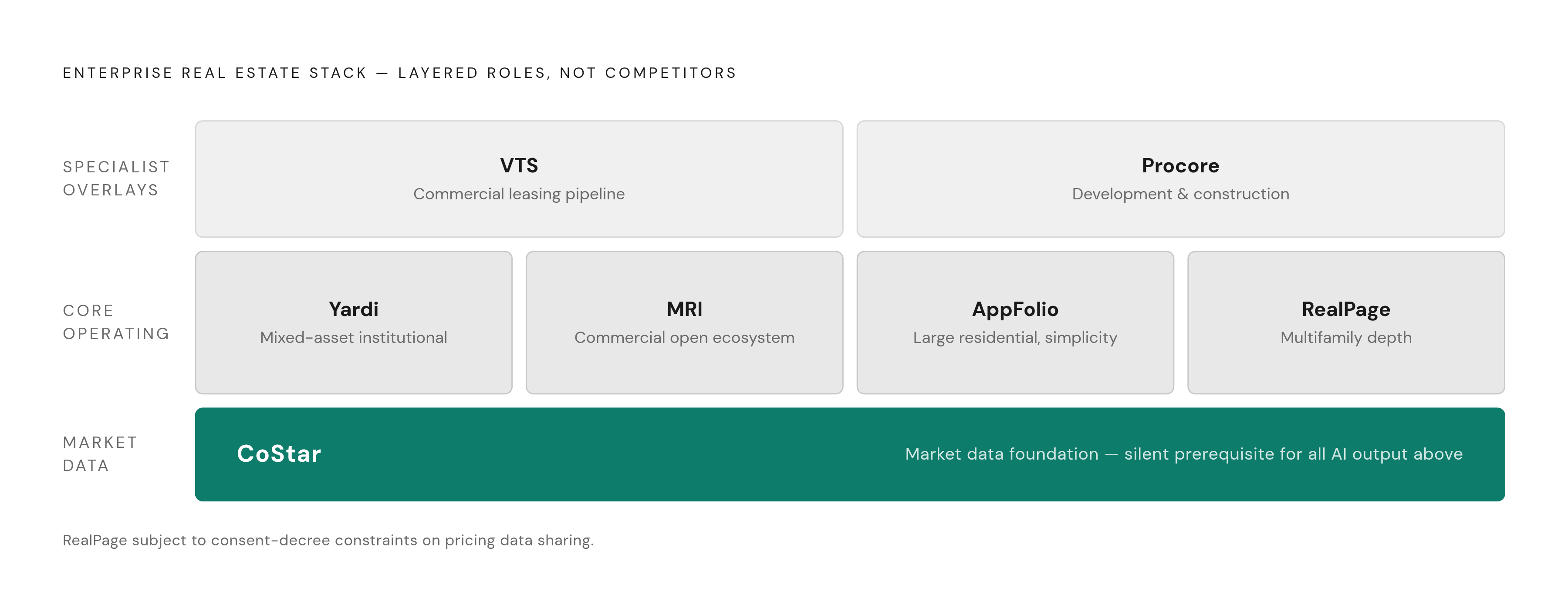
No single solution dominates all corporate environments, with those seven firms proving it through distinct merits instead of process of elimination. A handful of criteria drive the selection, and how a group responds to them identifies the right provider better than any checklist of capabilities.
Start with asset mix. Yardi's breadth suits a portfolio that is institutionally run, spans geographies, and holds more than one asset type; a book weighted toward commercial space in offices, shops, or warehouses fits the way MRI lets owners configure it; and AppFolio suits a large residential portfolio that puts operational simplicity first. Development is the next filter: firms engaged in ground-up builds or sizable capital improvement programs should add Procore on top of their chosen operating platform, and firms with no such projects can skip it. Third is leasing setup: big commercial owners who rely on brokers need VTS to track deals alongside their core management system rather than replacing it. Fourth, weigh data needs: teams building toward self-running AI processes require a trustworthy, up-to-date market data foundation beneath everything, and CoStar delivers that regardless of the operating system chosen above. Fifth is regulatory exposure: the consent decree involving RealPage shows most clearly why auditability deserves a place in the evaluation right alongside features and price.
In sum, the variables point to a market where vendors win less for sheer breadth than for the fit between their architecture and a portfolio's asset base, expansion plans, and tolerance for regulatory risk. These platforms earned a place in this guide because they are legible against that test. For any enterprise team, the right pick is the platform built around the portfolio it actually runs.