Commercial Property Valuation Software for Appraisers and Brokers
Four distinct jobs hide under one software category, and most platforms handle only one well.

Much of the frustration appraisers plus brokers feel about their tools traces back toward a simple mismatch: software built to do one job yet asked for another, because Commercial property valuation software isn’t a single market but at least four. There are at least four of them, and most of the frustration appraisers and brokers feel with their tools comes from a basic mismatch: software made for one job, then asked to handle something different. Fire up the tool on a Tuesday and those four tasks quit looking like minor tweaks of one idea, becoming distinct crafts grouped under the same category instead.
With DCF, cash flow modeling involves projecting rent and sale proceeds, checking yield and return inputs, and trying scenarios for one property or portfolio. It runs on heavy math and layered assumptions, holding up institutional underwriting. Producing official appraisals is another matter: USPAP and CUSPAP compliant report templates, file organization, and records that must stand up when an inspector or a lender's lawyer starts looking. Only certified appraisers handle this, so that software must follow a rules group even if the maker wants something else.
Comp study and market figures comes first: pulling together, holding, and searching comparable sales and lease records, a task property valuers and brokers handle on almost every job. For the Portfolio and its asset management valuation, the job is fundamentally about scale: doing the same valuation cycle over many assets, checking variance between cycles, and pulling data from the patchwork a big company uses.
When any vendor implies their platform handles all four tasks, they're padding three with stuff that seems fine in sales meetings but breaks during real work, while doing one right. One platform might straddle a couple of these roles fairly effectively. Size shifts the picture too, because one solo appraiser, any fifteen-person brokerage, plus whoever handles an institutional asset portfolio reach for separate tools even when picking from the same options. Remember the four-job breakdown, because everything that follows points back at it.
DCF and cash flow modeling platforms: ARGUS Intelligence Platform and Rockport VAL
Altus Group still holds ARGUS Enterprise as the go-to choice when doing institutional property valuation, just like it always has. By 2026 it ships as part of the wider ARGUS Intelligence Platform, a cloud-built offering that unifies ARGUS Enterprise with its own property and portfolio tracking tools. One real upgrade: the platform sorts every ARGUS Enterprise record by verified property location, so files for the same asset no longer end up scattering across folders.
Its selling point is breadth. Capital markets groups model office, hotel, retail, and industrial assets alongside build-to-rent, multifamily, and mixed-use properties, and they return for that breadth. ARGUS Enterprise can cost $5,000 or more per seat, so a solo appraiser can't afford it and the cost fits squarely enterprise buyers. People also note it is steep to learn, a complaint that has stuck with it for a long time, still unresolved after the consolidation.
As the challenger, Rockport VAL markets itself as built specifically for lenders, appraisers, and brokers handling one asset up to a full portfolio. Rockport VAL users say staff learn it in days, not months, users report a smoother transition from Excel compared to other platforms, and the audit log remains accessible. The tool handles what-if checks, comparing rent sheets, pricing numbers, and market assumptions together, with outputs built to go into a report.
When a counterparty in capital markets expects ARGUS, this settles the platform decision before any assessment begins, with institutional weight still resting on ARGUS given that fact. But for a group putting together its own process from zero, with no outside file rule holding it in place, choosing ARGUS purely on routine is a bad move. Rockport VAL is cheaper and better for usability, so cost and familiarity may explain why groups haven't moved over.
Formal appraisal reporting and workflow platforms: Valcre, LightBox, Realquantum, and Anow
Valcre pulls together property information for every asset class and makes CUSPAP and USPAP-ready report templates built for each assignment. Valcre Assist pairs each appraiser with white-glove support from assistants who take care of property research and neighborhood-level work. Valcre Assist pairs each appraiser with white-glove support from assistants who take care of property research and neighborhood-level work for the appraiser's jobs. Appraisers may find Valcre appealing because its proposition goes beyond automation.
LightBox looks at the whole job of an appraiser, from landing the work to delivering the report. Users can tap into information covering over 250,000 appraisals each year, a genuine draw for firms wanting to price RFPs with real numbers rather than guess at the going market rate. It adds 300 property details, zone info with map support, plus tax and assessment files reviewed by people. It works best for appraisal management firms and bigger shops, where winning clients counts as much as the final report.
Realquantum brands itself, in a September 2026 GetApp listing, as "The Operating System for Commercial Appraisers." It is SaaS, cloud-based, and built around cutting manual work to push appraiser revenue up. It scored 4.7 from a possible 5 across 31 verified ratings, more feedback than any other valuation software on that site. Appraisers get mobile reach and a workflow built cloud-first instead of one stuck on a desktop.
Anow handles the full appraisal lifecycle: intake, proposal setup, agreements, job progress, site scheduling, payment management, plus reporting. It's built more for running day-to-day work than the final report, handling who handles what among appraisers better than the write-up. So it suits firms managing multiple appraisers' work more than an individual focused on the final document.
These tools run on throughput and compliance, not on any modeling, so judge them on that first. The real bottleneck could lie in report standards, research depth, or coordinating many moving pieces, while each of the four platforms answers just one of those. Go with whichever one fits the bottleneck.
Comp research and market data tools: CoStar, CompStak, LoopNet, PropertyShark, and Compstash
CoStar still has the most local info for workplace, warehouse, shopping, and apartment properties, giving appraisers the fine points they need. Its real strength is refresh pace: data changes continuously, not by a quarterly release cycle; valuation inputs follow live markets rather than lag. Most institutional firms use it, and the cost skews to larger practices that can afford it.
CompStak takes a separate route: a crowdsourced collection built around commercial lease comparables, designed specifically for valuation and underwriting tasks. A 2026 rating positioned the platform between CoStar's enterprise offerings and narrower single-purpose tools. Its real worth shows up when lease comp data is tough to get from open files, mainly for underwriting tenant risk or making market rent assumptions.
LoopNet backs valuation by leaning on live and past listing comparables instead of serving as a main data source. Its large ad base and basic tools help gather similar deals and live offers by area and asset class, but it fits better alongside CoStar and CompStak for major-firm analysis.
PropertyShark focuses on address-specific homes, gathering transaction details, owner files, tax figures, and site features into one search. The payoff is hours back, not rare info: it avoids hopping between other platforms mid-search. So brokers and little practices find property-level answers quickly, without buying the full CoStar package.
Compstash tackles a separate issue. It keeps a company's deal records in-house for agents, offices, and real estate groups, so company know-how stays when someone leaves. The tool handles loading large data sets, map tagging, granular access settings, plus one-click branded output for Excel and PDF. It works alongside CoStar plus CompStak instead of competing with them, keeping the knowledge a company already has instead of bringing in outside info. It works alongside them by organizing what each firm truly knows rather than pulling fresh outside data.
Most comp research stacks wind up layered instead of single-platform, mixing a market source such as CoStar alongside CompStak with a lookup tool at the property level such as PropertyShark, plus LoopNet, and a tool such as Compstash stacked above to stop institutional know-how from walking out whenever someone leaves.
Portfolio and asset management valuation platforms: MRI Software, Yardi, JLL Asset Beacon, and The CRE Suite
MRI Software ranked first in commercial real estate management in a February 2026 assessment, earning 9.0 from 10. What makes it standout is that lease abstraction feeds numbers to valuation inputs, plus any update to the assumptions stays saved during managed report revisions, letting a reviewer follow each edit through to its impact on the valuation. Ingestion and versioning together is what wins the governance badge, and reviewers and lenders insist on that kind of proof rather than merely enjoying having it around. By 2026, MRI Software AI is also among the top 2 commercial lease abstraction tools, cutting work once taking hours per lease to minutes. The tradeoff is getting started: matching property identifiers, accurate lease data on entry, and linking older platforms, which can stretch out for a long time. This fits institutional portfolios with numerous assets, multiple reviewers, and obligations requiring a clear trail.
Yardi is right behind in that same wifitalents.com list, at 8.8 out of 10, serving as a full property and management platform with built-in valuation tools. Picking Yardi instead of MRI is not about who prices a property most accurately, but the platform that a firm's wider work already uses. It's about the backbone setup, not how precise the numbers are, and companies that frame it as a question of valuation-quality typically choose for the wrong reasons.
JLL Asset Beacon, JLL's asset platform, brings rent roll, accounting, and building records from separate sources into one hub so investors can see the whole portfolio. The 5.0 rating comes from 4 verified GetApp scores in September 2026, too small a sample to trust. Still, JLL Asset Beacon integrates with JLL’s broader data and AI tools, which may appeal to firms already using JLL’s services. This fits firms using JLL for consulting, brokerage, or similar help who need valuation intelligence linked to that data.
GetApp also showed The CRE Suite appears in a 2026 GetApp listing as a cloud-based platform for commercial real estate valuation. MRI and Yardi are also listed in the same category, offering portfolio-level valuation tools without buying a full property management infrastructure setup.
Every provider here handles multiple jobs together, and that sets it apart from what came before. The buyer requires valuation cycles that are repeatable, edition management over many properties, and results that satisfy an in-house investment panel and an outside auditor simultaneously. Picking software meant for one property and using it here costs more than any other error in this group.
Where AI reshapes valuations and where the hype runs ahead
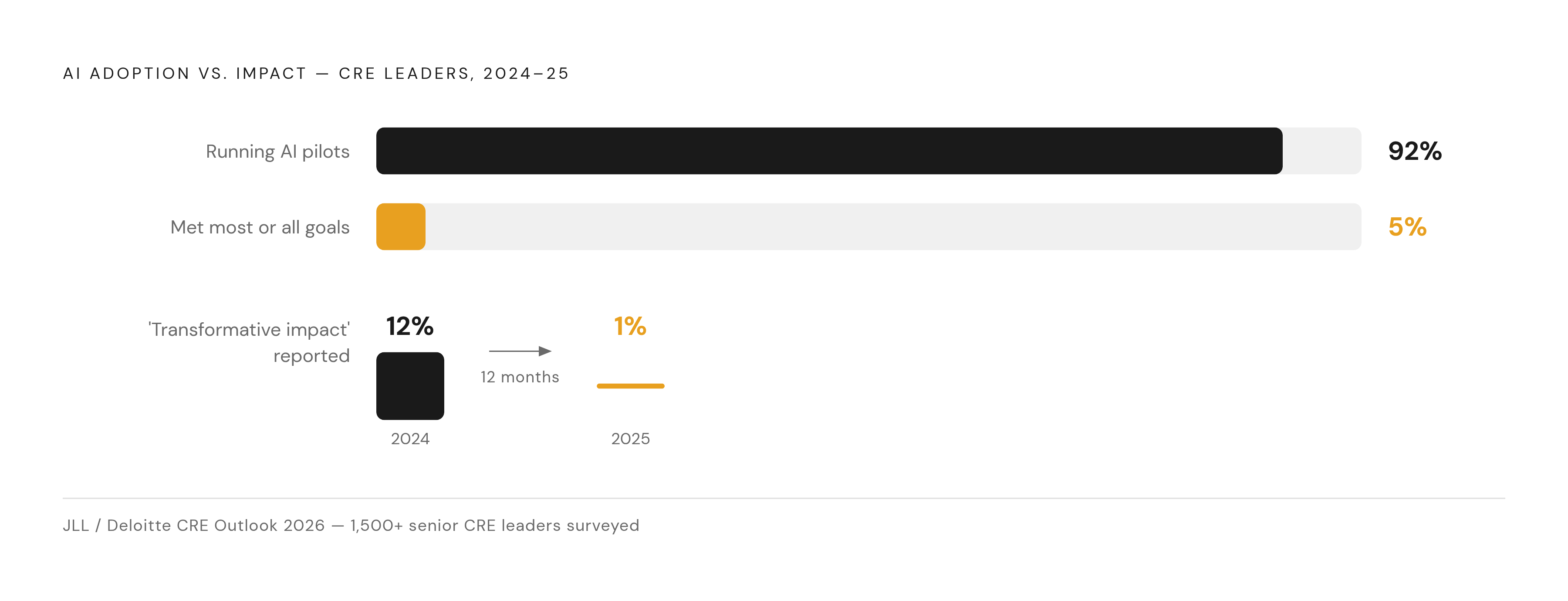
People know the space between what AI promises and what it delivers in commercial real estate runs deep. More than 1,500 top CRE leaders were asked by JLL, and 92% reported artificial intelligence pilots in progress, but just 5% felt they had met most or all of their goals. Anyone considering an AI add-on deal should hesitate, since near-universal use has brought near-universal disappointment.
Deloitte CRE Outlook 2026 shows the portion of firms reporting AI's "transformative impact" fell from 12% down to just 1% within twelve months. Most companies stuck AI on messy data, vague targets, and groups with no true capacity to handle it, and got just the outcomes that mix delivers. Feed it junk, get disappointment back.
Lease abstraction bucks the trend, serving as the single area where the payoff of AI shows up in actual figures rather than sales talk. Asset teams once devoted whole days to manually abstracting one commercial lease, pulling rent details, renewal dates, and escalation clauses out of the document word by word. Re-Leased Credia Extract, plus MRI Software AI and Prophia, now do it in moments. That's a tenfold shift on one small job, where AI delivers when data is structured and the work is tight, and falls flat anytime a company expects it to swap human effort for judgment. People mixing those up will fill Deloitte's upcoming letdown report.
Sources
- Top Rated Commercial Real Estate Software with For appraisers 2026 | GetApp
- Real Estate DCF, Valuation & Appraisal Software | Rockport VAL
- Top Commercial Property Valuation Software (2026)
- Best Investment & Valuation Software for Commercial Real Estate (2026) | CRE Software
- lightboxre.com
- valcre.com
- tommasomariaricci.com
- cognitivefuture.ai