Generative AI Use Cases in Real Estate Marketing and Due Diligence
AI automates marketing and due diligence tasks that eat entire workdays with uneven quality.

Generative AI is now doing real, measurable work in two of real estate's most labor-heavy functions: marketing and due diligence⟦c2⟧. It writes listing copy, builds walkthrough videos, stages empty rooms, and pulls key terms out of leases and title documents, cutting down tasks that used to eat entire workdays⟦c2⟧⟦c9⟧. The market backing this shift is growing fast on paper: the generative AI in real estate market sat at $0.77 billion in 2025, is on track to hit $1 billion in 2026 at a 30.4% compound annual growth rate, and should reach $2.86 billion by 2030, according to The Business Research Company⟦c3⟧. McKinsey's 2025 analysis, which folds in agentic AI and the development side of the business, pushes the potential annual value even higher, somewhere between $430 billion and $550 billion, well above its earlier estimate of $110 billion to $180 billion⟦c4⟧. The firm points to four areas where the payoff is biggest: property valuation, operational management, marketing, and demand forecasting⟦c4⟧.
Adoption numbers look strong on the surface. Over 60% of institutional real estate firms have worked AI into at least one core workflow, found in PwC's 2026 Emerging Trends report, and JLL's 2025 Global Real Estate Technology Survey, which polled more than 1,500 senior commercial real estate decision-makers, found 88% already piloting AI across an average of five use cases at once⟦c5⟧. That sounds like an industry moving in step. It isn't. Only 25% of real estate firms qualify as AI leaders, well below the 40% rate seen across other industries, and just 21% of AI initiatives in the property sector made it past the prototype stage in 2025, a finding from McKinsey's latest report on technology in real assets⟦c6⟧.
Deloitte's CRE Outlook 2026 puts a sharper point on the gap ⟦c7⟧. The share of operators reporting a "transformative impact" from AI fell from 12% to just 1% in a single year, and the drop wasn't caused by the technology failing to work⟦c7⟧. It happened because firms rushed to implement tools before they'd structured their data, defined what they wanted the tools to do, or built the internal skills to run them⟦c7⟧. Firms implementing AI effectively report net operating income gains above 10%, and the space between leaders and everyone else keeps widening⟦c8⟧. This isn't a story about winners and losers so much as a practical orientation problem, and the rest of this piece is meant to map out where the technology actually earns its keep, so that gap becomes easier to close.
Why marketing and due diligence are the two functions where generative AI earns its keep fastest
Marketing and due diligence share a structural trait that makes them ripe for this kind of automation: both involve high volumes of repetitive content or document work that doesn't scale with headcount, and both produce inconsistency and burn hours that professionals could spend on judgment calls instead⟦c9⟧. Every listing needs its own package of descriptions, photos, videos, ads, and social posts, all produced fast, all needing to sound like the same brand, and all bound by fair housing rules. Multiplying that by a large portfolio turns the content workload into a genuine bottleneck.
Due diligence carries the same weight in a different shape. A single commercial transaction can involve hundreds of leases alongside environmental reports, title documents, and zoning records, and reviewing all of it by hand is slow, expensive, and prone to the kind of mistakes that cost real money at closing. Generative AI's core strength, turning messy, unstructured input into clean, structured, readable output at speed, happens to map almost exactly onto both of these problems⟦c9⟧. That fit between generative AI's core strength and both of these problems holds up in detail, section by section ⟦c1⟧.
Generating listing content and property videos at scale
A set of listing photos and basic property data fed into a generative AI system can produce a walkthrough-style video complete with captions, background music, and an AI voiceover, no camera crew or video editor required⟦c10⟧⟦c11⟧. According to Abark.tech's overview of generative AI in real estate marketing, the pipeline runs in four steps: an agent uploads photos and property details, the AI sequences the photos into a logical walkthrough while picking out the property's key selling points, the system builds a video from branded templates and adds captions, transitions, music, and voiceover, and the agent reviews the result before exporting it to Instagram, TikTok, YouTube, or the major listing portals⟦c12⟧.
The same underlying system also writes listing descriptions tuned to an agency's brand voice, whether that's luxury, family-friendly, or investment-focused, generates several versions of ad headlines and copy for A/B testing, drafts social posts and reel scripts per listing, and puts together personalized property alert emails and newsletters⟦c10⟧. What used to take hours or days of manual editing now takes minutes, and pre-listing prep that once stretched anywhere from two weeks to six months can be compressed substantially, according to an analysis from Softwaremind⟦c13⟧. That time compression is really the whole value proposition here.
There's a brand-consistency angle too, and it matters more than it might sound. When AI works off a fixed set of prompts and templates, tone stays uniform across every agent, every listing, and every channel, which is a real structural advantage for brokerages where dozens of agents are otherwise producing content independently and inconsistently⟦c14⟧. AI also personalizes at a level no single agent writing one version of a listing description ever could, tailoring content by buyer segment (a first-time buyer worried about price and school districts versus an investor focused on yield) or by geography and language⟦c15⟧.
Adoption backs this up. NAR's 2025 Technology Survey, released September 18, 2025, found 46% of Realtors already use AI-generated content such as listing descriptions, with 20% using AI daily and 22% weekly⟦c16⟧. Only 17% of those surveyed reported the technology having a significantly positive effect on their business⟦c16⟧. The tools driving this are mostly familiar names. ChatGPT leads with 58% of agents reporting use, followed by Google's Gemini at 20% and Microsoft Copilot at 15%⟦c17⟧.
None of this removes the agent from the loop, and it shouldn't. Every AI-generated listing still needs a human check, because accuracy and fair housing compliance rest with the agent, not the software⟦c18⟧. Abark.tech's September 2026 analysis is blunt about the stakes here: systems need guardrails that catch exaggerated claims and discriminatory language before it goes live, since a phrase like "perfect for young couples" implies a buyer preference that fair housing law prohibits⟦c18⟧. Off-the-shelf tools work fine for an individual agent handling a handful of listings a month. Agencies and portals moving high volumes of listings are the ones who benefit from building a custom pipeline instead.
AI virtual staging: cost economics and buyer engagement evidence
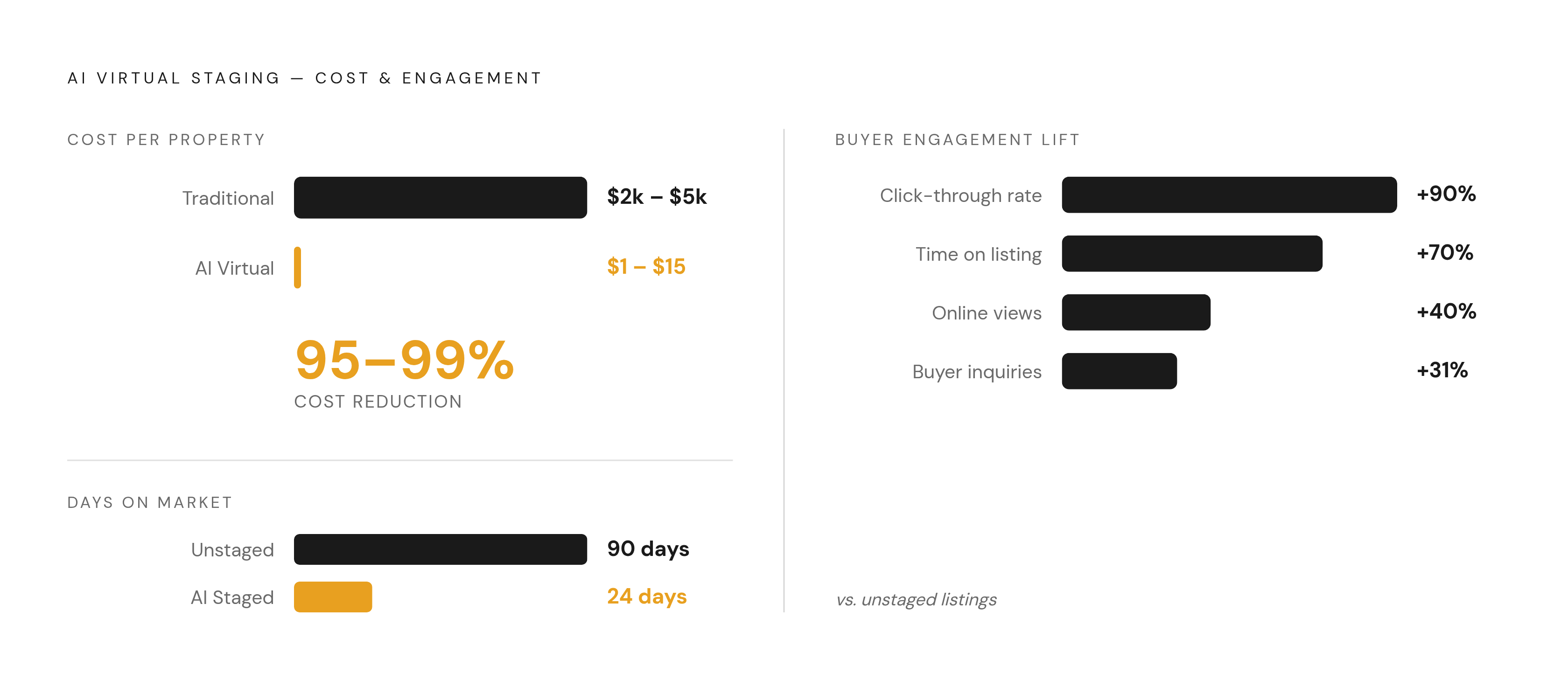
Virtual staging takes a photo of an empty room and fills it with generated furniture and décor, no physical furniture rented, no 3D artist hired⟦c19⟧. The economics here are close to disruptive. Traditional home staging costs $2,000–$5,000 per property, while AI virtual staging services start at $1–$15 per photo, a cost reduction of 95%–99%, a figure from Instant Interior AI's State of Virtual Staging report⟦c20⟧. The global virtual staging market reflects that shift, growing from $1.22 billion in 2025 to $1.33 billion in 2026 and projected to reach $2.96 billion by 2032 at a 13.51% compound annual growth rate, with 16% to 18% of agents now calling virtual staging a highly important part of their listing strategy⟦c21⟧.
What does staging actually buy an agent? Start with attention: listings using virtual staging see a 40% jump in online views and a 31% increase in buyer inquiries⟦c22⟧. The quality of those inquiries improves too, with a 74% increase in serious buyer interest paired with a 45% drop in "tire-kicker" showings, a dual effect that raises lead quality rather than just lead volume⟦c23⟧. Click-through rates rise 90%, and buyers spend 70% more time on listing pages that use virtually staged photos⟦c24⟧. None of this is just about engagement metrics either. Zillow's move to fold AI-powered virtual staging into its Showcase listings in late 2025 backs up the pattern at the platform level: agents using those premium features won 30% more listings⟦c28⟧.
The economics point overwhelmingly toward adoption, but a disclosure problem is catching up with the industry fast. A Coraly study reported by Real Estate News examined roughly 40,000 primary listing photographs pulled from Zillow, Redfin, Realtor.com, and Homes.com in the first three months of 2026, and found nearly 11% showed evidence of digital alteration⟦c29⟧. California responded with AB 723, effective January 1, 2026, which requires brokers and agents who use a digitally altered image in a property ad to include a conspicuous disclosure and a link to the unaltered original, or, for ads posted online, the unaltered image itself⟦c30⟧. It's the first major state-level law of its kind, and it turns disclosure from a courtesy into a compliance requirement. The cost savings on virtual staging are real and substantial, but so is the new obligation to be upfront about what's been altered. Virtually staged homes achieve 98.5%–99% of asking price versus 96%–97% for unstaged properties ⟦c25⟧. RESA reports staged homes sell in 24 days versus 90 days for unstaged homes, a 73% reduction in time on market ⟦c26⟧. The NAR 2025 Profile of Home Staging, surveying 49,806 agents, found that 29% observed a 1%–10% increase in dollar value offered by buyers when a home was staged ⟦c27⟧.
How the major listing platforms are embedding AI into search and consumer interaction
Zillow debuted AI Mode on March 25, 2026, a conversational interface that lets buyers and renters search for homes in plain text, schedule tours, connect with local agents, and ask direct questions like what a fair offer would look like or how a home's Zestimate has moved over time⟦c31⟧. The system remembers preferences across sessions and draws on Zillow's own data and valuation models, which matters because Zillow brings more than 230 million average monthly unique users to the table, generating a volume of high-intent, first-party behavioral signals that's structural to the company's advantage, not just a feature bolted onto the site⟦c32⟧.
Both Zillow and Redfin have taken this further by building apps inside OpenAI's ChatGPT, Zillow in October 2025 and Redfin in February 2026, an analysis from Realab.blog shows⟦c33⟧. Zillow's CEO has called generative AI a bigger platform shift for the company than mobile was ⟦c33⟧. That's a strong claim, and the fair housing safeguards built around it deserve detail: Zillow's congressional testimony stated the ChatGPT Zillow App runs on a fair housing-first design, with a Fair Housing Classifier embedded directly in the experience, and OpenAI is barred from using MLS data to train its models or reusing that data outside the Zillow experience⟦c34⟧.
Redfin's approach, launched in late 2025, lets buyers describe what they're looking for in plain language instead of clicking through filters, and Redfin reports buyers increasingly picking homes its AI suggests over homes they find through traditional search⟦c35⟧. Compass has gone a different direction, building AI tools for agents rather than consumers, tools that draft listing descriptions, schedule showings, and predict which buyers are most likely to actually close⟦c36⟧. Further down the stack, MoxiWorks introduced RISE in November 2025, calling it an "AI-native" marketing platform, meaning AI is the core of the system rather than getting added on as an extra⟦c37⟧. Placester rolled out an AI Website Builder the same month, purpose-built for real estate, capable of generating a custom website draft in minutes from a prompt-based setup instead of manual design work, and Placester's wider platform threads AI through its CRM and workflow automation tools too⟦c38⟧.
None of this is happening without friction. The depth of Zillow's and Redfin's ChatGPT integration has raised open legal questions around IDX licensing agreements, the rules governing how MLS data can be displayed, and that question hasn't been resolved⟦c39⟧. Consumers, for their part, are watching all of this with a mix of belief and skepticism. A Cotality global survey found 75% of homebuyers in 2026 believe AI already plays some role in the homebuying process, yet trust in AI to actually help find a home fell to just 16%, a 14-point drop from the year before⟦c40⟧. Platforms are pouring resources into transparency and fair housing safeguards partly because that trust gap is the thing standing between the technology and full consumer buy-in.
AI lease abstraction: accuracy and the limits of human review
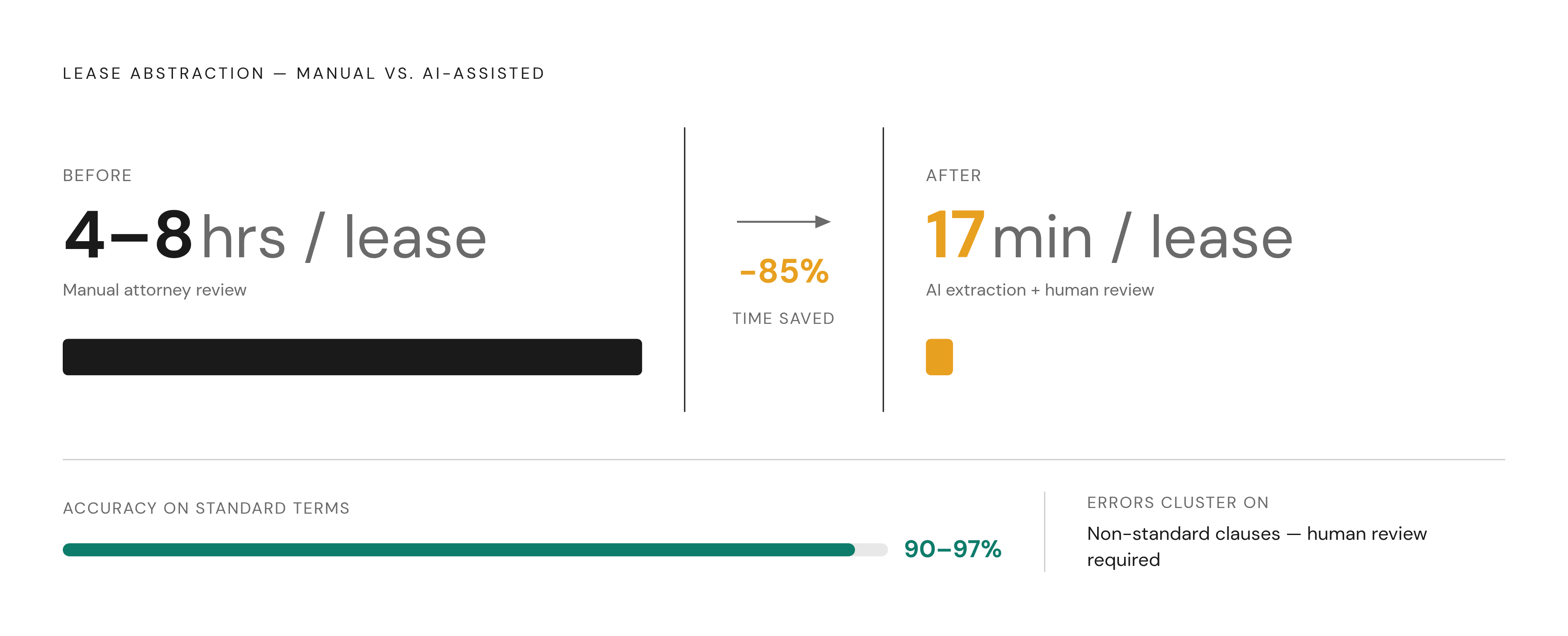
Lease abstraction means pulling the key economic and legal terms out of a lease, rent figures, escalation clauses, renewal options, expiration dates, tenant obligations, and putting them into a structured format that feeds portfolio management, transaction due diligence, and financial modeling. Done by hand, it traditionally takes four to eight hours per lease, and it's labor-intensive, error-prone, and expensive when outsourced⟦c41⟧.
AI changes the math considerably. Kolena's analysis of real-world deployments backs this up with harder numbers: firms managing billions in commercial real estate have cut per-lease review time by 85%, from roughly two hours down to 17 minutes, while cutting outsourcing costs substantially and holding accuracy above 95%⟦c43⟧.
The accuracy numbers are strong, but they're not the whole picture. The errors that do occur cluster around non-standard clauses, complicated rent escalation formulas, and cross-referenced exhibits, according to The AI Consulting Network's comparison⟦c45⟧. The best-practice model splits the work accordingly: AI handles the volume and does the first pass extraction, and a human reviewer spends their time on the flagged exceptions instead of rereading every line of every lease⟦c47⟧. That division of labor is the point of the technology. JLL's 2025 survey, which found 88% of commercial real estate investors piloting AI across an average of five use cases at once, indicates lease abstraction rarely appears as a standalone tool ⟦c5⟧. It tends to arrive bundled with other document review workflows already in motion⟦c48⟧. Leading AI lease abstraction platforms achieve 90%–97% accuracy on standard commercial lease terms, with abstraction time reduced to under 15 minutes per lease, according to a comparison by The AI Consulting Network ⟦c42⟧. EY's benchmarking data show that AI-assisted abstraction reduces processing time by 80%–90% ⟦c44⟧. These are precisely the clauses that matter most in a transaction, and a 90%–97% accuracy rate on standard terms still implies human review is required for edge cases ⟦c46⟧.
Broader document review in due diligence: environmental reports, title documents, and zoning analysis
Commercial due diligence reaches well past leases. Environmental site assessments, title commitments and their exception documents, zoning and land-use records, survey reports, inspection reports, and operating statements all pile up in a single transaction, and all of it needs review before anyone signs anything.
Generative AI applies a consistent pattern across this whole document universe ⟦c1⟧. It ingests large, unstructured files and extracts structured summaries out of them, flags clauses or data points that stray from expected parameters, cross-references multiple documents at once to catch inconsistencies (a title exception that quietly conflicts with a lease provision, for instance), and generates plain-language summaries for stakeholders working outside the underlying document type's area of specialty⟦c49⟧. It's the same basic mechanism seen in lease abstraction, just aimed at a wider set of document types.
What's missing here is the kind of hard benchmark data available for lease abstraction specifically. The pattern of use is well established across environmental reports, title documents, and zoning analysis, but the accuracy and reliability figures for these document types aren't as mature or as thoroughly measured yet. That reality should be stated rather than papered over with a number that doesn't exist. The sensible posture for now treats AI as a first-pass tool that surfaces what needs a specialist's attention ⟦c3⟧. Given how lease abstraction's own accuracy gaps cluster around the most consequential, non-standard clauses, there's little reason to expect environmental and title review to behave any differently once the benchmarks catch up.
Sources
- How Generative AI Content Generators are Transforming Real Estate Marketing
- 13 Impactful Real Estate Marketing AI News in 2026
- Generative Artificial Intelligence (AI) In Real Estate Global Market Report 2026
- Generative AI for Real Estate Marketing
- AI for Real Estate in 2026: Tools, Costs and ROI Guide
- How AI adoption is transforming real estate operations and work
- AI for Real Estate Document Review and Due Diligence: The Full Workflow Beyond Lease Abstraction - GTC Software
- re gen ai commercial real estate